AI Hedge Fund: Multi-Agent Investment System
The intersection of artificial intelligence and financial markets has always been a fascinating frontier. The AI Hedge Fund project by virattt takes this concept to an extraordinary level by implementing a multi-agent system where 19 distinct AI agents simulate the investment philosophies of legendary investors. With over 50,000 stars on GitHub, this project has captured the imagination of developers, quants, and AI enthusiasts worldwide.
What is AI Hedge Fund?
The AI Hedge Fund is an open-source project that implements a sophisticated multi-agent system for investment analysis and decision-making. Instead of relying on a single AI model or algorithm, it orchestrates 19 specialized agents, each embodying a unique investment philosophy or analytical approach. These agents range from value investing legends like Warren Buffett and Charlie Munger to technical analysts and risk managers.
The system uses LangGraph, a powerful framework for building stateful, multi-actor applications with language models, to coordinate these agents in a structured workflow. The result is a comprehensive investment analysis that considers multiple perspectives before making trading decisions.
Architecture Overview
Understanding the System Architecture
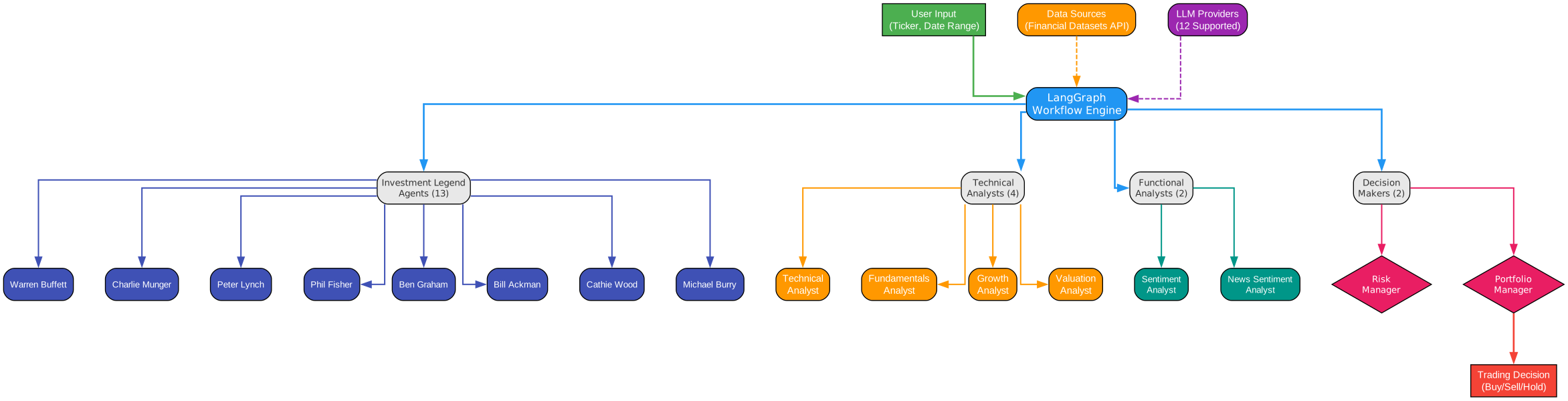
The AI Hedge Fund architecture represents a sophisticated multi-layered system designed to process financial data through multiple analytical lenses before arriving at investment decisions. At its core, the architecture follows a modular design pattern that enables seamless integration of diverse analytical approaches while maintaining clean separation of concerns.
Core Components:
1. Data Ingestion Layer The foundation of the system rests on a robust data ingestion layer that interfaces with Financial Datasets API. This layer is responsible for fetching real-time and historical market data, including stock prices, financial statements, news articles, and insider trading information. The data layer implements intelligent caching mechanisms to reduce API calls and improve response times for frequently requested data.
The ingestion layer handles multiple data types:
- Price data (OHLCV - Open, High, Low, Close, Volume)
- Financial metrics (P/E ratios, revenue growth, profit margins)
- News sentiment data from various sources
- Insider trading disclosures and patterns
- Company fundamentals and balance sheet data
2. Agent Orchestration Layer Built on LangGraph, the orchestration layer manages the complex interactions between 19 specialized agents. This layer implements a directed acyclic graph (DAG) structure that ensures proper execution order while enabling parallel processing where dependencies allow. The orchestration layer handles:
- Agent initialization and configuration
- State management across the workflow
- Message passing between agents
- Error handling and retry logic
- Timeout management for long-running analyses
3. State Management System The AgentState class serves as the central nervous system for data flow. Using LangGraph’s merge operators, the state accumulates analysis results from each agent while maintaining message history and metadata. This design enables agents to access previous analyses, build upon insights, and maintain context throughout the decision-making process.
4. LLM Integration Layer The system supports 12 different LLM providers, making it one of the most flexible AI investment platforms available. This abstraction layer handles:
- API authentication and rate limiting
- Model selection and configuration
- Response parsing and validation
- Fallback mechanisms for service outages
- Cost optimization through intelligent model routing
Data Flow Architecture:
The architecture implements a hub-and-spoke model where the central state acts as the hub, and agents operate as spokes. Each agent receives the current state, performs its specialized analysis, and returns updated state with its findings. This design pattern offers several advantages:
- Scalability: New agents can be added without modifying existing code
- Testability: Each agent can be tested in isolation
- Maintainability: Changes to one agent don’t affect others
- Flexibility: Agents can be enabled or disabled based on requirements
Key Architectural Insights:
The architecture draws inspiration from several proven patterns in distributed systems. The use of LangGraph for orchestration provides built-in support for checkpointing, time-travel debugging, and human-in-the-loop workflows. This is particularly valuable in financial applications where audit trails and explainability are regulatory requirements.
The modular design also enables hybrid deployment strategies. Organizations can run some agents locally for sensitive analyses while leveraging cloud-based LLMs for less critical processing. This flexibility addresses both cost concerns and data privacy requirements that vary across jurisdictions.
LangGraph Workflow
Understanding the LangGraph Workflow
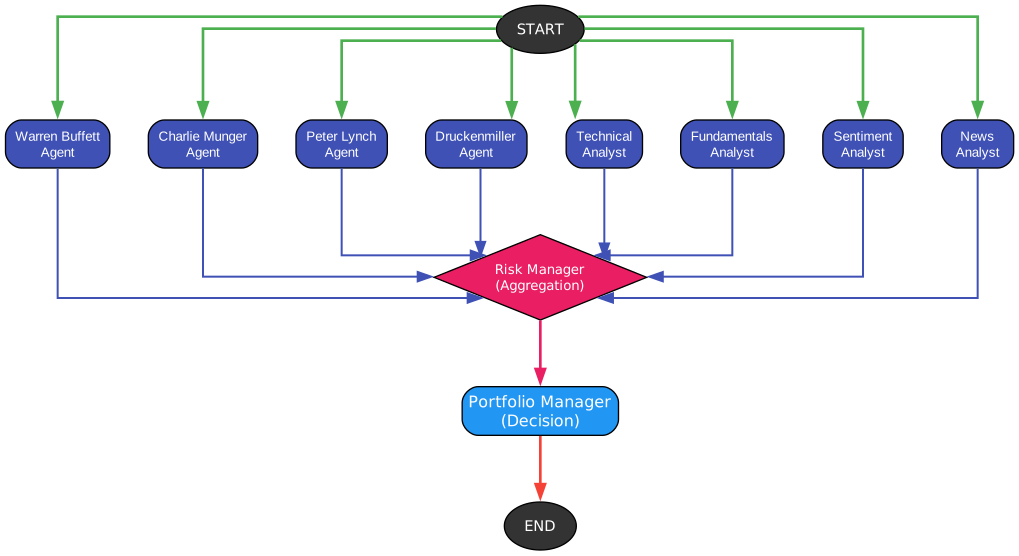
The LangGraph workflow represents the execution pipeline that transforms raw market data into actionable investment decisions. This workflow implements a sophisticated orchestration pattern that balances parallel processing efficiency with sequential decision-making requirements.
Workflow Stages:
1. START Node The workflow begins at the START node, which initializes the AgentState with the input parameters. This includes the stock ticker symbol, analysis date range, and any user-specified configuration options. The START node also validates inputs and sets up logging infrastructure for the entire analysis session.
2. Parallel Analyst Execution The most distinctive feature of this workflow is the parallel execution of all analyst agents. Unlike sequential systems where each analysis must wait for the previous one to complete, LangGraph enables simultaneous execution of all 19 agents. This dramatically reduces total analysis time from potentially minutes to seconds.
The parallel execution is made possible by LangGraph’s understanding of agent dependencies. Since most analysts operate independently (they analyze the same data from different perspectives), they can run concurrently. The framework handles:
- Concurrent API calls to LLM providers
- Thread-safe state updates using merge operators
- Result aggregation and conflict resolution
- Timeout handling for slow agents
3. Risk Manager Node After all analysts complete their evaluations, the workflow transitions to the Risk Manager. This agent serves as a critical checkpoint, reviewing all analyses for:
- Position sizing recommendations
- Risk exposure calculations
- Portfolio correlation analysis
- Stop-loss and take-profit levels
- Volatility assessments
The Risk Manager synthesizes risk metrics from multiple perspectives, ensuring that the final decision accounts for downside protection as rigorously as upside potential.
4. Portfolio Manager Node The final analytical stage is the Portfolio Manager, which integrates all inputs to produce the final trading decision. This agent considers:
- Weighted aggregation of analyst signals
- Confidence scores from each analysis
- Current portfolio context and constraints
- Market regime indicators
- Execution timing recommendations
5. END Node The workflow concludes at the END node, which packages the final decision along with supporting analyses, confidence metrics, and execution recommendations into a structured output format.
State Management Deep Dive:
The AgentState class implements a sophisticated state management pattern using TypedDict and LangGraph’s merge operators. Key state fields include:
class AgentState(TypedDict):
    messages: Annotated[list, add_messages]  # Conversation history
    data: Annotated[dict, merge_data]       # Market data
    metadata: Annotated[dict, merge_data]   # Analysis metadata
    decisions: Annotated[list, add_decisions] # Agent decisions
The add_messages operator ensures that conversation history grows with each agent interaction, enabling later agents to reference earlier analyses. The merge_data operator combines data from multiple sources, handling conflicts through configurable resolution strategies.
Workflow Optimization Insights:
The workflow design incorporates several optimization techniques from high-frequency trading systems:
- Lazy Evaluation: Some analyses are only triggered when specific conditions are met
- Early Termination: If critical signals are strongly negative, the workflow can short-circuit
- Caching: Frequently accessed data is cached to reduce API calls
- Batching: Multiple stock analyses can be batched for efficiency
Practical Implementation Considerations:
Organizations deploying this workflow should consider:
- Rate Limiting: LLM APIs have rate limits; the workflow implements backoff strategies
- Cost Management: Each agent call consumes tokens; caching and model selection optimize costs
- Latency vs. Quality: Users can configure faster (cheaper) or more thorough (expensive) analyses
- Human Override: The workflow supports human-in-the-loop checkpoints for critical decisions
Investment Legend Agents

Understanding the Investment Legend Agents
The Investment Legend Agents represent the crown jewel of the AI Hedge Fund system. These 13 specialized agents are designed to simulate the investment philosophies, analytical frameworks, and decision-making processes of some of history’s most successful investors. Each agent is programmed with distinct prompts, analytical approaches, and evaluation criteria that reflect their real-world counterparts.
Value Investing Legends:
1. Warren Buffett Agent The Oracle of Omaha’s agent focuses on identifying companies with durable competitive advantages (economic moats). Key analytical criteria include:
- Owner earnings calculation (net income + depreciation - capital expenditures)
- Return on invested capital (ROIC) trends over 10+ years
- Management quality assessment through capital allocation history
- Intrinsic value calculation using discounted cash flow models
- Circle of competence evaluation - staying within understandable businesses
The Buffett agent prioritizes companies with predictable earnings, strong brand value, and minimal debt. It applies a margin of safety principle, only recommending investments when price is significantly below calculated intrinsic value.
2. Charlie Munger Agent Munger’s agent complements Buffett’s approach with emphasis on:
- Mental models and multidisciplinary thinking
- Lollapalooza effects - where multiple factors combine for outsized results
- Inversion thinking - what could go wrong
- Circle of competence boundaries
- Long-term competitive dynamics
The Munger agent serves as a critical check on the Buffett agent, often identifying risks and cognitive biases that pure value analysis might miss.
3. Phil Fisher Agent Fisher’s growth-focused agent evaluates:
- Management integrity and long-term vision
- Research and development effectiveness
- Sales organization quality
- Profit margins and cost structure
- Customer satisfaction and loyalty metrics
The Fisher agent looks for “scuttlebutt” - qualitative information about company operations that quantitative metrics might miss.
4. Ben Graham Agent The father of value investing’s agent applies strict quantitative criteria:
- Net-net working capital analysis
- Price-to-book ratios below 1.5
- Current ratio above 2.0
- Earnings stability over 10 years
- Dividend payment consistency
The Graham agent is the most conservative, seeking deep value situations where assets alone justify the investment.
Modern Investment Legends:
5. Peter Lynch Agent Lynch’s agent focuses on:
- PEG ratio (Price/Earnings to Growth) analysis
- “Buy what you know” principle implementation
- Earnings growth acceleration detection
- Institutional ownership levels
- Insider buying patterns
The Lynch agent excels at finding growth at reasonable prices (GARP) and identifying potential “tenbaggers” - stocks that can increase tenfold in value.
6. Bill Ackman Agent Ackman’s activist investor agent evaluates:
- Management team quality and alignment
- Capital structure optimization opportunities
- Activist catalysts for value creation
- Real estate and asset value assessments
- Governance and shareholder rights
The Ackman agent looks for situations where management changes or strategic shifts could unlock hidden value.
7. Cathie Wood Agent Wood’s innovation-focused agent analyzes:
- Disruptive technology adoption curves
- Total addressable market (TAM) expansion
- Innovation platform convergence
- Unit economics improvement trajectories
- Regulatory tailwinds for emerging industries
The Wood agent embraces higher volatility in pursuit of transformational growth opportunities.
8. Michael Burry Agent Burry’s deep value agent specializes in:
- Contrarian investment opportunities
- Distressed asset valuation
- Short selling candidates identification
- Macro-economic risk assessment
- Balance sheet stress testing
The Burry agent often identifies opportunities that mainstream analysis overlooks, including potential short positions.
9. Stanley Druckenmiller Agent Druckenmiller’s macro-focused agent evaluates:
- Top-down economic analysis
- Sector rotation opportunities
- Currency and interest rate impacts
- Geopolitical risk factors
- Liquidity conditions
The Druckenmiller agent emphasizes risk management and position sizing based on conviction levels.
10. Aswath Damodaran Agent The “Dean of Valuation” agent applies:
- Discounted cash flow (DCF) modeling
- Cost of capital calculations
- Growth rate estimation methodologies
- Terminal value assumptions
- Cross-border valuation adjustments
The Damodaran agent provides rigorous valuation frameworks that other agents reference.
11. Mohnish Pabrai Agent Pabrai’s value investing agent focuses on:
- Low-risk, high-uncertainty opportunities
- Dhandho investor principles
- Arbitrage and special situations
- Business quality at bargain prices
- Cloning successful investment strategies
12. Nassim Taleb Agent Taleb’s agent emphasizes:
- Tail risk assessment
- Black swan vulnerability
- Antifragility evaluation
- Optionality in investments
- Fat-tail distribution analysis
The Taleb agent serves as the system’s primary risk conscience, identifying hidden risks others might miss.
13. Rakesh Jhunjhunwala Agent India’s legendary investor’s agent analyzes:
- Emerging market opportunities
- Growth at reasonable valuations
- Sector-specific knowledge
- Long-term wealth creation patterns
- Contrarian opportunities in developing markets
Agent Interaction Dynamics:
The Investment Legend agents don’t operate in isolation. The workflow enables them to reference each other’s analyses, creating a rich dialogue of investment perspectives. For example, the Buffett agent might identify a value opportunity, the Burry agent might flag hidden risks, and the Risk Manager synthesizes both perspectives into a balanced recommendation.
Analysis Pipeline
Understanding the Analysis Pipeline
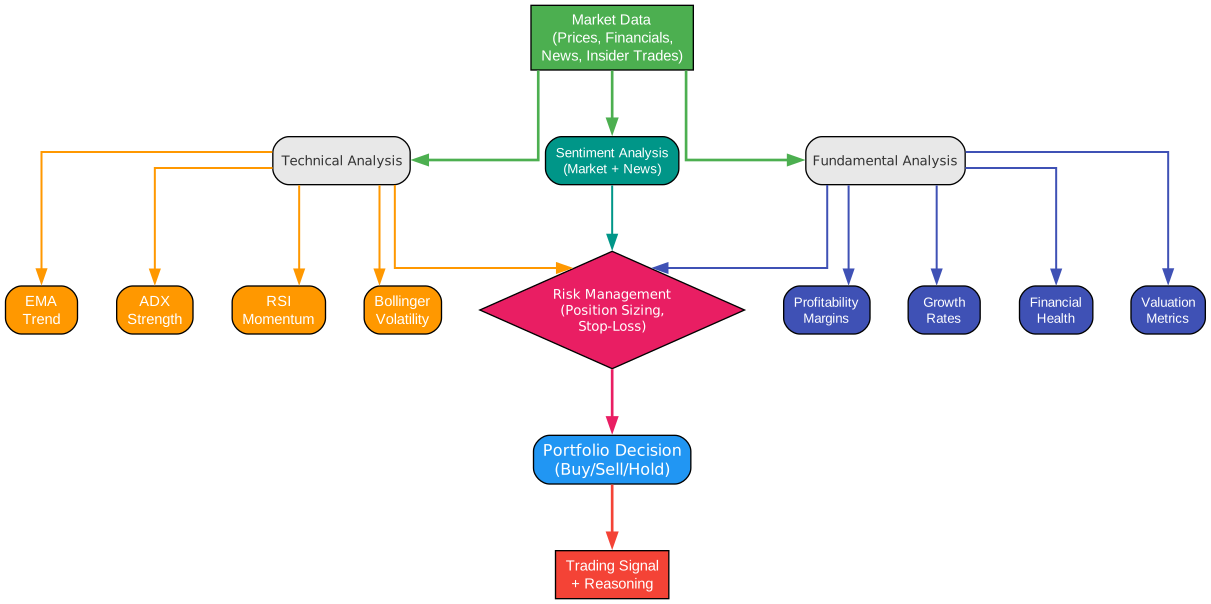
The Analysis Pipeline represents the technical backbone of the AI Hedge Fund, transforming raw market data into actionable insights through a series of sophisticated analytical processes. This pipeline integrates quantitative analysis, fundamental research, and sentiment evaluation to provide comprehensive investment recommendations.
Pipeline Stages:
1. Data Acquisition and Preprocessing The pipeline begins with data collection from multiple sources:
- Financial Datasets API for historical price data
- SEC filings for fundamental data
- News APIs for sentiment analysis
- Insider trading databases for transaction patterns
- Options data for volatility analysis
The preprocessing stage handles:
- Data cleaning and normalization
- Missing value imputation
- Outlier detection and treatment
- Time series alignment across different frequencies
- Currency and share adjustment calculations
2. Technical Analysis Module The technical analysis module implements multiple indicators:
Moving Averages:
- Exponential Moving Average (EMA) for trend identification
- Simple Moving Average (SMA) for support/resistance levels
- Moving average crossovers for signal generation
Momentum Indicators:
- Relative Strength Index (RSI) for overbought/oversold conditions
- Moving Average Convergence Divergence (MACD) for trend momentum
- Average Directional Index (ADX) for trend strength
Volatility Indicators:
- Bollinger Bands for volatility-based trading ranges
- Average True Range (ATR) for volatility measurement
- Implied volatility from options data
Volume Analysis:
- On-Balance Volume (OBV) for volume trend confirmation
- Volume-weighted average price (VWAP) for institutional activity
- Money Flow Index (MFI) for buying/selling pressure
3. Fundamental Analysis Module The fundamental analysis module processes:
Financial Statement Analysis:
- Income statement trends and margins
- Balance sheet strength and liquidity
- Cash flow statement quality
- Ratio analysis (profitability, efficiency, leverage)
Valuation Metrics:
- Price-to-Earnings (P/E) ratio analysis
- Price-to-Book (P/B) ratio evaluation
- Enterprise Value to EBITDA (EV/EBITDA)
- Price-to-Sales (P/S) for growth companies
- Dividend yield and payout ratio analysis
Quality Scores:
- Altman Z-Score for bankruptcy risk
- Piotroski F-Score for financial strength
- Graham number for value assessment
- Owner earnings calculation
4. Sentiment Analysis Module The sentiment module processes:
News Sentiment:
- Natural language processing of financial news
- Sentiment scoring using transformer models
- Topic modeling for emerging themes
- Entity recognition for company mentions
Social Sentiment:
- Social media sentiment aggregation
- Influencer mention tracking
- Retail investor sentiment indicators
- Discussion volume trends
Insider Activity:
- Insider buying/selling patterns
- Cluster buying detection
- CEO and CFO transaction significance
- 10b5-1 plan analysis
5. Warren Buffett Analysis Module A specialized module implements Buffett’s methodology:
Owner Earnings Calculation:
Owner Earnings = Net Income + Depreciation - CapEx - Working Capital Changes
Moat Analysis:
- Brand strength assessment
- Network effects evaluation
- Switching cost analysis
- Regulatory moat identification
- Cost advantage quantification
DCF Valuation:
- Free cash flow projection
- Terminal value calculation
- Discount rate determination
- Sensitivity analysis
6. Signal Integration and Weighting The final stage integrates all signals:
Signal Aggregation:
- Technical signals (trend, momentum, volatility)
- Fundamental signals (valuation, quality, growth)
- Sentiment signals (news, social, insider)
- Legend-specific signals (Buffett, Lynch, etc.)
Weighting Methodology:
- Dynamic weighting based on market conditions
- Confidence-weighted signal combination
- Risk-adjusted signal scaling
- Time-decay for older signals
Pipeline Output:
The pipeline produces a comprehensive analysis package including:
- Individual agent scores and recommendations
- Aggregated buy/sell/hold recommendation
- Confidence intervals and uncertainty metrics
- Key catalysts and risk factors
- Position sizing recommendations
- Entry and exit price targets
Performance Optimization:
The pipeline implements several optimizations:
- Parallel processing of independent analyses
- Caching of frequently accessed data
- Incremental updates for real-time data
- Batch processing for multiple stocks
- Lazy evaluation for expensive computations
LLM Integration
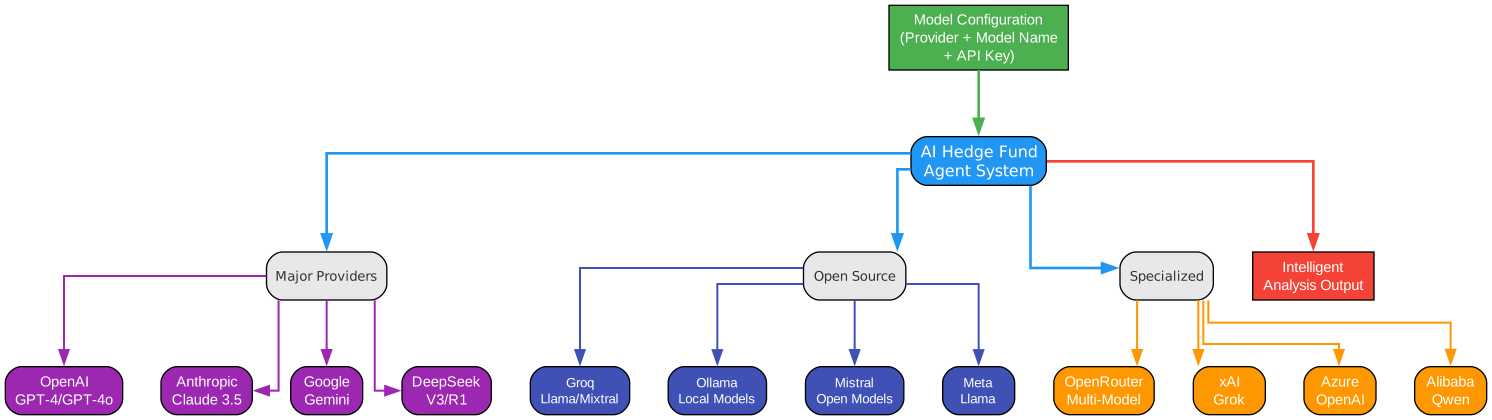
Understanding the LLM Integration
The AI Hedge Fund’s LLM integration layer represents one of its most sophisticated architectural components, supporting 12 different language model providers. This flexibility enables users to choose the optimal model for their specific use case, balancing factors like cost, latency, capability, and data privacy.
Supported LLM Providers:
1. OpenAI The most widely used provider, offering:
- GPT-4o for complex reasoning tasks
- GPT-4 Turbo for balanced performance
- GPT-3.5 Turbo for cost-effective processing
- Function calling for structured outputs
- Fine-tuned models for specialized tasks
2. Anthropic Known for safety and reasoning capabilities:
- Claude 3.5 Sonnet for balanced performance
- Claude 3 Opus for complex analysis
- Claude 3 Haiku for fast, cost-effective processing
- Extended context windows (200K tokens)
- Constitutional AI for aligned outputs
3. Google (Gemini) Google’s advanced models:
- Gemini 1.5 Pro for multimodal analysis
- Gemini 1.5 Flash for fast processing
- Gemini 1.0 Ultra for complex reasoning
- Native multimodal capabilities
- Long context window support
4. DeepSeek Cost-effective Chinese provider:
- DeepSeek V3 for general tasks
- DeepSeek R1 for reasoning tasks
- Competitive pricing
- Strong performance on benchmarks
- Growing ecosystem support
5. Groq Ultra-fast inference provider:
- Llama-based models with custom hardware
- Sub-100ms latency for most queries
- Ideal for real-time applications
- Open-source model hosting
- Cost-effective for high-volume usage
6. xAI Elon Musk’s AI company:
- Grok models for conversational AI
- Real-time information access
- Humorous and engaging outputs
- Integration with X (Twitter) data
- Competitive benchmark performance
7. Ollama Local model deployment:
- Run models on local hardware
- Privacy-preserving inference
- No API costs
- Support for open-source models
- Customizable model configurations
8. OpenRouter Model aggregation platform:
- Access to multiple providers through one API
- Automatic failover between providers
- Cost optimization routing
- Unified API interface
- Model comparison tools
9. GigaChat Russian LLM provider:
- Multilingual capabilities
- Strong Russian language support
- Enterprise deployment options
- Custom fine-tuning available
- Regional data compliance
10. Azure OpenAI Enterprise-grade OpenAI:
- Enterprise security and compliance
- Private networking options
- SLA guarantees
- Regional deployment options
- Integration with Azure services
11. Alibaba (Qwen) Chinese tech giant’s models:
- Qwen series for various tasks
- Strong Chinese language support
- Competitive pricing
- Enterprise solutions available
- Cloud integration options
12. Mistral European AI company:
- Mistral Large for complex tasks
- Mistral Medium for balanced use
- Mistral Small for efficiency
- Open-source model options
- Strong European data compliance
Model Selection Strategy:
The system implements intelligent model selection based on:
Task Complexity:
- Simple tasks (data extraction): Smaller, faster models
- Medium tasks (sentiment analysis): Mid-tier models
- Complex tasks (investment reasoning): Top-tier models
Cost Optimization:
- Route to most cost-effective provider
- Batch similar requests for efficiency
- Cache responses for repeated queries
- Use smaller models when appropriate
Latency Requirements:
- Real-time analysis: Fast providers (Groq, Gemini Flash)
- Batch analysis: Any provider
- Interactive sessions: Low-latency providers
Privacy Considerations:
- Sensitive data: Local models (Ollama) or enterprise providers
- Public data: Any provider
- Regulatory compliance: Regional providers (Azure, Alibaba)
API Management:
The integration layer handles:
Rate Limiting:
- Token bucket algorithms
- Exponential backoff
- Request queuing
- Priority-based routing
Error Handling:
- Automatic retry logic
- Fallback to alternative providers
- Graceful degradation
- Error logging and monitoring
Cost Tracking:
- Per-request cost calculation
- Budget enforcement
- Usage analytics
- Cost allocation by agent
Configuration Example:
# Configure multiple providers
llm_config = {
    "buffett_agent": {
        "provider": "anthropic",
        "model": "claude-3-opus",
        "temperature": 0.3
    },
    "technical_agent": {
        "provider": "openai",
        "model": "gpt-4-turbo",
        "temperature": 0.1
    },
    "sentiment_agent": {
        "provider": "groq",
        "model": "llama-70b",
        "temperature": 0.5
    }
}
Future-Proofing:
The abstraction layer is designed for easy addition of new providers:
- Standardized interface for all providers
- Provider-specific adapters
- Configuration-driven model selection
- A/B testing capabilities for new models
Key Features
Multi-Strategy Analysis
The AI Hedge Fund’s multi-strategy approach is its defining characteristic. Rather than relying on a single investment methodology, it synthesizes insights from multiple analytical frameworks:
Value Investing Strategies:
- Deep value screening (Graham, Buffett)
- Quality at reasonable price (Fisher, Lynch)
- Activist opportunities (Ackman)
- Special situations and arbitrage (Pabrai)
Growth Investing Strategies:
- Innovation and disruption (Wood)
- Emerging market growth (Jhunjhunwala)
- Technology adoption curves
- Platform company analysis
Quantitative Strategies:
- Technical momentum and trend following
- Mean reversion signals
- Volatility arbitrage
- Statistical arbitrage
Risk-Aware Strategies:
- Tail risk hedging (Taleb)
- Macro risk assessment (Druckenmiller)
- Short selling opportunities (Burry)
- Portfolio risk management
Technical Analysis Capabilities
The system implements comprehensive technical analysis:
Trend Indicators:
- Multiple timeframe moving averages
- Trend line detection algorithms
- Support and resistance identification
- Channel pattern recognition
Momentum Indicators:
- RSI with divergence detection
- MACD signal generation
- Stochastic oscillator analysis
- Rate of change calculations
Volatility Analysis:
- Bollinger Band width analysis
- ATR-based position sizing
- Implied volatility comparison
- Volatility regime detection
Fundamental Analysis Depth
The fundamental analysis module provides:
Financial Statement Analysis:
- Three-statement model integration
- Ratio analysis across 50+ metrics
- Trend analysis over multiple periods
- Peer comparison frameworks
Valuation Models:
- DCF modeling with sensitivity analysis
- Comparable company analysis
- Precedent transaction analysis
- Sum-of-the-parts valuation
Quality Assessment:
- Management quality scoring
- Competitive position evaluation
- Moat strength analysis
- ESG factor integration
Installation and Usage
Prerequisites
Before installing the AI Hedge Fund, ensure you have:
- Python 3.10 or higher
- Poetry package manager (recommended)
- API keys for LLM providers
- Financial Datasets API key
Installation Steps
# Clone the repository
git clone https://github.com/virattt/ai-hedge-fund.git
cd ai-hedge-fund

# Install dependencies using Poetry
poetry install

# Or using pip
pip install -r requirements.txt

# Set up environment variables
cp .env.example .env
# Edit .env with your API keys
Configuration
Create a .env file with your API keys:
# LLM Provider Keys
OPENAI_API_KEY=your_openai_key
ANTHROPIC_API_KEY=your_anthropic_key
GROQ_API_KEY=your_groq_key

# Data Provider Keys
FINANCIAL_DATASETS_API_KEY=your_financial_datasets_key

# Optional: Other providers
DEEPSEEK_API_KEY=your_deepseek_key
GOOGLE_API_KEY=your_google_key
Running Analysis
# Run with default settings
poetry run python src/main.py --ticker AAPL

# Specify date range
poetry run python src/main.py --ticker AAPL --start 2024-01-01 --end 2024-12-31

# Use specific LLM provider
poetry run python src/main.py --ticker AAPL --llm anthropic

# Enable specific agents only
poetry run python src/main.py --ticker AAPL --agents buffett,lynch,technical
Web Interface
The project also includes a web interface:
# Start the backend
cd app/backend
poetry run python main.py

# Start the frontend (in another terminal)
cd app/frontend
npm install
npm run dev
Docker Deployment
For containerized deployment:
# Build and run with Docker Compose
cd docker
docker-compose up -d

# Access the application
# Frontend: http://localhost:3000
# Backend API: http://localhost:8000
Conclusion
The AI Hedge Fund project represents a fascinating convergence of artificial intelligence and financial analysis. By implementing 19 specialized agents that simulate legendary investors, it provides a unique multi-perspective approach to investment decision-making.
The use of LangGraph for orchestration enables sophisticated workflow management, while support for 12 LLM providers offers unprecedented flexibility. The combination of technical analysis, fundamental research, and sentiment evaluation creates a comprehensive analytical framework.
Whether you’re a quantitative researcher exploring multi-agent systems, a developer learning about LangGraph, or an investor interested in AI-powered analysis, this project offers valuable insights and practical implementations. The modular architecture makes it easy to extend with new agents, and the extensive documentation helps users understand each component.
As AI continues to transform financial markets, projects like the AI Hedge Fund demonstrate how machine learning and large language models can augment human decision-making. The future of investment analysis lies not in replacing human judgment, but in providing sophisticated tools that aggregate diverse perspectives and surface insights that might otherwise be missed.
Related Posts
- AgentSkillOS: Skill Orchestration System
- MattPocock Skills: AI Agent Workflows
- DESIGN.md: AI-Powered Design Systems