Kronos: Foundation Model for Financial Markets Language
Kronos represents a groundbreaking advancement in financial machine learning as the first open-source foundation model specifically designed for financial candlesticks (K-lines). Trained on data from over 45 global exchanges, Kronos introduces a novel approach to understanding the unique “language” of financial markets through hierarchical tokenization and autoregressive modeling.
Introduction
Financial markets generate vast amounts of time-series data in the form of K-lines (candlesticks), each containing Open, High, Low, Close, Volume, and Amount (OHLCV) information. Unlike general-purpose time-series foundation models (TSFMs), Kronos is specifically architected to handle the unique characteristics of financial data: high noise levels, non-stationary distributions, and complex temporal dependencies.
The model leverages a two-stage framework that treats financial sequences as a language:
- Tokenization Stage: A specialized tokenizer quantizes continuous OHLCV data into hierarchical discrete tokens
- Foundation Model Stage: A large autoregressive Transformer learns to predict future tokens, enabling diverse quantitative tasks
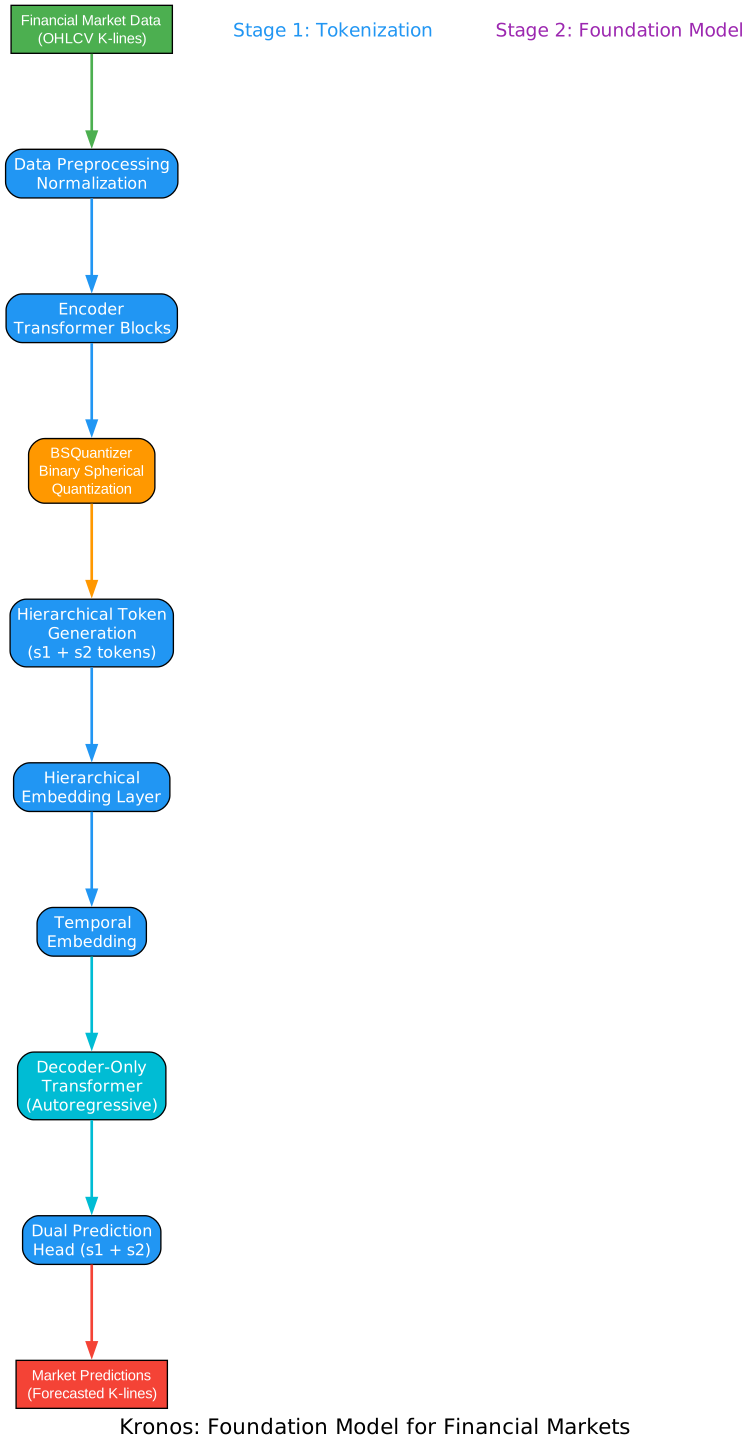
Understanding the Kronos Architecture
The architecture diagram above illustrates the complete pipeline from raw financial data to market predictions. Let’s examine each component in detail:
Stage 1: Tokenization Pipeline
The tokenization stage transforms continuous financial data into discrete tokens that can be processed by language models. This approach is revolutionary because it allows us to apply the powerful techniques developed for natural language processing to financial time-series data.
Data Preprocessing and Normalization The preprocessing layer takes raw OHLCV data and applies z-score normalization to standardize the input distribution. This is critical because financial data from different markets and instruments can have vastly different scales and volatilities. The normalization ensures that the model sees consistent input distributions regardless of the underlying asset’s price level.
Encoder Transformer Blocks The encoder consists of multiple Transformer blocks that learn to represent the normalized financial data in a latent space. Each block includes:
- Multi-head self-attention with Rotary Positional Embeddings (RoPE)
- Feed-forward networks with SwiGLU activation
- RMSNorm for layer normalization
- Residual connections for gradient flow
The encoder’s role is to compress the temporal patterns in financial data into a representation suitable for quantization.
Binary Spherical Quantizer (BSQ) The BSQuantizer is the core innovation that enables hierarchical tokenization. It projects the encoder output onto a hypersphere and quantizes it into binary codes. The quantization process:
- Normalizes vectors to unit length on the hypersphere
- Applies binary quantization (sign function) to each dimension
- Generates two types of tokens: s1 (coarse) and s2 (fine)
This hierarchical approach allows the model to capture both broad market movements (s1 tokens) and fine-grained price changes (s2 tokens).
Stage 2: Foundation Model
The foundation model is a decoder-only Transformer that learns to predict future tokens autoregressively.
Hierarchical Embedding Layer The embedding layer combines s1 and s2 token embeddings through a fusion projection. This allows the model to maintain the hierarchical structure throughout the network. Each token type has its own vocabulary:
- s1 vocabulary size: 2^(s1_bits)
- s2 vocabulary size: 2^(s2_bits)
Temporal Embedding Financial markets exhibit strong temporal patterns (intraday, weekly, monthly cycles). The temporal embedding layer encodes:
- Minute of hour (0-59)
- Hour of day (0-23)
- Day of week (0-6)
- Day of month (1-31)
- Month of year (1-12)
These embeddings are added to the token embeddings, providing the model with explicit temporal context.
Decoder Transformer The core of Kronos is a stack of Transformer blocks with:
- Causal self-attention (only attending to past tokens)
- RoPE for position encoding
- SwiGLU feed-forward networks
- Pre-normalization with RMSNorm
The autoregressive nature means each prediction depends only on previous tokens, making it suitable for forecasting.
Dual Prediction Head The model outputs predictions through two heads:
- s1 head: Predicts the next coarse token
- s2 head: Predicts the next fine token, conditioned on s1
This dependency-aware architecture ensures that fine-grained predictions are informed by coarse-grained context.
Tokenization Pipeline Deep Dive

Understanding the Tokenization Pipeline
The tokenization pipeline is the critical first stage that enables Kronos to process financial data as a language. Let’s break down each step:
OHLCV Data Input
The pipeline begins with raw market data in OHLCV format:
- Open: Price at the start of the time period
- High: Maximum price during the period
- Low: Minimum price during the period
- Close: Price at the end of the period
- Volume: Number of shares/contracts traded
- Amount: Total monetary value of trades
This six-dimensional data captures the complete state of the market at each time step. The model can process any frequency from tick data to daily bars.
Normalization (z-score)
Z-score normalization transforms each feature to have zero mean and unit variance:
x_normalized = (x - mean) / (std + epsilon)
This standardization is essential because:
- Different assets have vastly different price scales (e.g., $0.50 vs $500)
- Volume and amount are in different units than prices
- The model needs consistent input distributions for stable training
The epsilon term (typically 1e-5) prevents division by zero for features with near-zero variance.
Clipping (-5 to 5)
After normalization, values are clipped to the range [-5, 5]. This serves several purposes:
- Removes extreme outliers that could destabilize training
- Limits the range of values the model needs to learn
- Acts as a form of robustness against data errors
The choice of 5 standard deviations captures approximately 99.99994% of a normal distribution, so legitimate data is rarely affected.
Linear Embedding
The clipped values are projected into a higher-dimensional embedding space (d_model). This linear transformation:
- Increases the representational capacity
- Allows the model to learn feature interactions
- Prepares the data for the Transformer encoder
Encoder Layers
The encoder consists of multiple Transformer blocks that:
- Learn temporal dependencies through self-attention
- Build hierarchical representations of market patterns
- Compress information for efficient quantization
Each layer applies:
- RMSNorm for normalization
- Multi-head attention with RoPE
- Residual connection
- Feed-forward network (SwiGLU)
- Another residual connection
Binary Spherical Quantizer (BSQ)
The BSQ is the key innovation that enables discrete tokenization:
Spherical Projection First, the encoder output is L2-normalized to lie on a unit hypersphere. This constrains the representation to a bounded space.
Binary Quantization Each dimension is then quantized to either +1 or -1 based on its sign. This creates a binary code that can be interpreted as a token index.
Hierarchical Token Generation The binary code is split into two parts:
- s1 (Pre/Coarse): The first s1_bits represent coarse-grained information
- s2 (Post/Fine): The remaining s2_bits capture fine-grained details
This hierarchy allows the model to separate broad market movements from specific price fluctuations.
Entropy Regularization
During training, the BSQ applies entropy regularization to ensure:
- All codebook entries are used (preventing collapse)
- The distribution remains diverse
- The quantization is efficient
The loss function includes:
- Commitment loss: Distance between input and quantized vectors
- Entropy penalty: Encourages uniform codebook usage
Prediction Workflow
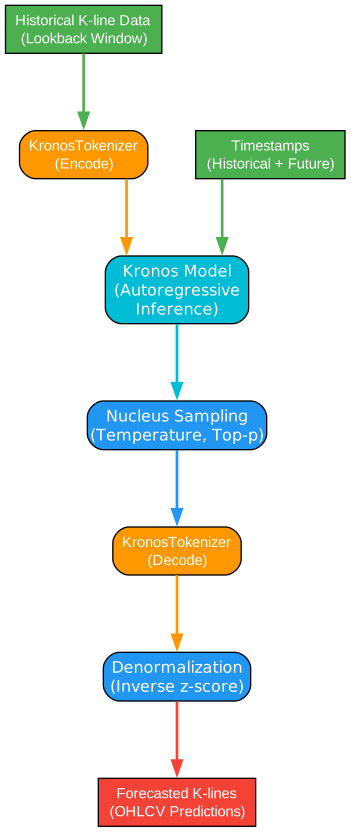
Understanding the Prediction Workflow
The prediction workflow shows how Kronos generates forecasts from historical data. This process is designed for practical deployment in quantitative trading systems.
Historical K-line Data (Lookback Window)
The workflow begins with historical market data. The lookback window typically contains:
- 400-512 time steps for Kronos-small/base
- Up to 2048 time steps for Kronos-mini
The choice of lookback window balances:
- Longer windows capture more historical context
- Shorter windows reduce computational cost
- Financial markets have limited “memory” - very old data may not be relevant
Timestamps (Historical + Future)
Temporal information is crucial for financial predictions. The model receives:
- Historical timestamps: When each past K-line occurred
- Future timestamps: When predictions should be made
This allows the model to:
- Learn intraday patterns (market open/close effects)
- Capture weekly cycles (weekend gaps)
- Understand monthly/quarterly patterns (earnings, expirations)
KronosTokenizer (Encode)
The tokenizer encodes the historical data into discrete tokens:
- Applies normalization using statistics from the lookback window
- Passes through the encoder layers
- Quantizes to hierarchical tokens (s1, s2)
The encoding process is deterministic at inference time, ensuring reproducible results.
Kronos Model (Autoregressive Inference)
The core prediction engine operates autoregressively:
- Takes the encoded tokens and timestamps
- Generates predictions one step at a time
- Each prediction conditions on all previous tokens
The autoregressive process:
- Starts with the historical context
- Generates pred_len future tokens
- Uses causal masking to prevent information leakage
Nucleus Sampling (Temperature, Top-p)
To generate diverse and realistic predictions, Kronos uses nucleus sampling:
- Temperature (T): Controls randomness (T=1.0 is standard, lower is more deterministic)
- Top-p: Keeps only the top tokens whose cumulative probability exceeds p (typically 0.9)
This sampling strategy:
- Avoids low-probability tokens that are likely errors
- Maintains diversity in predictions
- Allows ensemble forecasting (sample_count > 1)
KronosTokenizer (Decode)
After generating token predictions, the tokenizer decodes them back to continuous values:
- Converts token indices to binary codes
- Projects back to the embedding space
- Passes through decoder layers
- Applies inverse normalization
The decoding process reverses the encoding, producing OHLCV predictions.
Denormalization (Inverse z-score)
The final step transforms predictions back to the original scale:
prediction = normalized_prediction * std + mean
This uses the same statistics computed during encoding, ensuring consistency.
Forecasted K-lines (OHLCV Predictions)
The output is a complete K-line forecast containing:
- Predicted Open, High, Low, Close prices
- Predicted Volume and Amount
- Timestamps for each prediction
These predictions can be used for:
- Trading signal generation
- Risk management
- Portfolio optimization
- Market analysis
Model Components Architecture
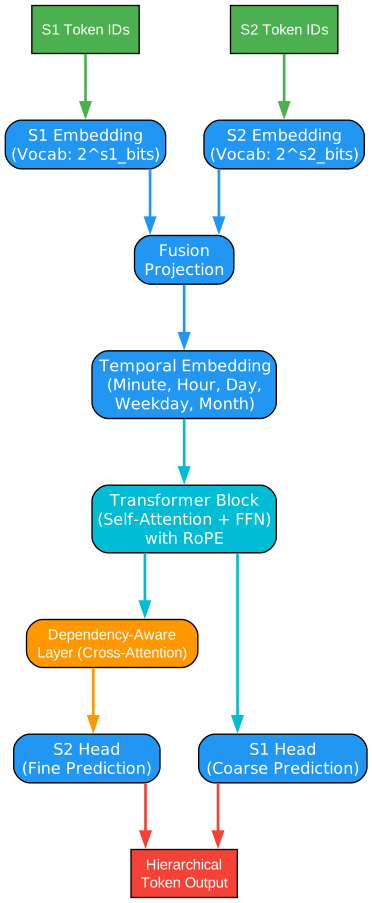
Understanding the Model Components
This diagram details the internal architecture of the Kronos foundation model, showing how hierarchical tokens flow through the network.
S1 and S2 Token Inputs
The model accepts two token streams:
- S1 Token IDs: Coarse-grained tokens representing broad market movements
- S2 Token IDs: Fine-grained tokens capturing detailed price changes
This dual-token system is inspired by multi-scale representations in computer vision, where different resolutions capture different levels of detail.
S1 and S2 Embeddings
Each token type has its own embedding table:
- S1 vocabulary size: 2^(s1_bits) entries
- S2 vocabulary size: 2^(s2_bits) entries
The embedding tables learn to represent:
- Price level information (bull/bear markets)
- Volatility regimes (calm/turbulent)
- Trend patterns (momentum/reversal)
Fusion Projection
The fusion layer combines s1 and s2 embeddings:
combined = Linear(concat(s1_emb, s2_emb))
This allows the model to:
- Learn interactions between coarse and fine information
- Create a unified representation for the Transformer
- Maintain the hierarchical structure throughout processing
Temporal Embedding
The temporal embedding encodes time information:
- Minute embedding: 60 possible values
- Hour embedding: 24 possible values
- Weekday embedding: 7 possible values
- Day embedding: 31 possible values
- Month embedding: 12 possible values
These are summed together and added to the token embedding, providing explicit temporal context that helps the model understand:
- Market session effects (pre-market, regular, after-hours)
- Day-of-week patterns (Monday effect, Friday effect)
- Monthly patterns (options expiration, rebalancing)
Transformer Block with RoPE
The core processing unit uses:
- Rotary Positional Embeddings (RoPE): Encodes relative positions, enabling better extrapolation to longer sequences
- Multi-head Self-Attention: Learns dependencies between all positions
- SwiGLU Feed-Forward Network: Non-linear transformation with gated activation
- RMSNorm: Efficient normalization without bias terms
The Transformer processes the sequence autoregressively, with causal masking ensuring each position only attends to previous positions.
Dependency-Aware Layer (Cross-Attention)
A key innovation in Kronos is the dependency-aware layer that conditions s2 predictions on s1:
- Uses cross-attention between s1 embeddings and Transformer context
- Allows fine-grained predictions to incorporate coarse-grained context
- Maintains the hierarchical relationship throughout decoding
This is crucial because:
- s1 tokens represent broader market direction
- s2 tokens should be consistent with the s1 context
- The dependency improves overall prediction coherence
Dual Prediction Heads
The model outputs predictions through two specialized heads:
- S1 Head: Predicts the next coarse token
- S2 Head: Predicts the next fine token (conditioned on s1)
Both heads are linear projections from the hidden dimension to their respective vocabulary sizes. During training, both are trained with cross-entropy loss.
Hierarchical Token Output
The final output is a pair of tokens (s1, s2) that together represent the predicted market state. This hierarchical representation:
- Captures multi-scale information
- Enables efficient encoding of complex patterns
- Provides interpretability (s1 shows overall direction, s2 shows details)
Finetuning Pipeline
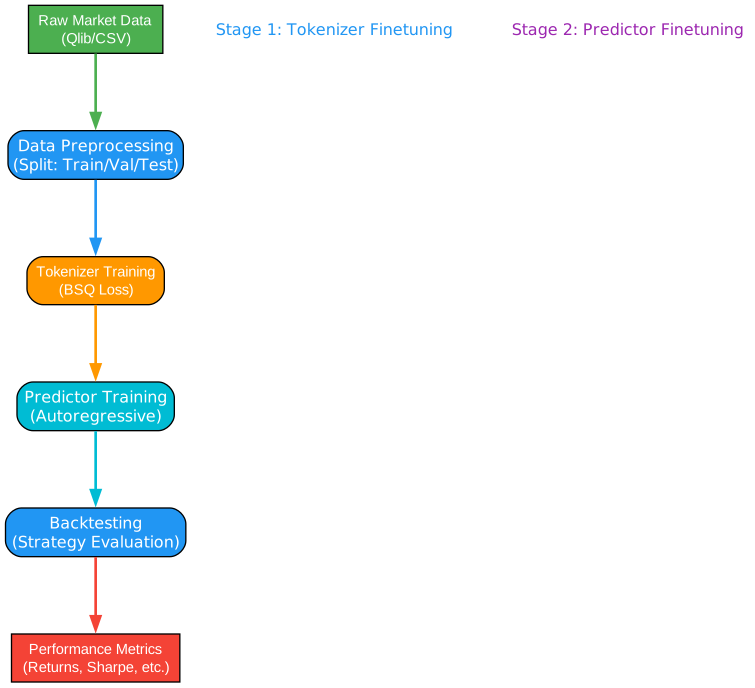
Understanding the Finetuning Pipeline
Kronos supports finetuning on custom datasets, allowing adaptation to specific markets or tasks. The pipeline is designed for production use with proper data handling.
Raw Market Data (Qlib/CSV)
The pipeline accepts data from multiple sources:
- Qlib: Microsoft’s quantitative investment platform with built-in data loaders
- CSV: Standard format with columns for OHLCV and timestamps
Supported markets include:
- US equities (NYSE, NASDAQ)
- Chinese A-shares (Shanghai, Shenzhen)
- Cryptocurrency exchanges
- Forex markets
- Commodity futures
Data Preprocessing (Split: Train/Val/Test)
Proper data splitting is critical for financial ML:
- Time-based splitting: Never use future data for training
- Train set: Historical data for model learning
- Validation set: For hyperparameter tuning
- Test set: Final evaluation, must be chronologically after validation
The preprocessing includes:
- Handling missing values
- Aligning timestamps across instruments
- Computing derived features if needed
Stage 1: Tokenizer Finetuning
The tokenizer must be adapted to the target market:
- Different markets have different volatility profiles
- Price scales vary significantly
- Trading patterns differ by market type
The tokenizer training optimizes:
- BSQ Loss: Reconstruction quality + entropy regularization
- Codebook Usage: Ensures all tokens are utilized
- Market-Specific Patterns: Learns relevant quantization levels
Training uses multi-GPU with torchrun:
torchrun --standalone --nproc_per_node=NUM_GPUS finetune/train_tokenizer.py
Stage 2: Predictor Finetuning
After tokenizer adaptation, the predictor model is finetuned:
- Loads pretrained weights from base Kronos model
- Trains on the target market data
- Optimizes for forecasting accuracy
The predictor training:
- Uses autoregressive language modeling objective
- Applies teacher forcing for stable training
- Supports mixed precision for efficiency
Backtesting (Strategy Evaluation)
The finetuned model is evaluated through backtesting:
- Generates predictions on test set
- Converts predictions to trading signals
- Simulates portfolio performance
- Computes risk-adjusted returns
Key metrics include:
- Cumulative returns
- Sharpe ratio
- Maximum drawdown
- Win rate
Performance Metrics (Returns, Sharpe, etc.)
The final output includes comprehensive metrics:
- Total Return: Overall profit/loss
- Annualized Return: Return normalized to yearly rate
- Sharpe Ratio: Risk-adjusted return
- Sortino Ratio: Downside risk-adjusted return
- Maximum Drawdown: Largest peak-to-trough decline
- Win Rate: Percentage of profitable trades
Model Zoo
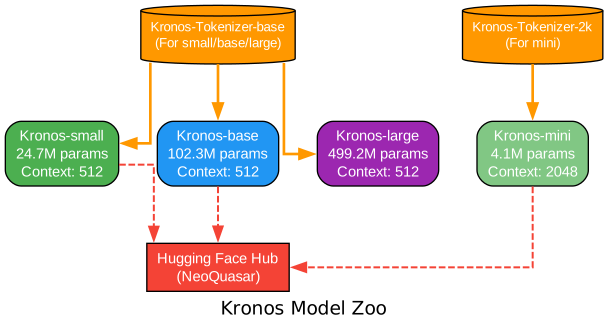
Understanding the Model Zoo
Kronos offers a family of models with varying capacities to suit different computational and application needs. All models are available on the Hugging Face Hub under the NeoQuasar organization.
Kronos-mini (4.1M parameters)
The smallest model is ideal for:
- Edge deployment and real-time inference
- Resource-constrained environments
- Rapid prototyping and experimentation
- Educational purposes
Key features:
- Context length: 2048 tokens
- Fastest inference speed
- Lowest memory footprint
- Uses Kronos-Tokenizer-2k
Despite its small size, Kronos-mini achieves competitive performance on many benchmarks, making it suitable for applications where latency is critical.
Kronos-small (24.7M parameters)
The balanced option for most use cases:
- Context length: 512 tokens
- Good trade-off between speed and accuracy
- Suitable for production deployment
- Uses Kronos-Tokenizer-base
This model is recommended for:
- General-purpose forecasting
- Research applications
- Medium-scale deployment
Kronos-base (102.3M parameters)
The standard model for high-quality predictions:
- Context length: 512 tokens
- Strong performance across benchmarks
- Suitable for demanding applications
- Uses Kronos-Tokenizer-base
Recommended for:
- Professional trading systems
- Risk management applications
- Research requiring high accuracy
Kronos-large (499.2M parameters)
The largest model (currently not open-sourced):
- Context length: 512 tokens
- State-of-the-art performance
- Requires significant computational resources
- Uses Kronos-Tokenizer-base
Tokenizer Compatibility
The tokenizers are designed for specific model sizes:
- Kronos-Tokenizer-2k: Optimized for mini model with 2048 context
- Kronos-Tokenizer-base: Standard tokenizer for small/base/large models
Using the correct tokenizer is essential for optimal performance.
Hugging Face Hub Integration
All models are accessible through the Hugging Face Hub:
from model import Kronos, KronosTokenizer

# Load tokenizer
tokenizer = KronosTokenizer.from_pretrained("NeoQuasar/Kronos-Tokenizer-base")

# Load model
model = Kronos.from_pretrained("NeoQuasar/Kronos-small")
This integration provides:
- Easy model loading and saving
- Version control for reproducibility
- Community contributions and variants
- Automatic model caching
Installation
Getting started with Kronos is straightforward. The library requires Python 3.10+ and standard deep learning dependencies.
Prerequisites
- Python 3.10 or higher
- PyTorch 2.0+ (recommended)
- CUDA-capable GPU (optional but recommended)
Installation Steps
# Clone the repository
git clone https://github.com/shiyu-coder/Kronos.git
cd Kronos

# Install dependencies
pip install -r requirements.txt
The requirements include:
torch- Deep learning frameworktransformers- Hugging Face integrationpandas- Data manipulationnumpy- Numerical operationseinops- Tensor operations
Quick Start
from model import Kronos, KronosTokenizer, KronosPredictor

# Load from Hugging Face Hub
tokenizer = KronosTokenizer.from_pretrained("NeoQuasar/Kronos-Tokenizer-base")
model = Kronos.from_pretrained("NeoQuasar/Kronos-small")

# Initialize predictor
predictor = KronosPredictor(model, tokenizer, max_context=512)

# Prepare data
import pandas as pd
df = pd.read_csv("your_data.csv")
df['timestamps'] = pd.to_datetime(df['timestamps'])

# Define prediction window
lookback = 400
pred_len = 120

x_df = df.loc[:lookback-1, ['open', 'high', 'low', 'close', 'volume', 'amount']]
x_timestamp = df.loc[:lookback-1, 'timestamps']
y_timestamp = df.loc[lookback:lookback+pred_len-1, 'timestamps']

# Generate predictions
pred_df = predictor.predict(
    df=x_df,
    x_timestamp=x_timestamp,
    y_timestamp=y_timestamp,
    pred_len=pred_len,
    T=1.0,          # Temperature
    top_p=0.9,      # Nucleus sampling
    sample_count=1  # Number of samples
)

print(pred_df.head())
Usage Examples
Single Asset Prediction
# Predict next 24 hours for BTC/USDT
pred_df = predictor.predict(
    df=historical_data,
    x_timestamp=historical_timestamps,
    y_timestamp=future_timestamps,
    pred_len=24,
    T=1.0,
    top_p=0.9,
    sample_count=1
)
Batch Prediction
For processing multiple assets efficiently:
# Prepare multiple datasets
df_list = [btc_data, eth_data, sol_data]
x_timestamp_list = [btc_ts, eth_ts, sol_ts]
y_timestamp_list = [btc_future, eth_future, sol_future]

# Batch prediction
pred_df_list = predictor.predict_batch(
    df_list=df_list,
    x_timestamp_list=x_timestamp_list,
    y_timestamp_list=y_timestamp_list,
    pred_len=24,
    T=1.0,
    top_p=0.9,
    sample_count=1,
    verbose=True
)
Probabilistic Forecasting
Generate multiple forecast paths for uncertainty quantification:
# Generate 10 forecast paths
pred_df = predictor.predict(
    df=historical_data,
    x_timestamp=historical_timestamps,
    y_timestamp=future_timestamps,
    pred_len=24,
    T=1.0,
    top_p=0.9,
    sample_count=10  # Average over 10 samples
)
Features
| Feature | Description |
|---|---|
| Hierarchical Tokenization | Novel s1/s2 token system captures multi-scale market patterns |
| Autoregressive Modeling | Decoder-only Transformer for sequential prediction |
| Temporal Embeddings | Explicit encoding of time features (minute, hour, day, month) |
| Multi-Exchange Training | Pre-trained on 45+ global exchanges |
| Probabilistic Forecasting | Nucleus sampling for uncertainty quantification |
| Batch Processing | Efficient parallel prediction for multiple assets |
| Finetuning Support | Complete pipeline for custom market adaptation |
| Hugging Face Integration | Easy model loading and sharing |
Key Advantages
1. Financial-Specific Design
Unlike general-purpose time-series models, Kronos is built specifically for financial data:
- Handles OHLCV structure natively
- Captures market microstructure patterns
- Understands temporal dependencies in trading
2. Hierarchical Representation
The s1/s2 token system provides:
- Coarse-to-fine information flow
- Better generalization across market regimes
- Interpretable intermediate representations
3. Open Source
As the first open-source foundation model for financial K-lines:
- Transparent methodology
- Reproducible results
- Community contributions welcome
4. Production Ready
The codebase includes:
- WebUI for visualization
- Batch processing support
- Comprehensive documentation
- Example scripts
Live Demo
A live demo is available at: https://shiyu-coder.github.io/Kronos-demo/
The demo showcases:
- BTC/USDT 24-hour forecasts
- Interactive visualization
- Real-time predictions
Citation
If you use Kronos in your research, please cite:
@misc{shi2025kronos,
      title={Kronos: A Foundation Model for the Language of Financial Markets},
      author={Yu Shi and Zongliang Fu and Shuo Chen and Bohan Zhao and Wei Xu and Changshui Zhang and Jian Li},
      year={2025},
      eprint={2508.02739},
      archivePrefix={arXiv},
      primaryClass={q-fin.ST},
      url={https://arxiv.org/abs/2508.02739},
}
Conclusion
Kronos represents a significant step forward in applying foundation models to financial markets. By treating K-line sequences as a language and applying hierarchical tokenization, it achieves state-of-the-art performance on forecasting tasks while maintaining interpretability.
The open-source release includes:
- Multiple model sizes for different use cases
- Complete finetuning pipeline
- WebUI for easy exploration
- Comprehensive documentation
Whether you’re building trading systems, conducting research, or exploring financial ML, Kronos provides a powerful foundation for your work.
Related Posts
- TimesFM: Time Series Foundation Model
- AI Hedge Fund: Multi-Agent Investment Analysis
- TradingAgents: AI-Powered Trading Strategies

Enjoyed this post? Never miss out on future posts by following us