OpenViking: Open-Source Context Database for AI Agents
In the rapidly evolving landscape of AI agent development, one challenge stands above all others: context management. As AI agents become more sophisticated and are tasked with increasingly complex, long-running operations, the need for intelligent context handling has never been more critical. Enter OpenViking, an open-source context database specifically designed for AI agents, offering a revolutionary approach to managing memories, resources, and skills through a filesystem paradigm.
The Context Challenge in AI Agent Development
Before diving into OpenViking’s solution, it’s essential to understand the fundamental challenges that plague modern AI agent development:
Fragmented Context Storage: Traditional approaches scatter context across multiple systems - memories stored in code, resources in vector databases, and skills in separate repositories. This fragmentation creates management nightmares and inconsistent access patterns.
Exploding Token Consumption: As agents execute long-running tasks, context accumulates at every step. Simple truncation or compression leads to information loss, while including everything rapidly exhausts token budgets and increases costs.
Ineffective Retrieval Mechanisms: Traditional RAG systems use flat storage models that lack a global view, making it difficult to understand the full context of information and leading to suboptimal retrieval results.
Black Box Operations: The implicit retrieval chains in traditional systems are opaque, making debugging nearly impossible when errors occur and providing no visibility into why certain context was retrieved.
Limited Memory Evolution: Current memory systems merely record user interactions, lacking the sophisticated task memory capabilities needed for agents to learn and improve from their experiences.
OpenViking’s Revolutionary Solution
OpenViking addresses these challenges through five core innovations that fundamentally transform how AI agents interact with context:
1. Filesystem Management Paradigm
OpenViking abandons the fragmented vector storage model of traditional RAG and introduces a revolutionary “file system paradigm” that unifies the structured organization of memories, resources, and skills needed by agents.
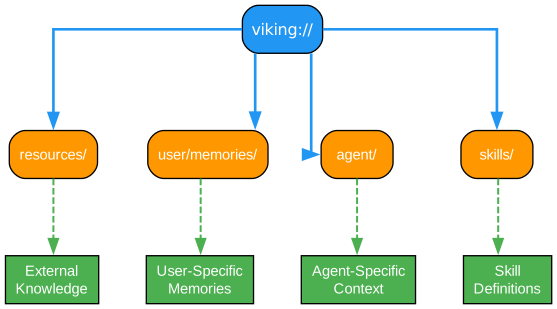
Understanding the Context Filesystem Architecture
The context filesystem diagram above illustrates OpenViking’s innovative approach to organizing agent context through a hierarchical virtual filesystem structure. This paradigm shift fundamentally changes how developers interact with and manage context for AI agents.
Core Components:
1. Root Namespace (viking://) The root namespace serves as the entry point for all context operations. Using the viking:// protocol prefix, every piece of context in the system has a unique, addressable URI. This design draws inspiration from modern operating systems and cloud storage paradigms, providing a familiar and intuitive interface for developers.
The URI-based approach enables precise context manipulation through standard commands like ls, find, and tree, transforming context management from vague semantic matching into deterministic, traceable operations. Developers can locate, browse, and manipulate information with the same confidence they have when managing local files.
2. Resources Directory The resources/ directory houses external knowledge that agents can leverage during execution. This includes project documentation, code repositories, web pages, and any other reference materials. Each resource maintains its original structure, allowing agents to navigate complex documentation hierarchies naturally.
When a resource is added, OpenViking automatically processes it through its semantic pipeline, creating vector embeddings and hierarchical summaries that enable both precise directory navigation and semantic search capabilities. This dual approach ensures that agents can find information whether they know exactly where it is or only have a vague idea of what they’re looking for.
3. User Memories Directory The user/memories/ directory stores user-specific context including preferences, habits, and interaction history. This separation ensures that personalization data remains distinct from general knowledge, enabling multi-user scenarios where each user’s preferences are preserved independently.
User memories can include structured data like writing styles, coding habits, and communication preferences. As agents interact with users over time, this directory accumulates valuable context that enables increasingly personalized responses without requiring explicit reconfiguration.
4. Agent Context Directory The agent/ directory contains agent-specific context including skills, instructions, and task memories. This is where the agent’s operational knowledge resides - from simple skill definitions to complex multi-step procedures.
Skills stored in this directory are more than static definitions; they include execution context, success metrics, and learned optimizations. When an agent encounters a task, it can query this directory to find relevant skills and their associated context, enabling intelligent skill selection and application.
Key Insights:
The filesystem paradigm provides several advantages over traditional approaches:
- Deterministic Access: Unlike purely semantic systems, filesystem paths provide exact addresses for context, eliminating ambiguity in retrieval.
- Hierarchical Organization: Natural directory structures mirror how humans organize information, making it easier to understand and navigate.
- Inheritance and Composition: Child directories inherit context from parents, enabling efficient propagation of shared context.
- Atomic Operations: Filesystem semantics enable atomic operations like move, copy, and delete, providing precise control over context lifecycle.
Practical Applications:
Organizations can leverage this architecture by:
- Creating project-specific resource hierarchies that mirror their documentation structure
- Defining user preference templates that automatically populate new user directories
- Building skill libraries that can be shared across multiple agents
- Implementing access control patterns familiar from filesystem permissions
2. Tiered Context Loading
OpenViking automatically processes context into three levels upon writing, enabling progressive loading that dramatically reduces token consumption while maintaining access to detailed information when needed.

Understanding Tiered Context Loading
The tiered loading diagram above demonstrates OpenViking’s sophisticated approach to managing context size while preserving information accessibility. This three-tier architecture represents a fundamental advancement in how AI agents consume and process context.
L0 Layer: Abstract (~100 tokens)
The L0 layer serves as the rapid identification tier, providing one-sentence summaries that enable quick relevance assessment. When an agent needs to determine whether a piece of context is relevant to the current task, it can examine L0 abstracts without committing to loading larger context chunks.
Purpose and Design Philosophy: The abstract layer is designed for high-speed filtering operations. In a system with thousands of context entries, loading full content for each would be prohibitively expensive. L0 abstracts enable the agent to quickly scan through potential matches, identifying relevant context with minimal token expenditure.
Implementation Details:
- Abstracts are generated automatically using VLM (Vision Language Model) processing
- Each abstract captures the essence of the content in approximately 100 tokens
- Abstracts are stored alongside metadata for rapid access
- The system maintains abstract consistency across updates and modifications
Best Practices:
- Use L0 for initial relevance screening in multi-step retrieval processes
- Combine L0 abstracts with directory structure for efficient navigation
- Consider L0 abstracts as the “title” or “headline” of context entries
L1 Layer: Overview (~2,000 tokens)
The L1 layer contains core information and usage scenarios, designed for Agent decision-making during the planning phase. When an agent needs to understand the structure and key points of context without diving into full details, L1 overviews provide the perfect balance.
Purpose and Design Philosophy: Overview layers enable agents to make informed decisions about context relevance and usage patterns. They contain enough detail to understand what information is available, how it’s structured, and when it might be useful, without the overhead of complete content.
Implementation Details:
- Overviews include section summaries, key concepts, and usage examples
- Structure mirrors the original content’s organization
- Cross-references to related context entries are included
- Usage scenarios and common patterns are highlighted
Best Practices:
- Use L1 for planning and decision-making phases
- L1 is ideal for understanding context structure before deep exploration
- Combine multiple L1 overviews for comprehensive planning sessions
- L1 overviews can inform retrieval strategies for L2 content
L2 Layer: Full Details (Complete Content)
The L2 layer contains the complete original data, reserved for deep reading when the agent absolutely needs full context. This layer is loaded only when necessary, ensuring that token consumption remains controlled while preserving access to complete information.
Purpose and Design Philosophy: Full details are available on demand, ensuring that agents never lose access to complete information. The key innovation is that L2 content is only loaded when explicitly needed, preventing unnecessary token consumption while maintaining information completeness.
Implementation Details:
- Original content is preserved without modification
- Full content is stored efficiently with compression where applicable
- Access patterns are tracked to inform future loading decisions
- Content can be streamed for very large entries
Token Savings Analysis:
The experimental results from OpenClaw integration demonstrate the dramatic efficiency gains:
| Configuration | Task Completion Rate | Input Token Cost |
|---|---|---|
| OpenClaw (memory-core) | 35.65% | 24,611,530 |
| OpenClaw + LanceDB | 44.55% | 51,574,530 |
| OpenViking Plugin (with memory) | 51.23% | 2,099,622 |
| OpenViking Plugin (without memory) | 52.08% | 4,264,396 |
Key Observations:
- 91% Token Reduction: OpenViking achieves up to 91% reduction in input token costs compared to traditional approaches
- Improved Performance: Task completion rates improve by 43% over baseline and 17% over LanceDB alternatives
- Scalable Architecture: The tiered approach scales efficiently as context grows, unlike flat storage models
Practical Applications:
Organizations can optimize context loading by:
- Configuring retrieval strategies to prefer L0/L1 for initial exploration
- Setting token budgets that automatically escalate from L0 to L1 to L2 as needed
- Implementing caching strategies that keep frequently accessed L1 content readily available
- Monitoring access patterns to optimize abstract and overview generation
3. Directory Recursive Retrieval
Single vector retrieval struggles with complex query intents. OpenViking’s innovative Directory Recursive Retrieval Strategy deeply integrates multiple retrieval methods for superior results.
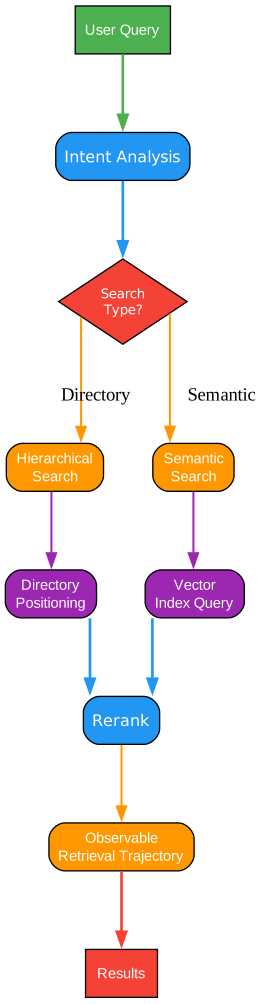
Understanding the Retrieval Flow
The retrieval flow diagram above illustrates OpenViking’s sophisticated multi-stage retrieval process that combines the precision of hierarchical navigation with the flexibility of semantic search. This hybrid approach addresses the fundamental limitations of pure vector search while maintaining the ability to handle complex, ambiguous queries.
Stage 1: User Query Input
The retrieval process begins with a user query, which can range from simple keyword searches to complex natural language questions. OpenViking accepts queries in multiple formats:
- Natural Language: “What is the authentication flow for the API?”
- Directory Paths: “viking://resources/my_project/docs/api/”
- Hybrid Queries: “Find error handling in the authentication module”
The system intelligently interprets the query type and routes it to the appropriate processing pipeline, ensuring optimal retrieval regardless of query format.
Stage 2: Intent Analysis
The Intent Analysis module examines the query to understand what the user is actually looking for. This goes beyond simple keyword extraction to understand:
- Query Intent: Is the user looking for specific information, exploring a topic, or trying to accomplish a task?
- Scope Requirements: Does the query require broad context or specific details?
- Context Dependencies: What related information might be relevant?
The intent analysis generates multiple retrieval conditions that capture different aspects of the query, enabling comprehensive coverage of potential matches. This multi-faceted approach ensures that relevant context isn’t missed due to vocabulary mismatches or ambiguous phrasing.
Stage 3: Search Type Decision
Based on intent analysis, the system decides between two primary search strategies:
Directory Search Branch: When the query suggests a specific location or hierarchical context, the system uses directory positioning to narrow the search space. This is particularly effective when:
- The query mentions specific modules, components, or sections
- Previous context suggests a relevant directory
- The user is exploring a known area of the knowledge base
Semantic Search Branch: When the query is exploratory or the target location is unknown, semantic search leverages vector embeddings to find relevant content regardless of location. This excels when:
- The user is asking conceptual questions
- The target information could be in multiple locations
- The query uses different terminology than the source material
Stage 4: Hierarchical Search and Vector Index
Hierarchical Search: The hierarchical search component navigates the virtual filesystem structure, using directory metadata and L0 abstracts to quickly locate promising areas. This process:
- Examines directory-level abstracts to identify relevant branches
- Drills down into promising subdirectories
- Updates candidate sets based on directory-level relevance scores
- Recursively explores until reaching file-level content
Vector Index Query: The vector search component queries the embedding index to find semantically similar content. This process:
- Generates embeddings for the query (and any expanded terms from intent analysis)
- Performs approximate nearest neighbor search in the vector index
- Returns top-k candidates with similarity scores
- Enriches candidates with surrounding context for better ranking
Stage 5: Rerank and Aggregation
The rerank stage combines results from both search branches, applying sophisticated scoring to identify the most relevant context:
- Relevance Scoring: Combines semantic similarity with directory relevance
- Context Coherence: Evaluates how well results fit together
- Coverage Analysis: Ensures diverse perspectives are represented
- Recency Weighting: Considers freshness of information
The aggregation process produces a ranked list of context entries, each with associated relevance scores and retrieval trajectories.
Stage 6: Observable Retrieval Trajectory
A key innovation in OpenViking is the preservation of retrieval trajectories. Unlike black-box RAG systems, OpenViking maintains a complete record of:
- Which directories were explored
- What search terms were used
- How results were ranked and combined
- Why specific context was selected
This observability enables:
- Debugging: Understand exactly why certain context was retrieved
- Optimization: Identify and fix retrieval logic issues
- Transparency: Explain to users how conclusions were reached
- Learning: Improve retrieval strategies based on feedback
Stage 7: Results Delivery
The final stage delivers context to the requesting agent, formatted appropriately for the use case:
- L0/L1/L2 Selection: Based on token budgets and relevance thresholds
- Context Packaging: Grouping related entries for coherent presentation
- Metadata Inclusion: Relevance scores, source locations, and confidence levels
Key Insights:
The directory recursive retrieval strategy represents a paradigm shift from traditional RAG:
- Global Context Awareness: By understanding directory structure, the system maintains awareness of context relationships that flat vector stores lose
- Deterministic Fallback: When semantic search fails, directory navigation provides a reliable backup
- Progressive Refinement: The system can start broad and narrow down, or start specific and expand, depending on query needs
- Explainable Results: Every retrieval can be traced and explained, building trust and enabling optimization
Practical Applications:
Organizations can optimize retrieval by:
- Structuring resources to mirror logical organization (projects, modules, features)
- Providing meaningful directory names and descriptions
- Using consistent naming conventions that aid both semantic and directory search
- Regularly reviewing retrieval trajectories to identify optimization opportunities
4. Visualized Retrieval Trajectory
OpenViking’s hierarchical virtual filesystem structure breaks the traditional flat black-box management mode. Every retrieval operation is fully traceable, allowing users to clearly observe the root cause of problems and guide the optimization of retrieval logic.
Key Benefits:
- Complete Transparency: Every step of the retrieval process is logged and visualizable
- Debugging Capability: Identify exactly where retrieval went wrong
- Optimization Insights: Understand which paths lead to successful retrievals
- Audit Trail: Maintain compliance and accountability for agent decisions
5. Automatic Session Management
OpenViking includes a built-in memory self-iteration loop. At the end of each session, developers can trigger memory extraction mechanisms that analyze task execution results and user feedback, automatically updating User and Agent memory directories.
User Memory Update: The system analyzes interactions to extract and update memories related to user preferences, enabling increasingly personalized responses that better fit user needs over time.
Agent Experience Accumulation: Core content such as operational tips and tool usage experience are extracted from task execution, aiding efficient decision-making in subsequent tasks. This enables the Agent to get “smarter with use” through interactions with the world, achieving self-evolution.
Architecture Overview
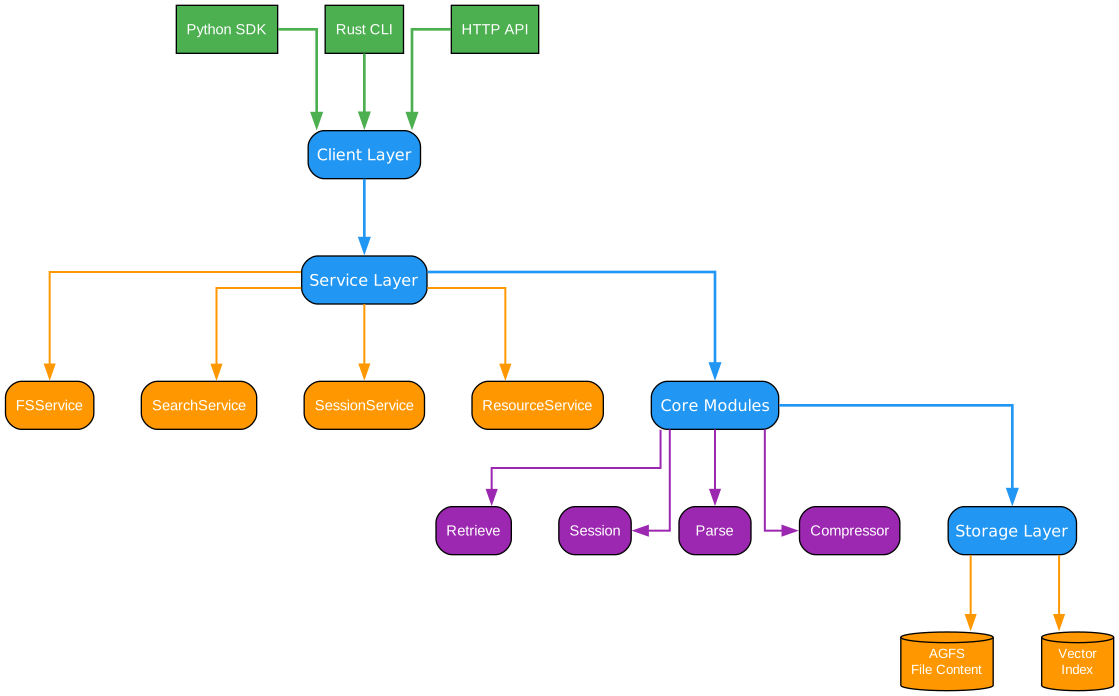
Understanding the Architecture
The architecture diagram above presents OpenViking’s four-layer design, showcasing how the system separates concerns while maintaining tight integration between components. Each layer serves a specific purpose and communicates through well-defined interfaces.
Layer 1: Client Layer
The Client Layer provides multiple interfaces for interacting with OpenViking:
Python SDK: The Python SDK offers the most feature-rich integration point, providing:
- Full access to all OpenViking capabilities
- Native Python objects for context manipulation
- Integration with popular AI frameworks (LangChain, LlamaIndex, etc.)
- Asynchronous operations for high-performance applications
Rust CLI: The Rust CLI (ov_cli) provides a command-line interface for:
- Server administration and configuration
- Quick context operations from terminals
- Scripting and automation workflows
- Debugging and exploration tasks
HTTP API: The HTTP API enables language-agnostic access:
- RESTful endpoints for all operations
- WebSocket support for real-time updates
- OpenAPI specification for easy integration
- Authentication and authorization support
Layer 2: Service Layer
The Service Layer orchestrates high-level operations:
FSService: Manages the virtual filesystem operations including:
- Directory creation, navigation, and deletion
- File upload, download, and manipulation
- Path resolution and URI handling
- Permission and access control
SearchService: Handles all retrieval operations:
- Query parsing and intent analysis
- Search strategy selection
- Result ranking and aggregation
- Trajectory tracking and logging
SessionService: Manages agent sessions:
- Session creation and lifecycle management
- Memory extraction and update triggers
- Context window management
- Conversation history tracking
ResourceService: Handles external resource integration:
- Resource ingestion and processing
- Format conversion and normalization
- Metadata extraction and indexing
- Update detection and synchronization
Layer 3: Core Modules
The Core Modules layer contains the processing engines:
Retrieve: The retrieval engine implements:
- Vector similarity search
- Hierarchical directory navigation
- Hybrid search strategies
- Result reranking and scoring
Session: The session management module handles:
- Conversation state persistence
- Memory compression and summarization
- Task context tracking
- Multi-turn interaction management
Parse: The parsing module processes:
- Document format conversion
- Content extraction and structuring
- Metadata identification
- Language detection and handling
Compressor: The compression module optimizes:
- Context size reduction
- Information preservation during compression
- L0/L1/L2 layer generation
- Token budget management
Layer 4: Storage Layer
The Storage Layer provides persistent data management:
AGFS (Agent File System): A purpose-built file system for AI context:
- Optimized for read-heavy workloads
- Efficient content storage and retrieval
- Version control and history tracking
- Distributed storage support
Vector Index: High-performance vector storage:
- Embedding storage and retrieval
- Approximate nearest neighbor search
- Index optimization and maintenance
- Multi-modal embedding support
Key Insights:
The layered architecture provides several advantages:
- Separation of Concerns: Each layer handles specific responsibilities, making the system easier to understand, test, and modify
- Scalability: Layers can be scaled independently based on workload requirements
- Flexibility: New clients, services, or storage backends can be added without disrupting existing functionality
- Testability: Each layer can be tested in isolation with well-defined interfaces
Practical Applications:
Organizations can leverage this architecture by:
- Deploying storage layers on high-performance infrastructure while keeping compute layers closer to agents
- Adding custom services for domain-specific operations
- Implementing custom storage backends for specialized requirements
- Extending client libraries for new programming languages or frameworks
Installation and Quick Start
Prerequisites
Before starting with OpenViking, ensure your environment meets these requirements:
- Python Version: 3.10 or higher
- Go Version: 1.22 or higher (for AGFS components)
- C++ Compiler: GCC 9+ or Clang 11+ (for core extensions)
- Operating System: Linux, macOS, or Windows
Installation
Python Package:
pip install openviking --upgrade --force-reinstall
Rust CLI (Optional):
curl -fsSL https://raw.githubusercontent.com/volcengine/OpenViking/main/crates/ov_cli/install.sh | bash
Or build from source:
cargo install --git https://github.com/volcengine/OpenViking ov_cli
Configuration
Create a configuration file at ~/.openviking/ov.conf:
{
  "storage": {
    "workspace": "/home/your-name/openviking_workspace"
  },
  "log": {
    "level": "INFO",
    "output": "stdout"
  },
  "embedding": {
    "dense": {
      "api_base": "<api-endpoint>",
      "api_key": "<your-api-key>",
      "provider": "openai",
      "dimension": 3072,
      "model": "text-embedding-3-large"
    },
    "max_concurrent": 10
  },
  "vlm": {
    "api_base": "<api-endpoint>",
    "api_key": "<your-api-key>",
    "provider": "openai",
    "model": "gpt-4o",
    "max_concurrent": 100
  }
}
Running Your First Example
Launch Server:
openviking-server
Run CLI Commands:
ov status
ov add-resource https://github.com/volcengine/OpenViking
ov ls viking://resources/
ov tree viking://resources/volcengine -L 2
ov find "what is openviking"
ov grep "openviking" --uri viking://resources/volcengine/OpenViking/docs/zh
VikingBot: AI Agent Framework
VikingBot is an AI agent framework built on top of OpenViking, providing a complete solution for building intelligent agents:
# Install VikingBot
pip install "openviking[bot]"

# Start server with Bot enabled
openviking-server --with-bot

# Start interactive chat
ov chat
Performance Results
OpenViking has been tested with the OpenClaw context plugin, demonstrating significant improvements:
| Configuration | Task Completion Rate | Input Token Cost |
|---|---|---|
| OpenClaw (baseline) | 35.65% | 24,611,530 |
| OpenClaw + LanceDB | 44.55% | 51,574,530 |
| OpenViking Plugin (with memory) | 51.23% | 2,099,622 |
| OpenViking Plugin (without memory) | 52.08% | 4,264,396 |
Key Findings:
- 43% improvement over original OpenClaw with 91% reduction in input token cost
- 15% improvement over LanceDB with 96% reduction in input token cost
- Consistent performance gains across different memory configurations
Supported Model Providers
OpenViking supports multiple VLM and embedding providers:
| Provider | VLM Support | Embedding Support |
|---|---|---|
| Volcengine (Doubao) | Yes | Yes |
| OpenAI | Yes | Yes |
| Anthropic (via LiteLLM) | Yes | No |
| DeepSeek (via LiteLLM) | Yes | No |
| Gemini | Yes | Yes |
| Qwen/DashScope | Yes | Yes |
| vLLM | Yes | No |
| Ollama | Yes | No |
Comparison with Other Context Solutions
| Feature | OpenViking | Traditional RAG | Vector Databases |
|---|---|---|---|
| Filesystem Paradigm | Yes | No | No |
| Tiered Loading | L0/L1/L2 | Single Level | Single Level |
| Retrieval Observability | Full | None | Limited |
| Memory Self-Iteration | Yes | No | No |
| Token Optimization | Up to 91% | Baseline | Baseline |
| Agent-Specific Design | Yes | No | No |
Community and Resources
OpenViking is an active open-source project with growing community support:
- Website: https://www.openviking.ai
- GitHub: https://github.com/volcengine/OpenViking
- Documentation: Full Documentation
- Discord: Join Discord Server
- X (Twitter): @openvikingai
Conclusion
OpenViking represents a paradigm shift in how we approach context management for AI agents. By introducing a filesystem paradigm, tiered loading, and observable retrieval, it solves the fundamental challenges that have plagued agent development:
- Fragmented context becomes unified under a single, intuitive filesystem interface
- Token consumption is dramatically reduced through intelligent tiered loading
- Retrieval effectiveness improves through hybrid directory-semantic search
- Black-box operations become transparent through full trajectory visualization
- Static memory evolves dynamically through automatic session management
With over 21,000 GitHub stars and rapid adoption, OpenViking is positioned to become the standard for AI agent context management. Whether you’re building simple chatbots or complex multi-agent systems, OpenViking provides the infrastructure needed to manage context efficiently and effectively.
The journey has just begun, and the project welcomes contributions from developers passionate about AI agent technology. By defining and building the future of AI Agent context management together, we can enable the next generation of intelligent, context-aware agents.
Related Posts
- AgentSkillOS: Skill Orchestration System
- DESIGN-md: AI-Powered Design Systems
- MattPocock Skills: AI Agent Workflows
