TradingAgents: Multi-Agent LLM Financial Trading Framework
Financial trading has entered a new era with the integration of Large Language Models (LLMs) and multi-agent systems. TradingAgents, an open-source project from TauricResearch with over 48,505 GitHub stars, represents a paradigm shift in how AI can be applied to investment decision-making. This framework mirrors the organizational structure of real-world trading firms, deploying specialized AI agents that collaborate to analyze markets, conduct research, execute trades, and manage risk.
Introduction
Traditional algorithmic trading systems rely on predefined rules and statistical models. While effective in certain contexts, these systems struggle with the nuance and complexity of modern financial markets. TradingAgents addresses this limitation by leveraging LLM-powered agents that can reason, debate, and make decisions based on diverse data sources.
The framework implements a sophisticated pipeline where different agent teams handle specific aspects of the trading process. From market analysis to risk management, each agent type brings specialized capabilities that, when combined, create a comprehensive trading intelligence system. This approach draws inspiration from how actual trading firms operate, where analysts, researchers, traders, and risk managers work together to make informed investment decisions.
Architecture Overview
TradingAgents employs a hierarchical multi-agent architecture built on LangGraph, a framework for orchestrating LLM agents. The system processes information through five distinct stages, each handled by specialized agents with specific roles and responsibilities.
The architecture separates concerns effectively: analysts gather and interpret data, researchers debate investment theses, traders make execution decisions, risk management evaluates exposure, and portfolio managers provide final oversight. This separation ensures that no single point of failure exists and that multiple perspectives inform every decision.
Understanding the Multi-Agent Architecture
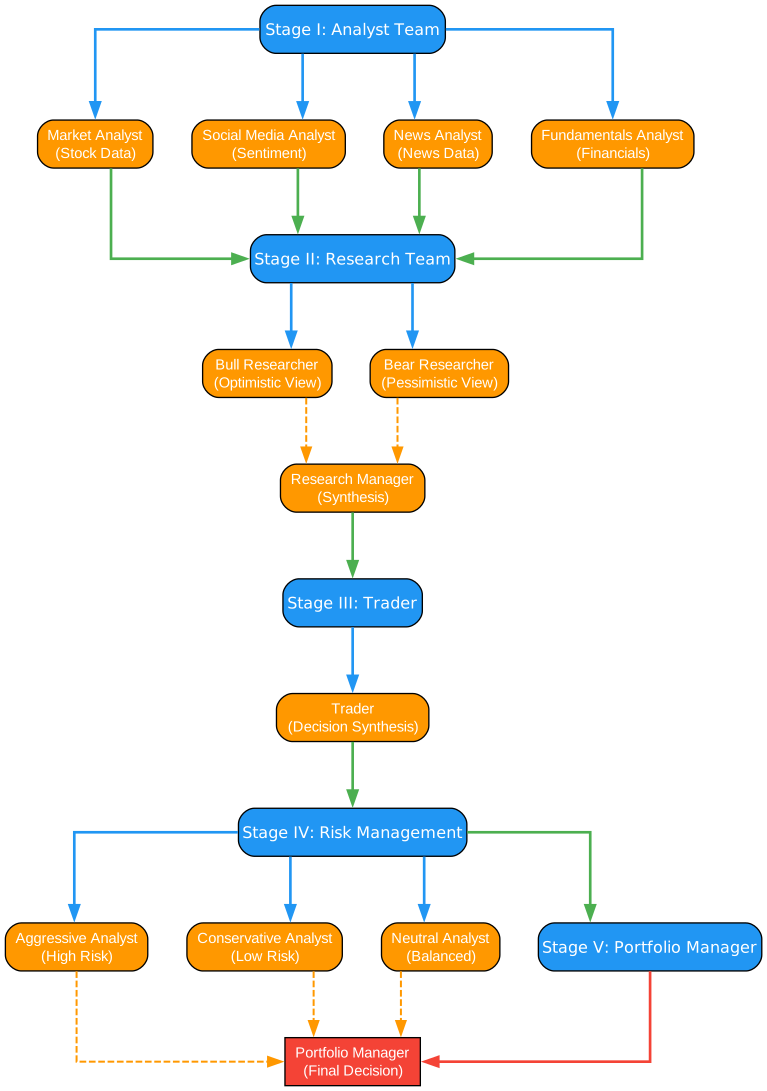
The architecture diagram above illustrates the hierarchical structure and information flow within TradingAgents. This design represents a significant advancement over single-agent trading systems by introducing specialized roles and structured collaboration patterns.
Stage 1: Analyst Team
The Analyst Team forms the foundation of the trading intelligence system. This team consists of four specialized analysts, each focusing on a distinct data domain:
-
Market Analyst: Processes real-time market data including price movements, volume patterns, and technical indicators. This agent identifies trends, support/resistance levels, and potential entry/exit points based on quantitative analysis.
-
Social Media Analyst: Monitors social media platforms for sentiment signals, tracking discussions on Twitter, Reddit, and financial forums. This agent detects emerging narratives, viral discussions, and shifts in retail investor sentiment that may precede price movements.
-
News Analyst: Analyzes financial news from major outlets, earnings reports, and regulatory filings. This agent extracts key events, assesses their market impact, and identifies potential catalysts or risks.
-
Fundamentals Analyst: Evaluates company financials, valuation metrics, and business fundamentals. This agent assesses intrinsic value, growth prospects, and financial health to inform long-term investment decisions.
Each analyst operates independently, gathering data and producing reports that feed into subsequent stages. This parallel processing approach ensures comprehensive coverage while maintaining efficiency.
Stage 2: Research Team
The Research Team receives analyst reports and conducts deeper investigation into investment opportunities. This team employs a debate-style format with Bull and Bear researchers:
-
Bull Researcher: Argues for investment opportunities, highlighting positive signals, growth potential, and favorable market conditions. This agent builds the case for why a position should be taken.
-
Bear Researcher: Presents counter-arguments, identifying risks, potential downsides, and market concerns. This agent ensures that investment decisions consider alternative perspectives.
This adversarial approach, inspired by debate methodologies, produces more robust investment theses by forcing consideration of opposing viewpoints. The Research Manager synthesizes these perspectives into actionable recommendations.
Stage 3: Trader
The Trader agent receives synthesized research and makes execution decisions. This agent determines:
- Position sizing based on conviction levels
- Entry and exit points
- Order types (market, limit, stop-loss)
- Timing considerations
The Trader balances the need for execution efficiency against market impact, considering liquidity, volatility, and current market conditions when making decisions.
Stage 4: Risk Management
Risk Management introduces another debate-style evaluation with three perspectives:
-
Aggressive Debator: Argues for higher risk tolerance, emphasizing potential returns and market opportunities.
-
Conservative Debator: Advocates for caution, highlighting potential losses and recommending protective measures.
-
Neutral Debator: Provides balanced assessment, weighing both upside potential and downside risk.
This multi-perspective risk evaluation ensures that decisions are not made in echo chambers and that potential downsides are thoroughly considered.
Stage 5: Portfolio Manager
The Portfolio Manager serves as the final decision authority, integrating all inputs to make final investment decisions. This agent considers:
- Overall portfolio composition and diversification
- Risk budget allocation
- Correlation with existing positions
- Market regime and macro conditions
The Portfolio Manager has the authority to approve, modify, or reject proposed trades, ensuring alignment with overall investment strategy and risk parameters.
Key Architectural Insights
This architecture draws from several important principles in both organizational design and AI systems:
-
Separation of Concerns: Each agent type handles a specific domain, allowing for specialized expertise and focused analysis.
-
Adversarial Collaboration: Debate-style interactions between Bull/Bear and Risk debators prevent confirmation bias and ensure thorough evaluation.
-
Hierarchical Decision-Making: The pipeline structure ensures that decisions are made with increasing levels of synthesis and oversight.
-
Modularity: Agents can be added, removed, or modified independently, allowing for customization and extension.
Understanding the Data Flow
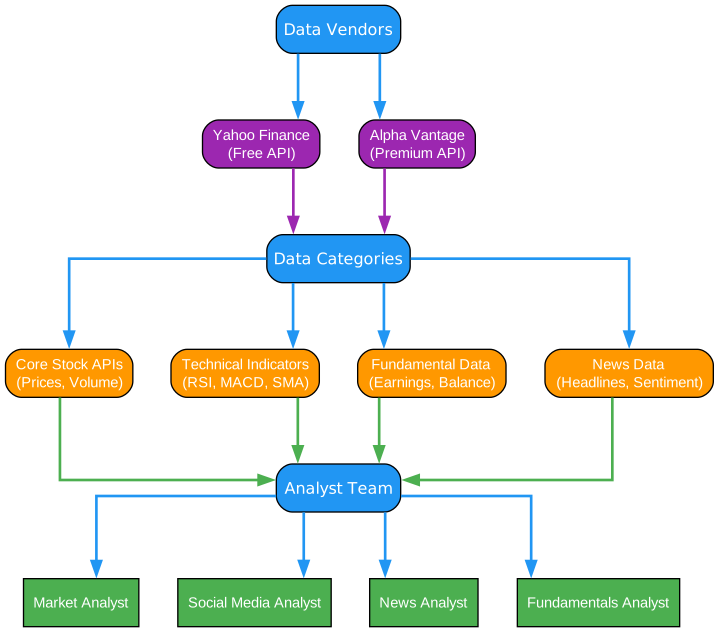
The data flow diagram illustrates how information moves through the TradingAgents system, from raw data ingestion to final trading decisions. Understanding this flow is essential for appreciating how the framework processes diverse data sources and transforms them into actionable insights.
Data Sources Layer
The system integrates multiple data sources to provide comprehensive market intelligence:
-
Yahoo Finance: Provides real-time and historical stock prices, volume data, and basic financial metrics. This free data source offers broad market coverage and is accessible through the yfinance library.
-
Alpha Vantage: Supplies advanced financial data including:
- Technical indicators (RSI, MACD, Bollinger Bands, etc.)
- Fundamental data (income statements, balance sheets, cash flow)
- Economic indicators and sector performance
- News sentiment analysis
These data sources are accessed through standardized interfaces that abstract away API complexities and provide consistent data formats for downstream processing.
Data Processing Pipeline
Raw data undergoes several processing steps before reaching agents:
-
Data Ingestion: API calls retrieve data from sources, with rate limiting and error handling to ensure reliability.
-
Data Normalization: Different data formats are standardized into consistent structures that agents can process uniformly.
-
Feature Extraction: Technical indicators and derived metrics are computed from raw price data.
-
Context Enrichment: Data is augmented with temporal context (market hours, earnings dates) and relational context (sector performance, peer comparisons).
Agent Processing Flow
Each agent in the pipeline receives processed data and produces outputs that flow to subsequent stages:
-
Analyst Reports: Structured documents containing analysis findings, key metrics, and preliminary recommendations.
-
Research Synthesis: Combined analysis from Bull and Bear perspectives, with supporting evidence and counter-arguments.
-
Trading Proposals: Specific trade recommendations with entry/exit points, position sizing, and execution parameters.
-
Risk Assessments: Evaluation of proposed trades from multiple risk perspectives, with recommendations for risk mitigation.
-
Final Decisions: Approved trades with execution instructions and portfolio allocation updates.
Memory Integration
A critical component of the data flow is the memory system, which stores past decisions and their outcomes. This enables:
-
Learning from Experience: Agents can reference similar past situations and their outcomes.
-
Pattern Recognition: Recurring patterns in market behavior can be identified and leveraged.
-
Performance Tracking: Decision quality can be measured and improved over time.
The memory system uses BM25 lexical similarity matching to retrieve relevant past experiences, ensuring that historical context informs current decisions.
Feedback Loops
The architecture includes feedback mechanisms that allow for continuous improvement:
-
Decision Outcomes: Trade results are recorded and fed back into the memory system.
-
Performance Metrics: Key performance indicators (win rate, Sharpe ratio, maximum drawdown) are tracked and analyzed.
-
Agent Calibration: Agent behavior can be adjusted based on performance feedback.
This data flow design ensures that information is processed efficiently while maintaining the depth of analysis required for informed trading decisions.
Understanding LLM Provider Integration
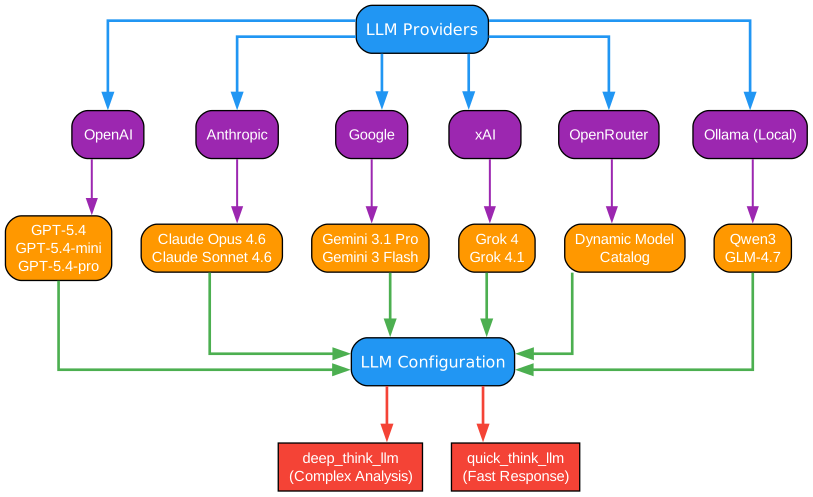
The LLM Providers diagram showcases the flexible model integration architecture that allows TradingAgents to leverage multiple AI providers. This flexibility is crucial for production trading systems where reliability, cost, and performance must be balanced.
Supported LLM Providers
TradingAgents supports a comprehensive range of LLM providers, each offering unique advantages:
-
OpenAI: The most widely supported provider, offering GPT-4 and GPT-4 Turbo models. Known for strong reasoning capabilities and extensive tool use support. Ideal for complex analysis tasks requiring nuanced understanding.
-
Anthropic: Provides Claude models (Claude 3 Opus, Sonnet, Haiku) known for their strong analytical capabilities and longer context windows. Particularly effective for processing large documents and detailed analysis.
-
Google: Offers Gemini models with strong multimodal capabilities. Useful for analyzing charts, images, and other visual data alongside text.
-
xAI: Grok models from xAI provide an alternative with real-time information access and distinctive reasoning approaches.
-
OpenRouter: A unified API that provides access to multiple models through a single interface. Enables easy model switching and cost optimization.
-
Ollama: Local model deployment for privacy-sensitive applications or cost reduction. Allows running open-source models like Llama 3 on local hardware.
Model Selection Strategy
Different agents may benefit from different model capabilities:
-
Analyst Agents: Can use faster, more cost-effective models for routine data processing.
-
Research Agents: May require more powerful models for complex reasoning and debate.
-
Risk Management: Benefits from conservative, well-calibrated models with strong uncertainty handling.
-
Portfolio Manager: Requires top-tier models for final decision synthesis.
The framework allows per-agent model configuration, enabling optimization of both cost and performance.
API Abstraction Layer
TradingAgents implements a unified interface for LLM interactions:
from tradingagents.llm_clients import create_client

# Create client for any provider
client = create_client(provider="openai", model="gpt-4")

# Standardized interface across providers
response = client.generate(prompt, tools=tools)
This abstraction enables:
-
Easy Provider Switching: Change providers without modifying agent code.
-
Fallback Mechanisms: Automatically switch to backup providers if primary fails.
-
Cost Optimization: Route different tasks to appropriate models based on complexity.
-
Testing and Development: Use cheaper models during development, production models in deployment.
Rate Limiting and Cost Management
Financial applications require careful management of API costs and rate limits:
-
Request Batching: Combine multiple queries where possible to reduce API calls.
-
Caching: Store and reuse responses for repeated queries.
-
Rate Limit Handling: Implement exponential backoff and request queuing.
-
Cost Tracking: Monitor and report API costs per agent and decision.
Model Configuration
Each agent can be configured with specific model parameters:
config = {
    "analyst_team": {
        "market_analyst": {"provider": "openai", "model": "gpt-4-turbo"},
        "news_analyst": {"provider": "anthropic", "model": "claude-3-sonnet"}
    },
    "research_team": {
        "bull_researcher": {"provider": "openai", "model": "gpt-4"},
        "bear_researcher": {"provider": "anthropic", "model": "claude-3-opus"}
    }
}
This flexibility ensures that TradingAgents can adapt to various deployment scenarios, from research environments using local models to production systems requiring enterprise-grade AI services.
Understanding the Trading Workflow
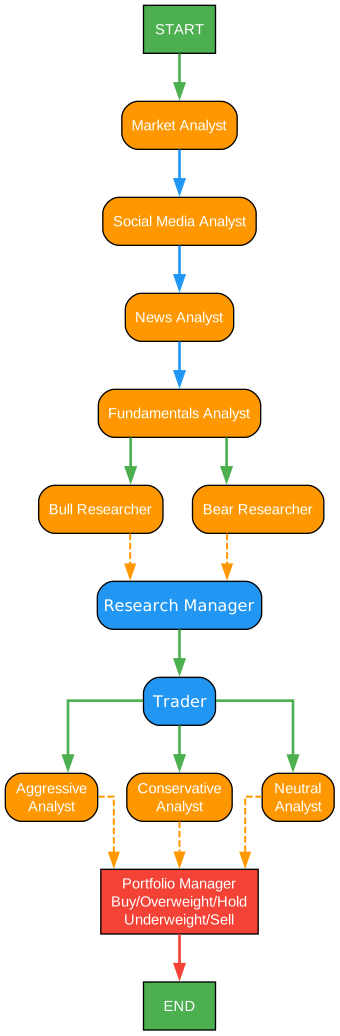
The workflow diagram presents the complete decision-making pipeline from initial data gathering to final trade execution. This structured approach ensures systematic analysis and consistent decision quality.
Phase 1: Data Gathering and Analysis
The workflow begins with parallel data collection across multiple domains:
-
Market Data Collection: Real-time price feeds, historical data, and technical indicators are retrieved and processed.
-
News and Sentiment Collection: Financial news, social media discussions, and analyst reports are aggregated and analyzed.
-
Fundamental Data Retrieval: Company financials, earnings data, and valuation metrics are compiled.
Each analyst agent processes its assigned data domain independently, producing structured reports that capture key findings and preliminary assessments. This parallel execution minimizes latency while ensuring comprehensive coverage.
Phase 2: Research and Debate
The research phase introduces structured debate:
-
Bull Case Development: The Bull Researcher constructs arguments for investment, citing positive signals, growth catalysts, and favorable conditions.
-
Bear Case Development: The Bear Researcher identifies risks, concerns, and reasons to avoid or reduce positions.
-
Synthesis: The Research Manager weighs both perspectives, identifying areas of agreement and disagreement, and produces a balanced research summary.
This debate format ensures that investment decisions consider multiple viewpoints and are not biased toward either optimism or pessimism.
Phase 3: Trade Formulation
Based on research synthesis, the Trader agent formulates specific trade proposals:
-
Position Sizing: Determines appropriate allocation based on conviction level and risk parameters.
-
Entry Strategy: Defines entry points, order types, and timing considerations.
-
Exit Planning: Establishes target prices, stop-loss levels, and time-based exit criteria.
-
Execution Parameters: Specifies order types (market, limit, stop) and execution timing.
Phase 4: Risk Evaluation
The Risk Management team evaluates proposed trades:
-
Aggressive Perspective: Evaluates potential upside and argues for risk tolerance.
-
Conservative Perspective: Identifies potential downsides and recommends protective measures.
-
Neutral Assessment: Provides balanced evaluation with specific risk metrics.
The risk evaluation produces a comprehensive risk assessment that quantifies potential gains and losses, identifies key risk factors, and recommends risk mitigation strategies.
Phase 5: Final Decision
The Portfolio Manager makes the final decision:
-
Portfolio Context: Considers existing positions, sector exposure, and correlation implications.
-
Risk Budget: Evaluates whether the proposed trade fits within overall risk parameters.
-
Execution Approval: Approves, modifies, or rejects the trade with specific instructions.
-
Documentation: Records the decision rationale for future reference and learning.
Execution and Feedback
After approval, trades are executed and outcomes are tracked:
-
Order Execution: Trades are submitted to the market through broker APIs.
-
Position Tracking: Open positions are monitored for performance and risk.
-
Outcome Recording: Trade results are recorded in the memory system.
-
Performance Analysis: Win/loss ratios, returns, and other metrics are calculated.
This feedback loop enables continuous learning and improvement of the trading system.
Workflow Orchestration with LangGraph
The entire workflow is orchestrated using LangGraph, which provides:
-
State Management: Tracks the state of each decision process across agents.
-
Conditional Routing: Routes information based on decision outcomes and conditions.
-
Error Handling: Manages failures and provides recovery mechanisms.
-
Parallel Execution: Enables concurrent processing where dependencies allow.
The workflow design ensures that TradingAgents operates systematically, with clear handoffs between stages and comprehensive documentation of the decision process.
Agent Types and Roles
TradingAgents implements a diverse set of specialized agents, each designed to handle specific aspects of the trading process. Understanding these roles is essential for customizing and extending the framework.
Analyst Agents
Market Analyst
The Market Analyst focuses on technical analysis and price action:
- Analyzes price charts and identifies patterns
- Calculates and interprets technical indicators
- Identifies support and resistance levels
- Detects trend direction and momentum
- Provides entry and exit point recommendations
Social Media Analyst
The Social Media Analyst monitors sentiment and discussions:
- Tracks Twitter/X for market-relevant discussions
- Analyzes Reddit forums (r/wallstreetbets, r/investing)
- Monitors financial news comment sections
- Detects sentiment shifts and viral narratives
- Identifies potential market-moving social events
News Analyst
The News Analyst processes financial news and announcements:
- Analyzes earnings reports and guidance
- Tracks regulatory filings and announcements
- Monitors macroeconomic news and events
- Identifies market-moving news catalysts
- Assesses news impact on specific securities
Fundamentals Analyst
The Fundamentals Analyst evaluates company financials:
- Analyzes income statements, balance sheets, cash flow
- Calculates valuation metrics (P/E, PEG, EV/EBITDA)
- Assesses business model and competitive position
- Evaluates management quality and governance
- Projects long-term growth prospects
Research Agents
Bull Researcher
The Bull Researcher advocates for investment opportunities:
- Constructs positive investment thesis
- Identifies growth catalysts and opportunities
- Presents supporting evidence and analysis
- Argues for position establishment or increase
Bear Researcher
The Bear Researcher presents counter-arguments:
- Identifies risks and potential downsides
- Presents evidence for caution or avoidance
- Challenges optimistic assumptions
- Argues for position reduction or avoidance
Risk Management Agents
Aggressive Debator
Argues for higher risk tolerance:
- Emphasizes potential returns
- Advocates for larger position sizes
- Highlights market opportunities
- Challenges conservative constraints
Conservative Debator
Advocates for caution:
- Emphasizes capital preservation
- Recommends protective measures
- Identifies potential losses
- Argues for smaller positions or avoidance
Neutral Debator
Provides balanced assessment:
- Weighs both upside and downside
- Provides objective risk metrics
- Recommends balanced approaches
- Synthesizes different perspectives
Decision Agents
Trader
Executes trading decisions:
- Formulates specific trade proposals
- Determines position sizing
- Sets entry and exit points
- Manages order execution
Portfolio Manager
Final decision authority:
- Approves or rejects trades
- Manages overall portfolio risk
- Ensures diversification
- Maintains strategic alignment
Memory System
TradingAgents implements a sophisticated memory system that enables learning from past decisions. This system uses BM25 lexical similarity matching to retrieve relevant historical experiences.
BM25-Based Memory Retrieval
BM25 (Best Matching 25) is a ranking function used to estimate the relevance of documents to a given search query. In TradingAgents, it enables:
- Similar Situation Retrieval: Find past market situations similar to current conditions
- Decision Pattern Matching: Identify recurring patterns in successful/failed trades
- Contextual Learning: Apply lessons from past decisions to current situations
Memory Components
The memory system stores:
- Market Conditions: State of the market when decisions were made
- Decision Rationale: Reasoning behind each decision
- Outcomes: Results of executed trades
- Performance Metrics: Win/loss ratios, returns, drawdowns
Implementation
from tradingagents.agents.utils.memory import Memory

# Initialize memory system
memory = Memory()

# Store decision
memory.store(
    ticker="AAPL",
    decision="BUY",
    rationale="Strong earnings, positive sentiment",
    market_conditions={"trend": "bullish", "volatility": "low"}
)

# Retrieve similar past decisions
similar = memory.retrieve(query="AAPL bullish sentiment", k=5)
This memory system enables TradingAgents to improve over time, learning from both successful and unsuccessful decisions.
Installation
Installing TradingAgents is straightforward using pip or poetry.
Prerequisites
- Python 3.10 or higher
- API keys for data sources (Alpha Vantage, etc.)
- LLM API keys (OpenAI, Anthropic, etc.)
Installation Steps
# Clone the repository
git clone https://github.com/TauricResearch/TradingAgents.git
cd TradingAgents

# Install dependencies using pip
pip install -r requirements.txt

# Or using poetry
poetry install

# Set up environment variables
cp .env.example .env
# Edit .env with your API keys
Environment Configuration
Create a .env file with your API keys:
# LLM Provider API Keys
OPENAI_API_KEY=your_openai_key
ANTHROPIC_API_KEY=your_anthropic_key
GOOGLE_API_KEY=your_google_key
XAI_API_KEY=your_xai_key

# Data Source API Keys
ALPHA_VANTAGE_API_KEY=your_alpha_vantage_key
Docker Deployment
TradingAgents also supports Docker deployment:
# Build the Docker image
docker build -t tradingagents .

# Run the container
docker run -env-file .env tradingagents
Usage Examples
Python API
from tradingagents import TradingGraph

# Initialize the trading graph
trading_graph = TradingGraph(
    ticker="AAPL",
    date="2024-01-15"
)

# Run the complete analysis pipeline
result = trading_graph.run()

# Access the final decision
print(f"Decision: {result.decision}")
print(f"Confidence: {result.confidence}")
print(f"Position Size: {result.position_size}")

# Access individual agent outputs
print(f"Market Analysis: {result.market_analysis}")
print(f"Research Summary: {result.research_summary}")
print(f"Risk Assessment: {result.risk_assessment}")
CLI Usage
TradingAgents provides a command-line interface for easy interaction:
# Initialize configuration
python main.py init

# Run analysis for a specific ticker
python main.py analyze --ticker AAPL

# Run with specific date
python main.py analyze --ticker AAPL --date 2024-01-15

# View technical analysis
python main.py technical --ticker AAPL

# View news analysis
python main.py news --ticker AAPL

# View transaction history
python main.py transactions
Custom Configuration
from tradingagents import TradingGraph
from tradingagents.default_config import DEFAULT_CONFIG

# Customize configuration
config = DEFAULT_CONFIG.copy()
config["max_retries"] = 3
config["model"] = "gpt-4-turbo"
config["risk_tolerance"] = "moderate"

# Initialize with custom config
trading_graph = TradingGraph(
    ticker="AAPL",
    config=config
)
Key Features
| Feature | Description |
|---|---|
| Multi-Agent Architecture | Specialized agents for different trading functions |
| 5-Stage Pipeline | Analyst, Research, Trader, Risk, Portfolio Manager |
| Multiple LLM Providers | OpenAI, Anthropic, Google, xAI, OpenRouter, Ollama |
| Data Integration | Yahoo Finance, Alpha Vantage, news sources |
| Memory System | BM25-based learning from past decisions |
| Debate-Style Analysis | Bull/Bear researchers and Risk debators |
| LangGraph Framework | Robust agent orchestration |
| CLI Interface | Command-line tools for easy usage |
| Docker Support | Containerized deployment |
| Extensible Design | Add custom agents and data sources |
Conclusion
TradingAgents represents a significant advancement in applying LLMs to financial trading. By implementing a multi-agent architecture that mirrors real-world trading firms, the framework enables sophisticated analysis and decision-making that would be impossible with single-agent systems.
The combination of specialized analysts, debate-style research, multi-perspective risk evaluation, and portfolio-level oversight creates a comprehensive trading intelligence system. The memory system enables continuous learning, while the flexible LLM provider support ensures the framework can adapt to evolving AI capabilities.
With over 48,505 GitHub stars, TradingAgents has demonstrated strong community interest and validation. The framework is actively maintained and continues to evolve with new features and improvements.
For traders, researchers, and developers interested in AI-powered trading, TradingAgents provides a solid foundation for building sophisticated trading systems. The modular architecture allows for customization and extension, while the comprehensive documentation and examples make it accessible to newcomers.
Resources
Related Posts
- AgentSkillOS: Skill Orchestration System
- AI Hedge Fund: Multi-Agent Investment Analysis
- Multi-Agent Reinforcement Learning