VibeVoice: Open-Source Frontier Voice AI from Microsoft
Voice AI has undergone a remarkable transformation in recent years, evolving from simple command recognition systems to sophisticated models capable of understanding and generating human-like speech. Microsoft’s VibeVoice represents a significant leap forward in this evolution, offering a comprehensive family of open-source voice AI models that push the boundaries of what’s possible in speech processing.
With over 38,000 stars on GitHub and recognition as a top AI/ML opportunity, VibeVoice has captured the attention of researchers, developers, and enterprises alike. This blog post provides an in-depth exploration of VibeVoice’s architecture, capabilities, and practical applications.
Overview of VibeVoice
Understanding the VibeVoice Architecture
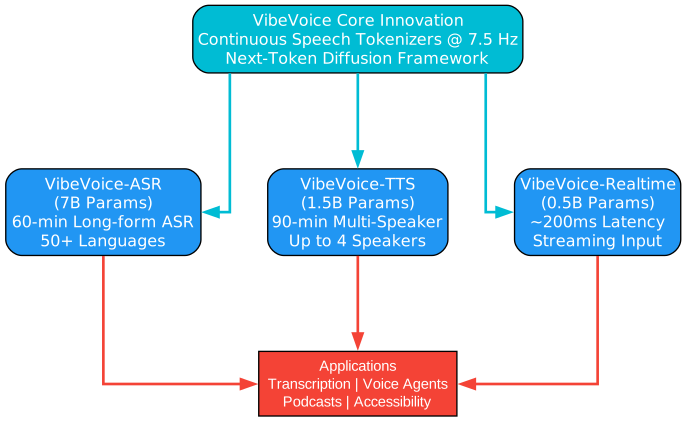
The VibeVoice overview diagram above illustrates the three core models that form this comprehensive voice AI family. Each model is designed for specific use cases while sharing a common technological foundation that enables unprecedented performance in their respective domains.
Core Innovation: Continuous Speech Tokenizers
At the heart of VibeVoice lies a groundbreaking approach to speech representation. The continuous speech tokenizers operate at an ultra-low frame rate of 7.5 Hz, which is significantly lower than traditional approaches that typically operate at 50-100 Hz. This reduction in frame rate provides several critical advantages:
-
Computational Efficiency: By reducing the number of frames that need to be processed, VibeVoice achieves remarkable speed improvements without sacrificing quality. The 7.5 Hz frame rate means that each second of audio is represented by only 7.5 tokens, compared to 50-100 tokens in conventional systems.
-
Long-Form Processing: The reduced frame rate enables processing of extremely long audio sequences. While traditional ASR systems struggle with audio longer than a few minutes, VibeVoice can handle up to 60 minutes of continuous audio in a single pass.
-
Memory Optimization: Lower frame rates translate directly to reduced memory requirements. This makes VibeVoice more accessible for deployment on consumer hardware and edge devices.
The Next-Token Diffusion Framework
VibeVoice employs a next-token diffusion framework that combines the strengths of large language models with diffusion-based acoustic generation. This hybrid approach enables:
-
Contextual Understanding: The LLM component (based on Qwen2.5) provides deep understanding of textual context and dialogue flow, ensuring that generated speech maintains semantic coherence.
-
High-Fidelity Acoustics: The diffusion head generates high-quality acoustic details, producing natural-sounding speech with proper intonation, rhythm, and emotional expression.
-
Unified Architecture: The same underlying framework supports both speech recognition (ASR) and speech synthesis (TTS), demonstrating the versatility of the approach.
VibeVoice-ASR: Long-Form Speech Recognition
Understanding the ASR Pipeline
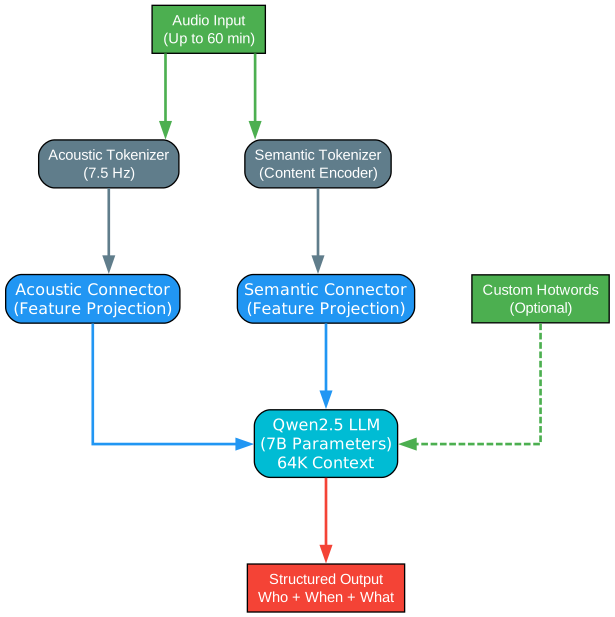
The VibeVoice-ASR architecture diagram above demonstrates how Microsoft has reimagined automatic speech recognition for long-form audio processing. This 7-billion parameter model represents a paradigm shift from traditional chunk-based approaches to holistic audio understanding.
Dual Tokenizer System
The ASR model employs two complementary tokenizers that work in parallel:
1. Acoustic Tokenizer (7.5 Hz)
The acoustic tokenizer captures the raw acoustic properties of speech, including:
- Spectral characteristics and formant structures
- Prosodic features such as pitch and energy contours
- Speaker-specific voice characteristics
- Background noise and environmental acoustics
Operating at 7.5 Hz means that for every second of audio, the tokenizer produces 7.5 discrete representations. This ultra-low frame rate is achieved through sophisticated compression techniques that preserve perceptually relevant information while discarding redundant data.
2. Semantic Tokenizer (Content Encoder)
While the acoustic tokenizer handles the “how” of speech, the semantic tokenizer focuses on the “what”:
- Phoneme-level content representation
- Linguistic features and word boundaries
- Semantic meaning and context
- Language-agnostic content encoding
The semantic tokenizer enables the model to understand what is being said, independent of how it is being said. This separation of concerns is crucial for robust speech recognition across different speakers, accents, and recording conditions.
Connector Layers and Feature Projection
Both tokenizers feed into dedicated connector layers that project the learned representations into the LLM’s embedding space:
-
The Acoustic Connector transforms acoustic tokens into features that the LLM can process, preserving temporal alignment and speaker information.
-
The Semantic Connector projects semantic tokens into a format that enables the LLM to understand the linguistic content.
These connectors are implemented as simple linear projections followed by layer normalization, ensuring efficient computation while maintaining the rich information from both tokenizers.
Qwen2.5 LLM Backbone (7B Parameters, 64K Context)
The choice of Qwen2.5 as the backbone LLM is strategic:
-
64K Token Context Window: This massive context window is what enables processing of 60-minute audio files in a single pass. Traditional ASR systems with 4K-8K context windows must chunk audio, leading to context loss at boundaries.
-
Multilingual Capabilities: Qwen2.5’s training on diverse multilingual data enables VibeVoice-ASR to support over 50 languages without explicit language switching.
-
Strong Reasoning: The LLM’s reasoning capabilities help resolve ambiguities, handle homophones, and maintain speaker consistency across long conversations.
Structured Output: Who, When, What
Unlike traditional ASR that outputs plain text, VibeVoice-ASR generates structured transcriptions:
-
Who (Speaker Diarization): The model identifies and tracks speakers throughout the conversation, assigning consistent speaker labels even across long pauses or interruptions.
-
When (Timestamps): Word-level timestamps enable precise alignment of text to audio, crucial for applications like video captioning and meeting notes.
-
What (Content): The actual transcribed text, with proper punctuation, capitalization, and formatting.
Custom Hotwords Integration
A unique feature of VibeVoice-ASR is the ability to provide custom hotwords:
- Technical terms and jargon specific to your domain
- Proper names that might be misrecognized
- Acronyms and abbreviations
- Contextual information that guides recognition
This feature significantly improves accuracy for specialized applications like medical transcription, legal proceedings, or technical discussions.
ASR Performance Benchmarks
VibeVoice-ASR achieves state-of-the-art results across multiple benchmarks:
| Dataset | Language | DER | cpWER | tcpWER | WER |
|---|---|---|---|---|---|
| MLC-Challenge | English | 4.28 | 11.48 | 13.02 | 7.99 |
| MLC-Challenge | French | 3.80 | 18.80 | 19.64 | 15.21 |
| MLC-Challenge | German | 1.04 | 17.10 | 17.26 | 16.30 |
| MLC-Challenge | Japanese | 0.82 | 15.33 | 15.41 | 14.69 |
| MLC-Challenge | Average | 3.42 | 14.81 | 15.66 | 12.07 |
The low Diarization Error Rate (DER) demonstrates exceptional speaker tracking, while competitive Word Error Rates (WER) show strong recognition accuracy across languages.
VibeVoice-TTS: Long-Form Multi-Speaker Synthesis
Understanding the TTS Pipeline
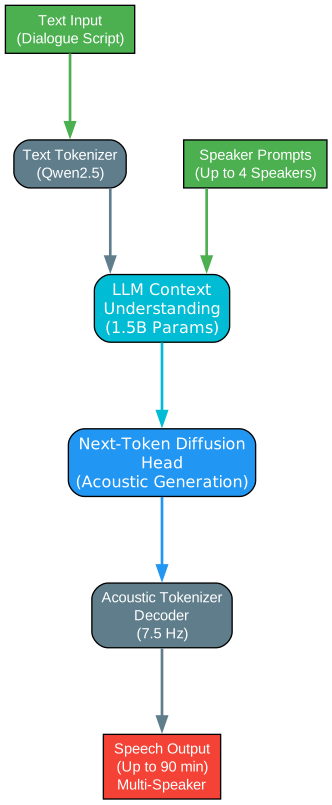
The VibeVoice-TTS architecture represents a breakthrough in long-form speech synthesis. Accepted as an Oral presentation at ICLR 2026, this model can generate up to 90 minutes of coherent, multi-speaker dialogue in a single pass.
Input Processing: Text and Speaker Prompts
The TTS pipeline begins with two key inputs:
1. Text Input (Dialogue Script)
The input text can include:
- Dialogue with speaker labels (e.g., “Speaker A: Hello! Speaker B: Hi there!”)
- Stage directions and emotional cues
- Long-form content like podcast scripts or audiobook chapters
- Mixed-language content with code-switching
2. Speaker Prompts (Up to 4 Speakers)
VibeVoice-TTS supports up to 4 distinct speakers in a single generation:
- Each speaker can have a unique voice characteristic
- Speaker consistency is maintained throughout the 90-minute output
- Natural turn-taking and conversational dynamics are preserved
Text Tokenizer (Qwen2.5)
The text processing leverages the same Qwen2.5 architecture used in ASR:
- Understanding of dialogue structure and turn-taking
- Proper handling of punctuation and prosodic markers
- Context-aware processing that considers the full conversation
LLM Context Understanding (1.5B Parameters)
The LLM component serves as the “brain” of the TTS system:
- Understanding the emotional context of each utterance
- Determining appropriate speaking rate and emphasis
- Managing speaker transitions and interruptions
- Maintaining narrative flow across long passages
Next-Token Diffusion Head
The diffusion head is where acoustic generation happens:
- Iterative Refinement: The diffusion process progressively refines acoustic representations from noise to clear speech
- Acoustic Token Generation: Generates tokens at 7.5 Hz that represent the acoustic properties of the target speech
- Parallel Processing: Multiple diffusion steps can be processed in parallel for efficiency
Acoustic Tokenizer Decoder (7.5 Hz)
The decoder converts acoustic tokens back to waveforms:
- Neural vocoder that produces high-fidelity audio
- 24kHz output sample rate for broadcast quality
- Smooth transitions between speakers and utterances
Speech Output Capabilities
The generated speech exhibits remarkable qualities:
- 90-minute continuous generation: No audible artifacts or quality degradation over time
- Multi-speaker consistency: Each speaker maintains their voice characteristics throughout
- Expressive prosody: Natural intonation, rhythm, and emotional expression
- Cross-lingual support: English, Chinese, and other languages with native-quality pronunciation
TTS Demo Examples
VibeVoice-TTS excels in various scenarios:
- English Conversations: Natural dialogue with proper turn-taking
- Chinese Speech: Native-quality Mandarin with correct tones
- Cross-Lingual: Seamless switching between languages
- Spontaneous Singing: Can generate singing voice from text
- 4-Person Discussions: Complex multi-speaker scenarios
VibeVoice-Realtime: Streaming TTS
Understanding the Realtime Pipeline
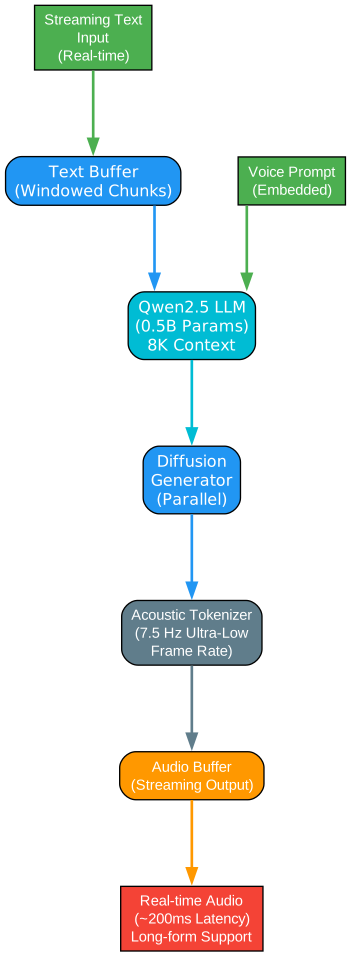
VibeVoice-Realtime addresses a critical need in voice AI: real-time speech synthesis with minimal latency. This 0.5-billion parameter model achieves ~200ms first audible latency, making it suitable for interactive applications.
Streaming Text Input (Real-time)
Unlike batch TTS, VibeVoice-Realtime accepts text as it arrives:
- Integration with LLM outputs for real-time voice agents
- Streaming from live data sources like news feeds
- Text-to-speech for accessibility applications
- Voice output for chatbots and virtual assistants
Text Buffer (Windowed Chunks)
The text buffer manages incoming text streams:
- Accumulates text until sufficient context is available
- Maintains a sliding window for continuous generation
- Handles sentence boundaries and phrase completion
- Buffers incomplete words for proper pronunciation
Qwen2.5 LLM (0.5B Parameters, 8K Context)
The smaller model size enables real-time performance:
- 8K Context Window: Sufficient for ~10 minutes of audio generation
- Fast Inference: Optimized for low-latency generation
- Streaming Support: Designed for incremental processing
Diffusion Generator (Parallel)
The diffusion process is optimized for streaming:
- Parallel Generation: Multiple audio chunks generated simultaneously
- Overlap-Add Strategy: Smooth transitions between chunks
- Adaptive Steps: Fewer diffusion steps for faster generation
Acoustic Tokenizer (7.5 Hz Ultra-Low Frame Rate)
The ultra-low frame rate is crucial for real-time performance:
- Fewer tokens to generate means faster synthesis
- Maintains quality despite reduced frame rate
- Efficient encoding enables streaming output
Audio Buffer (Streaming Output)
The audio buffer manages output delivery:
- Smooth playback without gaps or glitches
- Synchronization with text input stream
- Handling of network latency variations
Real-time Audio Output (~200ms Latency)
The achieved latency of ~200ms is remarkable:
- First Audible Speech: Users hear audio within 200ms of text input
- Long-form Support: Can generate up to 10 minutes continuously
- Deployment-Friendly: Runs on NVIDIA T4 or Mac M4 Pro
Realtime Performance Benchmarks
| Model | WER (%) | Speaker Similarity |
|---|---|---|
| VALL-E 2 | 2.40 | 0.643 |
| Voicebox | 1.90 | 0.662 |
| MELLE | 2.10 | 0.625 |
| VibeVoice-Realtime-0.5B | 2.00 | 0.695 |
The model achieves competitive WER while maintaining high speaker similarity, demonstrating that real-time performance doesn’t require sacrificing quality.
Installation and Setup
Prerequisites
VibeVoice requires NVIDIA GPU with CUDA support. The recommended setup uses NVIDIA Deep Learning Container:
# Launch NVIDIA PyTorch Container
sudo docker run --privileged --net=host --ipc=host \
  --ulimit memlock=-1:-1 --ulimit stack=-1:-1 \
  --gpus all --rm -it nvcr.io/nvidia/pytorch:25.12-py3
Installation Steps
# Clone the repository
git clone https://github.com/microsoft/VibeVoice.git
cd VibeVoice

# Install the package
pip install -e .

# For streaming TTS, install additional dependencies
pip install -e .[streamingtts]
Running ASR Demo
# Launch Gradio demo
python demo/vibevoice_asr_gradio_demo.py \
  --model_path microsoft/VibeVoice-ASR --share

# Or inference from files
python demo/vibevoice_asr_inference_from_file.py \
  --model_path microsoft/VibeVoice-ASR \
  --audio_files path/to/audio.mp3
Running Realtime TTS Demo
# Launch real-time websocket demo
python demo/vibevoice_realtime_demo.py \
  --model_path microsoft/VibeVoice-Realtime-0.5B

# Or inference from text files
python demo/realtime_model_inference_from_file.py \
  --model_path microsoft/VibeVoice-Realtime-0.5B \
  --txt_path demo/text_examples/1p_vibevoice.txt \
  --speaker_name Carter
Practical Applications
1. Meeting Transcription and Analysis
VibeVoice-ASR’s 60-minute processing capability makes it ideal for:
- Corporate meeting transcription with speaker identification
- Legal deposition recording and analysis
- Medical consultation documentation
- Academic lecture transcription
2. Podcast and Audiobook Production
VibeVoice-TTS enables:
- Automated podcast generation from scripts
- Audiobook narration with multiple character voices
- Radio broadcast automation
- Educational content creation
3. Real-time Voice Agents
VibeVoice-Realtime powers:
- Customer service voice bots
- Virtual assistants with instant voice response
- Accessibility tools for text-to-speech
- Live commentary and narration
4. Multilingual Communication
With 50+ language support:
- International meeting transcription
- Cross-language content creation
- Language learning applications
- Global accessibility solutions
Technical Deep Dive
The 7.5 Hz Innovation
The choice of 7.5 Hz frame rate is based on psychoacoustic research:
- Human speech perception operates on ~100ms time scales
- 7.5 Hz corresponds to ~133ms per frame
- This captures essential speech dynamics while minimizing redundancy
Streaming Processing for Long Audio
For audio exceeding 600 seconds, VibeVoice-ASR uses streaming processing:
- Audio is segmented into 60-second chunks
- Each chunk is processed independently
- Results are concatenated with proper alignment
- Avoids convolution overflow in tokenizer encoders
LoRA Fine-tuning Support
VibeVoice-ASR supports Low-Rank Adaptation (LoRA) fine-tuning:
- Adapt the model to specific domains or speakers
- Requires minimal training data
- Efficient training with limited GPU resources
- Preserves base model capabilities
Limitations and Responsible Use
Known Limitations
- ASR: May struggle with heavily accented speech or rare languages
- TTS: Code, formulas, and special symbols require preprocessing
- Realtime: Very short inputs (<3 words) may have quality issues
Responsible AI Considerations
Microsoft emphasizes responsible use:
- Not recommended for commercial applications without further testing
- Intended for research and development purposes
- Users must ensure lawful deployment
- Best practice: Disclose AI-generated content
Conclusion
VibeVoice represents a significant advancement in open-source voice AI. Its three-model family addresses the full spectrum of speech processing needs:
- VibeVoice-ASR: Unmatched long-form transcription with speaker diarization
- VibeVoice-TTS: Revolutionary 90-minute multi-speaker synthesis
- VibeVoice-Realtime: Production-ready streaming TTS with minimal latency
The integration with Hugging Face Transformers and support for vLLM inference makes VibeVoice accessible to developers worldwide. As voice AI continues to evolve, VibeVoice sets a new standard for what’s possible in speech processing.
Resources
Related Posts
- AgentSkillOS: Skill Orchestration System
- DESIGN.md: AI-Powered Design Systems
- MattPocock Skills: AI Agent Workflows

Enjoyed this post? Never miss out on future posts by following us
