Introduction
The landscape of Large Language Models (LLMs) has been transformed by Microsoft’s groundbreaking BitNet framework - the official inference framework for 1-bit LLMs. With over 37,000 stars on GitHub, BitNet represents a paradigm shift in how we approach model compression and efficient inference. Traditional LLMs require massive computational resources, often demanding high-end GPUs with substantial memory bandwidth. BitNet challenges this paradigm by introducing lossless 1.58-bit inference, enabling models to run efficiently on commodity hardware.
The core innovation behind BitNet lies in its ability to quantize neural network weights to ternary values (-1, 0, +1), dramatically reducing memory footprint while maintaining model quality. This approach allows 100B parameter models to run on standard CPUs at human reading speed, democratizing access to powerful AI capabilities. The framework supports both CPU and GPU inference, with specialized kernels optimized for different hardware architectures including x86 with AVX2 instructions and ARM with NEON support.
BitNet’s significance extends beyond mere efficiency gains. It represents a fundamental rethinking of how neural networks can be represented and computed. By reducing weight precision to approximately 1.58 bits per weight, the framework achieves remarkable compression ratios while preserving the semantic understanding capabilities of full-precision models. This breakthrough opens new possibilities for edge deployment, mobile inference, and scenarios where power consumption is a critical constraint.
Architecture Overview
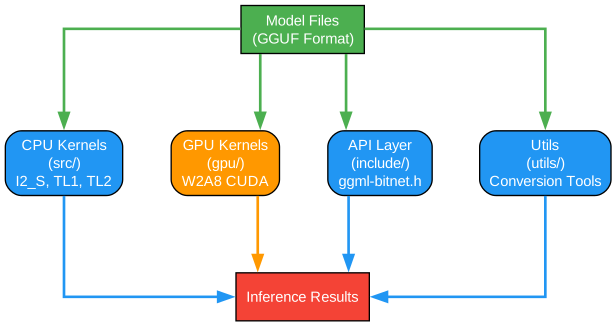
The BitNet architecture represents a sophisticated approach to 1-bit LLM inference that fundamentally reimagines how neural network computations can be performed. At its core, the architecture consists of several interconnected layers that work together to enable efficient inference on both CPU and GPU hardware platforms.
The Input Processing Layer serves as the entry point for all inference requests, handling tokenization and embedding operations. This layer converts raw text input into numerical representations that can be processed by the quantized model. The embedding layer uses specialized quantization techniques to ensure that the input representations are compatible with the subsequent 1-bit weight layers, maintaining numerical stability throughout the forward pass.
The Quantized Transformer Blocks form the backbone of the BitNet architecture. Each transformer block contains attention mechanisms and feed-forward networks that have been specifically designed for ternary weight representation. The attention layers use quantized query, key, and value projections, enabling efficient matrix multiplications using specialized kernels. The feed-forward networks follow a similar pattern, with weights constrained to {-1, 0, +1} values, allowing for dramatic reductions in memory bandwidth requirements.
The Kernel Selection Layer represents one of the most innovative aspects of BitNet’s architecture. This layer dynamically selects the optimal computational kernel based on the available hardware capabilities. For x86 processors with AVX2 support, the framework can utilize lookup table-based kernels (TL2) that leverage SIMD instructions for parallel computation. ARM processors benefit from different kernel implementations (TL1) optimized for NEON instruction sets. The framework also includes native 2-bit signed integer kernels (I2_S) that provide the most direct implementation for supported hardware.
The Memory Management Layer handles the efficient storage and retrieval of quantized weights. Unlike traditional models that require 16 or 32 bits per weight, BitNet’s ternary representation allows for significant compression. The memory management system uses bit-packing techniques to store multiple weights in single memory locations, minimizing memory bandwidth bottlenecks. This approach is particularly beneficial for CPU inference, where memory bandwidth often represents the primary performance bottleneck.
The Output Generation Layer completes the inference pipeline by converting the model’s hidden states back into human-readable text. This layer includes dequantization operations that transform the low-precision activations back into probability distributions over the vocabulary. The generation process supports various sampling strategies including greedy decoding, top-k sampling, and nucleus sampling, providing flexibility for different use cases.
The Hardware Abstraction Layer ensures that BitNet can run efficiently across diverse hardware platforms. This layer provides a unified interface for kernel execution, abstracting away the low-level details of SIMD instruction sets and memory layout optimizations. The abstraction enables the same model weights to be used across different hardware configurations without modification, simplifying deployment and reducing maintenance overhead.
Kernel Types Comparison
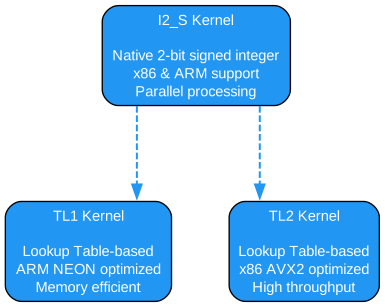
BitNet implements three distinct kernel types, each optimized for specific hardware configurations and computational requirements. Understanding these kernel types is essential for maximizing inference performance across different deployment scenarios.
The I2_S (Native 2-bit Signed Integer) kernel represents the most straightforward implementation of BitNet’s quantization strategy. This kernel type uses native 2-bit signed integer operations to perform matrix multiplications directly on quantized weights. The I2_S kernel is supported on both x86 and ARM architectures, making it the most portable option for cross-platform deployment. The kernel achieves its efficiency by eliminating the need for weight unpacking before computation, instead operating directly on the packed representation. This approach minimizes memory bandwidth requirements and reduces computational overhead, particularly beneficial for memory-bound workloads on CPU hardware.
The TL1 (Lookup Table for ARM NEON) kernel is specifically optimized for ARM processors with NEON SIMD support. This kernel type uses precomputed lookup tables to accelerate the matrix multiplication operations that form the core of neural network inference. The lookup table approach converts the ternary weight multiplication into a series of table lookups and additions, which can be efficiently parallelized using NEON’s vector instructions. TL1 kernels are particularly effective on mobile devices and embedded systems where ARM processors are prevalent. The kernel achieves speedups of 1.37x to 5.07x compared to baseline implementations, with energy reductions ranging from 55% to 70% depending on the model size and hardware configuration.
The TL2 (Lookup Table for x86 AVX2) kernel provides similar optimizations for x86 processors with AVX2 instruction set support. This kernel type leverages the wider 256-bit vector registers available in modern x86 processors to perform parallel lookup operations. The TL2 kernel achieves even greater speedups than TL1 on compatible hardware, with performance improvements ranging from 2.37x to 6.17x compared to baseline implementations. Energy reductions of 72% to 82% make this kernel particularly attractive for data center deployments where power efficiency directly impacts operational costs.
The choice between kernel types depends on several factors including hardware availability, model size, and performance requirements. For deployments on heterogeneous infrastructure, BitNet’s kernel selection mechanism can automatically choose the optimal kernel based on runtime hardware detection. This flexibility ensures that inference performance is maximized regardless of the underlying hardware configuration, simplifying deployment across diverse computing environments.
Each kernel type implements the same mathematical operations but with different optimization strategies. The common thread across all kernels is the exploitation of ternary weight representation to reduce computational complexity. By constraining weights to {-1, 0, +1}, the kernels can replace expensive floating-point multiplications with simpler addition and subtraction operations, or in the case of lookup table kernels, with memory access operations that are often faster than arithmetic computations on modern processors.
Inference Pipeline
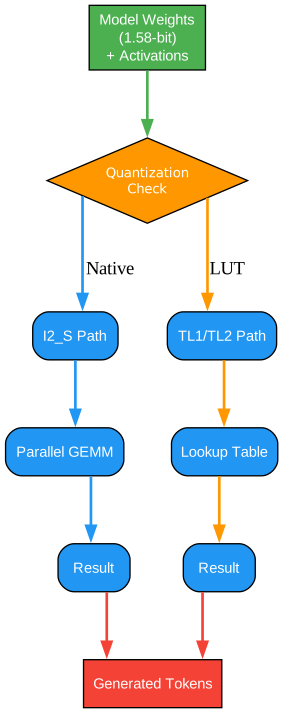
The BitNet inference pipeline represents a carefully orchestrated sequence of operations that transforms input text into generated output while maintaining the efficiency benefits of 1-bit quantization. Understanding this pipeline is crucial for developers looking to integrate BitNet into their applications and for researchers exploring further optimizations.
The pipeline begins with Model Loading, where the quantized model weights are loaded into memory. Unlike traditional LLM loading, BitNet models are stored in a highly compressed format that minimizes disk I/O and memory footprint. The loading process includes kernel compilation for the target hardware, ensuring that the optimal computational kernels are available for inference. This one-time setup cost is amortized across multiple inference requests, making it negligible for production workloads with sustained request volumes.
Tokenization follows model loading, converting raw input text into a sequence of token IDs that can be processed by the model. BitNet uses standard tokenizers compatible with the underlying model architecture, ensuring compatibility with existing preprocessing pipelines. The tokenization step also handles special tokens for prompts, system messages, and other control sequences that guide the model’s behavior during generation.
The Embedding Lookup stage converts token IDs into dense vector representations. In BitNet, the embedding layer is also quantized, maintaining consistency with the rest of the model architecture. The quantized embeddings are dequantized on-the-fly during the forward pass, minimizing memory bandwidth while preserving numerical precision where it matters most. This approach ensures that the embedding layer does not become a bottleneck in the inference pipeline.
The Core Transformer Processing stage represents the bulk of the computation in the inference pipeline. Each transformer layer processes the input sequence through attention mechanisms and feed-forward networks, all using quantized weights. The attention computation uses specialized kernels that efficiently compute query-key-value products using the selected kernel type (I2_S, TL1, or TL2). Layer normalization and residual connections are implemented with careful attention to numerical stability, ensuring that the quantized model produces outputs consistent with its full-precision counterpart.
The Logits Generation stage converts the final hidden states into probability distributions over the vocabulary. This involves a linear projection from the hidden dimension to the vocabulary size, followed by a softmax operation. BitNet implements this stage with optimizations for large vocabulary sizes, using techniques like hierarchical softmax or vocabulary pruning when appropriate. The logits can be further processed to apply temperature scaling, repetition penalties, and other generation parameters.
Token Sampling selects the next token based on the probability distribution produced by the logits. BitNet supports various sampling strategies including greedy decoding for deterministic output, top-k sampling for controlled randomness, and nucleus sampling (top-p) for adaptive diversity. The sampling process is implemented efficiently, avoiding unnecessary computation for tokens with negligible probability. The selected token is then added to the generated sequence, and the process repeats until an end-of-sequence token is produced or the maximum sequence length is reached.
The Detokenization stage converts the generated token IDs back into human-readable text. This final step uses the same tokenizer vocabulary to map token IDs back to text strings. Special handling for whitespace, punctuation, and other formatting ensures that the output text is properly formatted and readable. The detokenized output is then returned to the application for further processing or display to the user.
Performance Benchmarks
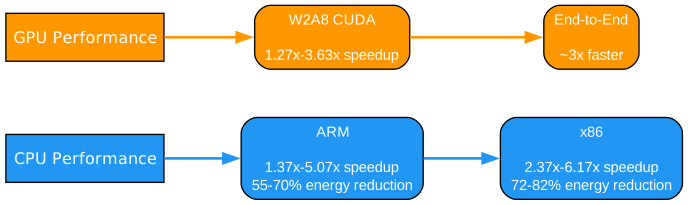
BitNet’s performance benchmarks demonstrate remarkable efficiency gains across diverse hardware platforms, validating the practical benefits of 1-bit LLM inference. These benchmarks provide concrete evidence of the framework’s ability to deliver high-quality inference while dramatically reducing computational costs.
On ARM CPU platforms, BitNet achieves speedups ranging from 1.37x to 5.07x compared to baseline implementations. The exact speedup depends on the specific processor model, available SIMD instructions, and the model being executed. For example, on Apple Silicon processors with powerful NEON units, the TL1 kernel achieves speedups at the higher end of this range. The energy reduction on ARM platforms ranges from 55% to 70%, making BitNet particularly attractive for mobile and edge deployments where battery life is a critical concern. These efficiency gains enable complex LLM inference on devices that would otherwise be incapable of running such models.
x86 CPU platforms show even more impressive performance improvements, with speedups ranging from 2.37x to 6.17x. The TL2 kernel leverages AVX2 instructions to maximize parallelism in the lookup table operations, achieving throughput that approaches memory bandwidth limits. Energy reductions of 72% to 82% translate directly into cost savings for data center deployments, where power consumption represents a significant portion of operational expenses. The ability to run inference efficiently on commodity x86 servers democratizes access to LLM capabilities, reducing the need for specialized GPU hardware.
GPU performance on NVIDIA A100 processors shows speedups from 1.27x to 3.63x, with end-to-end throughput improvements of approximately 3x. While the relative speedup on GPUs is lower than on CPUs, the absolute performance remains significantly higher due to the massive parallelism available in GPU architectures. BitNet’s GPU implementation uses custom CUDA kernels that efficiently pack and unpack quantized weights, minimizing the overhead of data movement between memory and compute units. The GPU implementation is particularly valuable for high-throughput serving scenarios where multiple inference requests must be processed concurrently.
The memory footprint reduction is perhaps the most significant benefit of BitNet’s quantization approach. By representing weights with approximately 1.58 bits instead of 16 or 32 bits, the framework achieves compression ratios of 10x or more compared to standard half-precision models. This reduction enables larger models to fit in limited memory, or alternatively, allows more model instances to run on the same hardware. For CPU inference, the reduced memory bandwidth requirements translate directly into improved throughput, as memory access is often the primary bottleneck.
Latency measurements show that BitNet can achieve human reading speed (approximately 5-10 tokens per second) for 100B parameter models on standard CPUs. This capability is unprecedented for models of this size, which traditionally require high-end GPUs for interactive inference. The ability to run such models on commodity hardware opens new possibilities for applications in resource-constrained environments, including developing regions with limited access to specialized computing infrastructure.
Installation Guide
Getting started with BitNet is straightforward, with support for both CPU and GPU inference. Follow these steps to set up BitNet on your system.
Prerequisites
- Python 3.8 or higher
- CMake 3.14 or higher (for CPU inference)
- CUDA 11.0+ (for GPU inference, optional)
- Git
CPU Installation
# Clone the repository
git clone https://github.com/microsoft/BitNet.git
cd BitNet

# Install Python dependencies
pip install -r requirements.txt

# Build the C++ inference engine
mkdir build && cd build
cmake ..
make -j$(nproc)
GPU Installation
# Clone the repository
git clone https://github.com/microsoft/BitNet.git
cd BitNet

# Install GPU dependencies
cd gpu
pip install -r requirements.txt

# Build CUDA kernels
cd bitnet_kernels
bash compile.sh
Model Preparation
BitNet requires models to be converted to its native format. The framework provides conversion scripts for popular model families:
# Convert HuggingFace model
python utils/convert-hf-to-gguf-bitnet.py --model-path /path/to/model --output-path /path/to/output

# Convert Microsoft BitNet model
python utils/convert-ms-to-gguf-bitnet.py --model-path /path/to/model --output-path /path/to/output
Usage Examples
Basic CPU Inference
from bitnet import BitNetModel

# Load the model
model = BitNetModel.from_pretrained("bitnet-b1.58-2b")

# Generate text
prompt = "Explain quantum computing in simple terms:"
output = model.generate(prompt, max_tokens=100)
print(output)
GPU Inference
from bitnet.gpu import BitNetGPUModel

# Load model on GPU
model = BitNetGPUModel.from_pretrained("bitnet-b1.58-2b", device="cuda:0")

# Batch inference
prompts = [
    "What is machine learning?",
    "Explain neural networks",
    "Define deep learning"
]
outputs = model.generate_batch(prompts, max_tokens=50)
Inference Server
# Start the inference server
python run_inference_server.py --model bitnet-b1.58-2b --port 8000

# Make requests via HTTP
curl -X POST http://localhost:8000/generate \
  -H "Content-Type: application/json" \
  -d '{"prompt": "Hello, world!", "max_tokens": 50}'
Supported Models
BitNet supports a growing ecosystem of 1-bit quantized models. The following table summarizes the currently supported models:
| Model | Parameters | Training Tokens | Kernel Support | Notes |
|---|---|---|---|---|
| BitNet-b1.58-2B-4T | 2B | 4T | I2_S, TL1, TL2 | Official Microsoft release |
| Llama3-8B-1.58-100B | 8B | 100B | I2_S, TL1, TL2 | Community quantization |
| Falcon3-1B-1.58 | 1B | Various | I2_S, TL1, TL2 | Lightweight option |
| Falcon3-3B-1.58 | 3B | Various | I2_S, TL1, TL2 | Balanced performance |
| Falcon3-7B-1.58 | 7B | Various | I2_S, TL1, TL2 | High capacity |
| Falcon3-10B-1.58 | 10B | Various | I2_S, TL1, TL2 | Largest Falcon variant |
Model Selection Guide
- BitNet-b1.58-2B-4T: Best for general-purpose applications requiring a balance of quality and efficiency. This is the official Microsoft release with extensive training.
- Llama3-8B-1.58-100B: Suitable for applications requiring higher capacity and willing to trade some efficiency for improved quality.
- Falcon3 Family: Provides a range of options for different deployment scenarios, from edge devices (1B) to server deployments (10B).
Technical Deep Dive
Quantization Methodology
BitNet uses a ternary quantization scheme where weights are constrained to three possible values: -1, 0, and +1. This representation requires approximately 1.58 bits per weight (log2(3) ≈ 1.585), hence the “1.58-bit” terminology used in the literature. The quantization process involves scaling the weight matrix and then rounding to the nearest ternary value.
The key insight behind BitNet’s success is that neural networks are remarkably robust to weight quantization. During training, the model learns to compensate for the reduced precision, resulting in models that maintain most of their predictive power despite the aggressive compression. The training process uses straight-through estimators to handle the non-differentiable quantization operation, enabling gradient-based optimization.
Kernel Implementation Details
The lookup table kernels (TL1 and TL2) use a clever optimization that converts matrix multiplication into table lookups. For ternary weights, the product of a weight and an activation can only take a limited number of distinct values. By precomputing these values in lookup tables, the kernel can replace expensive multiplications with memory accesses that are often faster on modern processors.
The I2_S kernel takes a different approach, using native 2-bit integer operations where available. This kernel type is particularly efficient on hardware with dedicated low-precision compute units, such as modern CPUs with AVX-512 VNNI instructions or ARM processors with dot-product instructions.
Memory Layout Optimization
BitNet employs sophisticated memory layout strategies to maximize cache efficiency. Weights are stored in a packed format that minimizes memory footprint while enabling efficient unpacking during computation. The layout is optimized for the specific access patterns of each kernel type, ensuring that memory bandwidth is utilized effectively.
Conclusion
BitNet represents a significant advancement in LLM inference technology, demonstrating that aggressive quantization can coexist with high-quality model outputs. The framework’s ability to run 100B parameter models on commodity CPUs at human reading speed opens new possibilities for AI deployment in resource-constrained environments.
The three kernel types (I2_S, TL1, TL2) provide flexibility across hardware platforms, ensuring optimal performance whether running on ARM mobile processors, x86 servers, or NVIDIA GPUs. The dramatic energy reductions (55-82%) have significant implications for sustainable AI, reducing the environmental impact of large-scale model deployment.
As the ecosystem of 1-bit models continues to grow, BitNet is positioned to become a foundational technology for efficient LLM inference. The framework’s open-source nature and active development community ensure that it will continue to evolve, incorporating new optimizations and supporting additional model architectures.
For developers and researchers looking to explore efficient LLM inference, BitNet provides an accessible entry point with comprehensive documentation and active community support. The framework’s modular architecture also makes it suitable for research into new quantization techniques and kernel optimizations.
Resources
BitNet is developed by Microsoft Research and released under the MIT License. This blog post provides an independent technical overview of the framework’s capabilities and implementation.