Introduction
TradingAgents is a groundbreaking multi-agent trading framework that leverages Large Language Models (LLMs) to mirror the dynamics of real-world trading firms. With over 49,000 GitHub stars, this open-source project represents a significant advancement in applying AI to financial trading. The framework deploys specialized LLM-powered agents including fundamental analysts, sentiment experts, technical analysts, and risk management teams that collaboratively evaluate market conditions and inform trading decisions through dynamic discussions.
The framework is designed for research purposes and supports multiple LLM providers including OpenAI (GPT-5.x), Google (Gemini 3.x), Anthropic (Claude 4.x), xAI (Grok 4.x), OpenRouter, and local models via Ollama. This flexibility allows researchers and practitioners to experiment with different model configurations while maintaining a consistent trading workflow.
Architecture Overview
The TradingAgents framework implements a sophisticated multi-agent architecture that decomposes complex trading tasks into specialized roles. This approach ensures robust, scalable market analysis and decision-making by leveraging the strengths of different agent types.
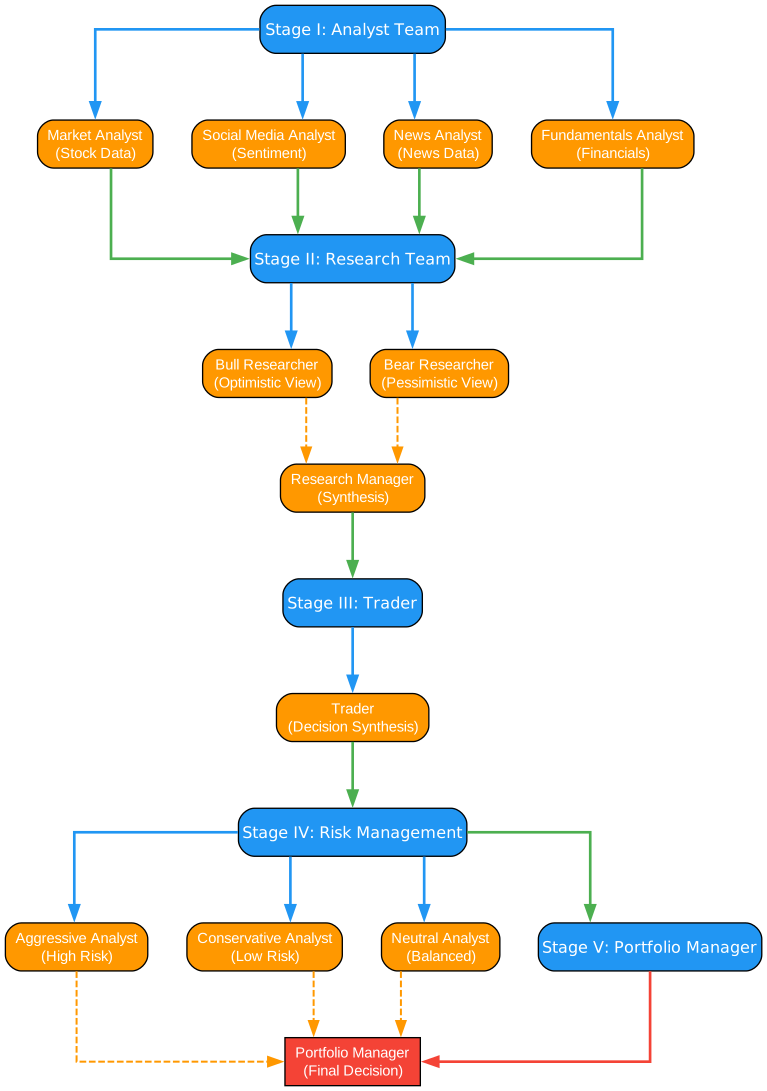
The architecture follows a hierarchical design where information flows from market data through various analysis layers before reaching a final trading decision. Each layer adds specialized expertise, creating a comprehensive evaluation pipeline that mimics how professional trading firms operate.
Key Architectural Components
The framework consists of several interconnected agent teams, each responsible for a specific aspect of the trading analysis process. The Analyst Team serves as the first line of analysis, processing raw market data and extracting actionable insights. The Researcher Team then critically evaluates these insights through structured debates, balancing potential gains against inherent risks. The Trader Agent synthesizes all information to make informed decisions, while the Risk Management Team continuously evaluates portfolio risk and provides assessment reports to the Portfolio Manager for final approval.
Analyst Team
The Analyst Team forms the foundation of the TradingAgents framework, comprising four specialized agents that process different aspects of market data:
-
Fundamentals Analyst: Evaluates company financials and performance metrics, identifying intrinsic values and potential red flags in financial statements. This agent analyzes balance sheets, income statements, and cash flow data to determine the fundamental value of securities.
-
Sentiment Analyst: Analyzes social media and public sentiment using sentiment scoring algorithms to gauge short-term market mood. This agent processes data from various social platforms to identify market sentiment trends that could impact trading decisions.
-
News Analyst: Monitors global news and macroeconomic indicators, interpreting the impact of events on market conditions. This agent tracks news feeds, economic reports, and geopolitical events that could influence market dynamics.
-
Technical Analyst: Utilizes technical indicators like MACD and RSI to detect trading patterns and forecast price movements. This agent applies quantitative analysis to identify entry and exit points based on historical price patterns.
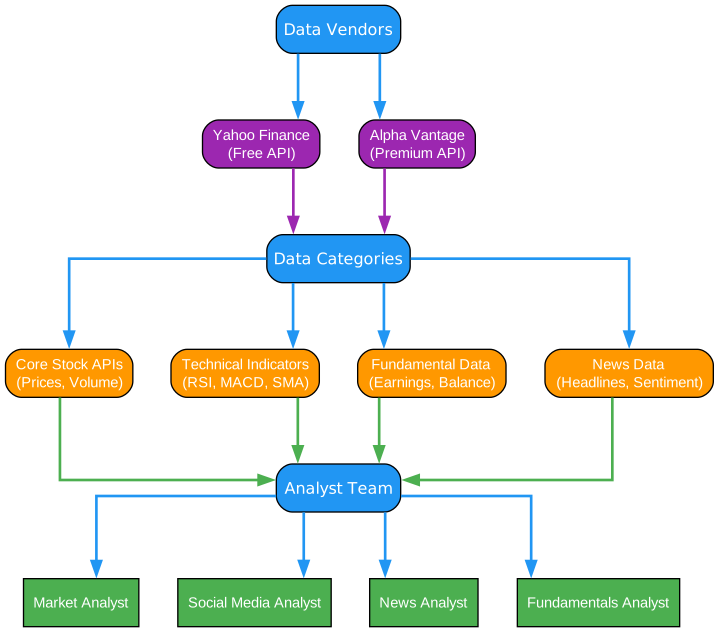
The data flow diagram illustrates how market data from various sources flows through the Dataflows module to the Analyst Team. Each analyst receives relevant data streams and processes them according to their specialized analysis methodology. The outputs from these analysts then feed into the Researcher Team for further evaluation.
Researcher Team
The Researcher Team introduces a critical debate mechanism that helps balance bullish and bearish perspectives on potential trades. This team consists of two specialized researchers:
-
Bull Researcher: Argues for the positive aspects of a trading opportunity, highlighting potential gains and favorable market conditions. This researcher uses data from the Fundamentals and Sentiment Analysts to build a case for buying.
-
Bear Researcher: Takes the opposite position, identifying risks and potential downsides. This researcher uses data from the News and Technical Analysts to build a case against the trade or for selling.
Through structured debates, these researchers ensure that all perspectives are considered before making a trading decision. This adversarial approach helps identify blind spots and reduces the risk of confirmation bias in trading decisions.
Trader Agent and Risk Management
The Trader Agent serves as the central decision-making component, composing reports from analysts and researchers to make informed trading decisions. It determines the timing and magnitude of trades based on comprehensive market insights gathered from all upstream agents.
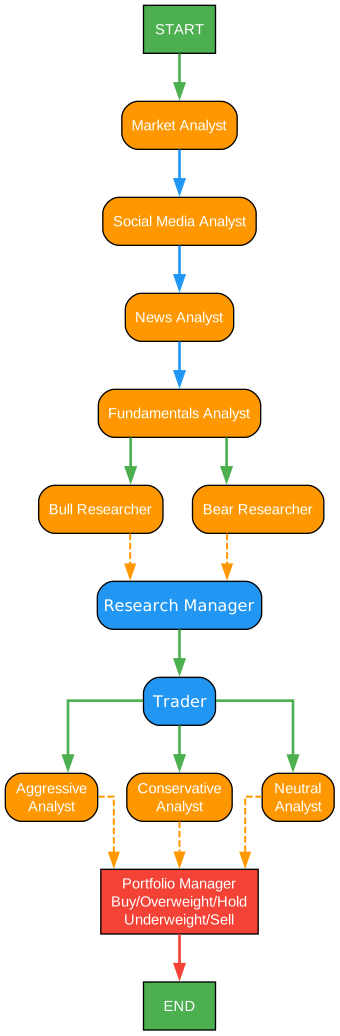
The workflow diagram shows the complete trading decision process, from initial ticker selection through final execution. The process includes multiple checkpoints where proposals can be rejected or modified based on risk assessment outcomes.
Risk Management Team
The Risk Management Team provides the final layer of evaluation before any trade is executed. This team includes three debators with different risk perspectives:
-
Aggressive Debator: Advocates for higher-risk, higher-reward strategies, pushing for larger position sizes and more aggressive entry points.
-
Conservative Debator: Emphasizes capital preservation and risk mitigation, arguing for smaller positions and more cautious approaches.
-
Neutral Debator: Provides balanced perspectives, helping to mediate between aggressive and conservative viewpoints.
The Risk Management Team continuously evaluates portfolio risk by assessing market volatility, liquidity, and other risk factors. They provide assessment reports to the Portfolio Manager, who has the final authority to approve or reject transaction proposals.
LLM Provider Support
One of TradingAgents’ key strengths is its support for multiple LLM providers, allowing users to choose the best model for their specific use case. The framework implements a unified client factory that abstracts away provider-specific implementation details.
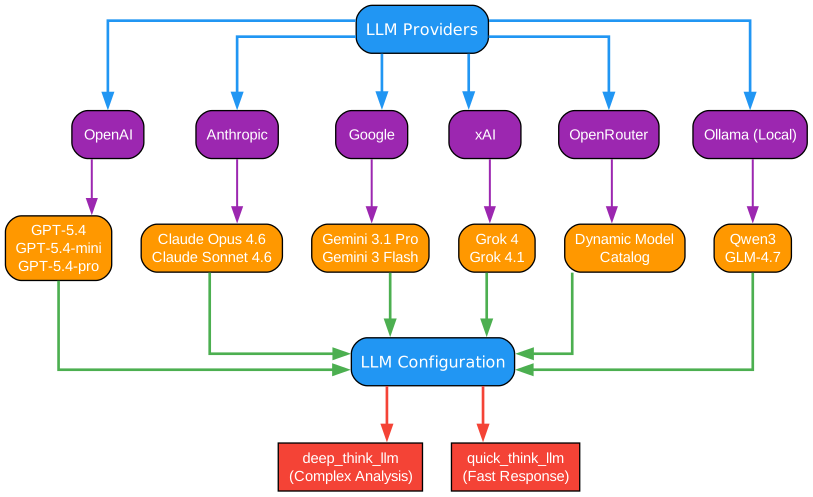
The LLM provider architecture supports both cloud-based and local models. Cloud providers include OpenAI (GPT-5.x series), Google (Gemini 3.x), Anthropic (Claude 4.x), xAI (Grok 4.x), and OpenRouter. For users preferring local deployment, Ollama integration allows running models on-premises.
Model Configuration
The framework distinguishes between two types of LLM usage:
-
Deep Think LLM: Used for complex reasoning tasks that require thorough analysis and nuanced understanding. This model type handles tasks like fundamental analysis, research debates, and risk assessment.
-
Quick Think LLM: Optimized for fast tasks that don’t require extensive reasoning. This model type handles data processing, sentiment scoring, and routine operations.
Users can configure which models to use for each purpose through the configuration system, allowing optimization of both cost and performance.
Installation and Setup
Getting started with TradingAgents is straightforward. The framework supports both traditional Python installation and Docker deployment.
Standard Installation
# Clone the repository
git clone https://github.com/TauricResearch/TradingAgents.git
cd TradingAgents

# Create virtual environment
conda create -n tradingagents python=3.13
conda activate tradingagents

# Install dependencies
pip install .
Docker Installation
For containerized deployment:
# Copy environment file and add API keys
cp .env.example .env

# Run with Docker
docker compose run --rm tradingagents

# For local models with Ollama
docker compose --profile ollama run --rm tradingagents-ollama
API Configuration
Configure your LLM provider API keys:
export OPENAI_API_KEY=...          # OpenAI (GPT)
export GOOGLE_API_KEY=...          # Google (Gemini)
export ANTHROPIC_API_KEY=...       # Anthropic (Claude)
export XAI_API_KEY=...             # xAI (Grok)
export OPENROUTER_API_KEY=...      # OpenRouter
export ALPHA_VANTAGE_API_KEY=...   # Alpha Vantage
Python Usage
The framework can be used programmatically within Python applications:
from tradingagents.graph.trading_graph import TradingAgentsGraph
from tradingagents.default_config import DEFAULT_CONFIG

# Initialize with default configuration
ta = TradingAgentsGraph(debug=True, config=DEFAULT_CONFIG.copy())

# Run analysis for a specific ticker and date
_, decision = ta.propagate("NVDA", "2026-01-15")
print(decision)
Custom Configuration
Users can customize the framework behavior:
from tradingagents.graph.trading_graph import TradingAgentsGraph
from tradingagents.default_config import DEFAULT_CONFIG

config = DEFAULT_CONFIG.copy()
config["llm_provider"] = "openai"        # openai, google, anthropic, xai, openrouter, ollama
config["deep_think_llm"] = "gpt-5.4"     # Model for complex reasoning
config["quick_think_llm"] = "gpt-5.4-mini" # Model for quick tasks
config["max_debate_rounds"] = 2

ta = TradingAgentsGraph(debug=True, config=config)
_, decision = ta.propagate("NVDA", "2026-01-15")
print(decision)
CLI Interface
TradingAgents provides an interactive CLI for easy usage:
# Using installed command
tradingagents

# Or run directly from source
python -m cli.main
The CLI interface allows users to:
- Select desired tickers for analysis
- Specify analysis date
- Choose LLM provider
- Configure research depth
- Monitor agent progress in real-time
Technical Implementation
The framework is built on LangGraph, ensuring flexibility and modularity. The codebase is organized into several key modules:
- agents/: Contains all agent implementations including analysts, researchers, traders, and risk management agents
- dataflows/: Handles data fetching from various sources including Alpha Vantage and Yahoo Finance
- graph/: Implements the trading graph and propagation logic
- llm_clients/: Provides unified interfaces for different LLM providers
Key Features
- Multi-Provider Support: Seamless integration with OpenAI, Google, Anthropic, xAI, OpenRouter, and Ollama
- Modular Architecture: Easy to extend with new agents and data sources
- Configurable Debates: Adjustable debate rounds for research team
- Risk Assessment: Built-in risk management with multiple perspectives
- Backtesting Support: Historical analysis capabilities for strategy validation
Recent Updates
The framework has seen significant recent development:
- v0.2.3: Multi-language support, GPT-5.4 family models, unified model catalog, backtesting date fidelity, and proxy support
- v0.2.2: GPT-5.4/Gemini 3.1/Claude 4.6 model coverage, five-tier rating scale, OpenAI Responses API, Anthropic effort control
- v0.2.0: Multi-provider LLM support and improved system architecture
- Trading-R1: Technical report released with Terminal expected soon
Research and Citation
TradingAgents is a research project, and the authors encourage citation for academic use:
@misc{xiao2025tradingagentsmultiagentsllmfinancial,
      title={TradingAgents: Multi-Agents LLM Financial Trading Framework},
      author={Yijia Xiao and Edward Sun and Di Luo and Wei Wang},
      year={2025},
      eprint={2412.20138},
      archivePrefix={arXiv},
      primaryClass={q-fin.TR},
      url={https://arxiv.org/abs/2412.20138},
}
Community and Contributing
The project welcomes contributions from the community. Whether fixing bugs, improving documentation, or suggesting new features, community input helps improve the project. Interested researchers can join the Tauric Research community for collaboration opportunities.
Disclaimer
TradingAgents is designed for research purposes. Trading performance may vary based on many factors, including the chosen backbone language models, model temperature, trading periods, the quality of data, and other non-deterministic factors. It is not intended as financial, investment, or trading advice.
Conclusion
TradingAgents represents a significant advancement in applying multi-agent LLM systems to financial trading. By mirroring the structure of real-world trading firms with specialized agents for different analysis tasks, the framework provides a robust platform for research and experimentation. The support for multiple LLM providers, combined with the modular architecture, makes it accessible to researchers and practitioners alike.
The framework’s approach to combining fundamental analysis, sentiment analysis, news monitoring, and technical analysis through structured debates provides a comprehensive view of market conditions. The addition of risk management layers ensures that trading decisions are thoroughly evaluated before execution, reducing the potential for costly mistakes.
As the field of AI in finance continues to evolve, frameworks like TradingAgents will play an increasingly important role in bridging the gap between cutting-edge AI research and practical trading applications. The open-source nature of the project ensures that the community can continue to build upon and improve this foundation for years to come. Enjoyed this post? Never miss out on future posts by following us 


