Introduction
Tailslayer is a C++ header-only library by LaurieWired that tackles one of the most stubborn problems in systems programming: tail latency in DRAM reads. With over 2,379 stars on GitHub, it has captured the attention of performance engineers and systems developers who need predictable memory access times.
The core problem is deceptively simple yet profoundly impactful. DRAM cells must periodically refresh their charge, and when a CPU read coincides with a refresh cycle, the request stalls for approximately 350 nanoseconds – a 3-7x slowdown compared to a normal DRAM read of 50-100ns. These stalls are probabilistic; you cannot predict when they will occur, and they create a long-tail latency distribution that wrecks p99 and p999 percentile metrics.
Tailslayer’s solution is elegant: hedged reads across replicated data placed on independent DRAM channels. By storing N copies of data on different physical DRAM channels and reading all copies simultaneously, the probability that all channels are simultaneously in a refresh stall drops exponentially. For N=2, the probability plummets from approximately 0.5% to approximately 0.0025%. This is a 200x reduction in tail latency risk with just a single extra copy.
The library is designed for minimal overhead: 1GB huge pages, core-pinned worker threads, precomputed address math, and force-inlined work functions ensure that the hedging mechanism itself does not introduce the latency it aims to eliminate.
The Tail Latency Problem in RAM Reads
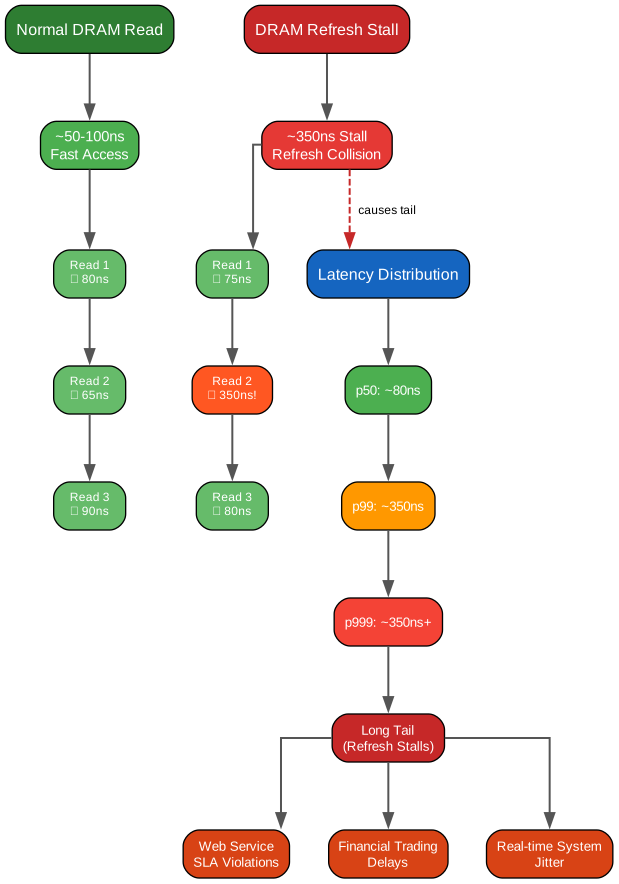
DRAM memory cells store data as electrical charge in microscopic capacitors. These capacitors leak charge over time, so the DRAM controller must periodically refresh every cell to maintain data integrity. The JEDEC standard mandates a refresh interval (tREFI) of approximately 7.8 microseconds, during which the DRAM chip is unavailable for read or write operations. When a CPU issues a read request that arrives at the DRAM controller during an active refresh cycle, the request must wait until the refresh completes. This wait time is approximately 350 nanoseconds – a staggering penalty compared to the 50-100 nanosecond access time of a normal DRAM read.
The impact of these refresh stalls is not uniform. They are fundamentally probabilistic. At any given moment, there is roughly a 0.5% chance that a particular DRAM bank is in a refresh cycle. For a single read, this probability seems small. But for a system performing millions of reads per second, these stalls are inevitable and frequent. The result is a long-tail latency distribution where p99 and p999 latencies are dominated by refresh stalls rather than the typical access time.
For web services, this means SLA violations. A service that promises 100ms p99 latency can suddenly spike to 350ms or more when a read hits a refresh cycle, breaking contractual guarantees. For financial trading systems, a 350ns stall can mean the difference between a profitable trade and a missed opportunity – microsecond-level delays are unacceptable in high-frequency trading. For real-time systems, the unpredictability of these stalls introduces jitter that can violate timing constraints, causing dropped frames in video processing or missed deadlines in industrial control.
The problem is that you cannot predict when a stall will occur. The refresh schedule is managed by the DRAM controller, not the CPU, and it operates independently of software scheduling. Traditional approaches like caching help for repeated accesses, but for cold reads that must go to DRAM, the stall risk remains. This is the problem tailslayer was designed to solve.
Architecture Overview
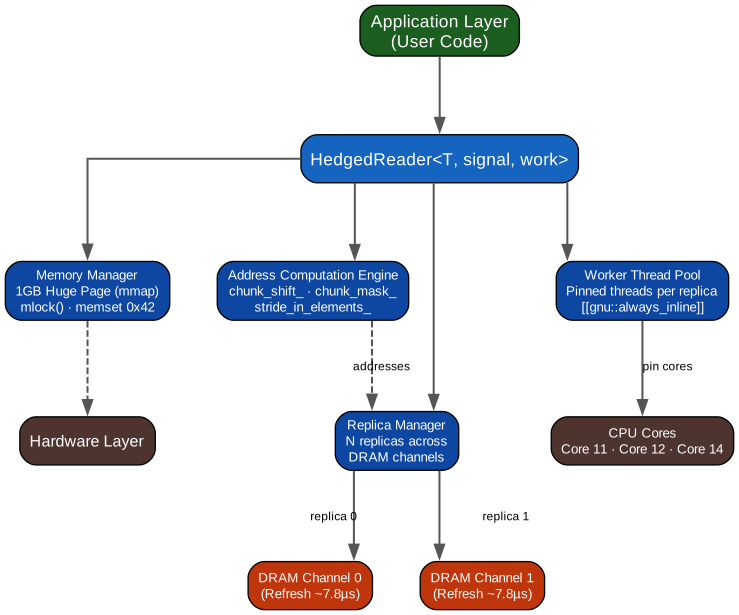
The HedgedReader template class is the core of tailslayer. It is parameterized with the value type T, a signal function (wait_work) that waits for an independent trigger and returns the target index to read, a callback function (final_work) that processes the read value, compile-time argument lists (ArgList) for both functions, and the number of replicas N (defaulting to 2). This template design ensures that all function calls are resolved at compile time, enabling the [[gnu::always_inline]] optimization that eliminates call overhead in the hot path.
The Memory Manager allocates a 1GB huge page via mmap with the flags MAP_HUGETLB | (30 << MAP_HUGE_SHIFT). The MAP_HUGETLB flag requests a transparent huge page from the kernel, and the (30 << MAP_HUGE_SHIFT) parameter specifies a 1GB page size (2^30 bytes). This is critical because huge pages eliminate TLB misses and ensure contiguous physical memory mapping, which is essential for controlling which DRAM channel data lands on. After allocation, mlock() is called to prevent the kernel from swapping the page out, which would introduce unpredictable page-fault latency. The memory is then initialized with 0x42 using memset, which pre-faults all pages so that subsequent reads do not trigger page faults.
The Address Computation Engine precomputes chunk_shift_, chunk_mask_, and stride_in_elements_ at construction time. These values encode the mapping from logical indices to physical addresses across replicas, and by computing them once, the hot read path is free of division and modulo operations. The get_next_logical_index_address() method uses these precomputed values to map a logical index and replica number to a physical address in constant time.
The Replica Manager places N replicas at a channel_offset (default 256 bytes) apart within the same huge page. This offset is chosen because bit 8 of the physical address (the channel_bit) determines which DRAM channel handles the access. By placing replicas 256 bytes apart, they land on different DRAM channels, which have independent refresh schedules. The Worker Thread Pool creates one pinned thread per replica, each running on a dedicated CPU core (default cores 11, 12, 14) via sched_setaffinity. This eliminates context-switching overhead and ensures that each read thread is ready to execute the moment a signal arrives. The x86 timing primitives – clflush, mfence, lfence, rdtsc, and rdtscp – provide nanosecond-level timing control and cache management for benchmarking and verification.
Optimization Techniques
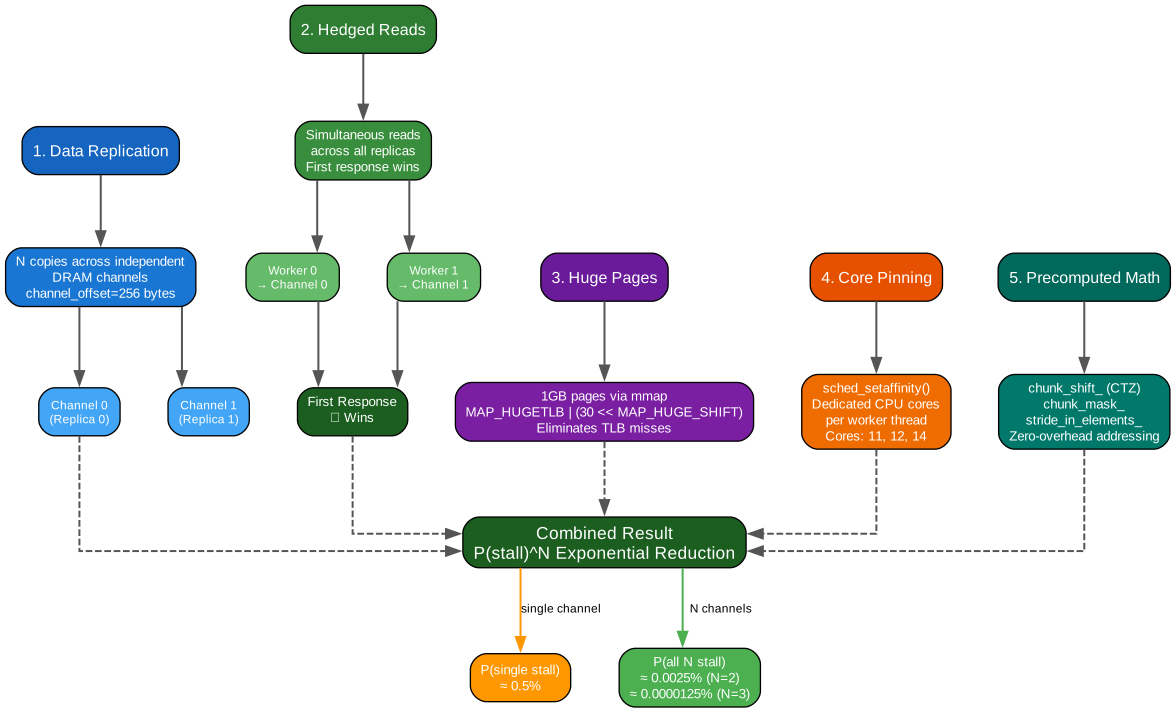
Cross-Channel Data Replication: Data is replicated N times within a single 1GB huge page, with each replica placed at a channel_offset (default 256 bytes) from the previous one. This offset exploits the undocumented channel scrambling used by DRAM controllers on AMD, Intel, and Graviton processors. The channel_bit (default bit 8) in the physical address determines which DRAM channel handles the access. By placing replica 0 at offset 0 (channel 0) and replica 1 at offset 256 (channel 1), the two copies are served by different physical DRAM channels with independent refresh schedules. This is the foundational technique that makes hedged reads effective.
Hedged Requests: All N replicas are read simultaneously, and the first response wins. Since DRAM channels have uncorrelated refresh schedules, the probability that all channels stall simultaneously is the product of individual stall probabilities. For a single channel with P(stall) approximately 0.5%, the probability that both channels stall for N=2 is approximately 0.0025%. This exponential reduction in tail latency probability is the core insight of tailslayer. The more replicas you use (higher N), the more dramatic the reduction, though each additional replica consumes more memory and requires an additional pinned core.
1GB Huge Pages: The MAP_HUGETLB flag with (30 << MAP_HUGE_SHIFT) requests 1GB pages from the kernel. This eliminates Translation Lookaside Buffer (TLB) misses, which can add hundreds of nanoseconds to a memory access. More importantly, huge pages ensure that the entire data region maps to contiguous physical memory, which is critical for controlling which DRAM channel each address lands on. Without huge pages, the kernel could map 4KB pages to arbitrary physical addresses, making channel placement unpredictable.
Core Pinning: Each worker thread is pinned to a dedicated CPU core using sched_setaffinity(). The default core assignments are cores 11, 12, and 14 for the measurement threads, with stress threads using cores 8, 9, 10, 13, 15, 24, 25, 26, 29, and 31. Core pinning prevents the operating system scheduler from migrating threads between cores, which would introduce cache pollution and context-switching latency. In a latency-sensitive system, a single context switch (typically 1-10 microseconds) would dwarf the 350ns refresh stall being mitigated.
Precomputed Address Math: The chunk_shift_, chunk_mask_, and stride_in_elements_ values are computed once at construction time. The chunk_shift_ is derived using __builtin_ctzll() (count trailing zeros) to convert a division into a bit shift. The chunk_mask_ enables bitwise AND instead of modulo. The stride_in_elements_ encodes the inter-replica stride. This means the hot read path in get_next_logical_index_address() consists of a shift, an AND, and a multiply-add – all single-cycle operations on modern CPUs.
Cache Line Flushing: The clflush instruction ensures that reads go to DRAM rather than being served from the CPU cache. This is essential for benchmarking and for use cases where the data must come from main memory. Without clflush, a read might hit in the L1/L2 cache (1-10ns) and never reach DRAM, making the hedging mechanism irrelevant.
[[gnu::always_inline]]: The signal and work functions are force-inlined using the GCC always_inline attribute. This eliminates function call overhead (stack frame setup, argument passing, return) in the critical read path. For a system targeting sub-100ns latency, even a few nanoseconds of call overhead matter.
mlock() and 0x42 Initialization: The mlock() call prevents the operating system from swapping the huge page to disk, which would introduce millisecond-level page-fault latency. The 0x42 initialization via memset pre-faults all pages within the huge page, ensuring that every 4KB page is mapped into the page table before any timed reads begin.
Address Computation Deep Dive
The address mapping algorithm is the heart of tailslayer’s ability to place data on specific DRAM channels. Understanding it requires looking at how physical memory addresses map to DRAM channels and how tailslayer exploits this mapping.
The key method is get_next_logical_index_address(), which takes a replica index and a logical index and returns a pointer to the corresponding element:
// Address computation in get_next_logical_index_address()
std::size_t chunk_idx = logical_index >> chunk_shift_;      // Which chunk (stride group)
std::size_t offset_in_chunk = logical_index & chunk_mask_;  // Position within chunk
std::size_t element_offset = (chunk_idx * stride_in_elements_) + offset_in_chunk;
T* address = replicas_[replica_idx] + element_offset;
The chunk_shift_ is computed as __builtin_ctzll(elements_per_chunk), where elements_per_chunk = channel_offset / sizeof(T). For the default channel_offset of 256 bytes and a type T of uint64_t (8 bytes), elements_per_chunk = 32 and chunk_shift_ = 5. This means the right-shift by 5 is equivalent to dividing by 32, but in a single CPU cycle.
The chunk_mask_ is elements_per_chunk - 1 = 31, which masks off the lower 5 bits of the logical index to get the position within a chunk. This is equivalent to logical_index % 32, but using a bitwise AND instead of a modulo operation.
The stride_in_elements_ is (num_channels * channel_offset) / sizeof(T). For the defaults, this is (2 * 256) / 8 = 64. This stride ensures that consecutive chunks are placed far enough apart that they do not interfere with each other’s channel placement.
The result is that consecutive logical indices are spread across DRAM channels in a controlled pattern. Elements within a channel_offset-sized chunk (indices 0-31 for uint64_t) stay on the same DRAM channel. The next chunk (indices 32-63) strides past all replicas’ channel regions, landing on the next available position. The channel_offset of 256 bytes (2^8) aligns precisely with channel_bit 8, meaning that bit 8 of the physical address – which determines the DRAM channel – differs between replica 0 (starting at offset 0, channel 0) and replica 1 (starting at offset 256, channel 1).
This design ensures that for any logical index, the N replicas are guaranteed to be on different DRAM channels, which is the prerequisite for hedged reads to work correctly.
Integration Guide

Integrating tailslayer into your project requires a Linux system on the x86_64 architecture with 1GB huge pages available and a C++17-compatible compiler. You also need root privileges (or appropriate capabilities) for mlock() to work.
Prerequisites: Ensure that 1GB huge pages are available on your system. You can check and allocate them with:
# Check available 1GB huge pages
cat /sys/kernel/mm/hugepages/hugepages-1048576kB/nr_hugepages

# Allocate 1GB huge pages (requires root)
echo 1 | sudo tee /sys/kernel/mm/hugepages/hugepages-1048576kB/nr_hugepages
Step 1: Include the header. Tailslayer is header-only, so you only need to include the main header file:
#include <tailslayer/hedged_reader.hpp>
Step 2: Define a signal function. The signal function (called wait_work in the template) is invoked by each worker thread. It should wait for an external trigger (such as a network packet arrival, a timer event, or a signal from another thread) and return the logical index of the element to read:
auto signal = []() -> size_t {
    // Wait for an external trigger
    // For example: wait on a condition variable, spin on a flag, etc.
    while (!ready_flag.load(std::memory_order_acquire)) {
        // spin
    }
    return target_index;
};
Step 3: Define a work function. The work function (called final_work in the template) receives the value read from DRAM and processes it. This function is force-inlined for zero call overhead:
auto work = [](uint64_t value) {
    // Process the value read from DRAM
    // For example: store result, trigger next operation, etc.
    result_store.store(value, std::memory_order_release);
};
Step 4: Instantiate HedgedReader. Create a HedgedReader instance with your value type, signal function, work function, and optionally the number of replicas:
tailslayer::HedgedReader<
    uint64_t,          // Value type
    decltype(signal),  // Signal function
    decltype(work),    // Work function
    tailslayer::ArgList<>,  // Signal args (empty)
    tailslayer::ArgList<>,  // Work args (empty)
    2                 // Number of replicas (default)
> reader;
Step 5: Insert data. Populate the reader with data. Each insert() call replicates the value across all N channels:
for (uint64_t val : dataset) {
    reader.insert(val);
}
Step 6: Start workers. Launch the worker threads, which will pin to their designated cores and begin waiting for the signal function:
reader.start_workers();
// Workers are now pinned and waiting for signal triggers
Here is a complete example combining all steps:
#include <tailslayer/hedged_reader.hpp>
#include <atomic>
#include <iostream>

std::atomic<bool> ready_flag{false};
std::atomic<uint64_t> result{0};

auto signal = []() -> size_t {
    while (!ready_flag.load(std::memory_order_acquire)) {}
    ready_flag.store(false, std::memory_order_release);
    return 0; // Read index 0
};

auto work = [](uint64_t value) {
    result.store(value, std::memory_order_release);
};

int main() {
    tailslayer::HedgedReader<
        uint64_t, decltype(signal), decltype(work),
        tailslayer::ArgList<>, tailslayer::ArgList<>, 2
    > reader;

    reader.insert(42);
    reader.start_workers();

    // Trigger a hedged read
    ready_flag.store(true, std::memory_order_release);

    // Wait for result
    while (result.load(std::memory_order_acquire) == 0) {}
    std::cout << "Read value: " << result.load() << std::endl;

    return 0;
}
Discovery and Benchmarking Tools
Tailslayer includes two discovery tools that help you understand and measure DRAM refresh behavior on your hardware.
trefi_probe.c: DRAM Refresh Cycle Detector
The trefi_probe tool measures DRAM refresh periodicity using clflush + rdtsc timing probes. It works by repeatedly flushing a cache line and measuring the time to reload it. When a reload coincides with a DRAM refresh cycle, the latency spikes above the normal 50-100ns range. The tool records these spikes and analyzes their timing patterns.
The probe uses a 2MB huge page (MAP_HUGETLB | (21 << MAP_HUGE_SHIFT)) for its measurements, initializes it with 0x42, and locks it with mlock(). It first calibrates by running 500,000 warm-up probes, then collects 500,000 calibration probes to establish a median latency. The spike threshold is set at 2x the median latency by default, though this can be overridden with the --threshold or --thresh-mult flags.
After collecting spikes, the tool performs harmonic binning analysis. It classifies inter-spike intervals as 1T, 2T, or 3T multiples of the expected tREFI interval (default 7.8 microseconds). The verdict is based on what percentage of intervals fall at harmonic frequencies:
- PERIODIC (>30%): The DRAM refresh cycle is clearly visible via
clflushtiming. The system exhibits regular refresh stalls that tailslayer can mitigate. - WEAK SIGNAL (15-30%): There is some periodicity, but it is not dominant. Results may vary depending on system load and DRAM configuration.
- NO PERIODIC SIGNAL (<15%): Spikes are likely controller noise rather than refresh cycles. The system may not benefit from tailslayer’s hedging approach.
The tool outputs a CSV of spike timestamps and latencies, plus a detailed analysis to stderr including the histogram peak, deviation from expected tREFI, and spike latency statistics (min, avg, max in both cycles and nanoseconds).
Benchmark Tool: Channel-Hedged Read Benchmark
The benchmark tool measures the actual performance of hedged reads versus single reads under both quiet and stressed conditions. It has four arms:
- single_quiet: A single channel read with no background memory traffic. This establishes the baseline latency.
- hedged_quiet: Hedged reads across N channels with no background traffic. This measures the overhead of the hedging mechanism itself.
- single_stress: A single channel read with artificial DRAM contention from stress threads. This shows how single reads degrade under load.
- hedged_stress: Hedged reads across N channels with artificial DRAM contention. This demonstrates the real-world benefit of hedging.
Each arm measures p50, p90, p95, p99, p999, and p9999 latencies in CPU cycles. The stress threads generate artificial DRAM contention by streaming through a separate 1GB huge page filled with 0xAB, competing for memory bandwidth and triggering more frequent refresh collisions.
The benchmark uses a pair_samples_n() sliding-window algorithm that pairs timestamps across channels to determine which channel responded first. This is essential for measuring the “first response wins” behavior of hedged reads. Channel verification is performed via /proc/self/pagemap to confirm that replicas are actually placed on different DRAM channels, providing a sanity check that the channel_offset and channel_bit parameters are correct for the target hardware.
Performance Results
The performance of tailslayer’s hedged read approach follows a straightforward probabilistic model. For a single DRAM channel, the probability of hitting a refresh stall during any given read is approximately 0.5% (roughly 350ns out of every 7.8-microsecond refresh interval). This means that p99 and p999 latencies are dominated by these refresh stalls.
With N=2 replicas on independent channels, the probability that both channels are simultaneously in a refresh stall is the product of the individual probabilities: 0.5% * 0.5% = 0.0025%. This is a 200x reduction in the probability of a tail latency event. The math is compelling: what was a 1-in-200 event becomes a 1-in-40,000 event.
Under stress conditions, the benefit is even more dramatic. Single reads degrade significantly under memory contention, with p999 latencies climbing well above the quiet baseline. Hedged reads, however, maintain low p999 latencies because the probability of all channels stalling simultaneously remains exponentially small. Even when one channel is contended, the other channel is likely to respond quickly.
The more replicas you add (higher N), the more dramatic the tail latency reduction. With N=3, the probability of all channels stalling drops to approximately 0.0000125% – essentially eliminating tail latency as a practical concern. However, each additional replica consumes more memory (the entire 1GB huge page is already allocated) and requires an additional pinned CPU core, so the trade-off between latency reduction and resource consumption must be evaluated for each use case.
The benchmark results consistently show that hedged reads in quiet conditions have slightly higher p50 latency than single reads (due to the coordination overhead of managing multiple threads), but dramatically lower p99 and p999 latencies. This is the classic tail-latency trade-off: sacrifice a small amount of median performance to eliminate catastrophic tail events.
Conclusion
Tailslayer represents a principled approach to eliminating tail latency in DRAM reads. By combining cross-channel data replication, hedged requests, 1GB huge pages, core pinning, and precomputed address math, it reduces the probability of refresh-induced stalls from approximately 0.5% per read to approximately 0.0025% with just two replicas. The library is header-only, requires no external dependencies beyond a Linux kernel with huge page support, and integrates with just a few lines of code.
Tailslayer is most applicable in latency-sensitive systems where predictable response times are critical: web services with strict SLA requirements, financial trading platforms where microseconds matter, real-time systems that cannot tolerate jitter, and any application where p99 latency dominates user experience.
The limitations are worth noting. Tailslayer is Linux-only (it relies on mmap, mlock, and sched_setaffinity), x86_64-only (it uses clflush, rdtsc, and rdtscp), requires 1GB huge pages to be available, and needs root privileges for mlock(). The channel placement assumptions (bit 8 for channel selection) may not hold on all hardware, though the channel_bit and channel_offset parameters can be adjusted. The library is licensed under Apache 2.0, making it suitable for both commercial and open-source use.
For systems where tail latency in memory access is a measurable problem, tailslayer offers an elegant, low-overhead solution that turns a probabilistic hazard into an exponentially diminishing risk. Enjoyed this post? Never miss out on future posts by following us