AgenticSeek: The Fully Local Autonomous AI Agent That Replaces Cloud Dependency
What if you could have an AI assistant that browses the web, writes and executes code, manages your files, and plans complex tasks – all without sending a single byte of data to the cloud? AgenticSeek, an open-source project with over 26,000 stars on GitHub, delivers exactly that. It is a fully local, privacy-first alternative to cloud-based AI agents like Manus AI, designed to run entirely on your hardware with zero API costs.
In a world where AI assistants increasingly rely on cloud infrastructure, AgenticSeek takes the opposite approach. Every component – from the LLM reasoning engine to the speech-to-text pipeline – runs locally on your machine. Your files, conversations, and web searches never leave your device. This is not just a privacy feature; it is a fundamental architectural choice that eliminates API costs, removes rate limits, and gives you complete control over your AI assistant.
What is AgenticSeek?
AgenticSeek is a voice-enabled autonomous AI agent that can browse the internet, write and execute code in multiple programming languages, manage files on your system, and decompose complex tasks into executable plans. Built by a small team of passionate developers (not a startup or corporation), it has rapidly gained traction in the open-source community for delivering a genuinely local AI experience.
The project supports a wide range of local LLM providers including Ollama, LM Studio, and llama.cpp-based servers. For users who prefer cloud APIs, it also supports OpenAI, Google Gemini, DeepSeek, TogetherAI, and OpenRouter – but these are entirely optional. The primary design goal is local-first operation.
Understanding the Architecture
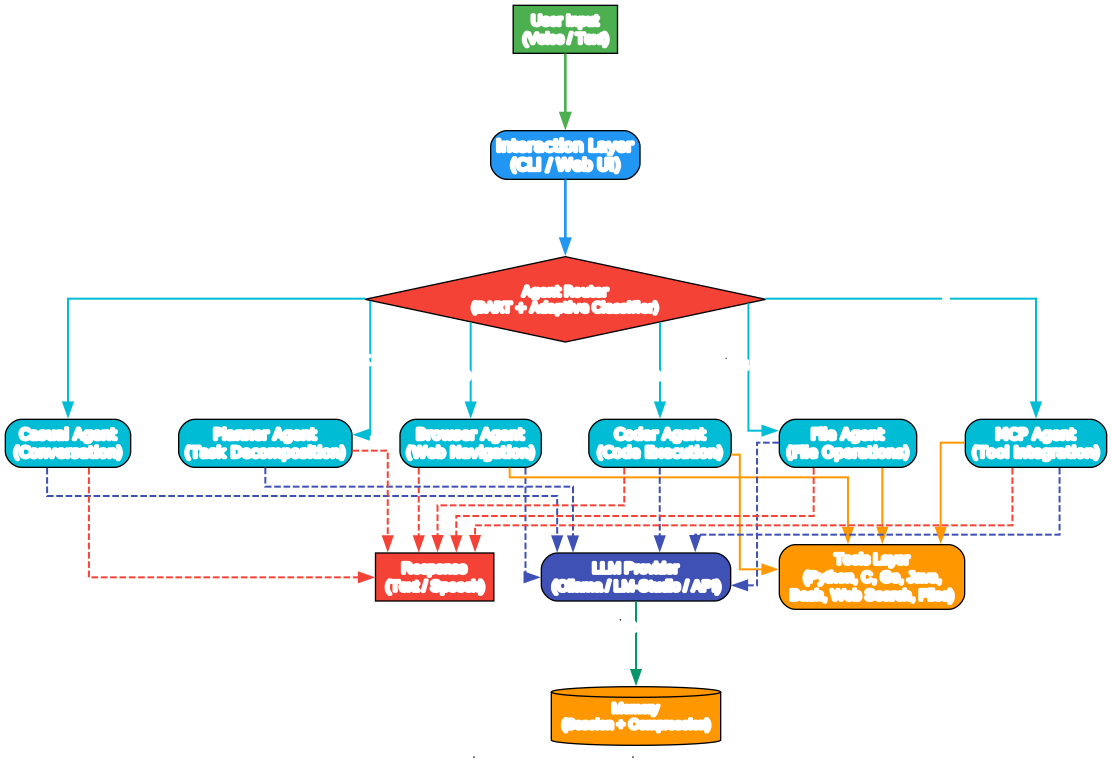
The architecture diagram above illustrates how AgenticSeek orchestrates its components to deliver a fully local autonomous AI experience. Let us break down each layer:
User Input Layer: AgenticSeek accepts input through both voice and text. The speech-to-text system uses a wake-word trigger (customizable agent name) to activate, making it feel like talking to a sci-fi AI assistant. Text input works through both a React-based web interface and a CLI mode.
Interaction Layer: The Interaction class manages the conversation flow, handling session recovery, TTS/STT initialization, and coordinating between the user and the agent system. It maintains conversation state and ensures seamless transitions between agents.
Agent Router: This is the brain of the routing system. It uses a dual-model voting mechanism – combining a BART zero-shot classifier (facebook/bart-large-mnli) with an Adaptive LLM router – to determine which agent should handle a given request. The router also estimates task complexity to decide whether a simple specialist agent suffices or whether the Planner Agent should decompose the task.
Specialist Agents: Six specialized agents handle different task categories:
- Casual Agent: Handles conversation and general queries
- Browser Agent: Navigates the web autonomously, searches, extracts information, fills forms
- Coder Agent: Writes and executes code in Python, C, Go, Java, and Bash
- File Agent: Manages file system operations – finding, organizing, and manipulating files
- Planner Agent: Decomposes complex multi-step tasks and delegates to other agents
- MCP Agent: Integrates with Model Context Protocol servers for extensible tool access
LLM Provider: The provider abstraction layer supports both local (Ollama, LM Studio, llama.cpp) and cloud (OpenAI, Google, DeepSeek, etc.) backends. When running locally, all inference happens on your GPU.
Memory System: Each agent maintains its own conversation memory with optional compression, enabling long-running sessions without context overflow.
How It Works: The Agent Workflow
Understanding how AgenticSeek processes a request reveals the sophistication behind its seemingly simple interface.
Understanding the Agent Workflow
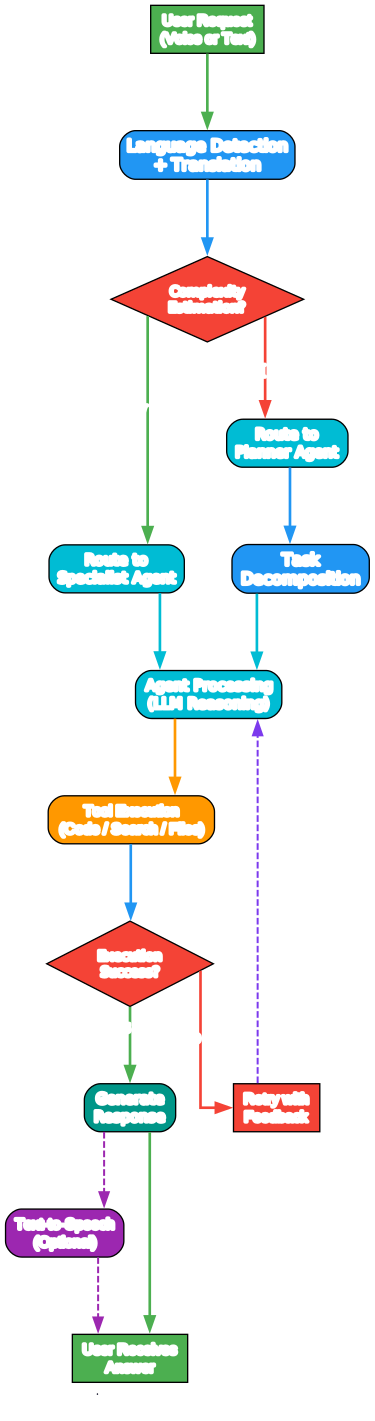
The workflow diagram above shows the complete lifecycle of a user request through AgenticSeek. Here is a detailed walkthrough:
1. Language Detection and Translation: When a request arrives, the system first detects the language and translates it if needed. AgenticSeek supports multiple languages (English, Chinese, French, and more), making it accessible to a global audience. The translation ensures the routing classifier works consistently regardless of input language.
2. Complexity Estimation: The Adaptive Classifier evaluates whether the task is simple (LOW complexity) or requires multi-step planning (HIGH complexity). This is critical – a simple “write a Python function” request goes directly to the Coder Agent, while “search for AI startups, analyze their products, and build a comparison app” triggers the Planner Agent.
3. Agent Routing: For LOW complexity tasks, the dual-voting router selects the best specialist agent. The BART model and Adaptive Classifier each produce a prediction with confidence scores. The system normalizes these scores and picks the winner. For HIGH complexity tasks, the request is routed directly to the Planner Agent.
4. Agent Processing: The selected agent loads its specialized prompt, pushes the user query into its memory, and calls the LLM. Reasoning models like DeepSeek-R1 produce a thinking block followed by an answer. The agent extracts both the reasoning and the final answer.
5. Tool Execution: If the answer contains code blocks (marked with language-specific tags like python orbash), the agent’s tool system parses and executes them. Each interpreter runs in a controlled environment with safety checks. If execution fails, the error feedback is pushed back into memory, and the agent retries with the new context.
6. Response Generation: Once execution succeeds, the agent formats the response. If TTS is enabled, the answer is spoken aloud. The user receives both the reasoning trace and the final result.
This retry loop is what makes AgenticSeek genuinely autonomous. It does not just generate code – it runs the code, reads the errors, and iterates until the task is complete.
Key Features
Understanding the Key Features
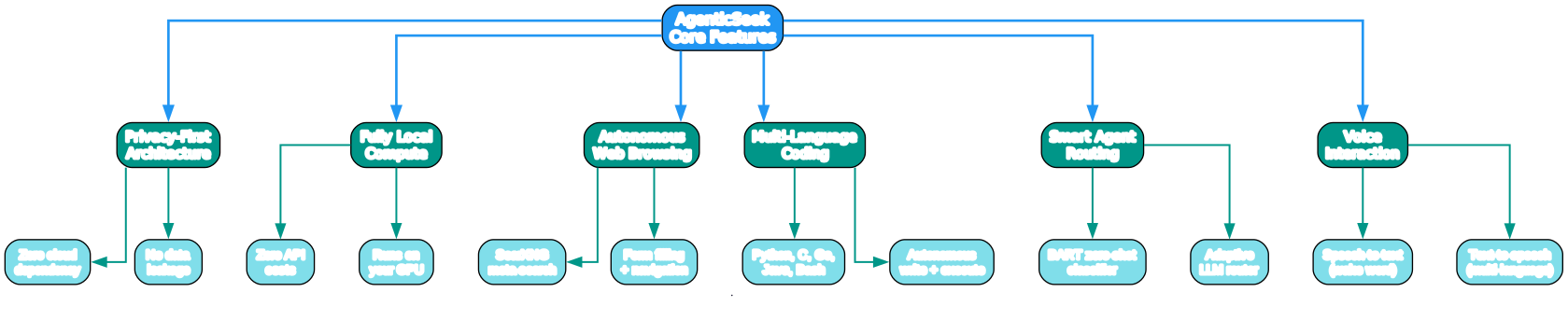
The features diagram above maps out the six pillars of AgenticSeek’s capability set. Each pillar represents a fundamental design decision:
Privacy-First Architecture: Unlike cloud-based agents, AgenticSeek keeps everything on your machine. No conversation data is transmitted to external servers. No API keys are required for local operation. This is not a configuration option – it is the default and primary mode. Your files, browsing history, and code never leave your hardware.
Fully Local Compute: With Ollama or LM Studio as the LLM backend, the entire pipeline runs on your GPU. This means zero API costs, no rate limits, and no dependency on internet connectivity for the core reasoning engine. The only network requirement is for web browsing tasks, which naturally need internet access.
Autonomous Web Browsing: The Browser Agent uses Selenium with stealth mode (undetected-chromedriver) to navigate websites, fill forms, extract information, and conduct searches via SearXNG – a privacy-respecting meta-search engine that runs as a local Docker service. The agent can click links, read page content, and take notes as it browses.
Multi-Language Coding: The Coder Agent supports Python, C, Go, Java, and Bash with dedicated interpreters for each language. It does not just generate code snippets – it writes complete programs, executes them, reads the output, and iterates on failures. Each interpreter includes safety checks to prevent destructive operations.
Smart Agent Routing: The dual-model voting system (BART + Adaptive Classifier) ensures requests reach the right specialist. This is more robust than single-model routing because it combines zero-shot classification with fine-tuned task prediction, reducing misrouting errors.
Voice Interaction: Speech-to-text uses a wake-word system (the agent’s name, e.g., “Friday” or “Jarvis”), and text-to-speech supports multiple languages. While STT is currently CLI-only and experimental, it demonstrates the project’s ambition toward a fully conversational AI experience.
The Provider and Tools Ecosystem

Understanding the Ecosystem
The ecosystem diagram above shows the three layers of AgenticSeek’s extensibility:
Local LLM Providers (solid connections): These are the recommended providers for privacy-first operation. Ollama is the most popular choice, supporting models like DeepSeek-R1 (14B, 32B, 70B) and Qwen. LM Studio provides a GUI for model management. llama.cpp servers offer OpenAI-compatible APIs for maximum flexibility. The self-hosted server option lets you run the LLM on a powerful remote machine while keeping the agent on your laptop.
Cloud API Providers (dashed connections): Entirely optional. OpenAI, Google Gemini, DeepSeek, TogetherAI, and OpenRouter are supported for users who lack local GPU hardware. The project explicitly warns that data will be sent to the cloud when using these providers.
Built-in Tools: The tool system is language-agnostic. Each tool implements a common interface with load_exec_block(), execute(), and interpreter_feedback() methods. The Python, C, Go, Java, and Bash interpreters all follow this pattern, making it straightforward to add new languages. The SearXNG search tool provides privacy-respecting web search, while the File Finder and MCP Finder extend the agent’s reach into your filesystem and external tool servers.
Infrastructure: Docker Compose orchestrates the full stack – SearXNG for search, Redis for caching, the React frontend, and the Python backend. This makes deployment consistent across platforms.
AgenticSeek vs. Manus AI: A Comparison
| Aspect | AgenticSeek | Manus AI |
|---|---|---|
| Data Privacy | 100% local, zero cloud dependency | Cloud-based, data sent to servers |
| API Costs | Zero (local inference) | Pay-per-use API pricing |
| LLM Control | Choose any local model | Fixed cloud models |
| Customization | Open source, fully modifiable | Proprietary, limited customization |
| Offline Capability | Works offline (except web browsing) | Requires internet |
| Code Execution | Local interpreters with safety checks | Sandboxed cloud execution |
| Web Browsing | Local SearXNG + Selenium | Cloud-based browsing |
| Voice Interface | Local STT/TTS | Cloud-based |
| Hardware Requirement | GPU with 12GB+ VRAM recommended | No local hardware needed |
The trade-off is clear: AgenticSeek requires local GPU hardware but gives you complete privacy and zero recurring costs. Manus AI requires no local hardware but sends your data to the cloud and charges per use.
Getting Started
Prerequisites
- Python 3.10.x
- Docker Engine and Docker Compose
- Git
- A GPU with at least 12GB VRAM (for 14B models) or 24GB+ (for 32B models)
Installation
git clone https://github.com/Fosowl/agenticSeek.git
cd agenticSeek
mv .env.example .env
Edit the .env file to set your working directory and service URLs:
SEARXNG_BASE_URL="http://searxng:8080"
REDIS_BASE_URL="redis://redis:6379/0"
WORK_DIR="/path/to/your/workspace"
OLLAMA_PORT="11434"
Configure the LLM Provider
Edit config.ini to set your local provider:
[MAIN]
is_local = True
provider_name = ollama
provider_model = deepseek-r1:14b
provider_server_address = 127.0.0.1:11434
agent_name = Friday
recover_last_session = True
save_session = True
speak = False
listen = False
languages = en

[BROWSER]
headless_browser = True
stealth_mode = True
Start Ollama and pull the model:
export OLLAMA_HOST=0.0.0.0:11434
ollama serve
ollama pull deepseek-r1:14b
Launch AgenticSeek
For the web interface (Docker):
./start_services.sh full
Then open http://localhost:3000 in your browser.
For CLI mode:
./install.sh
./start_services.sh
uv run python -m ensurepip
uv run cli.py
Example Queries
Once running, try these commands to explore AgenticSeek’s capabilities:
Make a snake game in python!
Search the web for top cafes in Rennes, France, and save a list of three with their addresses in rennes_cafes.txt.
Write a Go program to calculate the factorial of a number, save it as factorial.go in your workspace.
Search my summer_pictures folder for all JPG files, rename them with today's date, and save a list of renamed files in photos_list.txt.
For best results, be explicit about what you want. Instead of “Do you know some good countries for solo-travel?”, say “Do a web search and find out which are the best countries for solo-travel.”
Hardware Recommendations
Choosing the right model size is critical for a good experience:
| Model Size | GPU VRAM | Experience |
|---|---|---|
| 7B | 8GB | Not recommended. Frequent hallucinations, planner agent struggles. |
| 14B | 12GB (e.g., RTX 3060) | Usable for simple tasks. May struggle with web browsing and planning. |
| 32B | 24GB+ (e.g., RTX 4090) | Good with most tasks. May still struggle with complex planning. |
| 70B+ | 48GB+ | Excellent. Recommended for advanced use cases. |
Reasoning models like DeepSeek-R1 and Magistral are recommended over standard models because the prompt optimizations are tuned for their thinking patterns.
Privacy Benefits
The privacy argument for AgenticSeek goes beyond simple data protection. When you use a cloud-based AI agent, every file you ask it to read, every web search you conduct, and every line of code you ask it to execute passes through external servers. This creates a persistent data trail that you cannot control.
With AgenticSeek, the only network traffic occurs when the Browser Agent actively browses the web – and even that traffic goes through your local SearXNG instance, which strips tracking parameters and does not log your queries. The LLM inference, code execution, file operations, and conversation history all remain on your machine.
For developers working with proprietary code, researchers handling sensitive data, or anyone who values digital sovereignty, this architecture is not just a feature – it is a requirement.
Conclusion
AgenticSeek represents a compelling vision for the future of AI agents: one where autonomy does not require sacrificing privacy. By running entirely on local hardware with open-source LLMs, it eliminates the two biggest barriers to AI agent adoption – recurring API costs and data privacy concerns.
The project is still a work in progress. The MCP Agent is not yet functional, speech-to-text is experimental and CLI-only, and the routing system occasionally misroutes requests. But with 26,000 stars and an active community of contributors, AgenticSeek is evolving rapidly.
If you have a GPU with sufficient VRAM and want an AI assistant that truly belongs to you – not to a cloud provider – AgenticSeek is worth your attention. Clone the repository, configure your local LLM, and experience what fully autonomous, fully local AI feels like.
Links
- GitHub Repository: https://github.com/Fosowl/agenticSeek
- Project Website: https://fosowl.github.io/agenticSeek.html
- Discord Community: https://discord.gg/8hGDaME3TC

Enjoyed this post? Never miss out on future posts by following us


