Introduction
In the rapidly evolving landscape of AI-powered development tools, Superpowers stands out as a transformative framework that brings professional software engineering practices to AI coding assistants. Created by Jesse Vincent and the team at Prime Radiant, this open-source project has garnered over 144,000 stars on GitHub, demonstrating its significant impact on the developer community.
Superpowers is not just another AI tool - it’s a complete software development workflow built on composable “skills” that ensure your AI coding agent follows industry best practices. Instead of jumping straight into writing code, agents equipped with Superpowers step back, ask clarifying questions, create detailed plans, and execute them systematically using test-driven development principles.
What Makes Superpowers Different
The framework addresses a fundamental challenge in AI-assisted development: ensuring that AI agents don’t just produce code, but produce good code. Traditional AI coding assistants often:
- Jump into implementation without understanding requirements
- Skip testing entirely or add tests as an afterthought
- Miss edge cases and fail to consider error handling
- Produce code that works but lacks maintainability
Superpowers solves these problems by wrapping the development process in a structured workflow that enforces discipline at every stage. The framework acts as a meta-layer that guides AI agents through the same thought processes that experienced software engineers use instinctively.
The Core Workflow
At the heart of Superpowers is a seven-stage workflow that transforms how AI agents approach development tasks:

Stage 1: Brainstorming
The workflow begins with brainstorming - a critical phase that prevents the common AI mistake of implementing the wrong solution. When an agent equipped with Superpowers encounters a request, it doesn’t immediately start coding. Instead, it:
- Explores the project context by examining files, documentation, and recent commits
- Asks clarifying questions one at a time to understand the true intent
- Proposes 2-3 different approaches with trade-offs and recommendations
- Presents the design in manageable sections for validation
- Writes a design document and commits it for reference
This Socratic approach ensures that both the human and the AI agent share a common understanding of what needs to be built before any code is written.
Stage 2: Git Worktrees
Once the design is approved, Superpowers creates an isolated development environment using Git worktrees. This practice, borrowed from professional development workflows, ensures that:
- Development happens on a clean branch
- The main codebase remains untouched
- Parallel development is possible without conflicts
- A clean test baseline is established before changes
The worktree approach is particularly valuable for AI agents because it provides a sandboxed environment where mistakes can be easily rolled back without affecting the main project.
Stage 3: Writing Plans
Superpowers transforms approved designs into detailed implementation plans. Each plan breaks work into bite-sized tasks that can be completed in 2-5 minutes. Every task includes:
- Exact file paths for modifications
- Complete code snippets for implementation
- Clear verification steps
- Dependencies on previous tasks
This granular planning prevents the AI from getting lost in complex implementations and provides natural checkpoints for human review.
Stage 4: Subagent-Driven Development
One of Superpowers’ most innovative features is subagent-driven development. Instead of one monolithic AI session handling everything, the framework dispatches fresh subagents for each task:
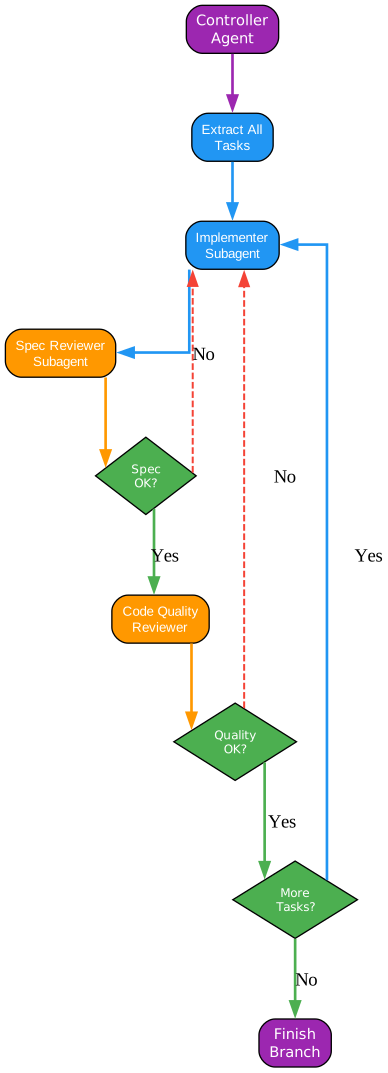
This approach offers several advantages:
- Fresh context per task: Each subagent starts with a clean slate, avoiding context pollution
- Two-stage review process: First spec compliance, then code quality
- Parallel-safe execution: Subagents don’t interfere with each other
- Continuous progress: No waiting for human approval between every task
The controller agent coordinates subagents, providing them with exactly the context they need and reviewing their work through dedicated reviewer subagents.
Stage 5: Test-Driven Development
Superpowers enforces strict TDD through its test-driven-development skill. This isn’t optional - it’s a mandatory workflow that ensures every piece of production code has a corresponding test that failed first.

The Red-Green-Refactor cycle is enforced through clear rules:
- RED: Write a failing test first. Watch it fail. Confirm it fails for the right reason.
- GREEN: Write the minimal code to pass the test. Nothing more.
- REFACTOR: Clean up the code while keeping tests green.
The framework includes extensive documentation on testing anti-patterns and common rationalizations for skipping TDD, helping agents resist the temptation to cut corners.
Stage 6: Code Review
Between tasks, Superpowers triggers code review skills that evaluate work against the plan. The requesting-code-review skill ensures that:
- Code matches the specification
- No extra features were added (scope creep)
- No requirements were missed
- Code quality meets standards
Critical issues block progress, preventing accumulation of technical debt.
Stage 7: Finishing the Branch
When all tasks complete, the finishing-a-development-branch skill guides the agent through:
- Verifying all tests pass
- Presenting options (merge, PR, keep, discard)
- Cleaning up the worktree
- Ensuring a clean state for the next task
The Skills Library
Superpowers includes a comprehensive library of skills organized into four categories:

Testing Skills
test-driven-development: Enforces the RED-GREEN-REFACTOR cycle with comprehensive documentation on testing anti-patterns. This skill includes detailed guidance on why order matters, common rationalizations for skipping TDD, and red flags that indicate when to start over.
Debugging Skills
systematic-debugging: A 4-phase root cause process that includes root-cause-tracing, defense-in-depth strategies, and condition-based-waiting techniques. This skill transforms ad-hoc debugging into a systematic investigation.
verification-before-completion: Ensures that fixes are actually fixes by requiring verification steps before marking work complete.
Collaboration Skills
The collaboration category contains the most skills, reflecting Superpowers’ focus on human-AI collaboration:
- brainstorming: Socratic design refinement through questions
- writing-plans: Creates detailed implementation plans
- executing-plans: Batch execution with human checkpoints
- dispatching-parallel-agents: Concurrent subagent workflows
- requesting-code-review: Pre-review checklist for code quality
- receiving-code-review: Responding appropriately to feedback
- using-git-worktrees: Parallel development branches
- finishing-a-development-branch: Merge/PR decision workflow
- subagent-driven-development: Fast iteration with two-stage review
Meta Skills
writing-skills: Create new skills following best practices, including testing methodology for skill development.
using-superpowers: Introduction to the skills system for new users.
The Brainstorming Process in Detail
The brainstorming skill deserves special attention because it fundamentally changes how AI agents approach new tasks. The process follows a strict flow:
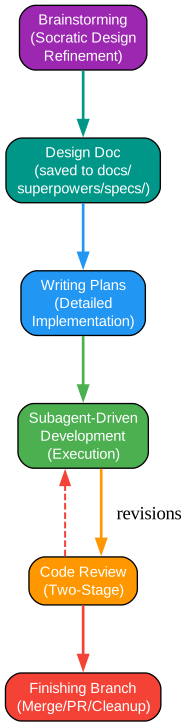
Key principles enforced during brainstorming:
- One question at a time: Don’t overwhelm with multiple questions
- Multiple choice preferred: Easier to answer than open-ended questions
- YAGNI ruthlessly: Remove unnecessary features from all designs
- Explore alternatives: Always propose 2-3 approaches before settling
- Incremental validation: Present design, get approval before moving on
The skill includes a “HARD-GATE” that prevents any implementation action until design is approved. This prevents the common pattern of AI agents starting to code before understanding requirements.
Philosophy and Design Principles
Superpowers is built on four core philosophical principles:
Test-Driven Development
Write tests first, always. The framework takes this principle seriously - there are no exceptions without explicit human partner permission. Tests written after code pass immediately, which proves nothing about their effectiveness.
Systematic Over Ad-Hoc
Process over guessing. Every skill follows a defined process that can be repeated and improved. This systematic approach reduces variability and increases reliability.
Complexity Reduction
Simplicity as a primary goal. Superpowers actively fights against over-engineering through YAGNI (You Aren’t Gonna Need It) enforcement and minimal implementation requirements.
Evidence Over Claims
Verify before declaring success. The framework requires actual evidence of success - passing tests, completed reviews, verified functionality - rather than accepting claims at face value.
Installation and Platform Support
Superpowers supports multiple AI coding platforms:
Claude Code
Available via the official Claude plugin marketplace:
/plugin install superpowers@claude-plugins-official
Or through the custom marketplace:
/plugin marketplace add obra/superpowers-marketplace
/plugin install superpowers@superpowers-marketplace
Cursor
Install from the plugin marketplace:
/add-plugin superpowers
Codex
Follow instructions from:
Fetch and follow instructions from https://raw.githubusercontent.com/obra/superpowers/refs/heads/main/.codex/INSTALL.md
OpenCode
Similar installation via:
Fetch and follow instructions from https://raw.githubusercontent.com/obra/superpowers/refs/heads/main/.opencode/INSTALL.md
GitHub Copilot CLI
copilot plugin marketplace add obra/superpowers-marketplace
copilot plugin install superpowers@superpowers-marketplace
Gemini CLI
gemini extensions install https://github.com/obra/superpowers
Why Superpowers Matters
The framework addresses a critical gap in AI-assisted development. While AI coding assistants have become remarkably good at generating code, they often lack the discipline and judgment that experienced developers bring to projects. Superpowers bridges this gap by:
- Enforcing process: No more skipping steps or cutting corners
- Providing structure: Clear workflows for every development phase
- Ensuring quality: Built-in reviews and verification steps
- Enabling autonomy: Agents can work for hours without deviating from plans
The result is AI-assisted development that produces maintainable, tested, well-designed code - not just code that works.
Community and Resources
Superpowers has a vibrant community:
- Discord: Join for community support, questions, and sharing
- GitHub Issues: Report bugs or request features
- Release announcements: Sign up to get notified about new versions
The project is open source under the MIT License and welcomes contributions. Skills live directly in the repository, making it easy to contribute new skills or improve existing ones.
Conclusion
Superpowers represents a significant evolution in AI-assisted development. By wrapping AI coding agents in a framework of professional software engineering practices, it transforms raw AI capability into disciplined, reliable development output.
For teams looking to integrate AI into their development workflow, Superpowers provides the guardrails and processes needed to ensure that AI assistance enhances rather than undermines code quality. The framework’s emphasis on TDD, systematic debugging, and structured planning means that AI-generated code meets the same standards expected from human developers.
As AI coding assistants continue to evolve, frameworks like Superpowers will become essential infrastructure for teams that want to leverage AI’s capabilities while maintaining engineering standards. The 144,000+ GitHub stars suggest that the developer community recognizes this need.

Enjoyed this post? Never miss out on future posts by following us


