What is AI Engineering from Scratch?
AI Engineering from Scratch is a massive open-source curriculum by Rohit Ghumare that covers the entire AI engineering stack — from linear algebra to autonomous agent swarms — in 428 lessons across 20 phases, totaling approximately 320 hours of content. It’s free, MIT-licensed, and built to run on your own laptop.
The core philosophy: you don’t just learn AI, you build it. End-to-end. By hand. Every algorithm gets built from raw math first. Backprop. Tokenizer. Attention. Agent loop. By the time PyTorch shows up, you already know what it’s doing under the hood.
The Problem It Solves
84% of students already use AI tools. Only 18% feel prepared to use them professionally.
Most AI material teaches in scattered pieces. A paper here, a fine-tuning post there, a flashy agent demo somewhere else. The pieces rarely line up. You ship a chatbot but can’t explain its loss curve. You hook a function to an agent but can’t say what attention does inside the model that’s calling it.
This curriculum is the spine — 20 phases, 428 lessons, four languages (Python, TypeScript, Rust, Julia). Linear algebra at one end, autonomous swarms at the other.
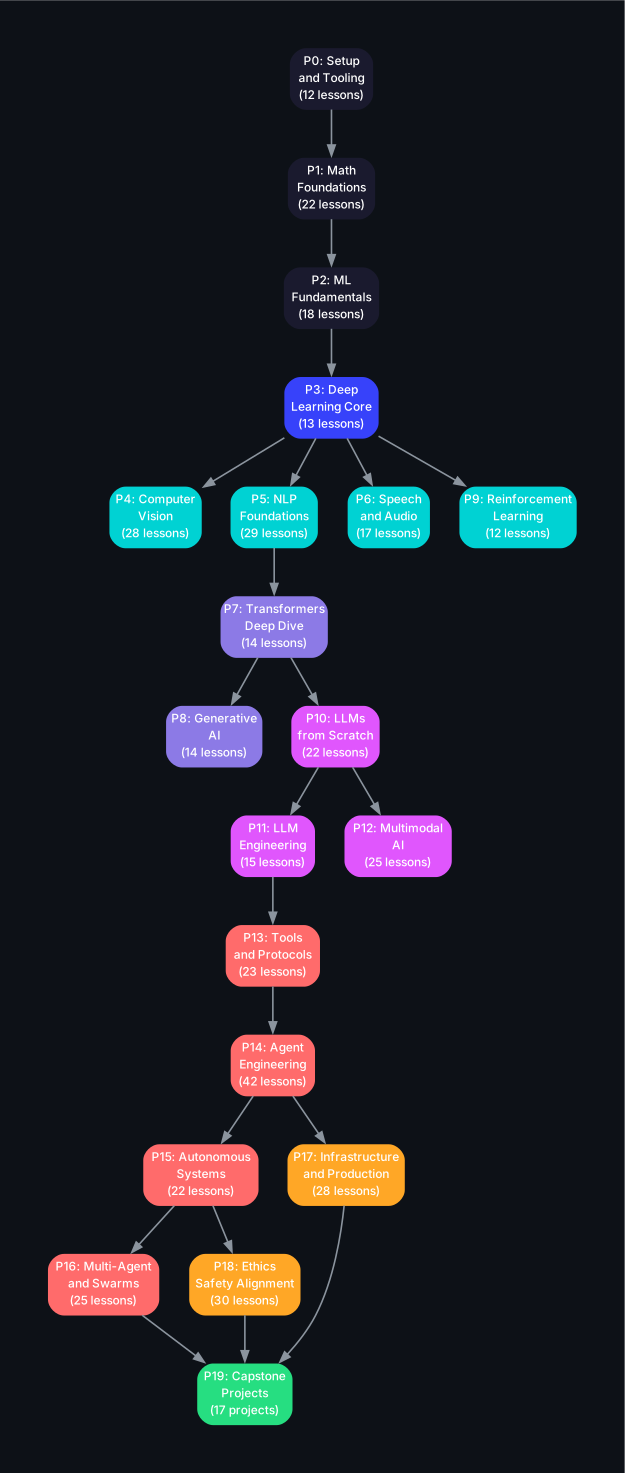
The 20-Phase Curriculum
Twenty phases stack on top of each other. Math is the floor. Agents and production are the roof.
Foundation Layer (Phases 0-2)
| Phase | Topic | Lessons | What You Build |
|---|---|---|---|
| P0 | Setup and Tooling | 12 | Dev environment, GPU setup, Docker, Jupyter |
| P1 | Math Foundations | 22 | Linear algebra, calculus, probability, optimization, SVD, Fourier transform |
| P2 | ML Fundamentals | 18 | Linear regression, decision trees, SVMs, ensemble methods, pipelines |
Deep Learning Core (Phase 3)
| Phase | Topic | Lessons | What You Build |
|---|---|---|---|
| P3 | Deep Learning Core | 13 | Perceptron, backprop from scratch, optimizers, mini framework, PyTorch intro |
Modality Branches (Phases 4-6, 9)
| Phase | Topic | Lessons | What You Build |
|---|---|---|---|
| P4 | Computer Vision | 28 | CNNs, YOLO, U-Net, GANs, diffusion, ViT, 3D Gaussian splatting, world models |
| P5 | NLP Foundations | 29 | Tokenization, Word2Vec, NER, attention, machine translation, RAG chunking |
| P6 | Speech and Audio | 17 | ASR, Whisper, TTS, voice cloning, music generation, neural codecs |
| P9 | Reinforcement Learning | 12 | Q-learning, DQN, PPO, RLHF, multi-agent RL |
Transformer Revolution (Phases 7-8)
| Phase | Topic | Lessons | What You Build |
|---|---|---|---|
| P7 | Transformers Deep Dive | 14 | Self-attention, multi-head attention, BERT, GPT, MoE, Flash Attention |
| P8 | Generative AI | 14 | VAEs, GANs, diffusion models, Stable Diffusion, ControlNet, video generation |
LLM Layer (Phases 10-12)
| Phase | Topic | Lessons | What You Build |
|---|---|---|---|
| P10 | LLMs from Scratch | 22 | Tokenizers, pre-training mini GPT, RLHF, DPO, quantization, DeepSeek-V3 walkthrough |
| P11 | LLM Engineering | 15 | Prompt engineering, RAG, LoRA fine-tuning, function calling, MCP, guardrails |
| P12 | Multimodal AI | 25 | CLIP, LLaVA, BLIP-2, video-language, embodied VLAs, multimodal RAG |
Agent Layer (Phases 13-16)
| Phase | Topic | Lessons | What You Build |
|---|---|---|---|
| P13 | Tools and Protocols | 23 | MCP servers/clients, A2A protocol, OAuth 2.1, OpenTelemetry, skill SDKs |
| P14 | Agent Engineering | 42 | Agent loop, ReWOO, LangGraph, CrewAI, OpenAI/Claude SDKs, workbench |
| P15 | Autonomous Systems | 22 | Self-improvement, kill switches, constitutional AI, METR, safety frameworks |
| P16 | Multi-Agent and Swarms | 25 | Supervisor patterns, A2A, consensus, swarm optimization, MARL |
Production and Ethics (Phases 17-18)
| Phase | Topic | Lessons | What You Build |
|---|---|---|---|
| P17 | Infrastructure and Production | 28 | vLLM, SGLang, TensorRT-LLM, chaos engineering, FinOps, compliance |
| P18 | Ethics, Safety, Alignment | 30 | Red-teaming, watermarking, differential privacy, EU AI Act, dual-use risk |
Capstone (Phase 19)
| Phase | Topic | Projects | What You Build |
|---|---|---|---|
| P19 | Capstone Projects | 17 | Terminal coding agent, RAG chatbot, voice assistant, multi-agent team, and more |
The 6-Beat Lesson Structure
Every lesson follows the same six beats. The Build It / Use It split is the spine — you implement the algorithm from scratch first, then run the same thing through the production library.
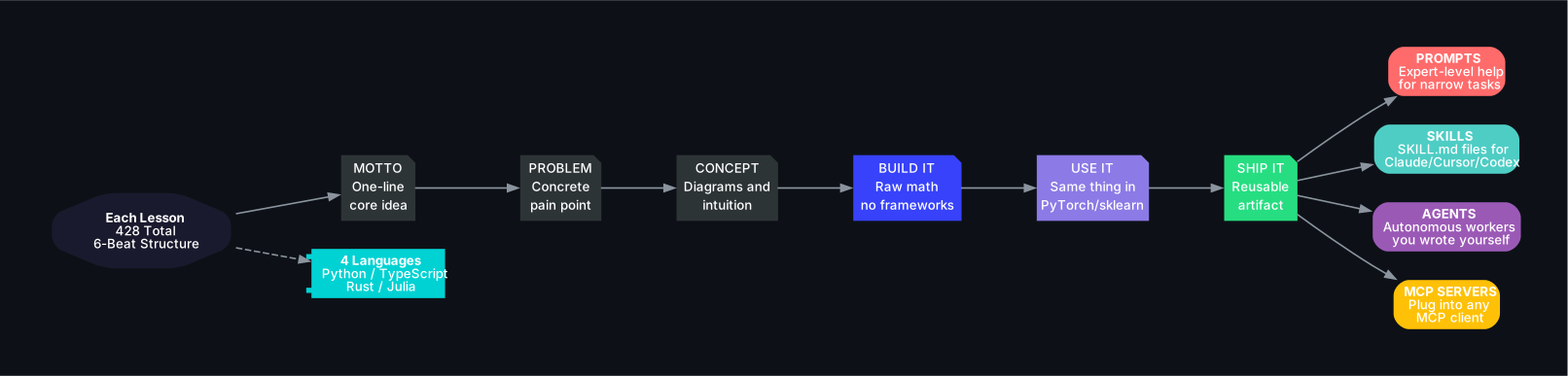
- MOTTO — One-line core idea
- PROBLEM — Concrete pain point
- CONCEPT — Diagrams and intuition
- BUILD IT — Raw math, no frameworks
- USE IT — Same thing in PyTorch / sklearn
- SHIP IT — Produce a reusable artifact
Every Lesson Ships Something
Other curricula end with “congratulations, you learned X.” Each lesson here ends with a reusable tool you can install or paste into your daily workflow:
| Artifact | What It Is |
|---|---|
| Prompts | Paste into any AI assistant for expert-level help on a narrow task |
| Skills | Drop into Claude, Cursor, Codex, OpenClaw, Hermes, or any agent that reads SKILL.md |
| Agents | Deploy as autonomous workers — you wrote the loop yourself in Phase 14 |
| MCP Servers | Plug into any MCP-compatible client. Built end-to-end in Phase 13 |
By the end of the curriculum, you have a portfolio of 428 artifacts you actually understand because you built them.
A Worked Example: The Agent Loop
Phase 14, lesson 1: the agent loop. ~120 lines of pure Python, no dependencies.
def run(query, tools):
    history = [user(query)]
    for step in range(MAX_STEPS):
        msg = llm(history)
        if msg.tool_calls:
            for call in msg.tool_calls:
                result = tools[call.name](**call.args)
                history.append(tool_result(call.id, result))
            continue
        return msg.content
    raise StepLimitExceeded
And the shipped artifact — a skill you can drop into any agent:
---
name: agent-loop
description: ReAct-style loop for any tool list
phase: 14
lesson: 01
---

Implement a minimal agent loop that...
Built-in Agent Skills
The curriculum includes two built-in skills for AI coding agents:
| Skill | What It Does |
|---|---|
/find-your-level | Ten-question placement quiz. Maps your knowledge to a starting phase and produces a personalized path with hour estimates |
/check-understanding <phase> | Per-phase quiz, eight questions, with feedback and specific lessons to review |
Four Languages
The curriculum uses Python, TypeScript, Rust, and Julia — each chosen where it makes the most sense:
- Python for ML/DL core and rapid prototyping
- TypeScript for production agents and web interfaces
- Rust for performance-critical inference and real-time processing
- Julia for mathematical foundations and numerical computing
Where to Start
| Background | Start at | Estimated Time |
|---|---|---|
| New to programming and AI | Phase 0 — Setup | ~306 hours |
| Know Python, new to ML | Phase 1 — Math Foundations | ~270 hours |
| Know ML, new to deep learning | Phase 3 — Deep Learning Core | ~200 hours |
| Know deep learning, want LLMs and agents | Phase 10 — LLMs from Scratch | ~100 hours |
| Senior engineer, only want agent engineering | Phase 14 — Agent Engineering | ~60 hours |
Quick Start
# Clone and run
git clone https://github.com/rohitg00/ai-engineering-from-scratch.git
cd ai-engineering-from-scratch
python phases/01-math-foundations/01-linear-algebra-intuition/code/vectors.py
Or read any completed lesson on aiengineeringfromscratch.com — no setup, no cloning.
Why This Curriculum Matters
AI Engineering from Scratch fills a critical gap in AI education. While most resources teach you to call APIs, this curriculum teaches you to understand what those APIs are doing — and then build production systems on top of that understanding.
Key differentiators:
- Build-first pedagogy — Every algorithm from raw math before touching a framework
- Shippable artifacts — 428 reusable tools, not just homework exercises
- Complete stack coverage — From linear algebra to autonomous swarms in one coherent path
- Multi-language — Python, TypeScript, Rust, Julia where each excels
- Agent-native — Built-in SkillKit integration for Claude, Cursor, Codex, and more
- Production-ready — Phase 17 covers real infrastructure: vLLM, SGLang, FinOps, compliance
For anyone serious about understanding AI from the ground up — not just using it — this is the most comprehensive open-source curriculum available.
Repository: github.com/rohitg00/ai-engineering-from-scratch Enjoyed this post? Never miss out on future posts by following us
Stars: 8.9K+ | License: MIT | Website: aiengineeringfromscratch.com 


