ESP-Claw: Espressif’s AI Agent Framework for IoT Devices
ESP-Claw is Espressif’s groundbreaking “Chat Coding” AI agent framework that brings intelligent agent capabilities directly to ESP32-series microcontrollers. Instead of treating IoT devices as passive command executors, ESP-Claw transforms them into active decision-making centers that can sense, think, and act locally – all through natural conversation. With an ESP32 chip costing just a few dollars, you can deploy an AI agent that responds in milliseconds, maintains structured memory, and communicates via the MCP protocol.
What is ESP-Claw?
ESP-Claw is an open-source (Apache 2.0) C-based framework from Espressif, the company behind the ubiquitous ESP32 microcontroller series. Inspired by the OpenClaw concept, it reimplements the agent runtime natively in C for maximum efficiency on resource-constrained devices. The framework defines device behavior through conversation – users chat via instant messaging platforms, and the device dynamically loads and executes Lua scripts to fulfill requests.
Traditional IoT stops at connectivity: devices can connect to the network but cannot think; they can execute commands but cannot make decisions. ESP-Claw bridges this gap by bringing the Agent Runtime directly onto Espressif chips, enabling them to operate as autonomous edge agents rather than remote-controlled peripherals.
Key Insight: ESP-Claw runs a complete AI agent loop on a microcontroller costing just a few dollars, achieving millisecond response times by processing events locally and only calling cloud LLMs when reasoning is needed.
Key Features
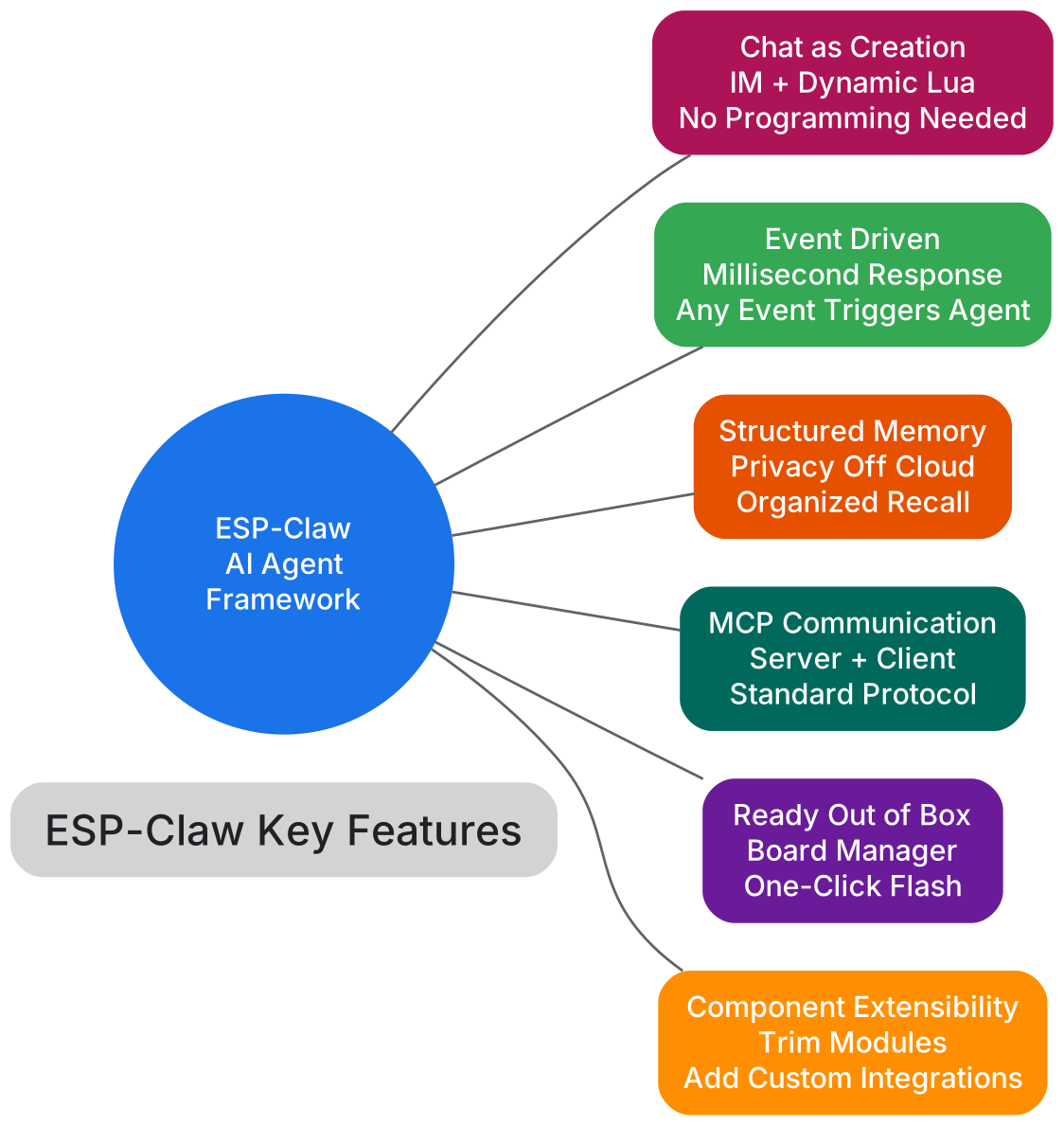
Understanding ESP-Claw’s Feature Set
The feature diagram above illustrates the six core capabilities that make ESP-Claw unique in the IoT landscape:
Chat as Creation – Users define device behavior through IM conversations on Telegram, QQ, Feishu, or WeChat. The framework dynamically loads Lua scripts based on conversational intent, meaning ordinary users can program IoT devices without writing a single line of code.
Event Driven – Any event (sensor reading, timer, IM message, MCP communication, or boot) can trigger the Agent Loop. Because processing happens on-device, responses can be as fast as milliseconds rather than the seconds typical of cloud round-trips.
Structured Memory – ESP-Claw organizes memories in a structured way that enables context-aware decision making. Privacy stays off the cloud by default – sensitive data never leaves the device unless explicitly configured.
MCP Communication – Full support for the Model Context Protocol (MCP) as both server and client. This enables ESP-Claw devices to communicate with other MCP-compatible tools and services, creating interoperable IoT ecosystems.
Ready Out of the Box – Board Manager provides quick setup with one-click flashing directly from the browser. No local compilation or development environment needed to get started.
Component Extensibility – Every module can be trimmed as needed for resource optimization, and custom component integrations can be added through the modular architecture.
The Agent Loop: Sense, Think, Act
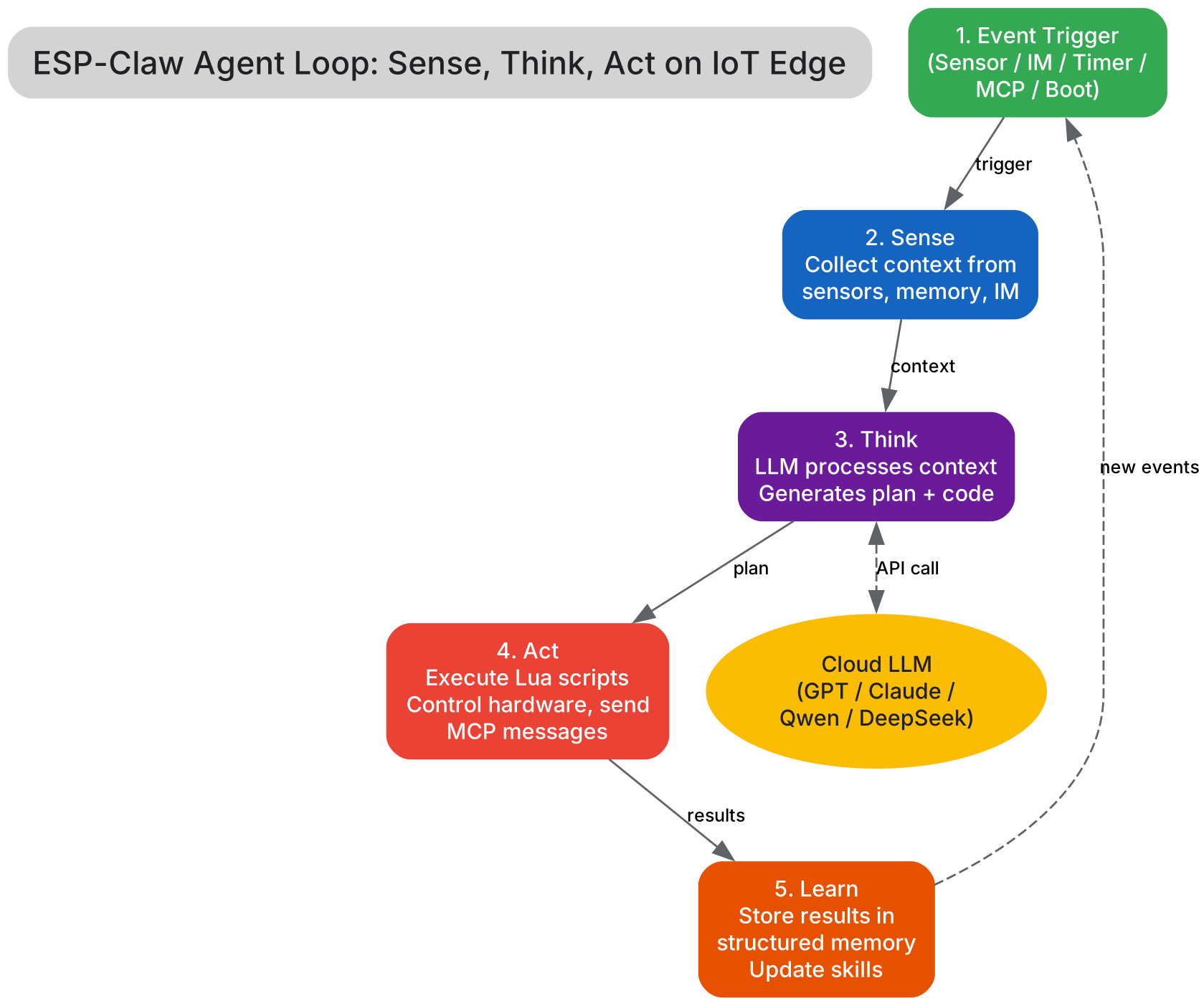
Understanding the Agent Loop
The agent loop diagram above shows how ESP-Claw implements the fundamental Sense-Think-Act cycle on IoT edge devices:
1. Event Trigger – The loop begins when any event fires: a sensor reading crosses a threshold, an IM message arrives, a timer expires, an MCP message is received, or the device boots. This event-driven architecture means the device is always responsive, never polling wastefully.
2. Sense – The agent collects context from all available sources: current sensor readings, recent memory entries, IM conversation history, and device state. This context gathering happens locally on the ESP32, ensuring low latency.
3. Think – The collected context is sent to a cloud LLM (GPT, Claude, Qwen, or DeepSeek) for reasoning. The LLM analyzes the situation and generates a plan that may include Lua code to execute, MCP messages to send, or memory entries to store. This is the only step that requires internet connectivity.
4. Act – The generated plan is executed locally: Lua scripts run to control hardware (GPIO, displays, sensors), MCP messages are sent to other devices, and IM responses are delivered back to the user. All execution happens on the ESP32 itself.
5. Learn – Results are stored in structured memory for future reference. Skills are updated, and the agent becomes more capable over time. New events from the action phase can trigger subsequent agent loops, creating autonomous behavior chains.
Takeaway: The agent loop design means ESP-Claw devices can operate semi-autonomously – they only need cloud LLM access for the “Think” phase, while all sensing, acting, and learning happens locally on the microcontroller.
Architecture Deep Dive
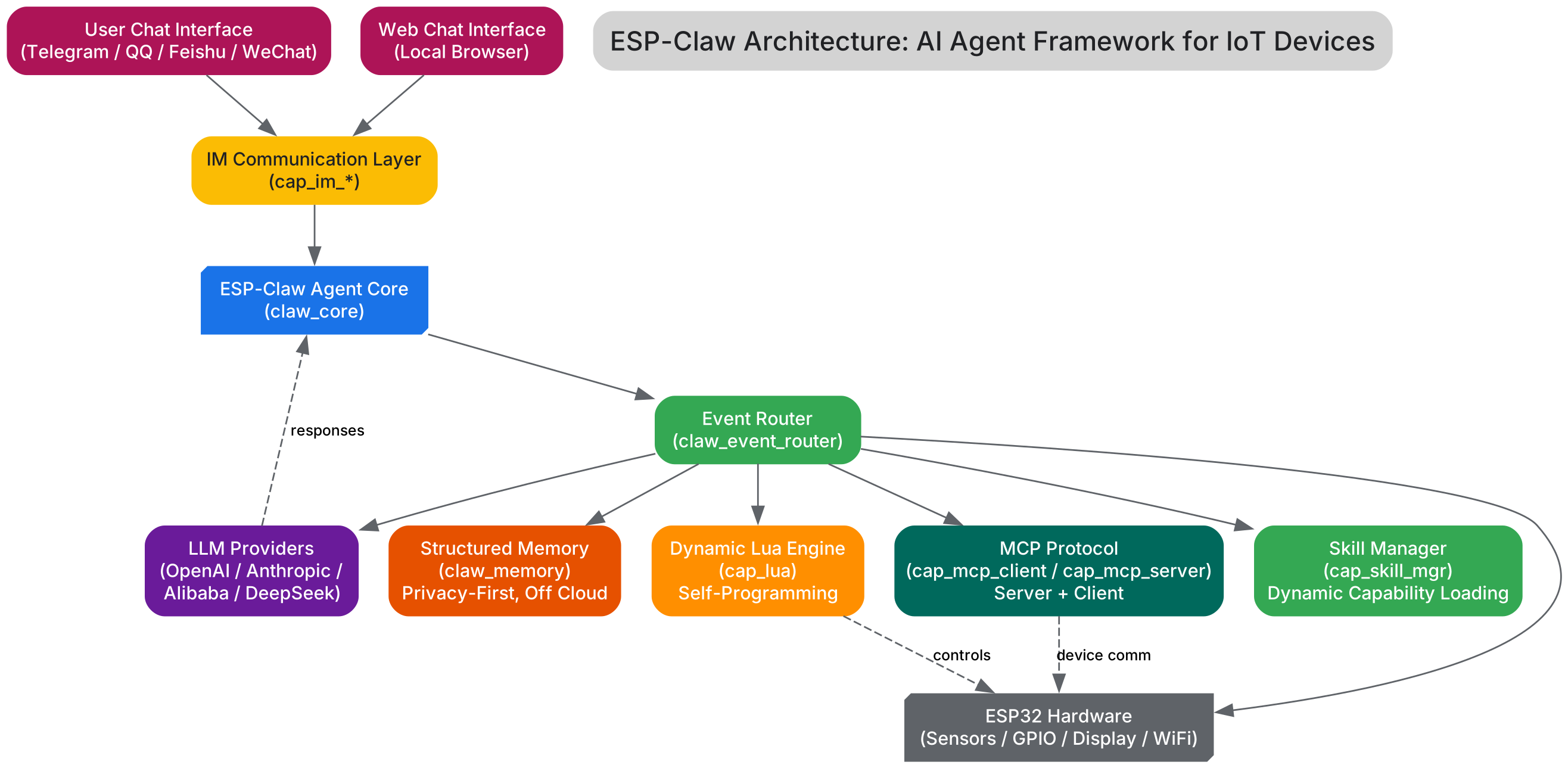
ESP-Claw’s architecture is built around a modular component system that runs on ESP32-S3 and ESP32-P4 chips:
Core Components
| Component | Purpose | Key Feature |
|---|---|---|
claw_core | Agent runtime engine | Orchestrates the full agent loop |
claw_event_router | Event dispatch system | Routes any event to trigger agent actions |
claw_memory | Structured memory store | Privacy-first, off-cloud storage |
claw_skill | Dynamic skill loading | Load/unload capabilities at runtime |
claw_cap | Capability framework | Base for all pluggable capabilities |
IM Communication Capabilities
| Module | Platform | Feature |
|---|---|---|
cap_im_tg | Telegram | Bot-based chat interface |
cap_im_qq | Chinese messaging platform | |
cap_im_feishu | Feishu (Lark) | Enterprise messaging with rich cards |
cap_im_wechat | QR login flow, message handling | |
cap_im_local | Local Web | Browser-based chat interface |
LLM Provider Support
ESP-Claw supports multiple LLM backends through a unified API:
- OpenAI – GPT models (recommended: gpt-5.4)
- Anthropic – Claude models (recommended: claude4.6-sonnet)
- Alibaba Cloud – Qwen models (recommended: qwen3.6-plus)
- DeepSeek – DeepSeek models (recommended: deepseek-v4-pro)
- Custom endpoints – Any OpenAI-compatible API
Important: ESP-Claw’s self-programming capability depends on models with strong tool use and instruction-following ability. The recommended models (gpt-5.4, qwen3.6-plus, claude4.6-sonnet, deepseek-v4-pro) provide the best results for dynamic Lua code generation.
Supported Hardware
ESP-Claw already supports multiple ESP32-S3-based development boards:
| Board | Manufacturer | Key Feature |
|---|---|---|
| ESP32-S3 Breadboard | Espressif | Minimal setup, breadboard-friendly |
| M5Stack CoreS3 | M5Stack | Integrated display, camera, IMU |
| M5Stack StickS3 | M5Stack | Compact stick form factor |
| DFRobot K10 | DFRobot | Community-contributed support |
| LilyGo T-Display S3 | LilyGo | Large display integration |
| ESP32-P4 Eye | Espressif | Camera and AI acceleration |
| Sensair Shuttle | Espressif | Environmental sensor board |
All supported boards can be flashed online directly from the browser – no local compilation or development environment required.
Installation and Quick Start
Online Flashing (Recommended)
The fastest way to get started with ESP-Claw is through the browser-based flashing tool:
- Visit ESP-Claw Online Flashing
- Select your board from the supported list
- Configure your board settings
- Click “Flash” to install the firmware
- Connect to the device via your preferred IM platform
Building from Source
For custom boards or advanced configuration:
# Clone the repository
git clone https://github.com/espressif/esp-claw.git
cd esp-claw

# Set up ESP-IDF environment
# Follow the guide at https://esp-claw.com/en/reference-project/build-from-source/

# Build for your target board
cd application/edge_agent
idf.py set-target esp32s3
idf.py -DBOARD=your_board build

# Flash to device
idf.py -DBOARD=your_board flash monitor
First-Run Setup
ESP-Claw includes a guided setup wizard for first-time configuration:
- LLM Provider – Choose from OpenAI, Anthropic, Alibaba Cloud, or DeepSeek presets
- Search Provider – Configure web search API keys
- IM Platform – Set up Telegram bot, WeChat, QQ, or Feishu integration
- WiFi – Connect to your local network
Amazing: The entire ESP-Claw agent framework, including the Lua runtime, event router, memory system, and IM communication, runs on an ESP32-S3 chip with just 8-16MB of flash storage – a fraction of what a typical AI agent needs on a full computer.
Dynamic Lua Scripting
One of ESP-Claw’s most powerful features is its dynamic Lua scripting engine. When a user sends a message like “Turn on the LED when the temperature exceeds 30 degrees,” the LLM generates Lua code that is loaded and executed on the device in real time.
Example Lua Capabilities
| Module | Purpose | Example Use |
|---|---|---|
lua_module_environmental_sensor | Read environmental sensors | Temperature, humidity monitoring |
lua_module_magnetometer | Magnetic field sensing | Compass, door open/close detection |
lua_module_fuel_gauge | Battery monitoring | Low battery alerts |
lua_module_lcd | Display control | Show status on screen |
lua_module_knob | Rotary encoder input | User input dial |
lua_module_ssd1306 | OLED display | Small screen output |
Each Lua module comes with example scripts and skill metadata, making it easy to extend device capabilities without deep C programming knowledge.
MCP Protocol Support
ESP-Claw implements the Model Context Protocol (MCP) as both a server and client, enabling:
- As MCP Server – Other AI agents and tools can discover and interact with ESP-Claw devices
- As MCP Client – ESP-Claw can call external MCP-compatible services and tools
- Device-to-Device – Multiple ESP-Claw devices can communicate and coordinate via MCP
This dual-role capability makes ESP-Claw devices first-class citizens in the broader AI agent ecosystem, not just passive endpoints.
Comparison with Alternatives
| Feature | ESP-Claw | OpenClaw | Traditional IoT |
|---|---|---|---|
| Runs on ESP32 | Yes | No (desktop) | Varies |
| Language | C (native) | TypeScript | C/C++ |
| Agent Loop | Built-in | Built-in | Manual |
| IM Integration | Native | Via plugins | None |
| MCP Support | Server + Client | Client only | None |
| Self-Programming | Lua dynamic | JavaScript | Firmware flash |
| Memory | Structured, local | Cloud-based | None |
| Cost | $3-5 chip | Desktop | Varies |
| Response Time | Milliseconds | Seconds | Varies |
Troubleshooting
| Issue | Solution |
|---|---|
| Device not entering network provisioning after online flash | Fixed in latest version – update firmware |
| Web Chat not receiving replies | Ensure WebSocket connection is stable; check firewall settings |
| LLM responses are poor quality | Use recommended models (gpt-5.4, claude4.6-sonnet, qwen3.6-plus, deepseek-v4-pro) |
| WiFi connection drops after settings change | Use wifi --apply for immediate STA settings application |
| Build errors on custom board | Verify board definitions in application/edge_agent/boards/ |
Links
- GitHub Repository: https://github.com/espressif/esp-claw
- Official Documentation: https://esp-claw.com/en/tutorial/
- Online Flashing Tool: https://esp-claw.com/en/flash/
- Build from Source Guide: https://esp-claw.com/en/reference-project/build-from-source/
Conclusion
ESP-Claw represents a paradigm shift in IoT development. By bringing AI agent capabilities directly to microcontrollers, Espressif has eliminated the traditional barrier between “connected devices” and “intelligent devices.” With chat-driven programming, millisecond event response, structured local memory, and MCP protocol support, ESP-Claw transforms a $3 ESP32 chip into an autonomous edge agent that can sense, think, and act without constant cloud supervision.
Whether you are building smart home controllers, industrial monitoring systems, or educational IoT projects, ESP-Claw provides the framework to make your devices truly intelligent – all through natural conversation. The combination of C-based efficiency, Lua extensibility, and multi-platform IM support makes it the most accessible and capable edge AI agent framework available for embedded systems today. Enjoyed this post? Never miss out on future posts by following us