Ruflo: Multi-Agent AI Orchestration for Claude Code
Ruflo is a multi-agent AI orchestration platform for Claude Code that deploys 100+ specialized agents in coordinated swarms with self-learning memory, federated communications, and enterprise-grade security. Whether you are building autonomous coding workflows, managing cross-team agent collaboration, or running background optimization tasks, Ruflo provides the infrastructure to make AI agents work together effectively.
Understanding the Architecture
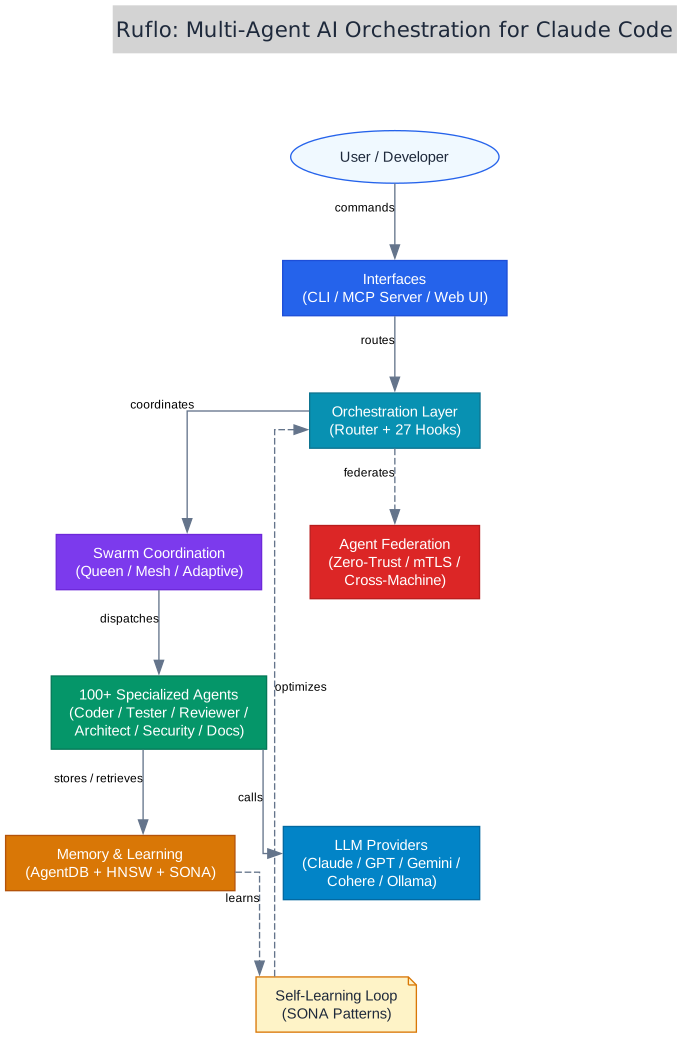
The architecture diagram above illustrates Ruflo’s layered design, where each component builds on the one below it to create a complete orchestration system.
User / Developer Layer At the top, developers interact with Ruflo through three interfaces: the CLI for terminal-based workflows, the MCP Server for integration with Claude Code and other AI tools, and the Web UI (flo.ruv.io) for browser-based multi-model chat with parallel tool calling. Each interface connects to the same orchestration engine, so commands and context stay consistent regardless of entry point.
Orchestration Layer The orchestration layer is the brain of Ruflo. It includes an intelligent router that achieves 89% accuracy in matching tasks to the right agent, plus 27 hooks that automatically intercept, route, and learn from every task. When you type a command, the router analyzes it, selects the best agent, and dispatches it through the swarm coordinator.
Swarm Coordination Ruflo supports three swarm topologies: Queen-led hierarchy (one coordinator agent dispatches work to workers), Mesh (all agents communicate peer-to-peer), and Adaptive (the system dynamically switches between topologies based on task complexity). Consensus protocols including Raft and Byzantine agreement ensure agents agree on outcomes even when some fail.
100+ Specialized Agents Below the swarm layer sit over 100 specialized agents, each designed for a specific domain: coding, testing, security auditing, documentation generation, architecture review, and more. Agents can work in parallel on different parts of a task, and the swarm coordinator ensures their outputs merge correctly.
Memory and Learning AgentDB provides persistent vector memory using HNSW indexing, delivering 150x to 12,500x faster search than brute force. SONA (Self-Optimizing Neural Architecture) captures successful patterns and feeds them back into the routing system, so the platform gets smarter with every task. ReasoningBank stores trajectory data for future reference.
LLM Providers Ruflo supports five LLM providers out of the box: Claude, GPT, Gemini, Cohere, and Ollama (for local models). Smart routing automatically selects the best provider for each task, with automatic failover if a provider is unavailable.
Agent Federation The federation layer enables agents on different machines, teams, or organizations to collaborate securely. Using mTLS and ed25519 challenge-response for identity verification, plus a 14-type PII detection pipeline, federation ensures that sensitive data never leaves your node while still enabling productive cross-boundary collaboration.
Key Insight: Ruflo’s HNSW vector memory delivers 150x to 12,500x faster search than brute force, enabling sub-millisecond retrieval across millions of vectors.
Key Features

Understanding the Features
The features diagram shows how all of Ruflo’s capabilities radiate from the central orchestration engine.
Swarm Coordination Ruflo’s swarm system supports three topologies: hierarchical (Queen-led), mesh (peer-to-peer), and adaptive (dynamic switching). The Queen topology uses Raft consensus for reliability, while mesh enables direct agent-to-agent communication for lower latency. Adaptive mode monitors task complexity and switches topologies in real time.
Vector Memory AgentDB with HNSW indexing provides persistent, sub-millisecond vector search across all agent sessions. Unlike session-only memory in vanilla Claude Code, Ruflo agents remember context across sessions, projects, and even machines. The 150x to 12,500x speed improvement over brute force search means agents retrieve relevant context instantly.
Self-Learning SONA (Self-Optimizing Neural Architecture) captures successful task patterns and feeds them back into the routing system. When an agent completes a task successfully, the trajectory is stored in ReasoningBank. Future tasks with similar characteristics are routed to the same agent type, improving accuracy from 89% baseline to even higher over time.
Agent Federation Federation enables zero-trust collaboration between agents on different machines. Remote agents start untrusted and must prove identity via mTLS and ed25519 challenge-response. A 14-type PII detection pipeline automatically strips sensitive data before it leaves your node. Behavioral trust scoring (0.4x success + 0.2x uptime + 0.2x threat + 0.2x integrity) continuously evaluates peer reliability.
Background Workers Twelve auto-triggered workers run in the background: audit, optimize, testgaps, security scan, documentation, and more. These workers monitor your codebase and proactively suggest improvements without any manual intervention.
Plugin Marketplace Ruflo offers 32 native Claude Code plugins plus 21 npm plugins covering core orchestration, memory, intelligence, code quality, security, architecture, DevOps, and domain-specific tasks. Each plugin adds focused capabilities without bloating the core system.
Multi-Provider LLM Five LLM providers are supported natively: Claude, GPT, Gemini, Cohere, and Ollama. Smart routing selects the best provider for each task, and automatic failover ensures continuity even when a provider experiences downtime.
Enterprise Security AIDefence blocks prompt injection attacks, detects PII, and scans for vulnerabilities. CVE remediation is built in, and path traversal prevention protects your filesystem. All federation traffic is encrypted and auditable for HIPAA, SOC2, and GDPR compliance.
Task Processing Workflow
Understanding the Workflow
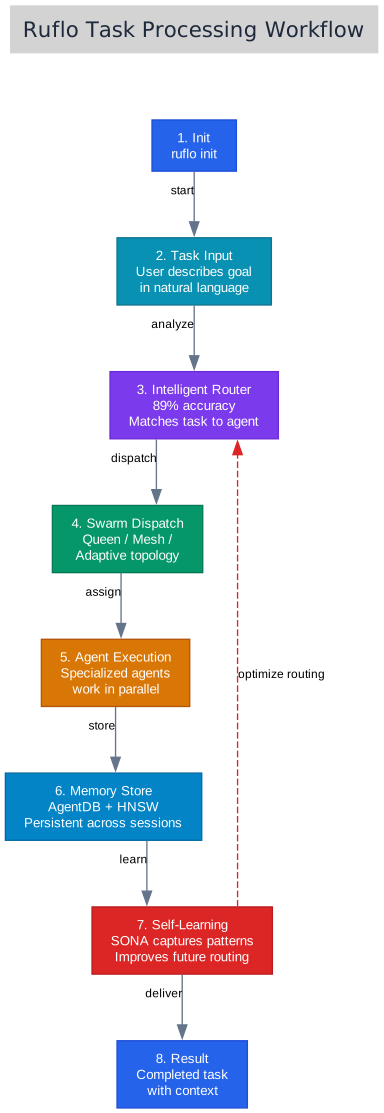
The workflow diagram shows how a task moves through Ruflo from initial input to completed result.
Step 1: Init Running ruflo init sets up the orchestration environment, configures hooks, registers agents, and initializes the memory database. This one-time setup gives Claude Code its “nervous system” for agent coordination.
Step 2: Task Input Users describe goals in natural language. There is no need to learn specific commands or JSON schemas. Simply tell Ruflo what you want to accomplish, and the system handles the rest.
Step 3: Intelligent Router The router analyzes the task description and matches it to the best agent type. With 89% baseline accuracy (improving over time through SONA learning), the router considers task complexity, agent availability, and historical success rates to make optimal assignments.
Step 4: Swarm Dispatch The swarm coordinator assigns the task to one or more agents using the appropriate topology. Simple tasks go to a single agent. Complex tasks get decomposed and distributed across multiple agents working in parallel.
Step 5: Agent Execution Specialized agents execute their assigned subtasks. Coder agents write code, tester agents generate tests, reviewer agents analyze quality, and security agents scan for vulnerabilities. All agents can operate simultaneously.
Step 6: Memory Store Results, context, and trajectory data are stored in AgentDB with HNSW indexing. This persistent memory means agents can recall relevant information from previous sessions, projects, and even other team members’ work.
Step 7: Self-Learning SONA captures the patterns of successful task completions and stores them in ReasoningBank. The learning loop feeds back into the router, continuously improving task-agent matching accuracy.
Step 8: Result The completed task, with full context and documentation, is delivered back to the user. The feedback loop from Step 7 back to Step 3 ensures that future similar tasks are routed even more efficiently.
Installation
Takeaway: With just
ruflo init, Claude Code gains a complete nervous system for agent coordination – no manual configuration needed. The 27 hooks automatically route tasks, learn from successful patterns, and coordinate agents in the background.
Claude Code Plugin (Recommended)
# Add the marketplace
/plugin marketplace add ruvnet/ruflo

# Install core + plugins you need
/plugin install ruflo-core@ruflo
/plugin install ruflo-swarm@ruflo
/plugin install ruflo-autopilot@ruflo
/plugin install ruflo-federation@ruflo
CLI Install
# One-line install
curl -fsSL https://cdn.jsdelivr.net/gh/ruvnet/ruflo@main/scripts/install.sh | bash

# Or via npx
npx ruflo@latest init --wizard

# Or install globally
npm install -g ruflo@latest
MCP Server
# Add Ruflo as an MCP server in Claude Code
claude mcp add ruflo -- npx -y @claude-flow/cli@latest
Usage
Basic Agent Orchestration
# Initialize Ruflo in your project
ruflo init

# Spawn a swarm of agents for a task
ruflo swarm spawn --task "Refactor the authentication module with tests"

# Check swarm status
ruflo swarm status

# View agent memory
ruflo memory search "authentication patterns"
Federation Setup
# Initialize federation on your machine
ruflo federation init

# Join a remote federation endpoint
ruflo federation join wss://partner.example.com:8443

# Send a task to a federated agent
ruflo federation send --to partner-team --type task-request \
  --message "Review the API changes for security issues"

# Check trust levels
ruflo federation status
Goal-Oriented Planning
# Describe a goal in plain English
ruflo goals create "Ship the payment integration with full test coverage"

# View the generated plan
ruflo goals plan

# Execute the plan with agents
ruflo goals execute
Plugin Ecosystem
Ruflo provides 32 native plugins organized by category:
| Category | Plugins | Purpose |
|---|---|---|
| Core and Orchestration | core, swarm, autopilot, loop-workers, workflows, federation | Agent coordination and task management |
| Memory and Knowledge | agentdb, rag-memory, rvf, ruvector, knowledge-graph | Persistent storage and retrieval |
| Intelligence and Learning | intelligence, daa, ruvllm, goals | Self-improvement and planning |
| Code Quality and Testing | testgen, browser, jujutsu, docs | Automated quality assurance |
| Security and Compliance | security-audit, aidefence | Vulnerability scanning and PII protection |
| Architecture and Methodology | adr, ddd, sparc | Design patterns and development methodology |
| DevOps and Observability | migrations, observability, cost-tracker | Infrastructure and monitoring |
| Extensibility | wasm, plugin-creator | Sandbox and custom plugin development |
| Domain-Specific | iot-cognitum, neural-trader, market-data | IoT, trading, and financial data |
Amazing: The intelligent router achieves 89% accuracy in matching tasks to the right agent type, and improves over time through SONA self-learning patterns that capture successful trajectories.
Comparison: Claude Code With vs Without Ruflo
| Capability | Claude Code Alone | With Ruflo |
|---|---|---|
| Agent Collaboration | Isolated, no shared context | Swarms with shared memory and consensus |
| Coordination | Manual orchestration | Queen-led hierarchy with Raft consensus |
| Memory | Session-only | HNSW vector memory with sub-ms retrieval |
| Learning | Static behavior | SONA self-learning with pattern matching |
| Task Routing | You decide | Intelligent routing (89% accuracy) |
| Background Workers | None | 12 auto-triggered workers |
| LLM Providers | Anthropic only | 5 providers with failover |
| Security | Standard | CVE-hardened with AIDefence |
| Cross-Machine | Not supported | Zero-trust federation with mTLS |
Important: Federation uses zero-trust security with mTLS and ed25519 challenge-response, meaning agents on different machines can collaborate without leaking sensitive data. A 14-type PII detection pipeline automatically strips personal information before it leaves your node.
Troubleshooting
| Issue | Solution |
|---|---|
ruflo init fails | Ensure Node.js 20+ is installed: node --version |
| Agents not spawning | Check swarm status with ruflo swarm status and verify MCP server is running |
| Memory search returns nothing | Run ruflo memory index to rebuild the HNSW index |
| Federation connection refused | Verify the remote endpoint is accessible and mTLS certificates are valid |
| Plugin install errors | Clear npm cache with npm cache clean --force and retry |
| High token usage | Use ruflo cost-tracker to monitor and set budget limits |
Conclusion
Ruflo transforms Claude Code from a single-agent tool into a full orchestration platform. With 100+ specialized agents, swarm coordination, self-learning memory, zero-trust federation, and a rich plugin ecosystem, Ruflo enables teams to deploy AI agents that collaborate, learn, and scale across trust boundaries. The one-command init setup and natural language interface make it accessible to developers at any level, while the enterprise security features ensure production readiness.
Check out the project on GitHub: https://github.com/ruvnet/ruflo Enjoyed this post? Never miss out on future posts by following us 


