FinceptTerminal: Open-Source Financial Intelligence Platform with CFA-Level Analytics
Financial professionals have long relied on expensive proprietary terminals like Bloomberg to access real-time market data, perform complex analytics, and execute trades. FinceptTerminal v4 changes this equation entirely – it is an open-source, native C++20 desktop application that delivers Bloomberg-terminal-class performance in a single binary, with no Electron overhead, no Node.js runtime, and no browser dependency.
With over 10,000 GitHub stars and 3,100+ stars gained in a single day, FinceptTerminal has rapidly become one of the most popular open-source finance platforms. Let us explore what makes this project exceptional.
What is FinceptTerminal?
FinceptTerminal is a state-of-the-art financial intelligence platform built with C++20 and Qt6. It combines CFA-level analytics, AI automation, and unlimited data connectivity into a single native desktop application. The project is dual-licensed under AGPL-3.0 for open-source use, with commercial licenses available for business applications.
The tagline says it all: “Your Thinking is the Only Limit. The Data Isn’t.”
Architecture: Four-Layer Native Design
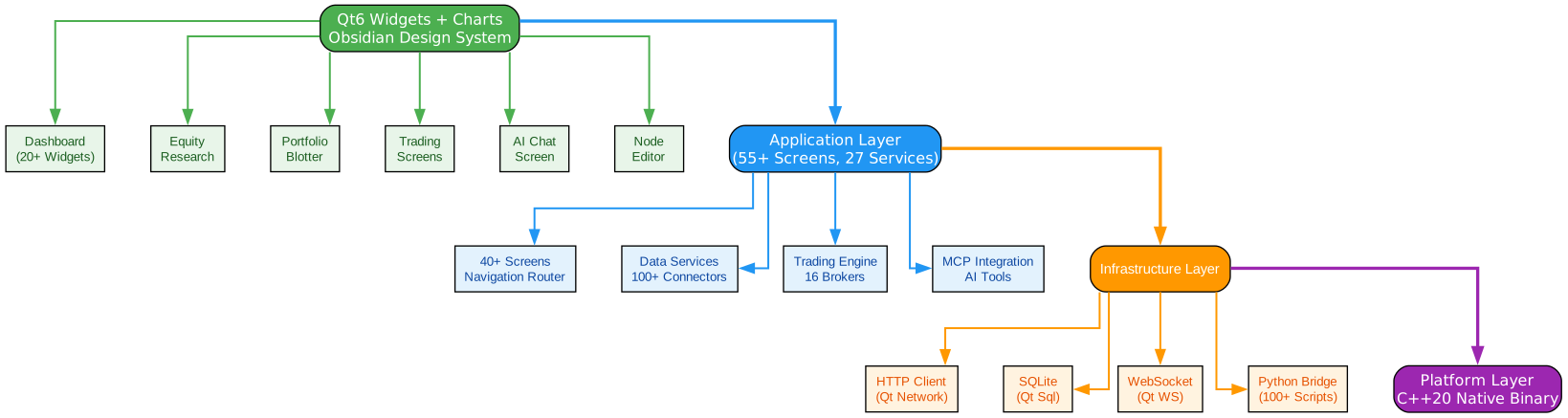
The architecture diagram above illustrates FinceptTerminal’s four-layer design, which prioritizes native performance and clean separation of concerns.
Understanding the Architecture
Layer 1: User Interface Layer
The UI layer is built entirely with Qt6 Widgets and Qt6 Charts, following an Obsidian-inspired design system that mirrors the Bloomberg terminal aesthetic. This is not a web application wrapped in Electron – it is a native retained-mode GUI that renders directly through the platform’s graphics pipeline. The result is instant responsiveness, minimal memory footprint, and zero JavaScript bundler overhead.
The UI layer hosts over 55 screens, including:
- Dashboard with 20+ real-time widgets
- Equity Research screen with DCF models and fundamental analysis
- Portfolio Blotter for multi-account portfolio management
- Trading Screens for 16 broker integrations
- AI Chat for conversational financial analysis
- Node Editor for visual workflow automation
Layer 2: Application Layer
The application layer contains the core business logic organized into four major subsystems:
- Screens (40+): Each screen is a self-contained Qt widget with its own data subscriptions, lifecycle management, and navigation routing through
ScreenRouterusingQStackedWidget. - Services (27): Data services that manage API connections, caching, and data transformation. Each service owns its HTTP clients, WebSocket connections, and Python script invocations.
- Trading Engine: A complete trading system supporting 16 broker integrations (Zerodha, Angel One, Upstox, Fyers, Dhan, Groww, Kotak, IIFL, 5paisa, AliceBlue, Shoonya, Motilal, IBKR, Alpaca, Tradier, Saxo) with real-time order management, paper trading, and algorithmic trading.
- MCP Integration: Model Context Protocol tools that allow AI agents to interact with the terminal’s data and trading capabilities programmatically.
Layer 3: Infrastructure Layer
The infrastructure layer provides the foundational services:
- HTTP Client (Qt Network): Handles all REST API calls with TLS support, rate limiting, and retry logic.
- SQLite Database (Qt Sql): Local storage for caching market data, user preferences, and session state.
- WebSocket Client (Qt WebSockets): Real-time streaming for crypto prices (Kraken, HyperLiquid), broker feeds, and news updates.
- Python Bridge: An embedded Python 3.11+ runtime that executes over 100 analytics scripts for quantitative analysis, risk modeling, and AI inference.
Layer 4: Platform Layer
The platform abstraction layer ensures cross-platform compatibility across Windows (MSVC), macOS (Clang), and Linux (GCC), all using C++20 features and Qt6’s platform abstraction.
DataHub: Pub/Sub Data Architecture
Understanding the DataHub Architecture
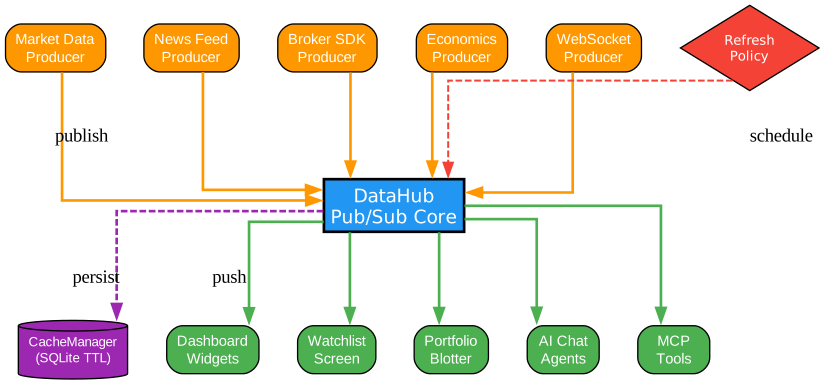
One of FinceptTerminal’s most sophisticated engineering achievements is its DataHub – an in-process publish/subscribe data layer that solves a critical problem in financial applications: data duplication and stale state.
The Problem DataHub Solves
Before DataHub, each of the 55+ screens and 20+ dashboard widgets independently fetched its own data. This meant:
- Duplicate Python process spawns for the same market data
- Duplicate HTTP requests to the same APIs from different screens
- Fragmented cache behavior with no single source of truth for “when was AAPL last updated?”
- Three incompatible response styles across 27 services:
std::functioncallbacks, Qt signals with request IDs, and raw WebSocket streams
How DataHub Works
DataHub implements a topic-based pub/sub pattern where:
-
Topics are string-keyed slots following the format
domain:subdomain:id[:modifier]. Examples includemarket:quote:AAPL,news:symbol:NVDA,econ:fred:GDP, andws:kraken:BTC-USD. -
Producers are services that own the refresh logic for a set of topic patterns. Each producer implements a
Producerinterface withtopic_patterns(),refresh(), and optionalmax_requests_per_sec()for rate limiting. -
Subscribers are any
QObject(widget, screen, service, MCP tool) that callsDataHub::subscribe(owner, topic, slot). When a subscriber is destroyed, its subscription auto-cleans via Qt’sQObject::destroyed()signal. -
Refresh Policy ensures that data is fetched only when needed – when at least one subscriber exists and the cached value is stale. This eliminates duplicate fetches entirely.
The DataHub architecture draws inspiration from financial data platforms like Bloomberg’s BPIPE and Reuters’s TREP, but adapts the pattern for a single-process desktop application using Qt’s signal/slot mechanism.
AI Agents and Features
Understanding the Feature Ecosystem
37 AI Agents Across Three Frameworks
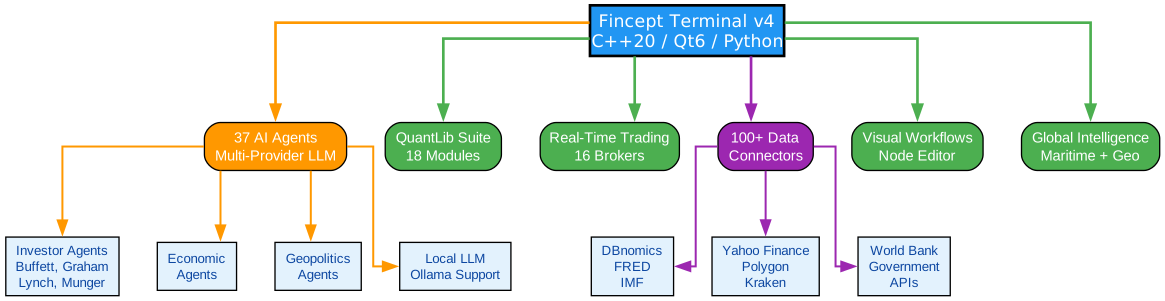
FinceptTerminal includes 37 pre-built AI agents organized into three categories:
-
Investor Agents: Modeled after legendary investors including Warren Buffett, Benjamin Graham, Peter Lynch, Charlie Munger, Seth Klarman, and Howard Marks. Each agent applies its namesake’s investment philosophy to analyze stocks, evaluate risk, and generate recommendations.
-
Economic Agents: Analyze macroeconomic indicators, central bank policies, and economic cycles to provide context for investment decisions.
-
Geopolitics Agents: Monitor geopolitical events, trade relationships, and political risk factors that affect markets.
All agents support multi-provider LLM integration (OpenAI, Anthropic, Gemini, Groq, DeepSeek, MiniMax, OpenRouter, and local Ollama), allowing users to choose their preferred AI backend or run everything locally for privacy.
QuantLib Suite: 18 Quantitative Analysis Modules
The embedded Python runtime powers 18 quantitative analysis modules covering:
- Options pricing (Black-Scholes, binomial models)
- Risk metrics (Value at Risk, Sharpe ratio, maximum drawdown)
- Stochastic modeling (Monte Carlo simulation, random walks)
- Volatility analysis (implied volatility surfaces, GARCH models)
- Fixed income (bond pricing, yield curves, duration/convexity)
100+ Data Connectors
FinceptTerminal connects to over 100 data sources including:
- Market Data: Yahoo Finance, Polygon, Kraken, HyperLiquid
- Economic Data: DBnomics, FRED (Federal Reserve), IMF, World Bank
- Government APIs: Multiple government data portals
- Alternative Data: Adanos market sentiment for equity research
- Regional Data: AkShare for Asian markets
Real-Time Trading
The trading engine supports 16 broker integrations with real-time WebSocket streaming for crypto markets, algorithmic trading, and a built-in paper trading engine for strategy testing without financial risk.
Installation
Option 1: Download Installer (Recommended)
Download the latest release from the GitHub Releases page:
| Platform | Download |
|---|---|
| Windows x64 | FinceptTerminal-4.0.2-win64-setup.exe |
| Linux x64 | FinceptTerminal-4.0.2-linux-x64-setup.run |
| macOS Apple Silicon | FinceptTerminal-4.0.2-macOS-setup.dmg |
Option 2: Quick Start (Linux/macOS)
git clone https://github.com/Fincept-Corporation/FinceptTerminal.git
cd FinceptTerminal
chmod +x setup.sh && ./setup.sh
The setup script handles: compiler check, CMake, Qt6, Python, build, and launch.
Option 3: Docker
docker pull ghcr.io/fincept-corporation/fincept-terminal:latest
docker run --rm -e DISPLAY=$DISPLAY -v /tmp/.X11-unix:/tmp/.X11-unix \
    ghcr.io/fincept-corporation/fincept-terminal:latest
Option 4: Build from Source
Prerequisites (pinned versions):
| Tool | Version |
|---|---|
| CMake | 3.27.7 |
| Ninja | 1.11.1 |
| C++ Compiler | MSVC 19.38 / GCC 12.3 / Apple Clang 15.0 |
| Qt | 6.8.3 |
| Python | 3.11.9 |
git clone https://github.com/Fincept-Corporation/FinceptTerminal.git
cd FinceptTerminal/fincept-qt

# Configure (one-time)
cmake --preset linux-release    # Linux
cmake --preset win-release      # Windows
cmake --preset macos-release    # macOS

# Build
cmake --build --preset linux-release
Key Features Summary
| Feature | Description |
|---|---|
| CFA-Level Analytics | DCF models, portfolio optimization, risk metrics (VaR, Sharpe), derivatives pricing via embedded Python |
| 37 AI Agents | Investor (Buffett, Graham, Lynch, Munger, Klarman, Marks), Economic, and Geopolitics frameworks; local LLM support |
| 100+ Data Connectors | DBnomics, Polygon, Kraken, Yahoo Finance, FRED, IMF, World Bank, AkShare, government APIs |
| Real-Time Trading | Crypto (Kraken/HyperLiquid WebSocket), equity, algo trading, paper trading, 16 broker integrations |
| QuantLib Suite | 18 quantitative analysis modules – pricing, risk, stochastic, volatility, fixed income |
| Global Intelligence | Maritime tracking, geopolitical analysis, relationship mapping, satellite data |
| Visual Workflows | Node editor for automation pipelines, MCP tool integration |
| AI Quant Lab | ML models, factor discovery, HFT, reinforcement learning trading |
Roadmap
| Timeline | Milestone |
|---|---|
| Shipped | Real-time streaming, 16 broker integrations, multi-account trading, PIN authentication, theme system |
| Q2 2026 | Options strategy builder, multi-portfolio management, 50+ AI agents |
| Q3 2026 | Programmatic API, ML training UI, institutional features |
| Future | Mobile companion, cloud sync, community marketplace |
What Sets FinceptTerminal Apart
FinceptTerminal distinguishes itself from other financial platforms through several key design decisions:
Native Performance: Built with C++20 and Qt6, the application runs as a single native binary with no Electron overhead, no Node.js runtime, and no JavaScript bundler. This means instant startup, minimal memory usage, and smooth real-time data rendering.
Single Binary Distribution: Unlike web-based financial tools that require browser runtimes, FinceptTerminal ships as a single executable with all dependencies embedded. No installation of separate runtimes is needed.
CFA-Level Analytics: The embedded Python runtime provides complete CFA curriculum coverage through 18 quantitative analysis modules, making it suitable for professional financial analysis.
100+ Data Connectors: From Yahoo Finance to government databases, FinceptTerminal connects to over 100 data sources, ensuring comprehensive market coverage.
Open Source (AGPL-3.0): The entire codebase is open source under AGPL-3.0, with commercial licenses available for business use. This transparency allows users to verify data handling, customize analytics, and contribute improvements.
Troubleshooting
| Issue | Solution |
|---|---|
| “Could not find Qt6 6.8.3” | Verify CMAKE_PREFIX_PATH points to Qt 6.8.3 install |
| MSVC version error | Use VS 2022 17.8+ (MSVC 19.38+). Check with cl /? |
| Different Qt minor version | Pass -DFINCEPT_ALLOW_QT_DRIFT=ON for local testing only |
| Clean rebuild needed | Delete build/<preset>/ and re-run configure |
Conclusion
FinceptTerminal represents a significant achievement in open-source financial technology. By combining native C++20 performance with Qt6’s cross-platform UI framework, embedded Python analytics, and a sophisticated pub/sub data architecture, it delivers professional-grade financial intelligence that was previously only available through expensive proprietary platforms.
The project’s rapid growth – gaining over 3,100 stars in a single day – reflects the strong demand for open-source financial tools that combine depth of analytics with accessibility. Whether you are a quantitative analyst, a day trader, or a finance student studying for the CFA, FinceptTerminal provides the tools you need in a single, self-contained application.
GitHub Repository: https://github.com/Fincept-Corporation/FinceptTerminal
License: AGPL-3.0 (Open Source) + Commercial Enjoyed this post? Never miss out on future posts by following us 


