What if your coding agent was so cheap you could just leave it running all day? DeepSeek-Reasonix is a terminal-based AI coding agent built from the ground up for DeepSeek’s API — and its secret weapon isn’t a smarter model, it’s a smarter loop. By engineering every layer around DeepSeek’s prefix-cache mechanic, Reasonix achieves a 99.82% cache hit rate in real-world usage, turning what would cost $61 into roughly $12 for the same workload.
Cache stability isn’t a feature you turn on; it’s an invariant the loop is designed around. That’s the whole reason Reasonix is DeepSeek-only — every layer is tuned to the byte-stable prefix-cache mechanic.
Key Features
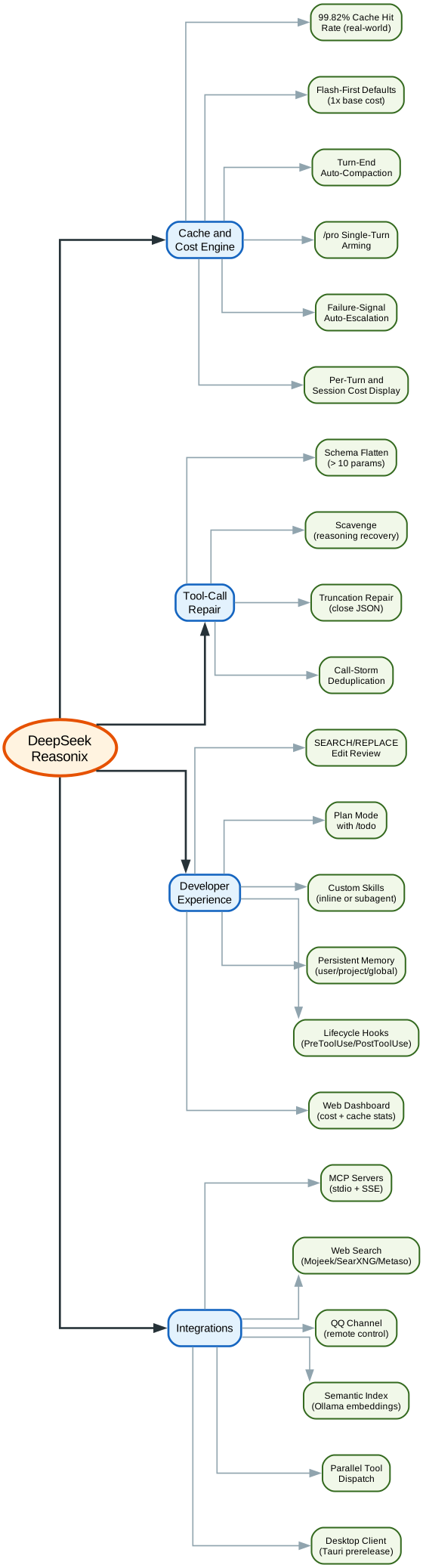
- 99.82% Cache Hit Rate — Real-world case study: 435M input tokens processed with near-perfect cache hits, reducing costs by ~80%
- Flash-First Cost Control — Defaults to
v4-flash(1x cost), auto-escalates tov4-proonly when the model struggles - Tool-Call Repair Pipeline — Four-pass system that fixes DeepSeek’s known failure modes: dropped tool calls, truncated JSON, and call-storms
- SEARCH/REPLACE Edit Review — Proposes edits inline; nothing touches disk until you
/apply - Custom Skills — Write Markdown playbooks the model can invoke as inline or subagent modes
- Persistent Memory — User, project, and global memory types pinned into the prefix
- MCP Bridge — Connect any MCP server via stdio or SSE
- Web Search — Built-in Mojeek, SearXNG, and Metaso engine support
- Parallel Tool Dispatch — Read-only tools run concurrently for faster iteration
- Desktop Client — Native Tauri app with multi-tab support (prerelease)
How It Works
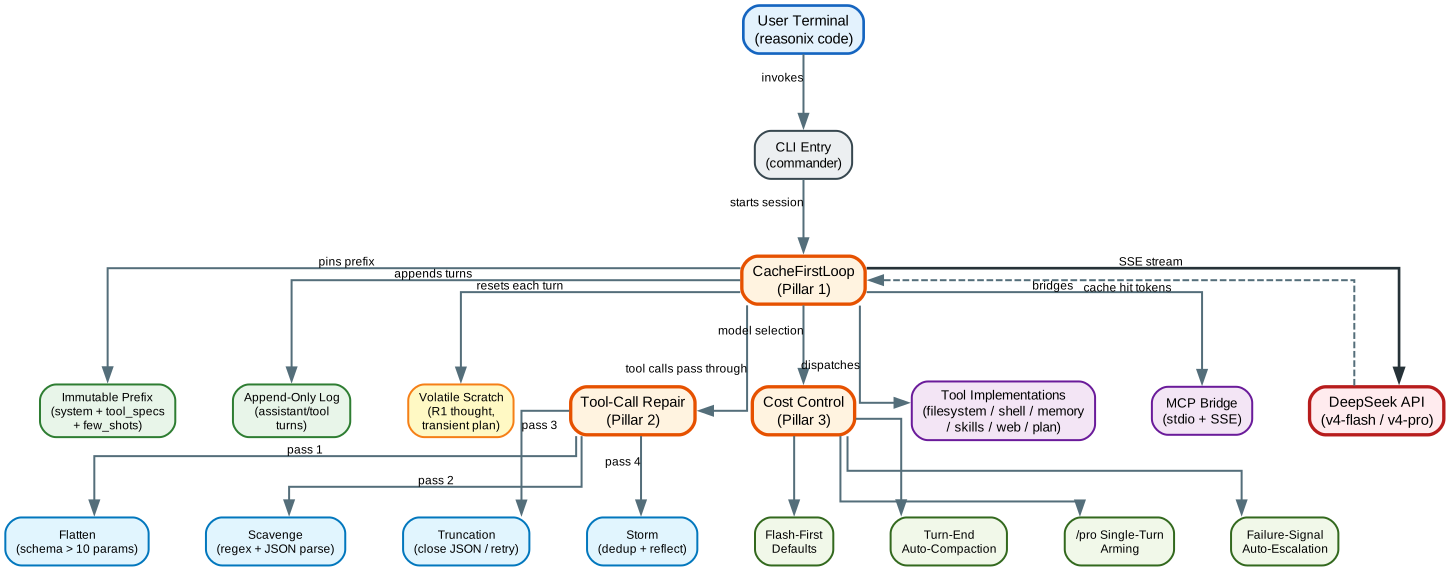
DeepSeek-Reasonix is organized around three architectural pillars, each solving a problem that generic agent frameworks overlook because they were designed for a different cache mechanic.
Pillar 1: Cache-First Loop
DeepSeek bills cached input tokens at roughly 10% of the miss rate. Automatic prefix caching activates only when the exact byte prefix of the previous request matches. Most agent loops reorder, rewrite, or inject timestamps each turn — resulting in cache hit rates below 20% in practice.
Reasonix solves this by partitioning the context into three regions:
- Immutable Prefix — System prompt, tool specs, and few-shots are computed once per session, hashed, and pinned. This is the cache hit candidate.
- Append-Only Log — Assistant and tool turns are serialized in append order with no rewrites, preserving the prefix of prior turns.
- Volatile Scratch — R1 reasoning thoughts and transient plan state live here. This region is reset each turn and never sent upstream.
The result: the prefix stays byte-stable across the entire session, and the append-only log grows monotonically — exactly the pattern DeepSeek’s cache needs.
Pillar 2: Tool-Call Repair
DeepSeek has empirical failure modes that generic agents don’t handle:
- Flatten — Schemas with more than 10 leaf parameters or depth greater than 2 are auto-detected and presented in dot-notation form, then re-nested before calling the tool function.
- Scavenge — A regex and JSON parser sweeps
reasoning_contentfor any tool call the model forgot to emit intool_calls. - Truncation — Detects unbalanced JSON from
max_tokenshits and repairs by closing braces or requesting a continuation completion. - Storm — Identical
(tool, args)tuples within a sliding window are suppressed, and a reflection turn is injected instead.
Pillar 3: Cost Control
Four complementary mechanisms keep costs predictable:
- Flash-First Defaults — The
autopreset starts onv4-flashand escalates tov4-proonly on hard turns. All auxiliary calls (summaries, subagents, repair retries) hard-codev4-flash. - Turn-End Auto-Compaction — Tool results exceeding 3,000 tokens are shrunk when a turn ends. The model had the full text for the turn that read it; subsequent turns see a compact summary.
/proSingle-Turn Arming — Type/proand the next turn runs onv4-pro, then auto-disarms. No forgotten reverts.- Failure-Signal Auto-Escalation — When the loop detects three “flash is struggling” events (SEARCH-not-found errors, repair fires), it escalates the remainder of the turn to
v4-prowith a visible warning.
Getting Started
Install Reasonix globally for the reasonix command on your PATH:
npm install -g reasonix
reasonix code my-project
Or run it once without installing:
cd my-project
npx reasonix code
Grab a DeepSeek API key — paste it on first run and it persists after. Reasonix requires Node 22 or later and works on macOS, Linux, and Windows.
Essential Commands
| Command | Purpose |
|---|---|
reasonix / reasonix code [dir] | The coding agent — start here |
reasonix chat | Plain chat — no filesystem or shell tools |
reasonix run "task" | One-shot, streams to stdout — good for pipes |
reasonix doctor | Health check: Node, API key, MCP wiring |
reasonix update | Upgrade Reasonix itself |
Configuration
One JSON file at ~/.reasonix/config.json plus per-project overrides under <project>/.reasonix/. Configure MCP servers, skills, memory, hooks, permissions, web search engines, and semantic indexing — all documented in the Configuration Guide.
Why DeepSeek-Reasonix Matters
The AI coding agent space is crowded, but most tools are built as general-purpose wrappers that work with any LLM provider. Reasonix takes the opposite approach: DeepSeek-only by design. This opinionated choice unlocks a property no multi-provider agent can replicate — byte-stable prefix caching across long sessions.
Real user, single day (2026-05-01): 435M input tokens, 99.82% cache hit, ~$12 instead of the ~$61 the same workload would cost with no cache on v4-flash.
The tool-call repair pipeline is equally significant. DeepSeek’s reasoning models have known failure modes — dropped tool calls, truncated JSON, call-storms — that generic agents simply fail on. Reasonix detects and repairs these automatically, making the DeepSeek experience reliable enough for production coding workflows.
The cost control pillar completes the picture. By defaulting to the cheaper v4-flash model and only escalating to v4-pro when the model struggles, Reasonix keeps per-task costs low without sacrificing quality on hard problems. The /pro arming mechanism and failure-signal escalation ensure you never pay premium rates for easy tasks, and you always get premium reasoning when you need it.
For developers who spend hours in the terminal, Reasonix offers something rare: an AI coding agent cheap enough to leave running as a persistent pair programmer, not a meter you watch nervously.
Conclusion
DeepSeek-Reasonix proves that the next leap in AI coding agents isn’t just about using a better model — it’s about building a better loop around the model you have. By engineering every layer for DeepSeek’s prefix-cache mechanic, adding a four-pass tool-call repair pipeline, and implementing intelligent cost control, Reasonix delivers a terminal coding agent that’s both powerful and affordable. With 1,000+ GitHub stars and an active open-source community, it’s a compelling choice for developers who want DeepSeek-native coding assistance without the premium price tag. Install it today with Enjoyed this post? Never miss out on future posts by following us npm install -g reasonix and start coding.