Every codebase accumulates technical debt. The question isn’t whether you have it — it’s whether you know where it hides, how bad it really is, and what to fix first. Most “code review” tools produce generic best-practice checklists that feel comprehensive but lead to zero action. Tech-Debt-Skill takes a fundamentally different approach: it forces Claude Code to understand your codebase before judging it, cite specific file locations on every finding, and explicitly surface things that look bad but are actually fine.
A finding without a citation is a vibe. Vibes don’t get fixed.
What is Tech-Debt-Skill?
Tech-Debt-Skill is a Claude Code skill that produces a thorough, citable tech debt audit of your entire codebase. Run a single command — /tech-debt-audit — and get back a TECH_DEBT_AUDIT.md with file-cited findings, severity ratings, effort estimates, and a ranked list of what to actually fix. It’s not a generic best-practices checklist. It’s an opinionated audit grounded in your actual code.
Key Features
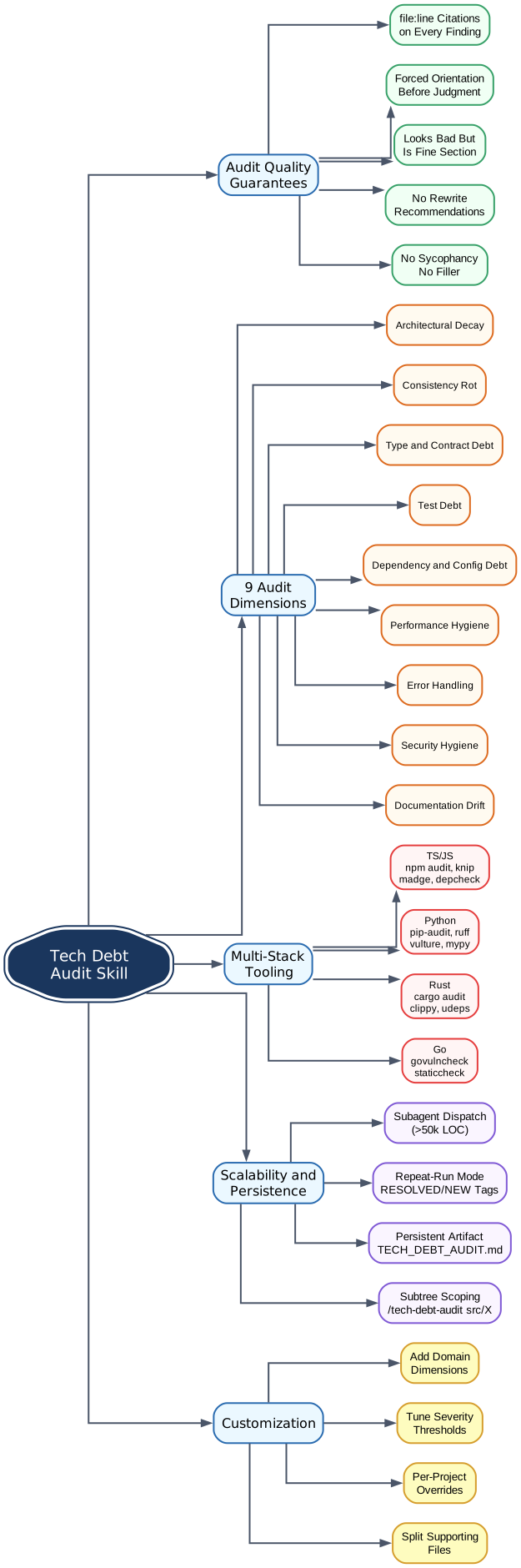
- Forced orientation before judgment — The protocol requires reading the manifest, mapping directory structure, analyzing git churn, and building a mental model before forming any opinions. Phase 1 is not optional.
- file:line citations on every finding — Every concrete finding includes
path/to/file.ext:LINE. Vague claims like “the code generally…” are rejected outright. - 9 audit dimensions — Architectural decay, consistency rot, type and contract debt, test debt, dependency and config debt, performance and resource hygiene, error handling and observability, security hygiene, and documentation drift.
- Multi-stack tooling — Automatically detects your stack and runs the right tools:
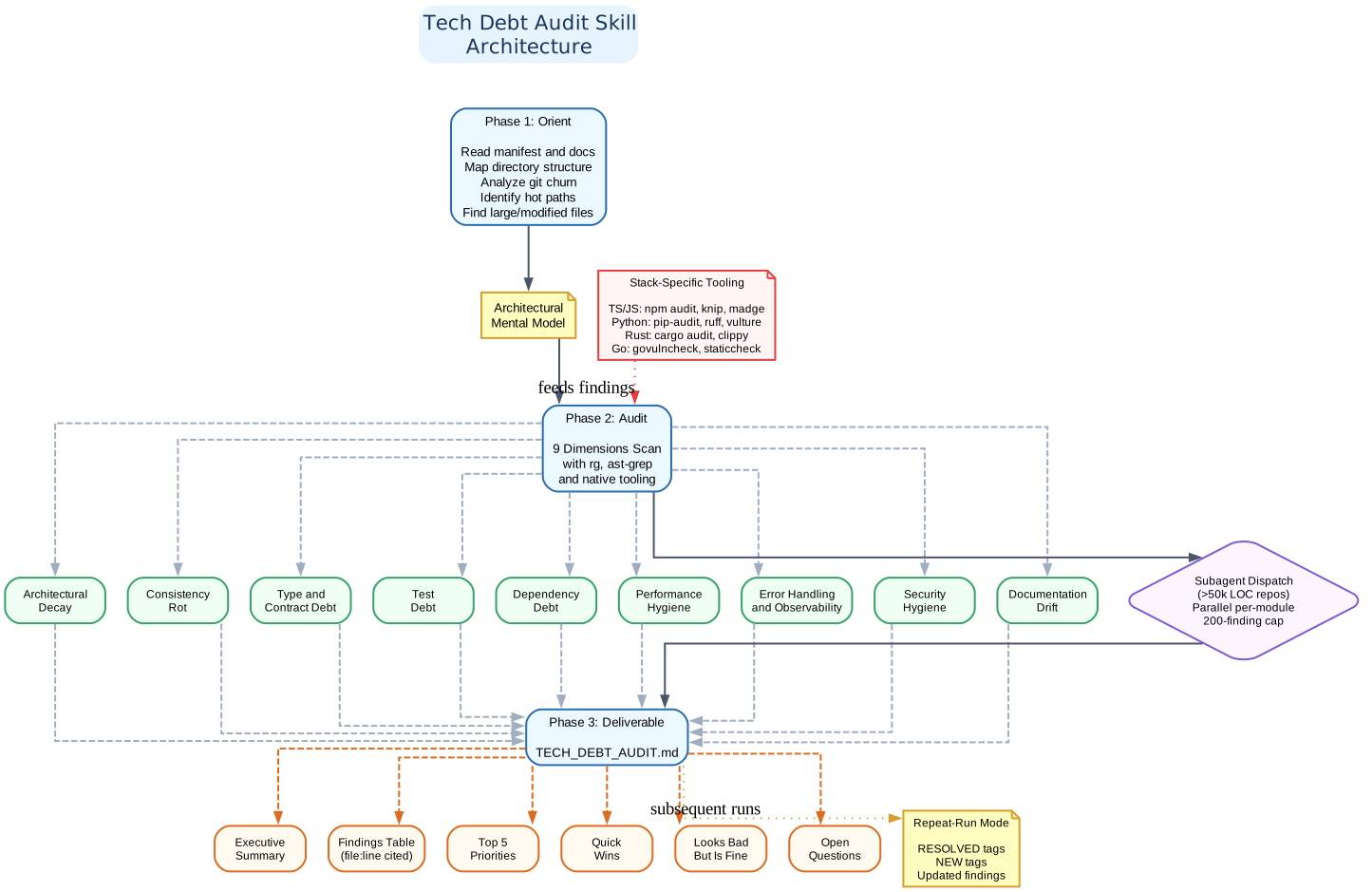
npm audit,knip,madgefor TS/JS;pip-audit,ruff,vulturefor Python;cargo audit,clippyfor Rust;govulncheck,staticcheckfor Go. - Subagent dispatch for large repos — For codebases over 50k LOC, the protocol parallelizes across modules so the main agent doesn’t run out of context.
- Repeat-run mode — On subsequent runs, resolved findings are marked
RESOLVED, stale ones are updated, and new findings are taggedNEW. The audit becomes a living document. - “Looks bad but is actually fine” section — Forces the model to surface calls it considered making and chose not to. If this section is empty, the audit didn’t look hard enough.
- Persistent, committable artifact —
TECH_DEBT_AUDIT.mdlives in your repo. You can commit it, review it in PRs, and link to specific findings.
How It Works
The audit follows a strict three-phase protocol designed to prevent the most common LLM audit failure modes:
Phase 1: Orient
The model reads your README, package manifest, architecture docs, and git log for churn data. It identifies the top 20 largest files and the 20 most frequently modified files — their intersection is where debt usually hides. A mental model of the architecture is written before any findings are formed.
Findings without context are vibes. Phase 1 isn’t optional decoration.
Phase 2: Audit
The model sweeps across nine dimensions using rg, ast-grep, and language-native tooling. Every finding must cite file:line. Stack-specific tools are detected and run in parallel when possible.
Phase 3: Deliverable
The model writes TECH_DEBT_AUDIT.md with an executive summary, architectural mental model, findings table (ID, Category, File:Line, Severity, Effort, Description, Recommendation), top 5 priorities, quick wins checklist, the required “looks bad but is actually fine” section, and open questions for the maintainer.
Getting Started
Install the skill globally (available across all your projects):
mkdir -p ~/.claude/skills/tech-debt-audit
curl -o ~/.claude/skills/tech-debt-audit/SKILL.md https://raw.githubusercontent.com/ksimback/tech-debt-skill/main/SKILL.md
Or install it project-only (just for this repo):
mkdir -p .claude/skills/tech-debt-audit && curl -o .claude/skills/tech-debt-audit/SKILL.md https://raw.githubusercontent.com/ksimback/tech-debt-skill/main/SKILL.md
Verify it’s loaded:
claude --print "/skills" | grep tech-debt-audit
Run the audit in any repo:
/tech-debt-audit
Audit a specific subtree (useful for large monorepos):
/tech-debt-audit src/payments
Why Tech-Debt-Skill Matters
Claude Code ships built-in skills like /review, /simplify, and /debug, but none of them do what a debt audit needs. /review is diff-scoped — useful before merging a branch, not when you’ve inherited 80k LOC and want to know what’s rotten. /simplify is tactical, not architectural. /debug is reactive — you point it at a known problem, while an audit’s job is to find the problems.
Tech-Debt-Skill fills this gap with three design choices that separate a real audit from checklist regurgitation:
- Forced orientation prevents pattern-matching against generic heuristics without grounding in the actual code.
- Mandatory citations make every finding falsifiable — you can verify it, dispute it, or act on it.
- The “looks bad but is actually fine” section catches shallow analysis. Forcing the model to explain why it didn’t flag something is what separates depth from surface-level scanning.
If the “looks bad but is actually fine” section comes back empty, the audit didn’t look hard enough.
The skill also explicitly forbids recommending rewrites and forbids padding categories with filler — both common LLM failure modes where rewriting is easier than diagnosing, and padding makes outputs feel thorough when they aren’t.
Customization
The skill is designed to be forked and adapted to your needs:
- Add domain-specific dimensions — Frontend repos can add accessibility; ML repos can add eval drift; LLM apps can add prompt versioning and tool-call cost.
- Tune severity thresholds — Adjust thresholds like “god files >500 LOC” to match your codebase baseline.
- Per-project overrides — A
.claude/skills/tech-debt-audit/SKILL.mdin a specific repo overrides the global one. - Split into supporting files — Extract sections into sibling files that Claude Code lazy-loads on demand.
Conclusion
Tech-Debt-Skill represents a shift in how AI assists with code quality — from generic checklist generation to grounded, citable, actionable audits. By forcing orientation before judgment, requiring file:line citations, and mandating a “looks bad but is actually fine” section, it produces findings that engineers actually act on. The persistent TECH_DEBT_AUDIT.md artifact and repeat-run mode turn it from a one-time scan into a living document you can track over time. If you’ve inherited a codebase and need to know what’s really rotten underneath, this is the tool to reach for.
Check out the GitHub repository to get started. Enjoyed this post? Never miss out on future posts by following us