AutoGPT: The Open-Source Platform for Building and Deploying Continuous AI Agents
In March 2023, a project called AutoGPT exploded onto GitHub, capturing the imagination of developers worldwide with the promise of autonomous AI agents that could reason, plan, and execute tasks without constant human supervision. Within weeks, it amassed over 100,000 stars and became the fastest-growing repository in GitHub history. But what started as a compelling proof-of-concept – a single autonomous agent looping through thought-action-observation cycles – has since evolved into something far more ambitious: a full-featured platform for building, deploying, and sharing continuous AI agents.
Today, AutoGPT boasts over 183,000 stars on GitHub and has transformed from a viral experiment into a production-grade platform. The project, maintained by Significant-Gravitas, now offers a visual agent builder with a drag-and-drop block system, an agent marketplace, credit-based execution billing, and over 30 integrations spanning everything from GitHub and Google to Discord and Reddit. This is no longer just an agent – it is an ecosystem.
In this deep dive, we will explore the architecture that powers the AutoGPT platform, dissect its block-based agent builder, trace the execution pipeline from graph definition to node-level processing, examine the marketplace and integrations ecosystem, and compare the modern platform against the original AutoGPT Classic. Whether you are evaluating AutoGPT for production automation or simply curious about how a 183K-star project reinvented itself, this post covers the technical details you need.
Platform Architecture
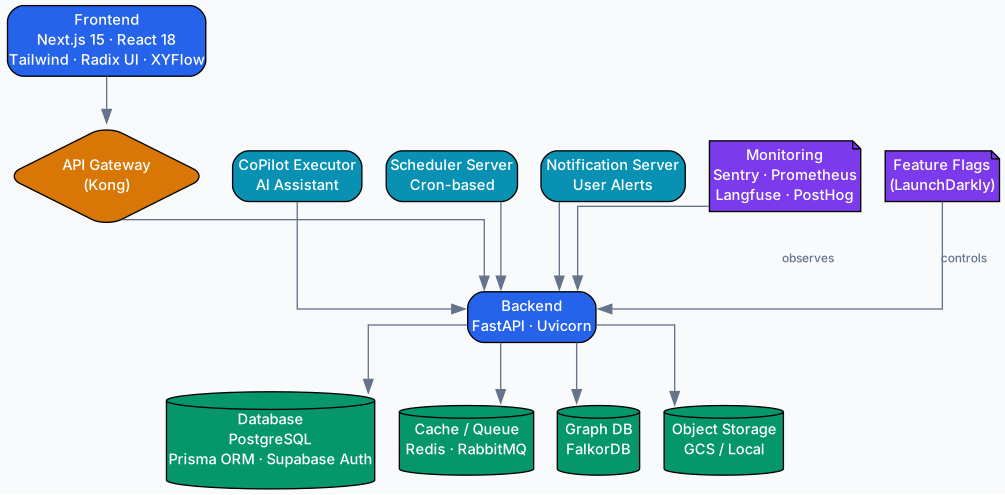
The AutoGPT platform is built on a layered microservices architecture designed for horizontal scalability, real-time monitoring, and multi-tenant isolation. At the top sits the Next.js 15 frontend, rendered with React 18 and TypeScript, styled through Tailwind CSS and Radix UI primitives, and powered by the XYFlow library for the visual agent graph editor. This frontend communicates with the backend exclusively through a RESTful API exposed via the Supabase Kong API Gateway, which handles routing, rate limiting, and authentication proxying.
The backend layer runs on FastAPI with Uvicorn as the ASGI server, supporting Python 3.10 through 3.13. FastAPI was chosen for its native async support, automatic OpenAPI schema generation, and Pydantic-based request validation. Every API endpoint is versioned and protected by Supabase Auth (GoTrue), which issues JWT tokens that the Kong gateway validates before forwarding requests to the backend. The backend itself is stateless – all persistent state lives in the data layer below.
The data layer comprises several specialized stores. PostgreSQL, hosted on Supabase and managed through the Prisma ORM, serves as the primary relational store for user accounts, agent definitions, execution metadata, and marketplace listings. The pgvector extension is enabled on PostgreSQL to power semantic search across agent descriptions and block catalogs using vector embeddings. Redis 6.2+ handles ephemeral state: session caching, rate limit counters, and queue management for the execution scheduler. RabbitMQ provides the durable message queue that dispatches agent execution jobs to worker processes, ensuring reliable delivery and retry semantics even during worker crashes. FalkorDB, a graph database, stores the structural definitions of agent graphs – nodes, edges, and their typed input/output contracts – enabling efficient graph traversal and validation.
The monitoring and observability stack is comprehensive. Sentry captures runtime exceptions and performance traces. Prometheus scrapes metrics from all services for alerting and capacity planning. Langfuse traces LLM calls, capturing prompts, completions, token counts, and latencies for cost optimization and quality auditing. PostHog tracks product analytics – feature adoption, funnel conversion, and user retention. LaunchDarkly manages feature flags, enabling gradual rollouts and A/B testing without redeployment. Stripe handles all payment flows, from subscription billing to pay-per-execution credit purchases.
This architecture enables the platform to run agents continuously, pause them for human review, resume execution after approval, and stream real-time updates to the frontend via WebSocket connections – all while maintaining strict tenant isolation and detailed audit trails.
Block-Based Agent Builder

The centerpiece of the AutoGPT platform is its visual agent builder, which replaces the text-based prompt engineering of the original AutoGPT with a structured, composable graph editor. Agents are defined as directed acyclic graphs (DAGs) where each node is a “block” – a self-contained unit of functionality with typed inputs and outputs declared via JSON Schema. Developers drag blocks from a categorized palette onto a canvas, wire their outputs to downstream inputs, and configure parameters through property panels. The result is an agent definition that is both human-readable and machine-executable.
The block catalog spans over 60 categories, organized into several broad families. AI blocks wrap LLM providers: OpenAI (GPT-4o, GPT-4o-mini), Anthropic (Claude, including the Claude Agent SDK), Groq, Ollama for local models, Replicate for hosted inference, and specialized providers like ElevenLabs for text-to-speech, Ideogram and Flux Kontext for image generation, and Perplexity for search-augmented generation. Data transformation blocks handle JSON parsing, text manipulation, arithmetic, date formatting, and conditional branching. Integration blocks connect to external services: GitHub (issues, PRs, repositories), Google (Calendar, Drive, Gmail, Sheets), Notion (databases, pages), Discord (messages, channels), Twitter/X (tweets, timelines), Reddit (posts, comments), YouTube (video metadata, transcripts), and many more. Flow control blocks implement loops, parallel branches, subgraph invocations, and error handling with fallback paths.
Every block declares its input and output schemas using JSON Schema, which serves three critical purposes. First, the builder UI uses these schemas to render type-aware connection ports – a string output can only connect to a string input, an array output to an array input, and so on. Second, the execution engine validates data at runtime against these schemas, catching type mismatches before they propagate downstream. Third, the schemas enable automatic documentation generation, so every block is self-describing without manual annotation.
Human-in-the-Loop (HITL) is a first-class concept in the block system. Any block can declare a human_input flag on one or more of its inputs. When the execution engine encounters such a block, it pauses the agent run, emits a WebSocket event to the frontend, and waits for a human operator to review the proposed action and provide the required input. This is essential for agents that perform sensitive operations – sending emails, deploying code, making financial transactions – where unreviewed autonomous execution would be unacceptable. The paused state is durable: if the reviewing human closes their browser, the agent remains paused in the database and can be resumed when they return.
The platform also supports Model Context Protocol (MCP) integration, allowing blocks to expose their capabilities as MCP tools that other agents or external MCP clients can discover and invoke. This transforms AutoGPT from a closed system into an interoperable node in the broader agent ecosystem. Webhook triggers enable agents to be activated by external events rather than manual invocation: a GitHub push, a Slack message, or an HTTP POST from any system can start an agent run. Combined with scheduling blocks, this enables truly continuous agents that operate around the clock, reacting to events and processing data without human initiation.
Agent Execution Pipeline
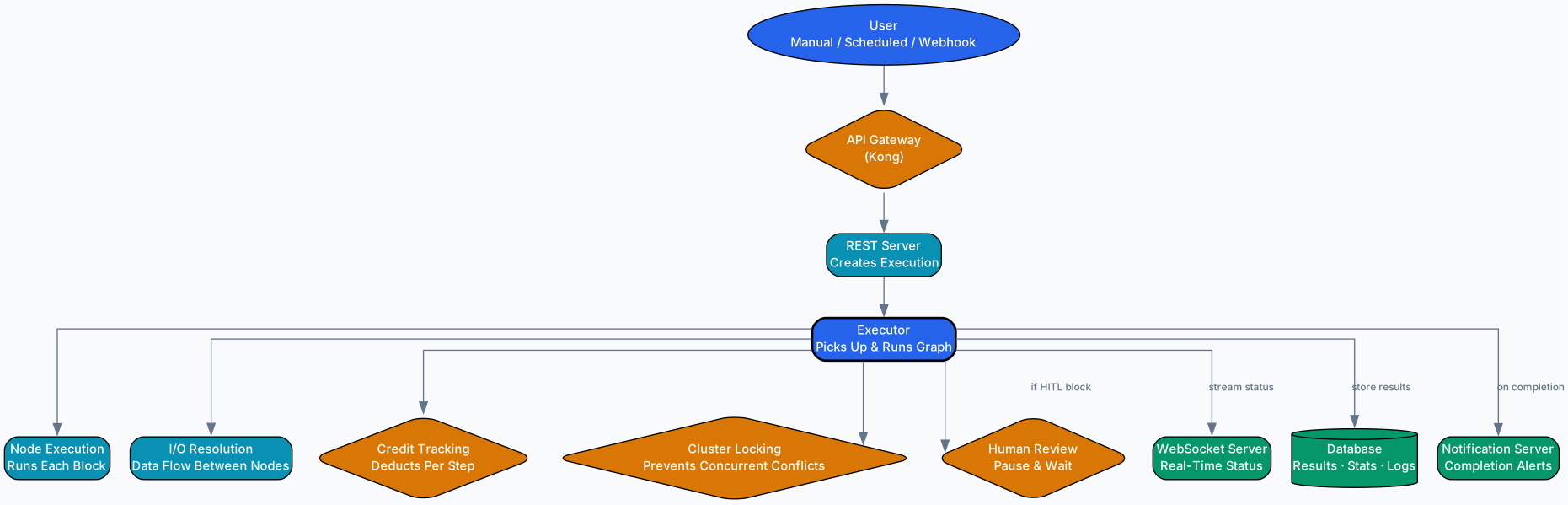
When a user clicks “Run” on an agent graph, the execution pipeline springs into motion through a carefully orchestrated sequence of stages. The process begins with graph validation: the backend traverses the stored graph definition in FalkorDB, checking that every required input has a source, that there are no circular dependencies, and that all block versions are still compatible. If validation passes, a new execution record is created in PostgreSQL with status QUEUED, and the graph definition is serialized into a job payload.
The job payload is published to RabbitMQ, where a dedicated exchange routes it to the appropriate worker queue. Worker processes, which can scale horizontally, consume jobs from these queues. When a worker picks up a job, it updates the execution status to RUNNING and begins node-by-node execution following a topological sort of the graph. Each node execution follows a strict lifecycle: the worker resolves the node’s inputs by collecting outputs from all upstream nodes that have already completed, merges any static default values configured on the node, validates the merged input against the block’s JSON Schema, and then invokes the block’s execute() method.
The execute() method is where the actual work happens – an LLM call, an API request, a data transformation, or a human review prompt. For LLM blocks, the execution engine wraps the call with Langfuse tracing, recording the full prompt, model parameters, response, token counts, and latency. For integration blocks, the engine handles OAuth token refresh, rate limiting, and retry logic transparently. For HITL blocks, the engine pauses execution, updates the node status to AWAITING_INPUT, and emits a WebSocket event. The worker does not block while waiting; instead, it releases the execution slot and registers a callback. When the human provides input through the frontend, a separate API call resumes the execution by feeding the input into the paused node and continuing the topological traversal.
Credit tracking is woven into every node execution. Before a node runs, the engine checks the user’s credit balance. LLM nodes consume credits proportional to the model’s per-token cost; integration nodes consume a flat fee per API call; flow control nodes are free. If the balance is insufficient, the execution is paused with an INSUFFICIENT_CREDITS status, and the user is notified. This credit system enables the marketplace model: agent creators can set a price per execution, and users pay with credits that they purchase through Stripe.
Cluster locking prevents concurrent execution conflicts. When an agent graph modifies shared state – writing to a Google Sheet, updating a GitHub issue, or posting to a Discord channel – the execution engine acquires a distributed lock via Redis before executing the node. This ensures that two concurrent runs of the same agent do not produce conflicting writes. Locks are held for the minimum duration necessary and are released automatically on completion or failure.
Throughout execution, the engine streams real-time updates to the frontend via WebSocket. Each node transition – from QUEUED to RUNNING, from RUNNING to COMPLETED or FAILED – is pushed as an event. LLM blocks stream their output tokens incrementally, so the user sees the model’s response appearing character by character, just as they would in a chat interface. Execution logs, including full input/output data for each node, are stored in PostgreSQL for post-mortem debugging and audit compliance.
Marketplace and Integrations Ecosystem
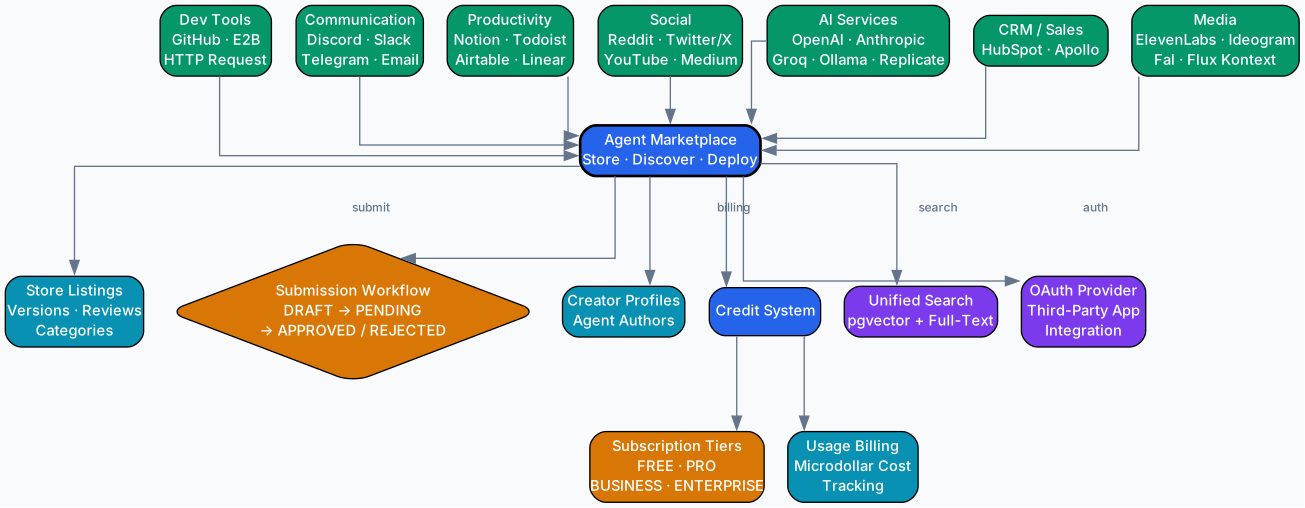
The AutoGPT Marketplace is the platform’s distribution layer, transforming individual agent graphs into shareable, installable, and monetizable products. Any user who has built an agent can submit it to the marketplace through a structured workflow: they provide a title, description, category tags, a cover image, and set a credit cost per execution. The submission enters a review queue where platform moderators verify that the agent functions as described, does not violate content policies, and properly declares its data access requirements. Approved agents are published to the marketplace catalog, where they become discoverable by all platform users.
Discovery is powered by a unified search system built on PostgreSQL with the pgvector extension. Agent descriptions, block names, and category tags are embedded into vector representations using an embedding model. When a user searches the marketplace, their query is embedded into the same vector space, and a hybrid search combining semantic similarity (pgvector) with traditional full-text search (PostgreSQL tsvector) returns ranked results. This means a search for “summarize my emails” can surface agents that use different wording but perform the requested function.
The credit system operates on a tiered model. Free-tier users receive a monthly allocation of credits sufficient for light experimentation. Paid tiers unlock larger credit pools, priority execution queues, and access to premium agents that consume more expensive models or integrations. Agent creators earn a share of the credits consumed when their agents are run by other users, creating a sustainable incentive for building high-quality, useful agents. All credit flows are tracked in PostgreSQL with full transaction histories, and Stripe handles the fiat-to-credit conversion for purchases.
The OAuth provider system is a critical piece of the integrations ecosystem. When an agent needs to access a user’s Google Calendar, GitHub repositories, or Notion workspace, it does not ask for raw credentials. Instead, the platform acts as an OAuth client: the user authorizes the platform to access their data on the third-party service, the platform stores the resulting access and refresh tokens securely, and agent executions use these tokens transparently. This means users never share passwords, and they can revoke access at any time from their dashboard. The platform currently supports OAuth flows for over 30 services, with new integrations added regularly by the community.
The integration catalog covers a broad spectrum. Developer tools: GitHub, GitLab, Bitbucket. Productivity: Google Workspace (Calendar, Drive, Gmail, Sheets), Notion, Airtable, Trello. Communication: Discord, Slack, Twitter/X, Reddit, Telegram. Media: YouTube, Spotify. E-commerce: Shopify. Databases: Supabase, PostgreSQL. AI and ML: OpenAI, Anthropic, Groq, Ollama, Replicate, Hugging Face, ElevenLabs, Ideogram, Flux Kontext, Perplexity. Infrastructure: AWS, Vercel. Finance: Stripe. The platform also supports custom HTTP blocks, enabling integration with any service that exposes a REST API, and webhook receivers for event-driven architectures.
Code execution is handled through the E2B sandbox, which provides secure, isolated environments where agents can run arbitrary code without risking the host infrastructure. This is essential for agents that need to perform data analysis, run simulations, or execute user-provided scripts. Memory is managed through dedicated blocks: Mem0 provides conversational memory that persists across agent runs, Graphiti enables knowledge graph construction and querying, and Pinecone offers vector storage for semantic retrieval. Together, these memory systems allow agents to learn from past executions and maintain context over long-running tasks.
AutoGPT Classic vs Platform
The original AutoGPT, now called AutoGPT Classic, remains available under the MIT license and represents the project’s roots. Classic is a single autonomous agent that loops through a thought-action-observation cycle: it receives a goal, reasons about what to do next, executes an action (web search, file write, code execution), observes the result, and repeats. It uses the Forge toolkit – a Python SDK that abstracts LLM interaction, memory management, and tool invocation – and can be evaluated against the Benchmark, a suite of tasks that measure an agent’s ability to complete complex, multi-step objectives.
The platform, by contrast, is licensed under Polyform Shield, which permits non-commercial and internal business use but restricts commercial redistribution. It replaces the single-agent loop with a composable graph model, adds the visual builder, marketplace, credit system, and multi-tenant infrastructure. Where Classic requires Python expertise and command-line interaction, the platform offers a browser-based editor accessible to non-developers. Where Classic runs one agent at a time on a local machine, the platform runs thousands concurrently on shared infrastructure.
Both projects comply with the Agent Protocol, an AI Engineer Foundation standard that defines a uniform REST API for agent interaction. This means tools built for one AutoGPT variant can often work with the other, and both can interoperate with any Agent Protocol-compliant system. The Forge toolkit, in particular, remains a shared dependency: it provides the LLM abstraction layer, prompt templates, and tool interfaces that underpin both Classic agents and platform blocks.
Getting Started
Running the Platform with Docker Compose
The fastest way to get the AutoGPT platform running locally is through Docker Compose, which orchestrates all the services – backend, frontend, PostgreSQL, Redis, RabbitMQ, and FalkorDB – in a single stack.
# Clone the repository
git clone https://github.com/Significant-Gravitas/AutoGPT.git
cd AutoGPT/autogpt_platform

# Copy the example environment file
cp .env.example .env

# Edit .env to add your API keys
# At minimum, set OPENAI_API_KEY for LLM blocks

# Start all services
docker compose up -d

# Verify all containers are running
docker compose ps
The .env file requires several keys to enable full functionality:
# LLM Provider Keys
OPENAI_API_KEY=sk-...
ANTHROPIC_API_KEY=sk-ant-...
GROQ_API_KEY=gsk_...

# Database (Supabase or self-hosted)
DATABASE_URL=postgresql://postgres:password@localhost:5432/autogpt

# Cache and Queue
REDIS_URL=redis://localhost:6379
RABBITMQ_URL=amqp://guest:guest@localhost:5672

# Auth (Supabase)
SUPABASE_URL=http://localhost:8000
SUPABASE_ANON_KEY=eyJ...

# Monitoring
SENTRY_DSN=https://...@sentry.io/...
Once the stack is running, open http://localhost:3000 in your browser to access the agent builder.
Creating a Simple Agent Graph
Agents are built by connecting blocks in the visual editor, but the platform also exposes a REST API for programmatic creation. Here is an example of defining a simple agent that reads a URL, summarizes it with an LLM, and posts the summary to Discord:
import requests

API_BASE = "http://localhost:8000/api/v1"
HEADERS = {"Authorization": "Bearer <your-jwt-token>"}

# Create a new graph
graph = requests.post(
    f"{API_BASE}/graphs",
    headers=HEADERS,
    json={
        "name": "URL Summarizer",
        "description": "Fetches a URL, summarizes it, and posts to Discord",
        "nodes": [
            {
                "id": "web-scraper",
                "block_id": "a1b2c3-web-scraper",
                "input_default": {"url": "https://example.com"}
            },
            {
                "id": "llm-summarizer",
                "block_id": "d4e5f6-llm-block",
                "input_default": {
                    "model": "gpt-4o-mini",
                    "prompt": "Summarize the following text concisely"
                }
            },
            {
                "id": "discord-poster",
                "block_id": "g7h8i9-discord-block",
                "input_default": {"channel_id": "1234567890"}
            }
        ],
        "links": [
            {"source_id": "web-scraper", "sink_id": "llm-summarizer",
             "source_name": "text", "sink_name": "content"},
            {"source_id": "llm-summarizer", "sink_id": "discord-poster",
             "source_name": "response", "sink_name": "message"}
        ]
    }
).json()

print(f"Created graph: {graph['id']}")
Block Configuration Example
Each block can be configured with default values and runtime overrides. Here is how a block definition looks internally:
from autogpt_platform.backend.blocks.llm import LlmBlock

class SummarizerBlock(LlmBlock):
    """Summarizes input text using an LLM."""

    class Input(BlockSchema):
        content: str
        model: str = "gpt-4o-mini"
        max_tokens: int = 500
        temperature: float = 0.3

    class Output(BlockSchema):
        summary: str
        token_count: int

    async def execute(self, input_data: Input) -> Output:
        response = await self.call_llm(
            model=input_data.model,
            messages=[
                {"role": "system", "content": "You are a concise summarizer."},
                {"role": "user", "content": f"Summarize:\n{input_data.content}"}
            ],
            max_tokens=input_data.max_tokens,
            temperature=input_data.temperature,
        )
        return self.Output(
            summary=response.content,
            token_count=response.usage.total_tokens,
        )
Running AutoGPT Classic
If you prefer the original single-agent experience, AutoGPT Classic is still actively maintained:
# Clone and enter the Classic directory
git clone https://github.com/Significant-Gravitas/AutoGPT.git
cd AutoGPT/autogpt_classic

# Create a virtual environment
python -m venv venv
source venv/bin/activate  # On Windows: venv\Scripts\activate

# Install dependencies
pip install -r requirements.txt

# Configure your AI provider
cp .env.example .env
# Edit .env to add OPENAI_API_KEY

# Run the agent
./autogpt.sh  # On Windows: autogpt.bat
Classic will prompt you for a goal, then autonomously reason and act until the objective is met or it determines no further progress can be made.
Conclusion
AutoGPT’s journey from a 2023 viral prototype to a 183K-star platform is a case study in how open-source projects can evolve beyond their initial concept. The original agent proved that autonomous LLM-driven loops were possible; the platform proves they can be productionized, composed, and shared at scale. By replacing monolithic agent scripts with a visual block-based graph editor, AutoGPT has made agent building accessible to a far broader audience while retaining the depth that power users demand.
The architecture choices – FastAPI for the backend, Next.js for the frontend, PostgreSQL with pgvector for storage and search, Redis and RabbitMQ for caching and queuing, FalkorDB for graph storage, and a comprehensive monitoring stack – reflect a design that prioritizes reliability, observability, and horizontal scalability. The credit system and marketplace create sustainable incentives for both the platform operators and agent creators, while the OAuth provider and 30+ integrations ensure that agents can interact with the tools and services that businesses already use.
Looking ahead, the platform’s commitment to the Agent Protocol standard positions it as an interoperable node in the emerging agent ecosystem. As more platforms adopt this standard, agents built on AutoGPT will be able to communicate with and invoke agents on other platforms, creating a network effect that amplifies the value of every agent in the system. The addition of MCP integration further extends this reach, enabling AutoGPT blocks to be discovered and used by any MCP-compliant client.
Whether you are a developer building automation workflows, a business operator seeking to deploy AI agents at scale, or a researcher exploring the frontier of autonomous systems, AutoGPT offers a mature, extensible, and community-driven platform to build on. The code is open, the blocks are composable, and the marketplace is growing. The era of continuous AI agents is not coming – it is here. Enjoyed this post? Never miss out on future posts by following us 


