Introduction
Hugging Face Transformers stands as the most widely-adopted machine learning library in the world, boasting over 159,000 GitHub stars and serving as the backbone for virtually every modern AI workflow. Since its inception in 2018 as a PyTorch implementation of the BERT model, the library has grown into a comprehensive framework supporting 453 distinct model architectures spanning natural language processing, computer vision, audio processing, and multimodal tasks. Its significance extends far beyond a simple model zoo – Transformers functions as the lingua franca of the ML ecosystem, providing a unified interface that bridges training frameworks, inference engines, and the broader tooling landscape.
The Hugging Face Hub hosts over one million model checkpoints, making it the de facto registry for pretrained models across the entire industry. From GPT and LLaMA to Stable Diffusion and Whisper, the Hub serves as the central distribution point where researchers publish checkpoints and practitioners download them. Transformers provides the API layer that makes this possible: a single from_pretrained() call fetches weights, configuration, and tokenizer files, then instantiates a ready-to-use model regardless of the underlying architecture. This frictionless experience is what turned Transformers from a convenience library into an ecosystem pivot.
What makes Transformers indispensable is its role as the connective tissue between every major component of the ML stack. Training frameworks like DeepSpeed, FSDP, and Accelerate integrate directly with the Hugging Face Trainer. Inference engines such as vLLM, SGLang, and Text Generation Inference (TGI) consume Hugging Face model formats as their primary input. Quantization libraries, attention backends, and experiment trackers all target the Transformers API as their integration point. This hub-and-spoke architecture means that adopting Transformers grants access to the entire ecosystem without custom glue code.
The library’s design philosophy centers on three principles: abstraction without opacity, convention over configuration, and progressive disclosure of complexity. Beginners can accomplish sophisticated tasks with a three-line pipeline call, while advanced practitioners can override every component down to the attention kernel level. This layered approach has made Transformers the entry point for ML newcomers and the daily driver for production engineers alike.
Architecture Overview
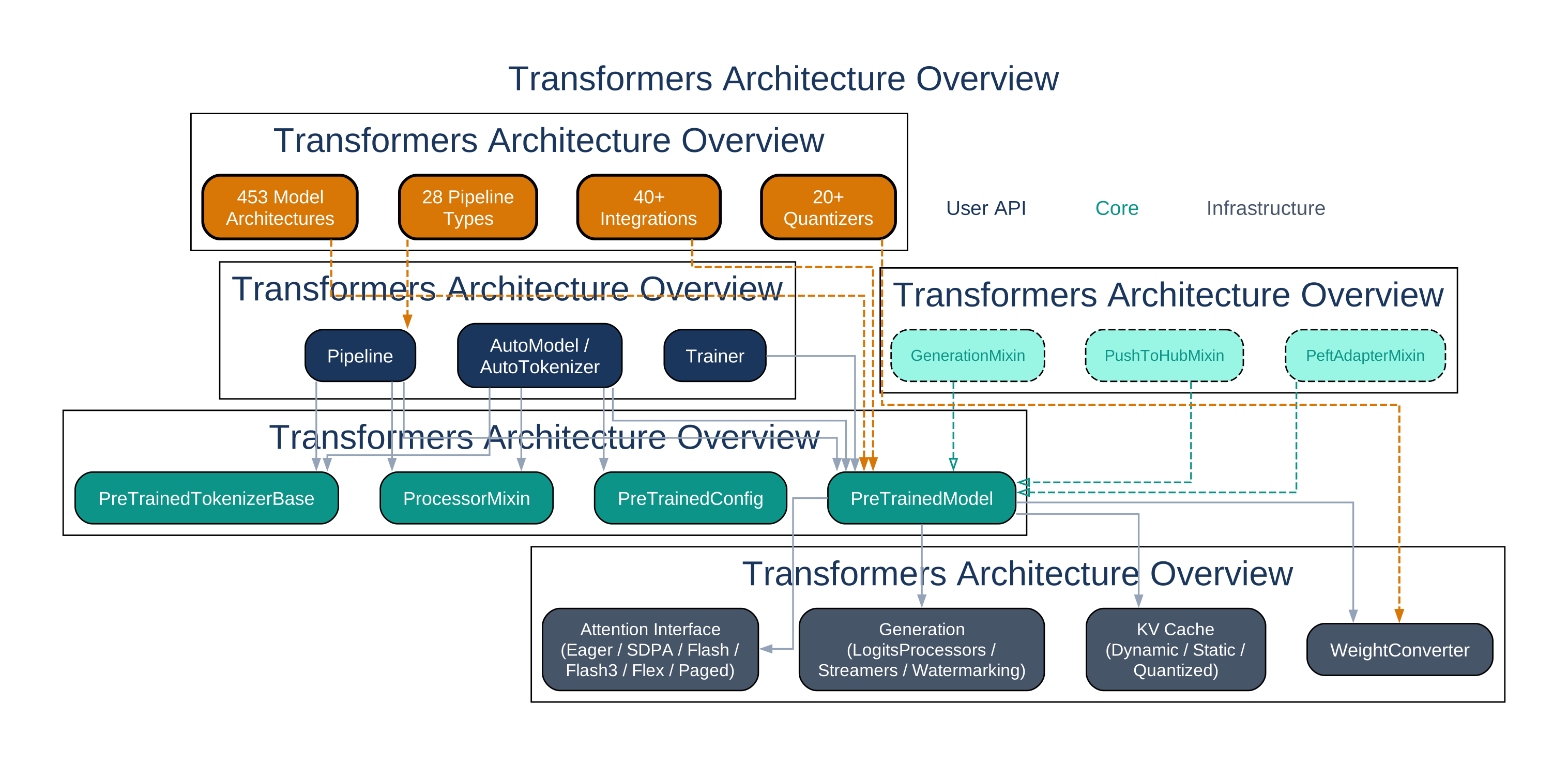
The Transformers library is organized into three distinct layers, each serving a specific role in the stack and exposing progressively lower-level APIs. At the top sits the User API layer, which provides the three primary entry points that most developers interact with: the pipeline() function for one-line inference, the AutoModel/AutoTokenizer factory classes for architecture-agnostic model loading, and the Trainer class for managed training loops. These abstractions handle tokenization, model instantiation, device placement, and output formatting automatically, requiring minimal configuration from the user.
Beneath the User API lies the Core layer, which houses the foundational classes that give Transformers its architectural consistency. PreTrainedModel serves as the base class for all 453 model architectures, providing shared functionality like weight initialization, serialization, device management, and the from_pretrained() / save_pretrained() contract. PreTrainedConfig manages hyperparameter validation and serialization, ensuring every model carries its configuration alongside its weights. The tokenizer hierarchy – now simplified in v5 to a backend-based architecture – handles text-to-token conversion with alignment tracking. Processing classes (ProcessorMixin) unify multimodal inputs by coordinating image, audio, and text preprocessors into a single callable object.
At the bottom sits the Infrastructure layer, which provides the performance-critical and integration-heavy components. The WeightConverter API (new in v5) handles declarative weight transformations during loading, enabling cross-format compatibility without manual conversion scripts. The KV Cache hierarchy manages key-value cache allocation, eviction, and quantization for autoregressive generation. The AttentionInterface dispatch system routes attention computation to the optimal backend – Flash Attention 2/3, PyTorch SDPA, Flex Attention, or Paged Attention – based on hardware capabilities and model requirements. The Generation system orchestrates beam search, sampling, constrained decoding, and speculative decoding through a composable pipeline of generation strategies.
The side statistics underscore the library’s scale: 453 model architectures covering every major architecture family, 28 pipeline types for out-of-the-box inference, 20+ quantization backends for compression, and 40+ integrations with external frameworks. This breadth is what makes Transformers the definitive ML framework – no other library provides this level of coverage with a unified API.
The Auto Factory Pattern
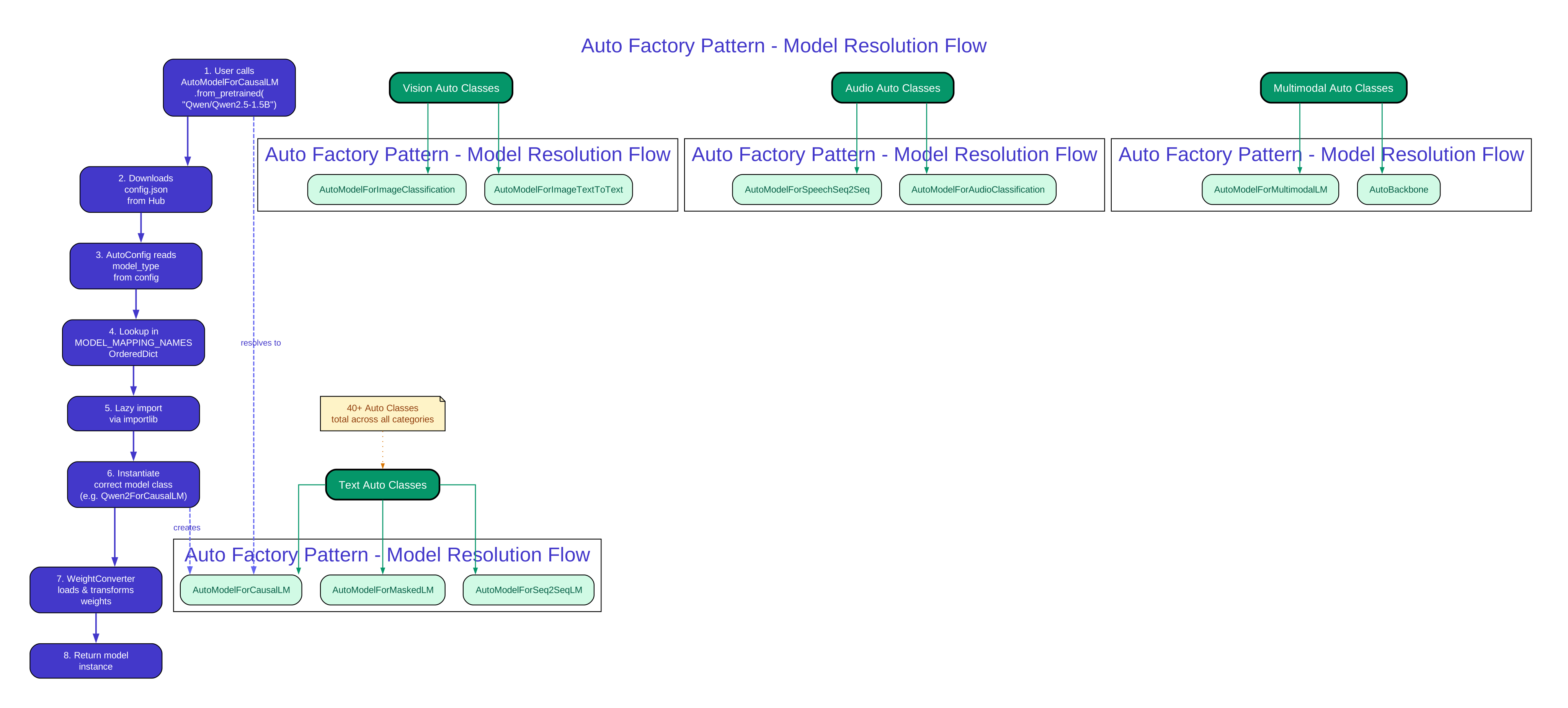
The Auto classes are perhaps the most recognizable feature of the Transformers library, and their implementation reveals a sophisticated factory pattern built on lazy loading and dynamic resolution. When you call AutoModelForCausalLM.from_pretrained("Qwen/Qwen2.5-1.5B"), a chain of operations unfolds that is far more complex than a simple class lookup.
The process begins with the from_pretrained() method on the base AutoModel class, which first downloads (or reads from cache) the model’s config.json file. From this config, it extracts the model_type field – for example, "qwen2". This string serves as the key into MODEL_MAPPING_NAMES, a dictionary that maps model type identifiers to their corresponding implementation classes stored as module paths (e.g., "transformers.models.qwen2.modeling_qwen2.Qwen2ForCausalLM"). The actual class is not imported until this lookup occurs, thanks to _LazyAutoMapping, which wraps the mapping dictionary and triggers importlib resolution only when a value is accessed. This lazy loading strategy means that importing transformers does not load all 453 model implementations into memory – only the one you actually use gets resolved.
Once the target class is resolved, from_pretrained() delegates to the concrete model class (e.g., Qwen2ForCausalLM), which inherits from PreTrainedModel. The PreTrainedModel.from_pretrained() method handles weight loading through the WeightConverter API, which applies any necessary transformations – dtype conversion, tensor renaming, shard assembly – declaratively rather than through ad-hoc conversion code. This ensures that checkpoint formats from different sources (safetensors, PyTorch bin, HF format) all converge to the same in-memory representation.
The Auto family comprises over 40 classes grouped by modality. Text classes include AutoModelForCausalLM, AutoModelForSeq2SeqLM, AutoModelForTokenClassification, AutoModelForQuestionAnswering, and AutoModelForMaskedLM. Vision classes cover AutoModelForImageClassification, AutoModelForObjectDetection, AutoModelForSegmentation, and AutoModelForDepthEstimation. Audio classes provide AutoModelForSpeechSeq2Seq, AutoModelForAudioClassification, and AutoModelForCTC. Multimodal classes include AutoModelForVision2Seq, AutoModelForDocumentQuestionAnswering, and AutoModelForZeroShotImageClassification. Each Auto class follows the same factory pattern, ensuring a consistent experience regardless of modality.
from transformers import AutoModelForCausalLM, AutoTokenizer

tokenizer = AutoTokenizer.from_pretrained("Qwen/Qwen2.5-1.5B")
model = AutoModelForCausalLM.from_pretrained("Qwen/Qwen2.5-1.5B")

inputs = tokenizer("The future of AI is", return_tensors="pt")
outputs = model.generate(**inputs, max_new_tokens=50)
print(tokenizer.decode(outputs[0], skip_special_tokens=True))
This pattern – load config, resolve class, instantiate model, convert weights – runs automatically behind a single function call, which is why the Auto API feels so effortless despite the complexity underneath.
Pipeline System

The pipeline() function is the highest-level abstraction in Transformers, designed to make inference accessible with minimal code. Internally, every pipeline follows a three-stage lifecycle: preprocess converts raw input (text, image, audio) into tensor format, _forward executes the model’s forward pass, and postprocess transforms raw logits or hidden states into human-readable output. This preprocess -> _forward -> postprocess contract is enforced by the Pipeline base class, and each of the 28 pipeline types implements these three methods with task-specific logic.
The pipeline() factory function serves as the entry point. When you call pipeline("text-generation", model="Qwen/Qwen2.5-1.5B"), the factory resolves the task name to a concrete pipeline class – in this case, TextGenerationPipeline. It then loads the appropriate model and tokenizer using the Auto classes, selects the correct device, and returns a callable pipeline object. The factory also handles default model selection: if no model is specified, it falls back to a curated default for each task.
The 28 pipeline types span four categories. NLP pipelines (10 types) cover text-generation, text-classification, token-classification, question-answering, fill-mask, summarization, translation, feature-extraction, text2text-generation, and zero-shot-classification. Vision pipelines (9 types) include image-classification, object-detection, image-segmentation, image-to-text, zero-shot-image-classification, zero-shot-object-detection, depth-estimation, image-feature-extraction, and mask-generation. Audio pipelines (4 types) provide automatic-speech-recognition, audio-classification, text-to-audio, and zero-shot-audio-classification. Multimodal pipelines (4 types) offer visual-question-answering, document-question-answering, image-to-audio, and video-classification.
Each pipeline type handles the intricacies of its domain automatically. The automatic-speech-recognition pipeline, for example, manages audio resampling, feature extraction, and timestamp alignment. The object-detection pipeline handles non-maximum suppression and bounding box formatting. The text-generation pipeline manages prompt templating, stop sequence detection, and streaming output. This domain-specific logic, hidden behind a uniform interface, is what makes pipelines so powerful for rapid prototyping and production deployment alike.
from transformers import pipeline

# Text generation
generator = pipeline("text-generation", model="Qwen/Qwen2.5-1.5B")
result = generator("The future of AI is")
print(result[0]["generated_text"])

# Image classification
classifier = pipeline("image-classification", model="google/vit-base-patch16-224")
result = classifier("https://huggingface.co/datasets/huggingface/documentation-images/resolve/main/pipeline-cat-chonk.jpeg")
print(result)
Ecosystem Integrations
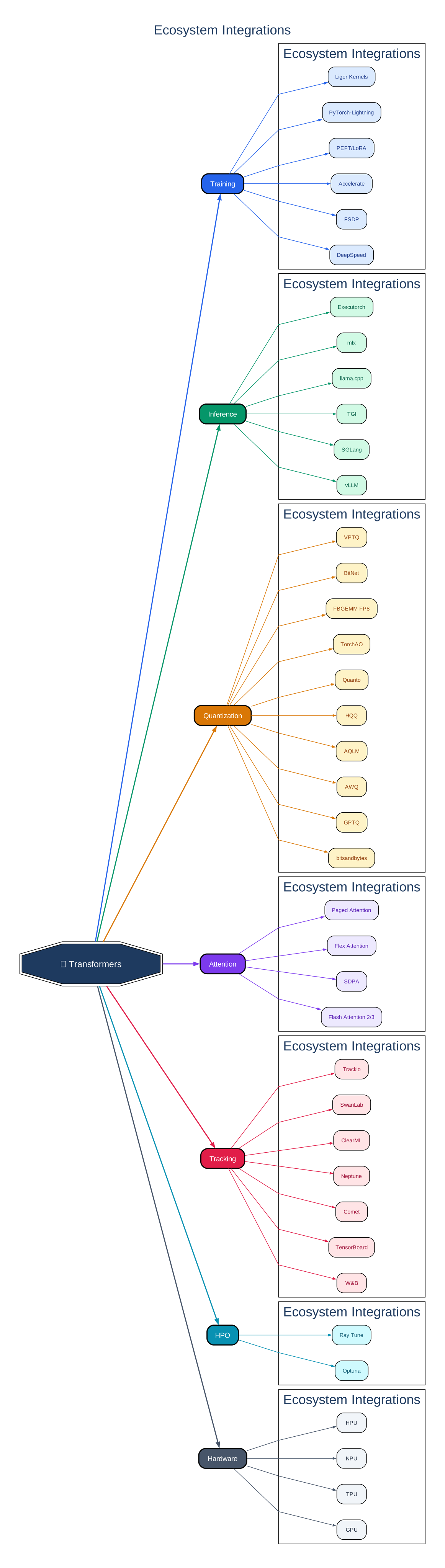
The true power of Hugging Face Transformers lies not in its standalone capabilities but in its position as the hub of a vast ecosystem. The library functions as a spoke-and-hub integration point where training frameworks, inference engines, quantization backends, attention implementations, and operational tools all converge through standardized interfaces. This architecture means that adopting Transformers grants immediate access to dozens of specialized tools without writing custom integration code.
Training frameworks integrate directly with the Hugging Face Trainer class. DeepSpeed provides ZeRO optimization stages 1-3 for distributed training across hundreds of GPUs. FSDP (Fully Sharded Data Parallel) from PyTorch offers native sharding with comparable memory efficiency. Accelerate abstracts the device management layer, enabling the same training script to run on single GPUs, multi-GPU setups, TPUs, and mixed configurations. PEFT (Parameter-Efficient Fine-Tuning) implements LoRA, QLoRA, AdaLoRA, and other adapter methods that reduce trainable parameters by orders of magnitude while preserving model quality.
Inference engines consume Hugging Face model formats as their primary input. vLLM provides PagedAttention-based serving with continuous batching for high-throughput production deployment. SGLang offers structured generation with RadixAttention for efficient prefix caching. Text Generation Inference (TGI) serves as Hugging Face’s own production server with tensor parallelism and watermarking. llama.cpp enables CPU and Apple Silicon inference with GGUF quantization. mlx-lm targets Apple Metal GPUs for on-device inference on Mac hardware.
Quantization backends compress models for deployment in memory-constrained environments. The library supports 20+ quantization methods: bitsandbytes (4-bit and 8-bit NFP/FP4), GPTQ (post-training quantization with calibration data), AWQ (activation-aware weight quantization), AQLM (additive quantization), HQQ (half-quantized quantization), Quanto (integer quantization), TorchAO (PyTorch native quantization), FBGEMM FP8 (server-grade 8-bit floating point), and BitNet (1-bit weight representations). Each backend integrates through a unified QuantizationConfig that plugs into the from_pretrained() loading pipeline.
Attention backends optimize the most computationally intensive component of transformer models. Flash Attention 2 and 3 provide IO-aware exact attention with minimal memory footprint. PyTorch SDPA (Scaled Dot Product Attention) offers native fused attention kernels. Flex Attention enables custom attention patterns through a block-mask abstraction. Paged Attention (from vLLM) manages KV cache blocks for efficient serving. The AttentionInterface dispatch system automatically selects the best available backend based on hardware, model architecture, and attention pattern requirements.
Operational integrations round out the ecosystem. Experiment tracking tools (W&B, TensorBoard, Comet, Neptune, ClearML) log metrics and artifacts through the Trainer’s callback system. Hyperparameter optimization frameworks (Optuna, Ray Tune) interface with Trainer for automated search. Hardware support spans NVIDIA GPUs, Google TPUs, Ascend NPUs, Intel HPUs, and AMD GPUs through dedicated accelerator backends.
v5 Architecture Evolution
The v5 release marks the most significant architectural shift in the library’s history, driven by the need to simplify the codebase and focus on what the community actually uses. The most consequential change is the removal of TensorFlow and JAX/Flax support – Transformers is now a PyTorch-only library. This decision reflects the reality that over 95% of the community’s usage was PyTorch, and maintaining three frameworks imposed a disproportionate maintenance burden. The removed TensorFlow and JAX code accounted for roughly 40% of the codebase; its removal enables faster iteration and cleaner abstractions.
The WeightConverter API is a new v5 primitive that replaces the ad-hoc weight conversion functions scattered across individual model files. Instead of each model implementing its own _convert_hf_to_pt and _convert_pt_to_hf methods, WeightConverter provides a declarative specification format where transformations are defined as a sequence of operations (rename, transpose, split, merge, cast). This makes weight loading more reliable, easier to debug, and extensible to new checkpoint formats without modifying model code.
Tokenizer architecture has been simplified from the previous “slow/fast” split – where PreTrainedTokenizer (Python) and PreTrainedTokenizerFast (Rust-based via tokenizers library) existed as parallel hierarchies – to a unified backend-based system. In v5, all tokenizers delegate to a backend implementation, and the distinction between slow and fast is handled at the backend level rather than through separate class hierarchies. This eliminates the confusing is_fast attribute and the dual code paths that developers had to navigate.
The v5 release also introduces continuous batching support for generation workloads, a CLI serving interface via transformers serve and transformers chat commands, and the AttentionInterface abstraction that decouples attention computation from model definitions. These changes position Transformers not just as a training library but as a complete inference platform, reducing the need for external serving frameworks for many deployment scenarios.
Getting Started
Getting started with Hugging Face Transformers requires only a single installation command:
pip install transformers
For GPU acceleration, install PyTorch with CUDA support first, then Transformers will automatically detect and use available hardware. The fastest path to a working model is the pipeline API:
from transformers import pipeline

pipe = pipeline("text-generation", model="Qwen/Qwen2.5-1.5B")
pipe("the secret to baking a really good cake is ")
For more control over the inference process, use the Auto classes directly:
from transformers import AutoModelForCausalLM, AutoTokenizer

tokenizer = AutoTokenizer.from_pretrained("Qwen/Qwen2.5-1.5B")
model = AutoModelForCausalLM.from_pretrained("Qwen/Qwen2.5-1.5B")

inputs = tokenizer("The key to effective prompt engineering is", return_tensors="pt")
outputs = model.generate(**inputs, max_new_tokens=100, temperature=0.7)
print(tokenizer.decode(outputs[0], skip_special_tokens=True))
For quantized inference on consumer hardware, load a model in 4-bit precision:
from transformers import AutoModelForCausalLM, BitsAndBytesConfig

quantization_config = BitsAndBytesConfig(load_in_4bit=True, bnb_4bit_compute_dtype="float16")
model = AutoModelForCausalLM.from_pretrained(
    "Qwen/Qwen2.5-1.5B",
    quantization_config=quantization_config,
)
Conclusion
Hugging Face Transformers has earned its position as the definitive ML framework through a combination of architectural breadth, ecosystem centrality, and progressive abstraction design. With 453 model architectures, 28 pipeline types, 20+ quantization backends, and 40+ framework integrations, no other library provides comparable coverage of the modern ML stack. Its role as the ecosystem pivot – the common interface that training frameworks, inference engines, and operational tools all target – makes it the single most important dependency in the machine learning ecosystem.
The v5 architectural evolution demonstrates the project’s commitment to simplification without sacrificing capability. By removing TensorFlow/JAX, unifying the tokenizer hierarchy, introducing the WeightConverter API, and adding native serving capabilities, Transformers is evolving from a model library into a complete ML platform. For any practitioner working with pretrained models – whether fine-tuning LLaMA on a single GPU, deploying GPT at scale, or building multimodal applications – Transformers remains the indispensable foundation upon which modern AI is built. Enjoyed this post? Never miss out on future posts by following us