Learn Rust and Axum in a Single Post: Complete Tutorial From Routing and Extractors to Tower Middleware and Deployment
Axum is the web framework from the Tokio team — a thin routing layer on Tower, on Hyper, on Tokio. It’s the Rust backend equivalent of FastAPI (Python) or Express, with Rust’s compile-time safety and the Tokio async runtime’s performance. This single post teaches the whole framework in five stages, with hand-drawn diagrams and runnable Rust.
Learning Roadmap
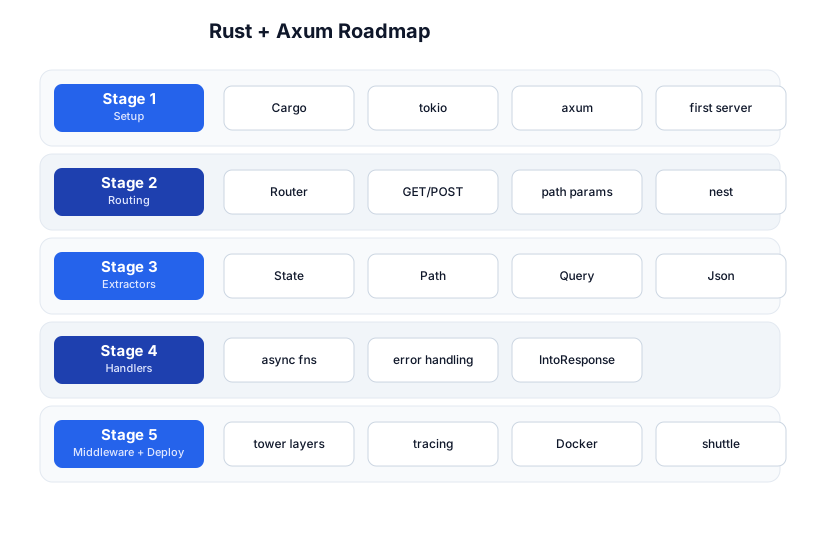
The roadmap moves from setup (Stage 1), through routing (Stage 2), the extractors that read requests (Stage 3), writing handlers (Stage 4), and the middleware + deployment layer (Stage 5). You’ll want the Rust tutorial first — ownership, async, and traits are prerequisites.
Stage 1 — Setup
The stack
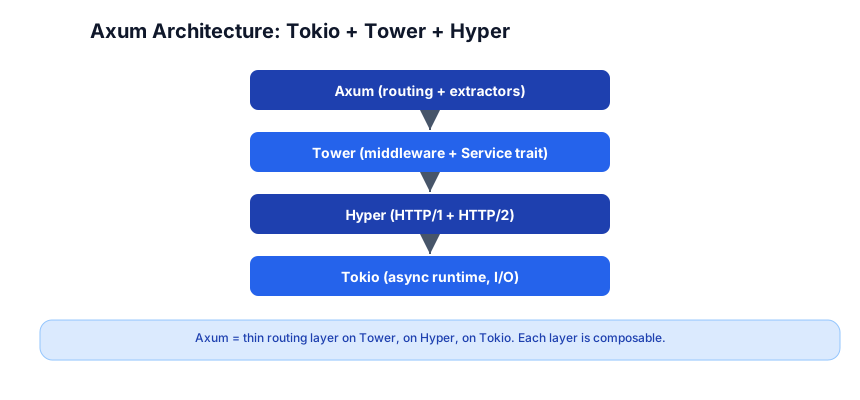
Axum is a thin layer:
- Axum — routing + extractors (the framework you write against).
- Tower — the middleware +
Servicetrait abstraction (Axum’s middleware is Tower). - Hyper — HTTP/1 + HTTP/2 (the actual HTTP server).
- Tokio — the async runtime (I/O, timers, tasks).
Each layer is composable and replaceable — Axum doesn’t reinvent the runtime or HTTP; it builds on the Rust async ecosystem.
A first server
# Cargo.toml
[dependencies]
axum = "0.7"
tokio = { version = "1", features = ["full"] }
serde = { version = "1", features = ["derive"] }
serde_json = "1"
use axum::{routing::get, Router};

#[tokio::main]
async fn main() {
    let app = Router::new().route("/", get(|| async { "Hello, world!" }));

    let listener = tokio::net::TcpListener::bind("0.0.0.0:3000").await.unwrap();
    axum::serve(listener, app).await.unwrap();
}
Run it with cargo run and hit http://localhost:3000. That’s a complete async HTTP server in 8 lines — the #[tokio::main] macro sets up the async runtime; axum::serve runs the router on the listener.
Pitfall: Forget
#[tokio::main](or thefeatures = ["full"]on tokio) and you get a cryptic “main function is not async” or “runtime not found” error. The runtime has to be set up before anyawait.
Stage 2 — Routing
Routes and methods
use axum::{routing::{get, post, put, delete}, Router};

let app = Router::new()
    .route("/", get(root))
    .route("/users", post(create_user))
    .route("/users/:id", get(get_user).put(update_user).delete(delete_user))
    .route("/users/:id/posts", get(list_user_posts));
Each .route(path, method_router) maps a path + HTTP method(s) to a handler. Path params use :name syntax (:id).
Path params
async fn get_user(axum::extract::Path(id): axum::extract::Path<u64>) -> String {
    format!("User {}", id)
}
Path(id): Path<u64> extracts the :id from the URL and parses it as a u64 — if the path segment isn’t a valid u64, Axum returns a 400 automatically. You can also extract a struct: Path(params): Path<UserParams> where UserParams derives Deserialize.
Nesting routers
let api_routes = Router::new()
    .route("/users", get(list_users).post(create_user))
    .route("/users/:id", get(get_user));

let app = Router::new()
    .nest("/api/v1", api_routes);   // -> /api/v1/users, /api/v1/users/:id
nest("/prefix", router) mounts a sub-router under a prefix — how you split routes into modules. Each module’s Router composes into the final app.
Pitfall: Axum routes are statically dispatched — the path patterns (
/users/:id) are matched by a generated router, not a runtime regex. This is fast (the router is a state machine), but it means you can’t have overlapping patterns (/users/:idand/users/meconflict unless ordered — Axum resolves this, but be deliberate about path design).
Stage 3 — Extractors
How Axum reads requests
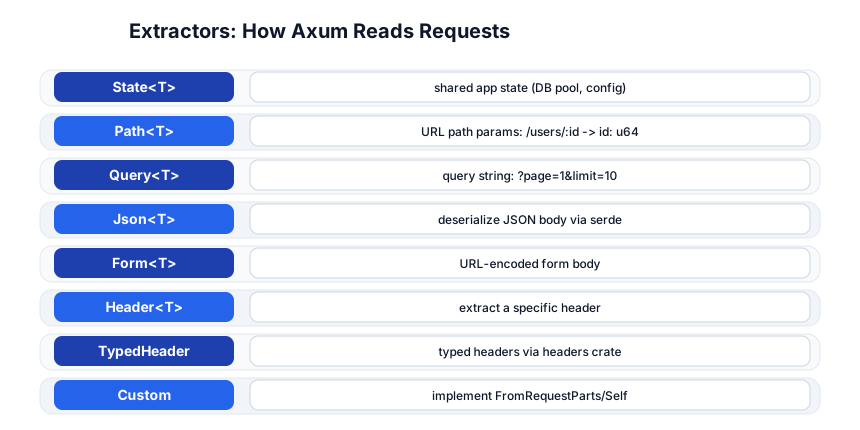
An extractor is a type that implements FromRequest (or FromRequestParts) — it pulls data out of the request and parses it. You list extractors as handler arguments, in any order.
use axum::extract::{State, Path, Query};
use serde::Deserialize;

#[derive(Deserialize)]
struct Pagination { page: u64, limit: u64 }

async fn list_users(
    State(db): State<DbPool>,
    Query(pagination): Query<Pagination>,
) -> impl IntoResponse {
    let users = db.query("SELECT * FROM users LIMIT $1 OFFSET $2", &[&pagination.limit, &pagination.page]).await?;
    Json(users)
}
| Extractor | What it reads |
|---|---|
State<T> | shared app state (DB pool, config) |
Path<T> | URL path params (/users/:id → id) |
Query<T> | query string (?page=1&limit=10) |
Json<T> | deserialize JSON body via serde |
Form<T> | URL-encoded form body |
Header<T> | a specific header |
TypedHeader | typed headers via the headers crate |
Custom | implement FromRequestParts yourself |
State — shared application state
#[derive(Clone)]
struct AppState { db: PgPool, config: Config }

let app = Router::new()
    .route("/users", get(list_users))
    .with_state(AppState { db, config });   // inject state

async fn list_users(State(state): State<AppState>) -> impl IntoResponse {
    let users = sqlx::query_as::<_, User>("SELECT * FROM users").fetch_all(&state.db).await?;
    Json(users)
}
State must be Clone (it’s cloned per request, so wrap expensive things in Arc). The .with_state(...) call injects it into the router; handlers that need it add State<T> as an argument.
Custom extractors
struct ApiKey(String);

impl<S> FromRequestParts<S> for ApiKey where S: Send + Sync {
    type Rejection = StatusCode;
    async fn from_request_parts(parts: &mut Parts, _state: &S) -> Result<Self, Self::Rejection> {
        let key = parts.headers.get("x-api-key").and_then(|v| v.to_str().ok());
        match key {
            Some(k) => Ok(ApiKey(k.to_string())),
            None => Err(StatusCode::UNAUTHORIZED),
        }
    }
}

async fn protected(ApiKey(key): ApiKey) -> String { format!("key: {}", key) }
Implement FromRequestParts to extract from headers/headers without consuming the body, or FromRequest (which consumes the body). Custom extractors are how you build auth, request IDs, and tenant resolution.
Pitfall: Extractor order matters: body-consuming extractors (
Json,Form) must come last — once the body is read, you can’t re-read it. ThePartsextractors (State,Path,Query,Header) are fine in any order.
Stage 4 — Handlers
Handlers are just async functions
A handler is any async function whose arguments are extractors and whose return type is IntoResponse. Axum generates the dispatch code at compile time.
use axum::Json;
use serde::Serialize;

#[derive(Serialize)]
struct User { id: u64, name: String }

async fn get_user(Path(id): Path<u64>) -> Json<User> {
    Json(User { id, name: "Ada".into() })
}
Json<T> is both an extractor (deserialize request body) and a response (serialize + set Content-Type: application/json). The return just needs impl IntoResponse — String, &'static str, Json<T>, (StatusCode, Json<T>), tuples, and custom types all work.
Error handling
use axum::response::{IntoResponse, Response};
use axum::http::StatusCode;

enum AppError {
    NotFound,
    Database(sqlx::Error),
}

impl IntoResponse for AppError {
    fn into_response(self) -> Response {
        match self {
            AppError::NotFound => (StatusCode::NOT_FOUND, "not found").into_response(),
            AppError::Database(e) => {
                tracing::error!("db error: {:?}", e);
                (StatusCode::INTERNAL_SERVER_ERROR, "internal error").into_response()
            }
        }
    }
}

async fn get_user(Path(id): Path<u64>, State(db): State<DbPool>) -> Result<Json<User>, AppError> {
    let user = sqlx::query_as::<_, User>("SELECT * FROM users WHERE id = $1")
        .bind(id as i64)
        .fetch_optional(&db)
        .await
        .map_err(AppError::Database)?
        .ok_or(AppError::NotFound)?;
    Ok(Json(user))
}
The pattern: define an error enum, implement IntoResponse to map each variant to a status code, and return Result<T, AppError> from handlers. The ? operator propagates errors through your handler; Axum converts them to HTTP responses via your IntoResponse impl. Never leak internal error details to the client — log them (tracing::error!) and return a generic message.
Pitfall: Returning
500with the rawDebugof an error leaks internals (and sometimes secrets). Always map errors through a customIntoResponsethat logs the full error server-side and returns a sanitized message to the client.
Stage 5 — Middleware + Deploy
Tower middleware
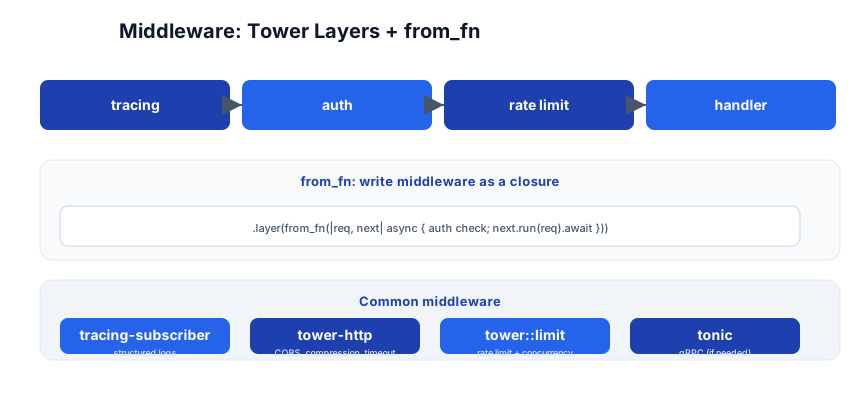
Axum middleware is Tower layers — composable wrappers around the Service trait. The simplest way to write one is from_fn:
use axum::middleware::from_fn;
use axum::extract::Request;
use axum::middleware::Next;
use axum::response::Response;

async fn auth_middleware(req: Request, next: Next) -> Response {
    if let Some(token) = req.headers().get("authorization") {
        if validate_token(token.to_str().unwrap()) {
            return next.run(req).await;   // pass to the next layer / handler
        }
    }
    (StatusCode::UNAUTHORIZED, "missing or invalid token").into_response()
}

let app = Router::new()
    .route("/protected", get(protected))
    .layer(from_fn(auth_middleware));   // apply to all routes in this router
from_fn turns an async fn(req, next) -> Response into a Tower layer. next.run(req) hands the request to the next layer (or the handler); your middleware can transform the request before and the response after. Apply middleware with .layer(...) — the order matters: layers added later run first (outermost).
Common middleware (tower-http)
use tower_http::{
    trace::TraceLayer,
    cors::CorsLayer,
    compression::CompressionLayer,
    timeout::TimeoutLayer,
};

let app = Router::new()
    .route("/", get(root))
    .layer(TraceLayer::new_for_http())       // structured request logging
    .layer(CompressionLayer::new())          // gzip response
    .layer(CorsLayer::permissive())          // CORS
    .layer(TimeoutLayer::new(Duration::from_secs(30)));  // request timeout
tower-http provides the standard middleware: tracing, CORS, compression, timeouts, request IDs, sensitive-header logging. These are battle-tested and composable.
Database: sqlx
use sqlx::postgres::PgPoolOptions;

#[derive(Clone)]
struct AppState { db: PgPool }

#[tokio::main]
async fn main() {
    let db = PgPoolOptions::new()
        .max_connections(5)
        .connect("postgres://user:pass@localhost/app").await.unwrap();
    let app = Router::new().route("/users", get(list_users)).with_state(AppState { db });
    // ...
}
sqlx is the standard async SQL crate — it supports compile-time SQL checking (sqlx::query! macro validates your SQL against the database at build time), PostgreSQL/MySQL/SQLite, and connection pooling. For an ORM on top, sea-orm is the async choice.
Deploy
# Multi-stage build -> tiny final image
FROM rust:1.80 AS build
WORKDIR /app
COPY . .
RUN cargo build --release

FROM debian:bookworm-slim
COPY --from=build /app/target/release/myapp /usr/local/bin/myapp
EXPOSE 3000
CMD ["myapp"]
A release Rust binary is self-contained (no runtime, no dependencies beyond libc) — the final Docker image is tiny and fast to start. Alternatives: shuttle.rs (Rust-native deploy, shuttle deploy), fly.io (edge), or ship the binary directly.
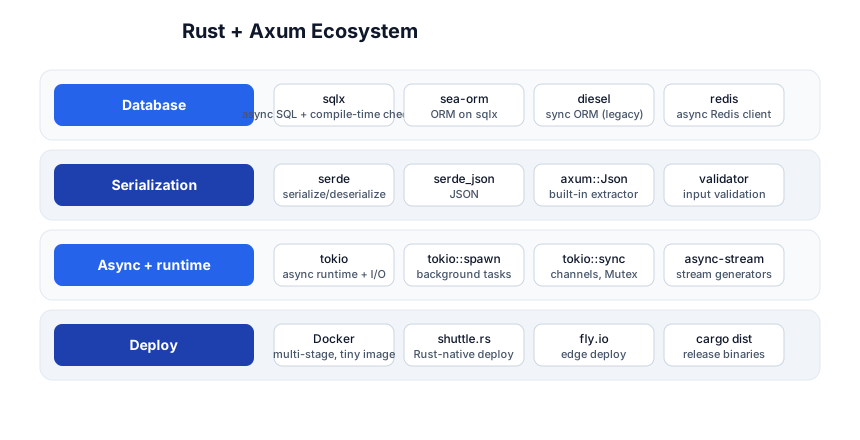
| Concern | Crate |
|---|---|
| Database | sqlx (async, compile-time checked), sea-orm, redis |
| Serialization | serde, serde_json, validator |
| Async runtime | tokio, tokio::spawn, async-stream |
| Middleware | tower, tower-http (tracing, CORS, compression, timeout) |
| Deploy | Docker (tiny image), shuttle.rs, fly.io |
Quick-Start Checklist
cargo new myapi && cd myapi— addaxum,tokio(full),serde,serde_jsontoCargo.toml.- Write the 8-line hello-world server —
Router::new().route("/", get(...))+axum::serve. - Add a
/users/:idroute with aPath<u64>extractor. - Add
State<AppState>— inject a shared struct via.with_state(...). - Return
Json<T>from a handler — deriveSerializeon your response type. - Accept
Json<T>in a POST handler — deriveDeserialize. - Write a custom error type —
enum AppError+impl IntoResponse. - Add
from_fnmiddleware — a logging or auth layer. - Add
tower-http—TraceLayer+CompressionLayer+TimeoutLayer. - Connect sqlx — pool,
query_as, compile-time checked SQL.
Common Pitfalls
- Missing
#[tokio::main]— asyncmainneeds the macro + tokio features; without it, a cryptic error. - Body extractors not last —
Json/Formconsume the body; put them afterPath/Query/State. StatenotClone— it’s cloned per request; wrap expensive fields inArc.- Forgetting
.with_state(...)— a handler usingState<T>without the state injected fails to compile (a feature, not a bug). - Leaking errors in
IntoResponse— return sanitized messages; log the full error server-side. - Middleware order —
.layer(a).layer(b)meansbruns first (outermost). Think “onion.” - Blocking in async —
std::fs::read,thread::sleep, or sync DB calls block the runtime thread. Usetokio::fs, async crates, ortokio::task::spawn_blocking. - Unbounded channels /
Mutex— usetokio::sync::Mutex(notstd::sync::Mutex) across.await; use bounded channels to apply backpressure. - Debug build in production —
cargo runis unoptimized; shipcargo build --release.
Further Reading
- Axum Docs — the official API reference
- Tokio Tutorial — the async runtime Axum runs on
- Tower Docs — the middleware abstraction
- sqlx Docs — async SQL + compile-time checking
- Zero To Production In Rust by Luca Palmieri — the canonical Axum backend book
Related guides
Axum is the Rust backend — these PyShine tutorials connect to it:
- Learn Rust in One Post — ownership, lifetimes, async, traits — the prerequisites.
- Learn FastAPI in One Post — the Python equivalent; extractors ≈ Depends.
- Learn Node.js + Express in One Post — the JS equivalent; Tower middleware ≈ Express middleware.
- Learn PostgreSQL in One Post — what sqlx talks to.
- Learn Docker in One Post — the multi-stage Dockerfile above builds a tiny image.
Axum’s pitch is a thin, type-safe routing layer on the Tower/Hyper/Tokio stack — compile-time-checked routing, extractors that parse and validate at the type level, and middleware that composes via Tower. The five stages here — setup, routing, extractors, handlers, middleware + deploy — cover everything from a hello-world server to a SQL-backed, middleware-wrapped, Dockerized API. The two habits that pay off: let the type system do the work (extractors + Enjoyed this post? Never miss out on future posts by following us Result<T, AppError> catch errors at compile time), and never block the async runtime (use async crates or spawn_blocking). cargo new an Axum app, add a route with a Path + Json extractor, and watch the compiler enforce your request schema — once you’ve felt that safety, there’s no going back. 


