Learn JavaScript and TypeScript in a Single Post: A Complete Tutorial from Event Loop to Type System
JavaScript is the language of the web — the only language that runs natively in every browser. TypeScript is JavaScript with a static type system layered on top, compiled away to plain JS. Together they are the default stack for frontend, backend (Node), CLI tools, and increasingly everything else.
This post teaches both in five stages with runnable snippets. By the end you’ll understand closures and this, the single-threaded event loop and async/await, the module system, and the TypeScript type system — unions, generics, narrowing, utility types. The goal: stop fighting JS quirks and start using TS to write safe, navigable code.
We target ES2023+ JavaScript and TypeScript 5.x. Everything here runs in a modern browser or Node 20+.
The Roadmap
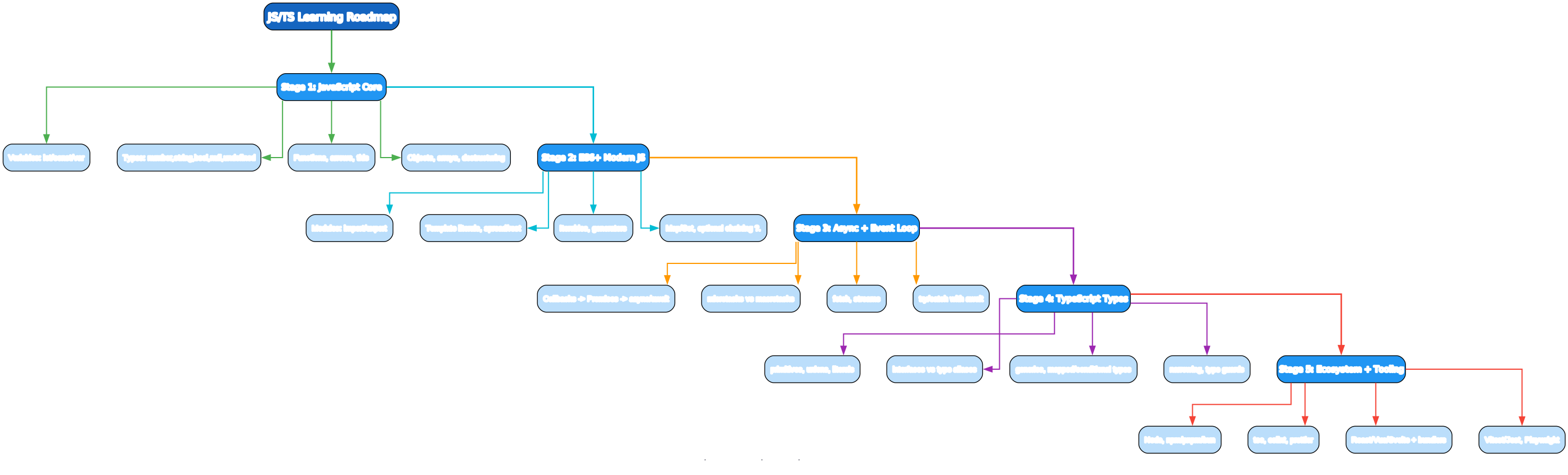
- JavaScript Core — variables, types, functions,
this, objects, arrays, destructuring - ES6+ Modern JS — modules, template literals, spread/rest, iterables, generators
- Async + Event Loop — callbacks → promises → async/await, microtasks vs macrotasks
- TypeScript Types — primitives, unions, interfaces vs type aliases, generics, narrowing
- Ecosystem + Tooling — Node, npm/pnpm/bun, tsc, eslint/prettier, React/Vue, bundlers, testing
Stage 1 — JavaScript Core
A program
console.log("Hello, JS!");
Run it in a browser console, in Node (node file.js), in Deno, or in Bun. There is no main — the file runs top to bottom.
Variables: let / const / var
let x = 10;        // block-scoped, reassignable
const y = 20;      // block-scoped, not reassignable (but objects inside are mutable)
var z = 30;        // function-scoped, hoisted — legacy, avoid in new code

// const does not make objects immutable:
const obj = { a: 1 };
obj.a = 2;          // OK — const binds the name, not the value
// obj = { b: 3 };  // TypeError — can't reassign the binding
Use const by default; reach for let only when you must reassign. var is legacy and has scoping surprises (function scope, not block scope) — don’t use it in new code.
Types and coercion
JavaScript has 8 types: number, string, boolean, null, undefined, symbol, bigint, and object. Numbers are all IEEE 754 doubles (no int/float split):
typeof 1        // "number"
typeof NaN      // "number" (NaN is a number, yes)
typeof "a"      // "string"
typeof null     // "object"  ← historical bug, can't be fixed
typeof undefined // "undefined"
typeof {}       // "object"
typeof function(){} // "function"

// Coercion is the famous footgun
"3" + 4   // "34"  + coerces to string
"3" - 4   // -1    - coerces to number
"3" == 3  // true  == coerces
"3" === 3 // false === does not coerce
Always use === and !==. They don’t coerce, so they say what you mean. The == operator has a conversion table no one memorizes.
Functions, arrows, and this
function add(a, b) { return a + b; }
const sub = (a, b) => a - b;            // arrow — concise body, implicit return

// Default and rest params
function greet(name = "world", ...rest) { return `hi ${name} ${rest}`; }

// Closures — inner function captures outer variables
function counter() {
    let n = 0;
    return () => ++n;                   // captures n
}
const c = counter();
c(); c(); c()  // 3
this is the famous JS puzzle. Arrows don’t bind their own this — they inherit it from the enclosing scope. Regular functions do bind it, and the binding depends on how they’re called:
const obj = {
    v: 10,
    reg() { return this.v; },           // this = obj -> 10
    arrow: () => this.v,                // this = enclosing (module) -> undefined
};
obj.reg()   // 10
obj.arrow() // undefined

// Methods lose `this` when detached
const detached = obj.reg;
detached();  // undefined — `this` is whatever called it (global/undefined)
const bound = obj.reg.bind(obj);
bound();     // 10
Rule: use arrows for short callbacks and when you want the surrounding this; use regular functions for object methods. call/apply/bind let you set this explicitly when needed.
Objects, arrays, destructuring
const obj = { a: 1, b: 2, ["c" + "d"]: 3 };  // computed keys
const { a, b } = obj;                         // destructuring
const { a: renamed } = obj;                   // rename
const { e = 0 } = obj;                         // default

const arr = [1, 2, 3];
const [x, y, ...rest] = arr;                  // array destructuring + rest
const [, second] = arr;                        // skip first

// Spread
const copy = { ...obj, f: 9 };
const merged = [...arr1, ...arr2];
Arrays are objects with a length property and indexed keys. They’re not typed:
arr.map(x => x * x)         // [1, 4, 9]   — new array
arr.filter(x => x > 1)      // [2, 3]
arr.reduce((sum, x) => sum + x, 0)  // 6
arr.forEach(x => console.log(x))    // side effects
arr.find(x => x > 1)        // 2 (first match)
arr.includes(2)             // true
[...arr].sort()            // copy then sort (sort mutates!)
sort() mutates the array in place and sorts lexicographically by default ([10, 2].sort() → [10, 2]). Pass a comparator: arr.sort((a, b) => a - b).
Stage 2 — ES6+ Modern JavaScript
Modules
// math.js
export const PI = 3.14;
export function add(a, b) { return a + b; }
export default function multiply(a, b) { return a * b; }

// main.js
import multiply, { PI, add } from "./math.js";
import * as math from "./math.js";
const mod = await import("./math.js");    // dynamic import — async
ESM (ECMAScript Modules) is the standard, replacing CommonJS (require). Node supports both; .mjs or "type": "module" in package.json forces ESM. Use ESM in all new code.
Template literals, spread/rest, optional chaining
const name = "Ada";
`Hello, ${name}! ${1 + 2}`                 // string interpolation
`multi
line`                                      // multi-line strings

const obj = { user: { profile: { age: 30 } } };
obj?.user?.profile?.age                    // 30  optional chaining
obj?.missing?.profile?.age                 // undefined (not a TypeError)
obj.user.profile?.city ?? "unknown"        // nullish coalescing — only null/undefined
?. short-circuits to undefined instead of throwing on a missing property. ?? returns the right side only for null/undefined (not 0 or ""), unlike || which falsy-coerces.
Iterables and generators
// for...of works on any iterable (has Symbol.iterator)
for (const x of [1, 2, 3]) { }
for (const [k, v] of new Map([["a", 1]])) { }

// Generators — lazy sequences with yield
function* evens() {
    let i = 0;
    while (true) { yield i; i += 2; }
}
const it = evens();
it.next();  // { value: 0, done: false }
it.next();  // { value: 2, done: false }

// Custom iterable
const range = {
    [Symbol.iterator]() {
        let i = 0;
        return { next: () => i < 3 ? { value: i++, done: false } : { done: true } };
    },
};
[...range]  // [0, 1, 2]
Map/Set and other collections
const m = new Map([["a", 1]]);
m.set("b", 2); m.get("a"); m.has("b"); m.size
const s = new Set([1, 1, 2, 3]);   // {1, 2, 3} — dedup
const wm = new WeakMap();           // keys must be objects, GC-friendly
Use Map over objects when keys are non-string or you need ordered iteration; Set for uniqueness; WeakMap/WeakSet for metadata that shouldn’t prevent GC.
Stage 3 — Async and the Event Loop
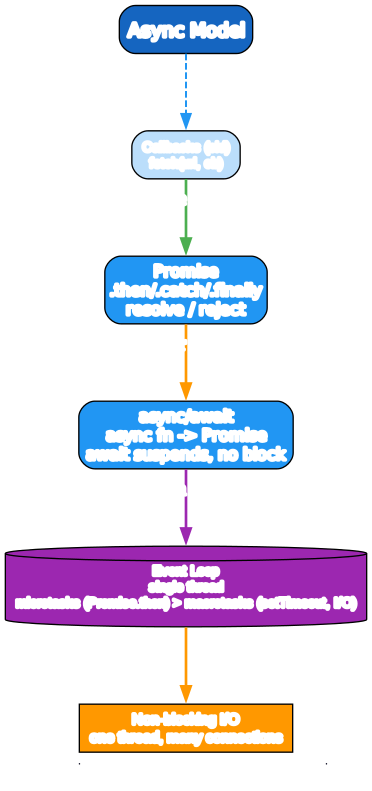
JavaScript is single-threaded with an event loop. There’s one call stack; I/O is non-blocking because the runtime (browser/Node) does the waiting off-thread and enqueues callbacks when ready.
Callbacks → Promises → async/await
// Callbacks (old style) — nested, inversion of control
fetch(url, (err, data) => {
    if (err) return handle(err);
    process(data, (err2, r2) => { /* callback hell */ });
});

// Promises — a value that will resolve or reject later
fetch(url)
    .then(r => r.json())
    .then(data => process(data))
    .catch(err => handle(err))
    .finally(() => cleanup());

const p = new Promise((resolve, reject) => {
    setTimeout(() => resolve(42), 100);
});

// async/await — syntax sugar over promises
async function getData(url) {
    try {
        const r = await fetch(url);        // suspends, doesn't block
        const data = await r.json();
        return data;
    } catch (err) {
        handle(err);
        throw err;                          // re-throw to propagate
    }
}

// Parallel — all promises, fail-fast
const [a, b] = await Promise.all([getA(), getB()]);
const first = await Promise.race([fast(), slow()]);
const all = await Promise.allSettled([...]); // never rejects
async functions always return a Promise. await pauses the function until the Promise settles, yielding control to the event loop — it does not block the thread. This is why you can have thousands of concurrent fetches on one thread.
Microtasks vs macrotasks
console.log(1);
setTimeout(() => console.log(4), 0);          // macrotask
Promise.resolve().then(() => console.log(3)); // microtask
console.log(2);
// Output: 1, 2, 3, 4
The event loop drains the call stack, then runs all microtasks (Promise .then callbacks, queueMicrotask) before processing one macrotask (setTimeout, I/O callbacks, setImmediate). Microtasks always run before the next macrotask. This ordering explains many “why did my callback run first?” puzzles.
Streams
// Read a response body as a stream
const r = await fetch(url);
for await (const chunk of r.body) {
    process(chunk);        // Uint8Array chunks
}
Async iteration over streams is the modern way to handle large or chunked data without buffering it all in memory.
Stage 4 — TypeScript Types
TypeScript adds a static type system that’s erased at runtime — it compiles to plain JS. The type system is structural (shape-based, like Go interfaces) and quite powerful.

Basic types and annotations
let n: number = 10;
let s: string = "hi";
let b: boolean = true;
let nothing: null = null;
let u: undefined = undefined;
let big: bigint = 100n;
let sym: symbol = Symbol();

// Function signatures
function add(a: number, b: number): number { return a + b; }
const sub = (a: number, b: number): number => a - b;

// Optional and default params
function greet(name: string, greeting = "hi"): string { return `${greeting}, ${name}`; }
function opt(x?: number): number { return x ?? 0; }  // x: number | undefined
Unions and literals
type Result = "ok" | "error";                // union of literals
type ID = number | string;                   // union of types
type State = "idle" | "loading" | { data: number };

function handle(s: State) {
    if (s === "idle") { /* narrowed to "idle" */ }
    else if (typeof s === "object") { s.data }  // narrowed to object
}
Interfaces vs type aliases
interface Point { x: number; y: number }
type Point2 = { x: number; y: number };

interface Point { z?: number }     // interfaces can be reopened (declaration merging)
// type Point2 = { z: number }     // error — type aliases can't be reopened

// Extending
interface Point3D extends Point { z: number }
type WithLabel<T> = T & { label: string }
Use interfaces for object shapes (they can be extended/reopened and show better error messages); use type aliases for unions, intersections, and computed types. They’re largely interchangeable for plain objects.
Generics
function first<T>(xs: T[]): T | undefined { return xs[0] }
const n = first([1, 2, 3]);   // T inferred as number

// Constraints
function len<T extends { length: number }>(x: T): number { return x.length }
len("hi"); len([1, 2]);       // both have .length

// Generic types
class Box<T> { constructor(public value: T) {} }
const b = new Box(42);

// Mapped types
type Readonly<T> = { readonly [K in keyof T]: T[K] };
type Partial_<T> = { [K in keyof T]?: T[K] };

// Conditional types
type IsString<T> = T extends string ? true : false;
type X = IsString<"a">;      // true
Narrowing and type guards
function f(x: string | number) {
    if (typeof x === "string") { x.toUpperCase() }  // narrowed to string
    else { x.toFixed(2) }                            // narrowed to number
}

// instanceof, in, discriminated unions
interface Circle { kind: "circle"; r: number }
interface Square { kind: "square"; s: number }
type Shape = Circle | Square;

function area(s: Shape): number {
    switch (s.kind) {                                  // discriminant
        case "circle": return Math.PI * s.r ** 2;
        case "square": return s.s ** 2;
    }
}

// User-defined type guards
function isError(x: unknown): x is Error { return x instanceof Error }
if (isError(e)) { e.message }                           // narrowed to Error
Utility types
Partial<User>          // all fields optional
Required<User>         // all fields required
Pick<User, "id"|"email">   // subset of fields
Omit<User, "password">     // all except specified
Record<string, number> // { [k: string]: number }
Readonly<User>         // all readonly
ReturnType<typeof f>  // the return type of f
Parameters<typeof f>[0]  // first param type of f
unknown is the safe top type (you must narrow before use); any opts out of type checking entirely — avoid it. The built-in utility types (Partial, Pick, Omit, Record, ReturnType) cover most transformation needs.
Stage 5 — Ecosystem and Toolchain
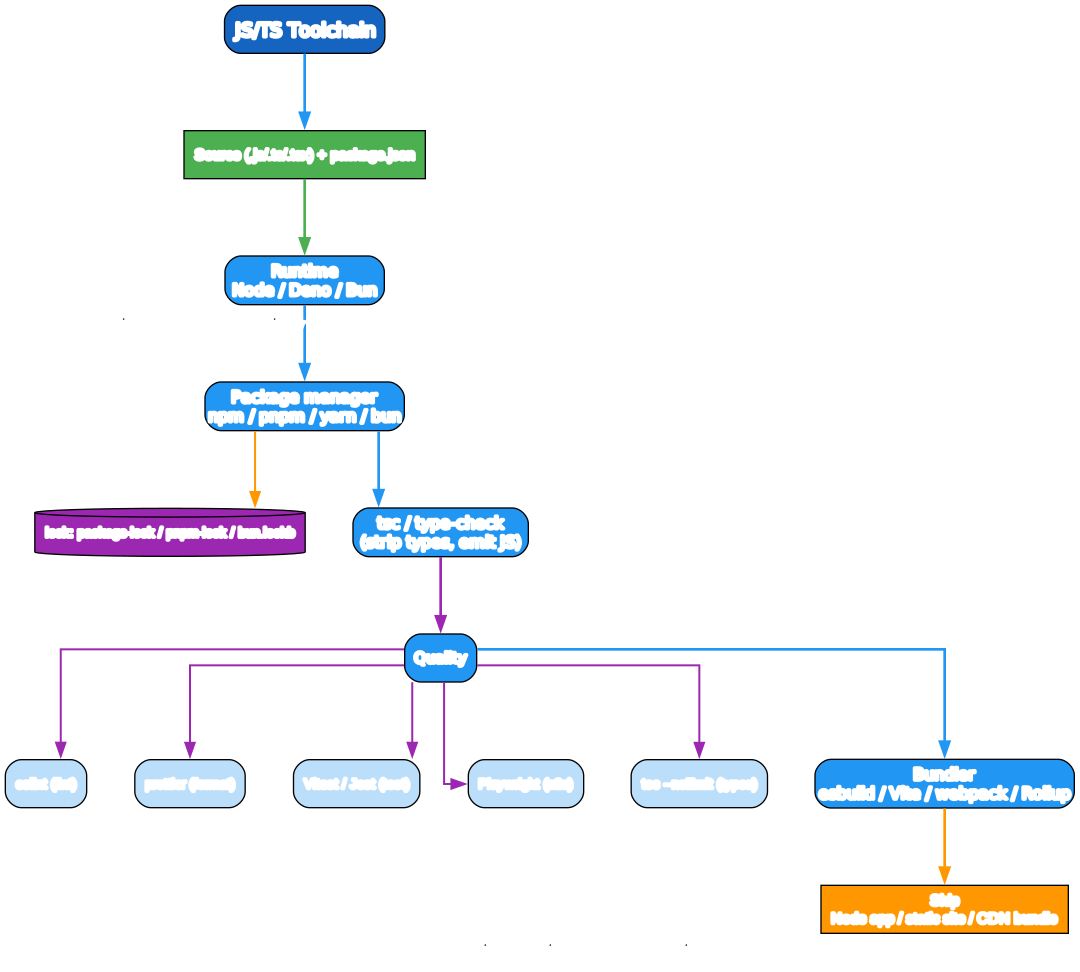
Runtimes and package managers
# Runtimes
node file.js            # the dominant runtime
deno run file.ts        # secure by default, TS native
bun run file.ts         # fast, all-in-one

# Package managers (npm registry)
npm install express
pnpm install express      # faster, deduped via symlinks
yarn add express
bun add express           # fastest

# Lock files
package-lock.json / pnpm-lock.yaml / yarn.lock / bun.lockb
A minimal package.json:
{
  "name": "myapp",
  "type": "module",
  "scripts": {
    "dev": "vite",
    "build": "vite build",
    "test": "vitest",
    "lint": "eslint .",
    "typecheck": "tsc --noEmit"
  },
  "dependencies": { "react": "^19.0.0" },
  "devDependencies": { "typescript": "^5.4.0", "vitest": "^2.0.0", "vite": "^6.0.0" }
}
A minimal tsconfig.json:
{
  "compilerOptions": {
    "target": "ES2022",
    "module": "ESNext",
    "moduleResolution": "bundler",
    "strict": true,
    "noUncheckedIndexedAccess": true,
    "esModuleInterop": true,
    "skipLibCheck": true,
    "verbatimModuleSyntax": true
  },
  "include": ["src"]
}
strict: true turns on all the safety checks — enable it from day one. noUncheckedIndexedAccess makes arr[i] return T | undefined, which catches out-of-bounds reads.
Frameworks, bundlers, testing
- Frontend frameworks: React (dominant), Vue, Svelte, Solid, Astro, Qwik.
- Bundlers: Vite (default for new apps), esbuild (raw speed), webpack (legacy), Rollup (libraries), Rspack (Rust webpack).
- Testing: Vitest (Jest-compatible, faster), Jest (legacy), Playwright (e2e, browser), Bun test.
- Lint/format: ESLint (
eslint), Prettier (prettier), Biome (Rust, all-in-one). - Backend: Node + Express/Fastify/Hono, Deno, Bun.
# Quality gates
npx tsc --noEmit              # type check without emit
npx eslint .                  # lint
npx prettier --write .        # format
npx vitest                    # test runner
npx playwright test           # e2e

# Build
npx vite build                # bundle for production
A Quick-Start Checklist
===only — never==. Read the coercion table once and then forget it.constby default,letonly when reassigning, nevervar.- Understand
thisand closures — they’re the two things that surprise newcomers. - Use ESM (
import/export,"type": "module") in all new code. - Prefer async/await over raw
.thenchains; wrap with try/catch. - Enable
strictin tsconfig from day one; addnoUncheckedIndexedAccess. unknownoverany— narrow with type guards instead of opting out.- Pick a stack: Vite + Vitest + ESLint + Prettier for most projects.
- Run
tsc --noEmitandeslintin CI, plus tests.
Common Pitfalls
==coercion —"0" == falseistrue. Use===.varhoisting —varis function-scoped and hoisted, leading to “use before declaration” surprises. Uselet/const.thisin callbacks — a regular function passed as a callback loses itsthis. Use an arrow or.bind.- Mutating while iterating — adding/removing during
forEach/forcauses skips. Build a new array instead. sort()without comparator — sorts as strings ([10, 9, 2]→[10, 2, 9]). Pass(a, b) => a - b.asyncwithoutawait— anasyncfn with noawaitruns synchronously and wraps the return in a Promise for no reason.- Top-level
awaitin a non-ESM file — only works in modules. anyspreading —anydisables checking; oneanyin a chain infects everything downstream. Useunknown+ narrow.- Array/object copy —
=copies the reference. Use spread ([...arr],{...obj}) for shallow, or a deep-clone library for nested. nullvsundefined—nullis explicit “no value”;undefinedis “not set”. Most APIs useundefined;??handles both.
What to Learn Next
- MDN Web Docs — developer.mozilla.org the authoritative JS/Web API reference.
- JavaScript.info — javascript.info a thorough modern tutorial.
- You Don’t Know JS by Kyle Simpson — the deep dive on closures, types, async.
- Eloquent JavaScript by Marijn Haverbeke — free online, a gentle intro.
- TypeScript Handbook — typescriptlang.org/docs/handbook the official type-system guide.
- Type Challenges — typehero.dev / github.com/type-challenges to practice the type system.
- Total TypeScript by Matt Pocock — practical, modern TS.
- Node.js docs — nodejs.org/docs for the runtime and stdlib.
JavaScript’s quirks (coercion, this, prototypes) are legacy; TypeScript’s type system is modern and powerful. Learn both: the quirks so you don’t get bitten, the types so you can refactor a large codebase with confidence. Once async/await and generics are reflexes, the stack gets out of your way.
Good luck — and turn on strict.
Resources:
- MDN: https://developer.mozilla.org/
- JavaScript.info: https://javascript.info/
- TypeScript: https://www.typescriptlang.org/
- Node.js: https://nodejs.org/
- Vite: https://vitejs.dev/
- Vitest: https://vitest.dev/

Enjoyed this post? Never miss out on future posts by following us


