HackingTool is an all-in-one hacking tool for security researchers and pentesters. With 185+ tools across 20 categories, it provides a unified interface for penetration testing, vulnerability assessment, and security research.
What is HackingTool?
HackingTool is a comprehensive Python-based toolkit that aggregates the best open-source security tools into a single, easy-to-use interface. With 62,642 stars and a thriving community, it’s one of the most popular cybersecurity repositories on GitHub.
The project recently released v2.0.0 with significant improvements including Python 3.10+ support, OS-aware menus, smart updates, and Docker integration.
Architecture Overview
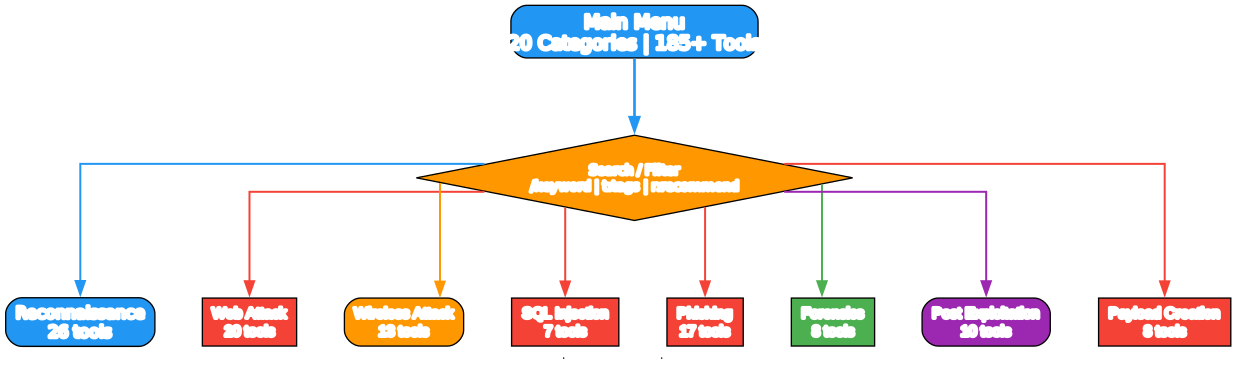
The tool follows a modular architecture:
- Main Menu: Central hub with 20 categories and 185+ tools
- Search & Filter: Quick search (
/query), tag filtering (t), and AI-like recommendations (r) - Category Selection: Browse tools by security domain
- Tool Execution: Install, update, and run individual tools
- Docker Support: Optional containerized execution for isolation
Tool Categories

HackingTool organizes tools into 20 categories covering the full spectrum of cybersecurity:
Offensive Security
| Category | Tools | Description | |———-|——-|————-| | Information Gathering | 26 | Network mapping, port scanning, OSINT | | Web Attack | 20 | Directory brute-forcing, vulnerability scanning | | Wireless Attack | 13 | WiFi auditing, Bluetooth testing | | SQL Injection | 7 | Database exploitation tools | | Phishing Attack | 17 | Social engineering frameworks | | DDoS | 5 | Stress testing and load generation | | XSS Attack | 9 | Cross-site scripting payloads |
Defensive Security
| Category | Tools | Description | |———-|——-|————-| | Forensics | 8 | Memory analysis, disk imaging | | Cloud Security | 4 | AWS/GCP/Azure auditing | | Mobile Security | 3 | Android/iOS testing | | Active Directory | 6 | Windows domain assessment | | Steganography | 4 | Hidden data detection |
Utility & Frameworks
| Category | Tools | Description | |———-|——-|————-| | Wordlist Generator | 7 | Password list creation | | Payload Creation | 8 | Malware development | | Exploit Framework | 4 | Vulnerability exploitation | | Reverse Engineering | 5 | Binary analysis | | Post Exploitation | 10 | Persistence and lateral movement | | Other Tools | 24 | Miscellaneous utilities |
User Workflow

Getting started with HackingTool is straightforward:
# One-liner installation
curl -sSL https://raw.githubusercontent.com/Z4nzu/hackingtool/master/install.sh | sudo bash

# Launch the tool
python hackingtool.py
Once launched, users can:
- Search (
/query) — Find tools by keyword - Filter by Tags (
t) — Filter by 19 tags (osint, web, c2, cloud, mobile…) - Get Recommendations (
r) — “I want to scan a network” → shows relevant tools - Batch Install (
97) — Install all tools in a category at once - Check Status — ✔/✘ shown next to every tool
Key Features in v2.0.0

Smart Search & Recommendations
- Search (
/): Find tools by name, description, or keyword - Tag Filter (
t): Filter by 19 predefined tags - Recommend (
r): Natural language queries like “I want to scan a network”
Installation Management
- Install Status: Visual indicators (✔/✘) for each tool
- Batch Install: Option
97installs all tools in a category - Smart Update: Auto-detects git pull / pip upgrade / go install
- Open Folder: Jump into any tool’s directory for manual inspection
Platform Support
- OS-Aware Menus: Linux-only tools hidden on macOS
- Docker: Builds locally with no unverified external images
- One-Liner Install: Zero manual steps required
Popular Tools Included
Information Gathering
- nmap — Network discovery and security auditing
- theHarvester — Email harvesting and OSINT
- Amass — DNS enumeration and network mapping
- RustScan — Fast port scanner
- SpiderFoot — Automated OSINT
Web Attack
- Nuclei — Fast vulnerability scanner
- ffuf — Fast web fuzzer
- OWASP ZAP — Web application security scanner
- Nikto — Web server scanner
- Caido — Lightweight web proxy
Post Exploitation
- Sliver — Cross-platform implant framework
- Havoc — Modern post-exploitation framework
- PEASS-ng — Privilege escalation scripts
- Chisel — Fast TCP/UDP tunneling
- Mythic — Collaborative red team platform
Installation Requirements
- Python 3.10+
- Linux (Kali, Parrot) or macOS
- Root privileges for some tools
- Docker (optional, for containerized execution)
Conclusion
HackingTool v2.0.0 represents a significant evolution in penetration testing toolkits. By aggregating 185+ tools into a unified interface with smart search, batch operations, and Docker support, it dramatically reduces the time spent on tool management and increases productivity for security professionals.
Whether you’re conducting red team operations, vulnerability assessments, or security research, HackingTool provides the comprehensive toolkit you need in a single, well-organized package.
| Get Started: GitHub Repository | Suggest a Tool |

Enjoyed this post? Never miss out on future posts by following us


