1. Introduction
The AI landscape has exploded. In 2026, there are more large language model providers than most developers can keep track of — OpenAI, Anthropic, Google Gemini, xAI Grok, DeepSeek, Mistral, Qwen, Meta Llama, Groq, NVIDIA NIM, MiniMax, Cohere, and hundreds more. Each one ships its own SDK, its own authentication flow, its own rate limits, its own billing dashboard, and its own API quirks. For a developer who just wants to build something with AI, this fragmentation is a tax on productivity that never stops compounding.
OmniRoute is an open-source project that asks a simple question: what if you only needed one endpoint? Instead of juggling a dozen API keys, a dozen billing pages, and a dozen SDKs, you point every AI tool you own at a single local URL — http://localhost:20128/v1 — and OmniRoute handles the rest. It routes your request to the best available provider, falls back automatically when a quota runs out, compresses your prompts to save tokens, and gives you a dashboard to monitor everything.
At the time of writing, OmniRoute has over 12,500 GitHub stars and is growing at roughly 4,500 stars per week. It supports 237 upstream providers (90+ with a free tier, 11 free forever), 17 routing strategies, a 10-engine compression pipeline, a built-in MCP server with 95 tools, and the A2A agent protocol. It is written entirely in TypeScript, runs on Node.js 22+, and is MIT licensed. This post is a deep dive into what OmniRoute does, how it works, and why it matters.
2. The Fragmentation Problem
To understand why OmniRoute exists, you have to feel the pain it solves. Consider a typical AI-powered development workflow in 2026. You use Claude Code for most of your coding tasks, but your Claude subscription quota runs out around the 20th of every month. You have an OpenAI API key for GPT-5, but the per-token cost adds up fast. You heard DeepSeek is cheap, so you signed up for that too. Groq is fast, so you grabbed a key there. Gemini has a generous free tier, so you set that up. And you just discovered that Qwen3 Coder is excellent for code generation, so now you have yet another account.
Each of these providers has a different API format. OpenAI uses /v1/chat/completions. Anthropic uses /v1/messages with a different request schema. Gemini uses a completely different generateContent endpoint. Each has different streaming conventions, different error formats, different rate-limit headers, and different authentication mechanisms — some use bearer tokens, some use OAuth, some use API keys in headers, some use query parameters.
When you switch between models, you rewrite your client code. When a quota runs out, you manually switch to another provider. When a provider has an outage, your application breaks until you notice and manually fail over. When you want to compare costs, you log into five different dashboards. This is the fragmentation problem, and it is exactly what OmniRoute was built to eliminate.
3. How OmniRoute Works
OmniRoute is a local proxy server. You install it on your machine — via npm, Docker, or as a desktop app — and it starts listening on port 20128. It exposes a single OpenAI-compatible API surface at /v1/*. Every AI tool that speaks the OpenAI API format (which is most of them) can point at this endpoint and immediately access all 237 providers behind it.
The magic is in the translation layer. When a request arrives at OmniRoute, it does three things. First, it normalizes the request format — if your client sends an OpenAI-format request but the target provider is Anthropic, OmniRoute translates the request schema on the fly. If your client sends a Claude-format request but the target is Gemini, it translates that too. The same applies to the Responses API format, so tools that use OpenAI’s newer Responses API work seamlessly against any provider.
Second, it routes the request. Based on the model you specify (or the auto smart-routing mode), OmniRoute picks the best provider from your connected pool. It considers 9 factors in auto mode: provider health, remaining quota, cost per token, latency, success rate, freshness, context-window fit, and more. If the first choice fails — quota exhausted, provider down, rate limited — it falls back to the next provider in milliseconds.
Third, it compresses the request. Before sending anything upstream, OmniRoute runs the prompt through its 10-engine compression pipeline, which can cut token usage by 15–95% depending on the content. Tool outputs, build logs, and verbose prose get aggressively compressed; code blocks, URLs, and JSON are always preserved byte-perfect. The provider receives a smaller prompt, charges you less, and returns the same quality answer.
4. Architecture Overview
OmniRoute is built on Next.js 16 with React 19 and Tailwind CSS 4, running entirely on Node.js. The same process serves both the API gateway and the web dashboard on a single port. The core architecture has four layers: the API surface, the routing engine, the provider execution layer, and the persistence layer.
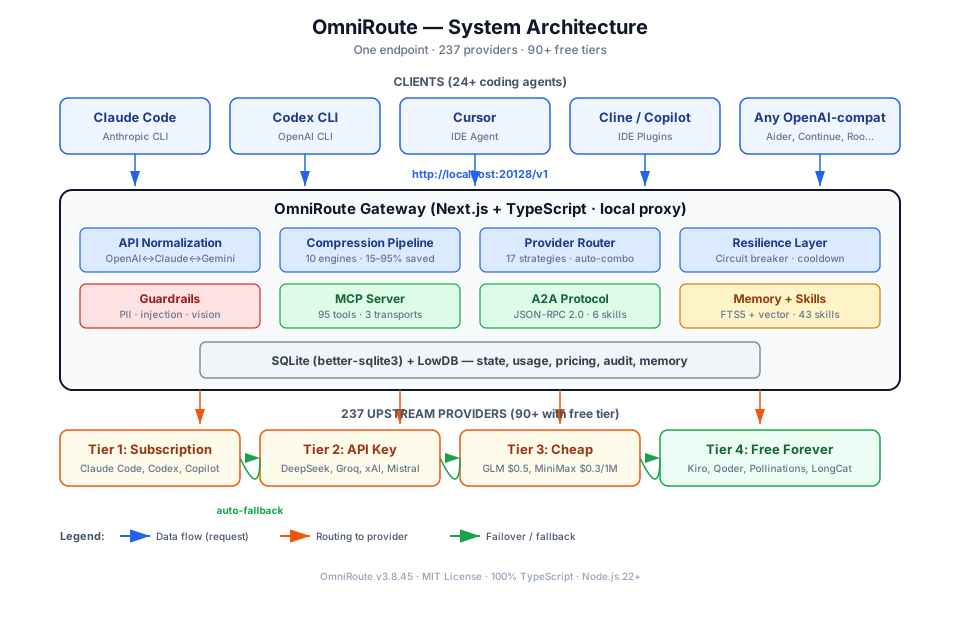
The API surface lives in src/app/api/* and implements both the dashboard management APIs and the OpenAI-compatible compatibility APIs (/v1/chat/completions, /v1/messages, /v1/responses, /v1/embeddings, /v1/images/generations, /v1/audio/transcriptions, /v1/audio/speech, and more). A shared SSE and routing core in src/sse/* and open-sse/* handles provider execution, streaming, fallback, and usage tracking.
The routing engine is the brain of the system. It maintains a live catalog of all connected providers, their models, their pricing, their current quota status, and their health. When a request comes in, the engine evaluates it against the configured combo (a chain of models with a routing strategy) and selects the best target. The engine supports 17 distinct routing strategies, from simple priority ordering to sophisticated cost-optimized selection to a fusion mode that fans out to a panel of models and synthesizes the best answer.
The provider execution layer handles the actual HTTP calls to upstream providers. It manages OAuth token refresh, API key rotation, circuit breakers, connection cooldowns, and model-level lockouts. Each provider has a dedicated executor that knows how to translate requests and responses for that provider’s specific API format.
The persistence layer uses SQLite (via better-sqlite3) as the primary database for domain state — providers, keys, aliases, combos, settings, pricing, usage logs, and audit trails. LowDB provides JSON-based legacy storage for simpler configuration. All credentials are encrypted at rest with AES-256-GCM.
5. Provider Routing
Routing is where OmniRoute distinguishes itself from every other AI gateway. Most routers offer one or two strategies: round-robin or priority-based fallback. OmniRoute offers 17, and they can be mixed and matched per combo step.

The flagship feature is the auto-combo engine. Instead of manually building a combo, you set your model to auto and OmniRoute builds a virtual combo from your connected providers, scored live across 9 factors. There are six auto variants: auto (balanced), auto/coding (quality-first for code), auto/fast (lowest latency), auto/cheap (cheapest per token), auto/offline (most quota headroom), and auto/smart (quality-first with 10% exploration to discover better models).
For users who want fine-grained control, the 17 strategies include priority (drain each target before moving to the next), fill-first (fill each target’s quota fully), weighted (weighted random by per-target weight), round-robin, p2c (power-of-two-choices load balancing), least-used, cost-optimized (minimize cost per request from live pricing), headroom (pick the target with the most remaining quota), reset-window, reset-aware, context-relay (hand off context across targets for long conversations), context-optimized, lkgp (last-known-good path — sticky to the last successful target), auto, and fusion (fan out to a panel of models with a judge that synthesizes one answer).
Resilience is built in across three independent layers. The circuit breaker operates at the whole-provider level — if a provider is failing upstream, OmniRoute stops hammering it and auto-probes to recover. The connection cooldown operates at the account/key level — if one key is rate-limited, other keys for the same provider keep serving. The model lockout operates at the provider-plus-model level — if one model on a provider hits its quota, only that model is quarantined, not the entire connection.
6. Key Features
OmniRoute’s feature set is unusually broad for an open-source project. It is not just a proxy — it is a complete AI gateway platform.

237 providers. The most complete catalog of any open-source router. Every major lab is represented — OpenAI, Anthropic, Gemini, xAI Grok, DeepSeek, Mistral, Qwen, Meta Llama, Groq, NVIDIA, MiniMax, Cohere, Perplexity, HuggingFace, Together, Fireworks, Cloudflare, Baidu — plus 220+ more, including niche providers, regional gateways, and free-forever services.
90+ free-tier providers, 11 free forever. Kiro offers free Claude Sonnet 4.5 with ~50 credits per month. Qoder offers unlimited Kimi-K2 and DeepSeek-R1. Pollinations offers GPT-5, Claude, and Gemini with no key needed. LongCat offers 10M tokens one-time. Cloudflare AI offers 50+ models with 10K neurons per day. NVIDIA NIM offers 129 models at ~40 RPM. Cerebras offers Qwen3 235B with 1M tokens per day. Aggregated across all free tiers, OmniRoute documents approximately 1.6 billion free tokens per month.
Unified API. One endpoint, every format. OpenAI chat completions, Anthropic messages, Gemini generateContent, and the OpenAI Responses API are all translated transparently. Point any OpenAI-compatible tool at /v1 and it works.
17 routing strategies. From simple priority to fusion-based panel judging, OmniRoute gives you more control over how requests are distributed than any other gateway.
10-engine compression pipeline. RTK, Caveman, LLMLingua-2, Headroom, CCR, Session-Dedup, Relevance, Lite, Aggressive, and Ultra — composable, independently toggleable, configurable per combo. Savings range from 15% (Lite) to 95% (stacked RTK + Caveman on tool-heavy sessions).
MCP server with 95 tools. Expose OmniRoute over stdio, HTTP, or SSE and any MCP-compatible agent gets full control of the gateway — routing, providers, combos, cache, compression, memory. Claude Desktop, Cursor, and any MCP client can drive OmniRoute autonomously.
A2A protocol. JSON-RPC 2.0 with SSE streaming and 6 skills. Agent-to-agent communication so an AI agent can control OmniRoute itself.
24+ tool integrations. Claude Code, Codex CLI, Cursor, Cline, Copilot, Antigravity, Continue, OpenCode, Kilo Code, Roo Code, Goose, Qwen Code, Aider, and any other OpenAI-compatible tool — all through one config.
Security and privacy. Credentials encrypted at rest with AES-256-GCM. Zero telemetry by default. API-key scoping, IP filtering, rate limits, prompt-injection guard, loopback-only process routes. MIT licensed and fully auditable.
7. Claude Code Integration
Claude Code is one of the most popular AI coding agents, and OmniRoute makes it trivially easy to connect. The integration works by pointing Claude Code’s API base URL at OmniRoute’s local endpoint.
The simplest method is the one-command setup:
omniroute setup claude-code
This guided command detects your Claude Code installation, picks a model from your connected providers, and writes the configuration automatically. Alternatively, you can configure it manually:
# Set the environment variable
export ANTHROPIC_BASE_URL=http://localhost:20128/v1
export ANTHROPIC_API_KEY=your-omniroute-key

# Or use the zero-config launcher
omniroute launch
Once configured, Claude Code sends all requests through OmniRoute. You can set the model to auto for smart routing, or specify a particular provider model like kr/claude-sonnet-4.5 (Kiro’s free Claude) or cc/claude-opus-4-7 (your Claude subscription). When your subscription quota runs out, OmniRoute automatically falls back to the next provider in your combo — no manual intervention needed.
The per-model profile feature lets you assign different models to different tasks. You might use auto/coding for code generation (quality-first), auto/fast for quick questions (lowest latency), and auto/cheap for long-running background tasks (cheapest per token). Claude Code respects these profiles, and OmniRoute routes accordingly.
8. Codex Integration
Codex CLI is OpenAI’s command-line coding agent, and OmniRoute connects it just as easily. The setup is symmetric with Claude Code:
omniroute setup codex
Or manually:
export OPENAI_BASE_URL=http://localhost:20128/v1
export OPENAI_API_KEY=your-omniroute-key

# Zero-config launcher
omniroute launch-codex
Because OmniRoute translates between API formats transparently, you can run Codex (which speaks OpenAI) against Claude models, Gemini models, or any of the 237 providers. This is particularly powerful for developers who prefer Codex’s workflow but want access to non-OpenAI models. You can set the model to auto and let OmniRoute pick the best provider, or pin it to a specific free model like if/kimi-k2-thinking (Qoder’s unlimited free tier).
The remote mode feature is especially useful for Codex. If you run OmniRoute on a VPS (where the loopback redirect works for OAuth flows that your local machine cannot reach), you can drive it from your laptop:
omniroute connect 192.168.0.15
omniroute configure codex
This connects to the remote OmniRoute, picks a model, and writes a local Codex profile that routes through the remote server. Your laptop runs Codex; the VPS runs OmniRoute and handles provider connections.
9. Free Tier Providers
One of OmniRoute’s most compelling features is its aggregation of free-tier providers. The project documents approximately 1.6 billion free tokens per month across 40+ provider pools and 500+ models, with up to 2.1 billion in your first month thanks to signup credits.
The 11 free-forever providers are the backbone of the $0 stack:
| Provider | Free Models | Quota |
|---|---|---|
| Kiro | Claude Sonnet 4.5, Haiku 4.5, Opus 4.6 | ~50 credits/month |
| Qoder | kimi-k2-thinking, qwen3-coder-plus, deepseek-r1 | Unlimited |
| Qwen | qwen3-coder-plus/flash/next | Unlimited |
| Pollinations | GPT-5, Claude, Gemini, DeepSeek, Llama 4 | No key needed |
| LongCat | LongCat-2.0 | 10M tokens one-time (KYC) |
| Cloudflare AI | 50+ models | 10K neurons/day |
| NVIDIA NIM | 129 models | ~40 RPM |
| Cerebras | Qwen3 235B, GPT-OSS 120B | 1M tokens/day |
| AgentRouter | GPT-5, Claude, Gemini | $100 free credits |
| OpenCode Free | Various | No auth needed |
| SenseNova | Chat + text-to-image | Free token plan |
The dashboard’s /dashboard/free-tiers page shows a live breakdown: per-model usage, remaining quota for the current month, and a transparent terms flag per provider. OmniRoute counts each shared free pool once (pool-deduped), so the headline number is honest rather than inflated by rate-limit ceilings.
The $0 Free Stack combo chains these providers for an unbreakable free experience:
1. kr/claude-sonnet-4.5   (Kiro — ~50 credits/mo per account)
2. if/kimi-k2-thinking    (Qoder — unlimited)
3. pol/gpt-5              (Pollinations — no key)
4. lc/LongCat-2.0         (10M one-time backup, KYC)
Compression: aggressive (~50%) → double your free quota
Cost: $0/month
10. Installation and Quick Start
OmniRoute is designed to be running in under two minutes. The primary install method is npm:
npm install -g omniroute
omniroute
This starts the gateway and dashboard on port 20128. The dashboard is at http://localhost:20128 and the API is at http://localhost:20128/v1.
For Docker users:
docker run -d --name omniroute --restart unless-stopped --stop-timeout 40 \
  -p 20128:20128 -v omniroute-data:/app/data diegosouzapw/omniroute:latest
From source:
git clone https://github.com/diegosouzapw/OmniRoute.git
cd OmniRoute
cp .env.example .env
npm install
PORT=20128 npm run dev
Once running, connect a free provider through the dashboard (Providers → connect Kiro AI or OpenCode Free — no signup needed), then point your coding tool at the endpoint:
Base URL: http://localhost:20128/v1
API Key:  [copy from Dashboard → Endpoints]
Model:    auto
Verify it is working:
curl http://localhost:20128/v1/models -H "Authorization: Bearer YOUR_KEY"
You should see your connected models listed. That is the entire setup — start coding, and OmniRoute handles routing and fallback automatically.
For clients that cannot send custom headers, OmniRoute exposes tokenized compatibility aliases:
OpenAI catalog:   http://localhost:20128/vscode/YOUR_KEY/
OpenAI chat:       http://localhost:20128/vscode/YOUR_KEY/chat/completions
Ollama chat:       http://localhost:20128/vscode/YOUR_KEY/api/chat
11. Usage Examples
Basic chat completion:
import OpenAI from "openai";

const client = new OpenAI({
  baseURL: "http://localhost:20128/v1",
  apiKey: "your-omniroute-key",
});

const response = await client.chat.completions.create({
  model: "auto",  // smart routing — picks the best available provider
  messages: [{ role: "user", content: "Explain how circuit breakers work" }],
});

console.log(response.choices[0].message.content);
Streaming with model switching:
const stream = await client.chat.completions.create({
  model: "auto/coding",  // quality-first for code generation
  messages: [{ role: "user", content: "Write a Rust HTTP server" }],
  stream: true,
});

for await (const chunk of stream) {
  process.stdout.write(chunk.choices[0]?.delta?.content || "");
}
Multi-provider combo with explicit fallback:
# Dashboard → Combos → Create
name: "always-on"
strategy: priority
steps:
  - provider: cc        # Claude Code subscription
    model: claude-opus-4-7
  - provider: cx        # Codex subscription
    model: gpt-5.5
  - provider: glm       # Cheap backup
    model: glm-5.1
  - provider: kr        # Free forever
    model: claude-sonnet-4.5
Per-request routing override:
curl http://localhost:20128/v1/chat/completions \
  -H "Authorization: Bearer YOUR_KEY" \
  -H "X-Route-Model: auto/cheap" \
  -H "X-OmniRoute-Budget: 0.50" \
  -d '{
    "model": "auto",
    "messages": [{"role": "user", "content": "Summarize this log"}]
  }'
The X-Route-Model header overrides the combo for a single request, and X-OmniRoute-Budget sets a hard USD cost ceiling. The X-OmniRoute-Mode header can override the mode preset (e.g., fast, cheap, coding).
Using the CLI chat client:
omniroute chat
# Interactive TUI with slash commands: /model /combo /skill /memory
12. Comparison with Alternatives
OmniRoute is not the only AI gateway, but it is the most comprehensive. Here is how it stacks up against the three most common alternatives.
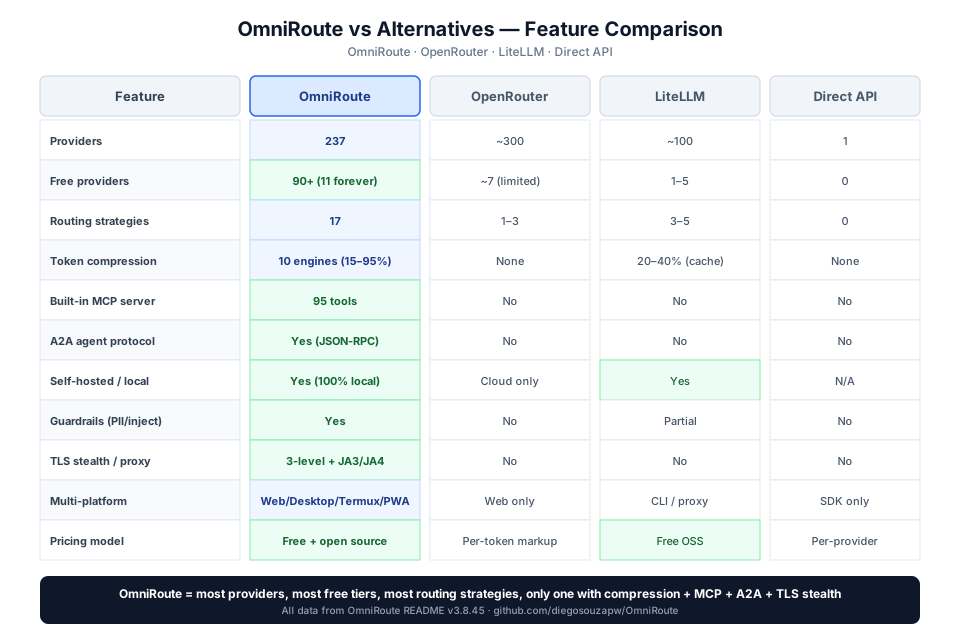
OmniRoute vs OpenRouter. OpenRouter is a cloud-based AI gateway with approximately 300 providers. It charges a per-token markup on top of provider pricing. OmniRoute is self-hosted and free — you pay only the providers directly, with no intermediary markup. OpenRouter has 1–3 routing strategies; OmniRoute has 17. OpenRouter has no token compression; OmniRoute saves 15–95%. OpenRouter has no MCP server, no A2A protocol, no guardrails, and no TLS stealth. OmniRoute has all of these. OpenRouter is web-only; OmniRoute runs as a web app, desktop app, Docker container, Termux app on Android, and PWA.
OmniRoute vs LiteLLM. LiteLLM is an open-source AI gateway with approximately 100 providers. It supports 3–5 routing strategies and has a proxy mode for self-hosting. OmniRoute has 237 providers, 17 routing strategies, a 10-engine compression pipeline, a built-in MCP server, A2A protocol, guardrails, and TLS fingerprint stealth — none of which LiteLLM offers. LiteLLM’s pricing dataset does feed OmniRoute’s cost-tracking sync, so the two projects are complementary in that respect. But for features, OmniRoute is strictly more capable.
OmniRoute vs Direct API. Using a provider’s API directly gives you maximum control but maximum complexity. You manage authentication, rate limits, failover, format translation, and cost tracking yourself. You get one provider, zero free tiers beyond what that provider offers, zero routing strategies, zero compression, and zero protocol support. OmniRoute wraps all of this into a single endpoint with 237 providers, 90+ free tiers, 17 routing strategies, 10 compression engines, MCP, A2A, and full resilience.
13. Cost Optimization
Cost is where OmniRoute delivers its most tangible value. The project’s philosophy is that the dashboard “cost” number is a savings tracker, not a bill — OmniRoute never charges you. A “$290 total cost” using free models means $290 saved.
The cost optimization stack has four layers. First, the 4-tier fallback model: Subscription → API Key → Cheap → Free. You use your paid subscriptions first (maximizing their value), then fall back to cheap per-token providers, then to free-forever providers. This ensures you never pay more than necessary and never stop coding when a quota runs out.
Second, the cost-optimized routing strategy (cost-optimized) minimizes the dollar cost per request using live catalog pricing. OmniRoute syncs pricing data from LiteLLM’s public dataset and from models.dev, so the cost engine always has current numbers. The auto/cheap mode variant routes to the cheapest viable model automatically.
Third, the compression pipeline. On tool-heavy sessions (git diffs, build logs, grep output), the stacked RTK + Caveman pipeline saves an average of 89% of eligible tokens. Since you pay per token, this directly reduces your bill. A 10,000-token prompt compressed to 1,080 tokens costs 89% less on any per-token provider.
Fourth, the free-tier aggregation. With 90+ free-tier providers and 11 free-forever providers, OmniRoute gives you access to approximately 1.6 billion free tokens per month. For many developers, this is enough to never pay for AI inference at all. The $0 Free Stack combo (Kiro → Qoder → Pollinations → LongCat with aggressive compression) provides an unbreakable free pipeline.
The per-request X-OmniRoute-Budget header lets you set a hard USD cost ceiling on individual requests. If no provider can satisfy the request within the budget, OmniRoute routes to a free provider instead. The X-OmniRoute-Cost-Saved header on cache-hit responses shows you exactly how much you saved.
14. Developer Experience
OmniRoute is not just a server — it is a full command-line cockpit with 80+ commands. The CLI is a first-class interface, not an afterthought.
omniroute               # serve gateway + dashboard (port 20128)
omniroute chat          # interactive TUI chat client
omniroute setup         # guided first-run wizard
omniroute doctor        # diagnose providers, ports, native deps
omniroute models list   # list all available models
omniroute configure codex  # configure a coding tool
omniroute tokens create --name ci --scope read  # mint scoped tokens
The command surface covers providers, OAuth, keys, combos, models, cache, compression, cost, usage, quota, health, resilience, telemetry, logs, audit, MCP, A2A, cloud agents, memory, skills, evals, tunnels, backups, sync, webhooks, policies, pricing, and more.
The dashboard is a comprehensive web application with 30+ pages. The Providers page manages connections and credentials. The Combos page builds routing strategies with a step-based builder. The Auto-Combo page configures scoring weights and mode packs. The Costs page shows cost aggregation and pricing visibility. The Analytics page displays usage analytics, evaluations, and combo target health. The Health page shows uptime, circuit breaker status, rate limits, and quota-monitored sessions. The Compression Studio provides a real-time visual pipeline editor with Play lanes and A/B Compare. The CLI Tools page offers per-tool onboarding with runtime detection and config generation.
The MCP server exposes 95 tools across 3 transports (stdio, HTTP, SSE) with 30 scopes and a full audit trail. This means any MCP-compatible agent — Claude Desktop, Cursor, or a custom agent — can programmatically control every aspect of OmniRoute: add providers, create combos, adjust compression, query usage, run evals. The A2A server adds JSON-RPC 2.0 protocol support with 6 skills and task lifecycle management, enabling agent-to-agent communication where an AI agent drives OmniRoute autonomously.
The testing infrastructure is serious: 21,000+ test cases across 2,586 files covering unit, integration, E2E, security, and ecosystem tests, running on Node.js’s native test runner plus Vitest. The project supports 42 locales with full i18n, runs on Windows, macOS, Linux, Android (Termux), and as a PWA, and ships as an Electron desktop app with system tray integration.
15. Conclusion
OmniRoute represents a fundamental shift in how developers interact with AI providers. The old model — one SDK per provider, one dashboard per provider, manual failover, manual cost tracking — does not scale to a world with 237 providers. OmniRoute’s model — one endpoint, automatic routing, automatic fallback, automatic compression, one dashboard — is the future.
What makes OmniRoute stand out is not any single feature but the combination. Other gateways have more providers (OpenRouter) or are self-hosted (LiteLLM), but none combine 237 providers, 90+ free tiers, 17 routing strategies, a 10-engine compression pipeline, a 95-tool MCP server, A2A protocol, guardrails, TLS stealth, 42-locale i18n, and a full desktop/Termux/PWA multi-platform story in one MIT-licensed package. The 12,500+ stars and 4,500-star-per-week growth rate are a market signal that developers want exactly this combination.
For individual developers, OmniRoute means never hitting a quota wall mid-coding session, never overpaying for tokens, and never juggling more than one API endpoint. For teams, the Quota-Share feature distributes a provider’s time-based quota fairly across keys in a pool, so one developer’s burst does not lock out the rest of the team. For organizations in regions where AI is blocked, the 3-level proxy with TLS fingerprint stealth provides access from anywhere.
The project is actively maintained — version 3.8.45 at the time of writing, with a detailed changelog, 280+ contributors, and a passionate community across Discord, Telegram, and WhatsApp. The architecture is clean (100% TypeScript, zero any in core modules since v2.0), the documentation is extensive (100+ docs files covering every subsystem), and the test coverage is exceptional (21,000+ tests).
If you use any AI coding tool — Claude Code, Codex, Cursor, Cline, Copilot, or any OpenAI-compatible client — OmniRoute is worth installing today. The setup takes two minutes, the first free provider takes one click, and the payoff is immediate: one endpoint, every provider, never stop coding.
Links: GitHub · npm · Docker Hub · Website · Discord Enjoyed this post? Never miss out on future posts by following us 


