You know the developer. Long ponytail, oval glasses, been at the company longer than version control. You show them fifty lines of code; they squint, delete forty-nine, and replace them with one. They do not write clever code. They write less code. And somehow their features ship faster, break less, and never need a migration guide.
Ponytail puts that developer inside your AI coding agent.
Before your agent writes a single line of new code, Ponytail makes it walk a 6-rung laziness ladder – and it stops at the first rung that holds. Does this feature need to exist? Does the standard library already do it? Does the native platform cover it? Is there an installed dependency that solves it? Can it be one line? Only then, at the very bottom, does the agent write the minimum code that works.
The key differentiator: lazy means efficient, not negligent. Input validation at trust boundaries, error handling that prevents data loss, security, and accessibility are never on the chopping block. The code ends up small because it is necessary, not because it was golfed.
Quick start is one command. For Claude Code:
/plugin marketplace add DietrichGebert/ponytail
/plugin install ponytail@ponytail
That is it. Ponytail is active every session, intercepting every coding decision, quietly deleting the code that never needed to exist.
Amazing: Ponytail makes your AI agent walk a 6-rung laziness ladder before writing any code – and the results are dramatic: 80-94% less code, 3-6x faster, 42-75% cheaper on every Claude model. The best code is the code you never wrote.
What is Ponytail?
Ponytail is an AI agent skill and plugin from Dietrich Gebert, currently sitting at over 16,000 GitHub stars, released under the MIT license at version 0.1.0. Its core philosophy is stated in one sentence on the repository: the best code is the code you never wrote.
That philosophy is operationalized through the 6-rung laziness ladder. Before the agent writes any code, it walks the ladder from top to bottom:
- YAGNI – Does this need to exist? If not, skip it entirely.
- Stdlib – Does the standard library do it? Use it.
- Platform – Does the native platform cover it? Use the platform feature.
- Installed Dep – Does an already-installed dependency solve it? Use it.
- One Line – Can this be one line? Write one line.
- Minimum – Only then: write the minimum code that works.
The agent stops at the first rung that holds. If Rung 3 catches the problem, it never reaches Rung 6. No new code, no new dependencies, no new abstractions.
But Ponytail is not lazy about everything. The ruleset explicitly protects input validation at trust boundaries, error handling that prevents data loss, security, accessibility, and hardware calibration. If the user explicitly requests a feature, Ponytail builds it. Non-trivial logic leaves one runnable check behind – the smallest thing that fails if the logic breaks. No frameworks, no fixtures.
Every shortcut Ponytail takes is marked with a ponytail: comment that names its ceiling and its upgrade path. This creates a living technical debt ledger that is visible in the codebase and harvestable with the /ponytail-debt command.
Ponytail works with 13 agents: Claude Code, Codex, GitHub Copilot CLI, Pi, OpenCode, Gemini CLI, Antigravity CLI, and OpenClaw in full plugin mode; Cursor, Windsurf, Cline, Aider, and Kiro in instruction-only mode.
Key Insight: Every shortcut ponytail takes is marked with a
ponytail:comment naming its ceiling and upgrade path. This means “later” doesn’t become “never” – the debt is visible, harvestable with/ponytail-debt, and upgradeable when the ceiling is hit.
The 6-Rung Laziness Ladder
The laziness ladder is the heart of Ponytail. It is a structured decision framework that intercepts every coding decision, not just the first one. The ladder is checked every turn, on every response, throughout the entire session.
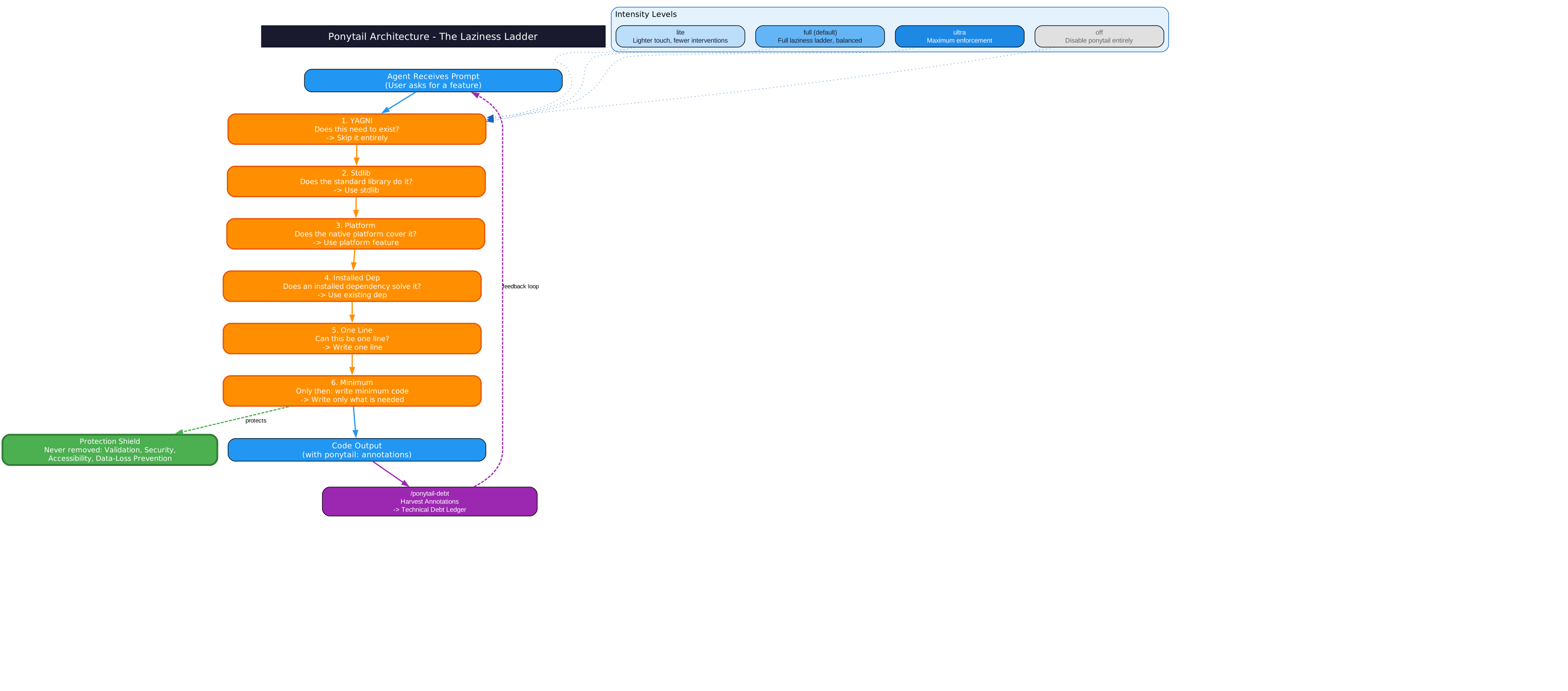
Let us walk through each rung with the canonical example: you ask the agent to add a date picker to a form.
Rung 1 – YAGNI. “Does this need to exist?” The most powerful rung. If the feature does not need to exist, skip it entirely. No code, no bugs, no maintenance. In the date picker example, the feature is explicitly requested, so Rung 1 does not hold. We continue.
Rung 2 – Stdlib. “Does the standard library do it?” If the language’s standard library already provides the functionality, use it. No new imports, no new dependencies. For a date picker in the browser, the standard library does not provide one. We continue.
Rung 3 – Platform. “Does the native platform cover it?” If the platform provides the feature natively, use it. The browser has <input type="date"> – a native HTML date picker. Rung 3 holds. The agent writes one line and stops.
Without Ponytail, the same prompt produces a very different outcome. The agent installs flatpickr, writes a wrapper component, adds a stylesheet, imports a locale config, and starts a discussion about timezone handling. Fifty lines, one new dependency, and a maintenance burden that did not need to exist.
Rung 4 – Installed Dep. “Does an already-installed dependency solve it?” If a package already in your node_modules or requirements.txt can handle the task, use it. No new packages.
Rung 5 – One Line. “Can this be one line?” If the solution can be expressed in a single line, write one line. No boilerplate, no abstraction layer, no factory.
Rung 6 – Minimum. “Only then: write the minimum code that works.” This is the fallback. When no higher rung holds, the agent writes code – but only the minimum that the task requires. Not a framework. Not a library. Not a general-purpose utility. The minimum.
The ladder prevents over-engineering at every level. It does not say “write fewer tokens.” It says: write only what the task needs. The difference matters. Token minimization produces dense, golfed code. The ladder produces necessary code.
Benchmarks: 80-94% Less Code
Ponytail’s performance claims are not marketing. They are measured.
The benchmark methodology is straightforward. Five everyday tasks were selected: an email validator, a debounce function, a CSV column sum, a countdown timer, and a rate limiter. These are the kind of tasks AI coding agents handle every day – not algorithmic puzzles, not system design, just the work that fills a real session.
Three Claude models were tested: Haiku, Sonnet, and Opus. Three arms were compared: no skill (baseline), the caveman skill (another “reduce AI output” approach), and Ponytail. Ten runs per cell, median reported.
The results:
| Metric | Model | Baseline | Caveman | Ponytail |
|---|---|---|---|---|
| Code (lines) | Haiku | 518 | 116 | 39 |
| Code (lines) | Sonnet | 693 | 120 | 44 |
| Code (lines) | Opus | 256 | 67 | 51 |
| Cost (USD) | Haiku | 0.030 | 0.014 | 0.011 |
| Cost (USD) | Sonnet | 0.137 | 0.046 | 0.035 |
| Cost (USD) | Opus | 0.137 | 0.072 | 0.079 |
| Latency (s) | Haiku | 37.7 | 14.9 | 9.9 |
| Latency (s) | Sonnet | 124.1 | 34.7 | 20.1 |
| Latency (s) | Opus | 58.7 | 23.1 | 18.0 |
Across every model, Ponytail produces 80-94% less code than the baseline, 42-75% less cost, and 3-6x faster responses. The pattern is consistent: the laziness ladder eliminates code that never needed to exist.
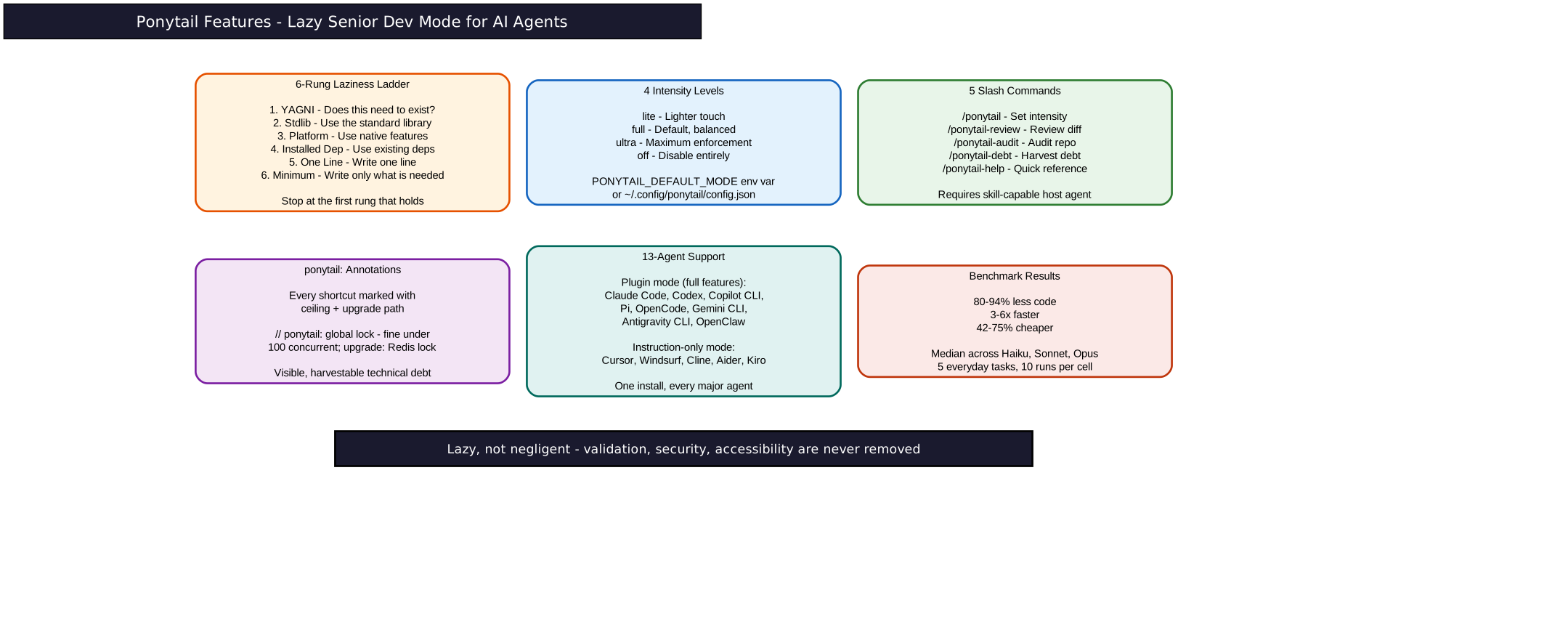
An important caveat: these are Claude numbers. The ladder is a deliberation step – it adds reasoning before code generation. On terse reasoning models that already produce minimal output, the extra deliberation can go the other way and per-session cost can land either way. The rule was never “fewest tokens.” It is: write only what the task needs.
You can reproduce the benchmarks yourself:
npx promptfoo eval -c benchmarks/promptfooconfig.yaml
Four Intensity Levels
Not every codebase deserves the same level of enforcement. Ponytail provides four intensity levels:
- lite – Lighter touch, fewer interventions. For when you want subtle guidance without the agent questioning every decision.
- full (default) – The full laziness ladder, balanced approach. This is what most sessions should use.
- ultra – Maximum enforcement. For when the codebase has wronged you personally and you want the agent to question everything.
- off – Disable Ponytail entirely. The agent reverts to its default behavior.
Set the default level via the PONYTAIL_DEFAULT_MODE environment variable:
export PONYTAIL_DEFAULT_MODE=ultra
Or persist it in a config file:
{
  "defaultMode": "ultra"
}
The config file lives at ~/.config/ponytail/config.json. The /ponytail command switches levels mid-session without restarting – type /ponytail lite and the enforcement immediately relaxes.
The difference between levels is in how aggressively the ladder is applied. In lite mode, the agent may skip rungs for small tasks. In ultra mode, every decision walks the full ladder, no exceptions. The protection shield (validation, security, accessibility) is active at every level except off.
Five Slash Commands
Ponytail provides five slash commands for ongoing enforcement beyond the initial coding session:
| Command | What it does |
|---|---|
/ponytail [lite\|full\|ultra\|off] | Set intensity level, or report current level if no argument given |
/ponytail-review | Review the current diff for over-engineering, return a delete-list |
/ponytail-audit | Audit the entire repo for over-engineering, not just the current diff |
/ponytail-debt | Harvest all ponytail: annotations into a structured technical debt ledger |
/ponytail-help | Quick reference for all commands |
These commands need a skill-capable host agent. In Claude Code, they are native slash commands. In Codex, commands are skills invoked with @ – for example, @ponytail-review runs the review skill. In GitHub Copilot CLI, commands are namespaced: /ponytail:ponytail-review.
Instruction-only adapters (Cursor, Windsurf, Cline, Aider, Kiro) load the always-on ruleset without command support. The laziness ladder still intercepts every coding decision, but the review, audit, and debt harvesting commands are not available. You get the ladder without the enforcement tools.
The /ponytail-review command is particularly useful after a long session. It examines the current diff and returns a delete-list – specific lines or blocks that the ladder would have caught. /ponytail-audit goes further, scanning the entire repository for over-engineering patterns. /ponytail-debt harvests every ponytail: comment into a structured ledger organized by ceiling and upgrade path.
13-Agent Multi-Platform Support
Ponytail works with 13 agents across two integration modes.
Plugin mode (full features including commands):
| Agent | Install Command |
|---|---|
| Claude Code | /plugin marketplace add DietrichGebert/ponytail then /plugin install ponytail@ponytail |
| Codex | codex plugin marketplace add DietrichGebert/ponytail |
| GitHub Copilot CLI | copilot plugin marketplace add DietrichGebert/ponytail |
| Pi | pi install git:github.com/DietrichGebert/ponytail |
| OpenCode | Add plugin path to opencode.json |
| Gemini CLI | gemini extensions install https://github.com/DietrichGebert/ponytail |
| Antigravity CLI | agy plugin install https://github.com/DietrichGebert/ponytail |
| OpenClaw | clawhub install ponytail |
Instruction-only mode (always-on ruleset, no commands):
| Agent | Setup |
|---|---|
| Cursor | Copy rules to .cursor/rules/ |
| Windsurf | Copy rules to .windsurf/rules/ |
| Cline | Copy rules to .clinerules/ |
| Aider | Use AGENTS.md from the repo |
| Kiro | Copy .kiro/steering/ponytail.md to ~/.kiro/steering/ |

One install, every major agent. The laziness ladder works the same way everywhere – the only difference is whether you get the slash commands on top.
A note on Node.js: Claude Code and Codex plugins use lifecycle hooks that require Node.js on PATH. If Node.js is not available, the skills still work but always-on activation stays quiet. The ladder still intercepts decisions; the startup banner just does not display.
The ponytail: Comment Convention
Every shortcut Ponytail takes is annotated with a ponytail: comment. The comment names two things: the ceiling (when the shortcut breaks) and the upgrade path (how to fix it).
// ponytail: global lock - fine under 100 concurrent; upgrade: Redis lock
const cache = {};
// ponytail: O(n^2) scan - fine under 10K items; upgrade: indexed lookup
function findMatch(items, target) {
  return items.filter(i => i.id === target.id);
}
// ponytail: naive heuristic - fine for typical inputs; upgrade: proper parser
function extractField(text) {
  return text.split(':')[1]?.trim();
}
This convention creates a living technical debt ledger that lives directly in the codebase. It is not a separate document that goes stale. It is not a Jira ticket that gets closed without verification. The annotation is right there, next to the code it describes, visible to every developer who reads the file.
The /ponytail-debt command harvests all ponytail: annotations into a structured ledger. The ledger is organized by ceiling and upgrade path, making it easy to prioritize what to upgrade when the ceiling is hit. When the global lock starts failing under 200 concurrent users, you search the ledger for “global lock” and find the upgrade path: Redis lock.
“Later” does not become “never” because the debt is visible and harvestable. The annotation is a promise with a trigger condition.
Not Lazy About: What Ponytail Protects
Ponytail is lazy, not negligent. The ruleset explicitly protects several categories of code from the laziness ladder:
Trust-boundary validation. Input validation at trust boundaries – API endpoints, user form submissions, external data ingestion – is never removed. If untrusted data crosses a boundary, it gets validated. No exceptions, no intensity level overrides.
Data-loss prevention. Error handling that prevents data loss is always kept. If removing a try/catch could result in silent data corruption, it stays. The ladder does not trade correctness for brevity.
Security. Security checks are never on the chopping block. Authentication, authorization, input sanitization, output encoding – these are not “over-engineering.” They are the floor.
Accessibility. ARIA labels, keyboard navigation, semantic HTML, focus management – accessibility is never sacrificed for brevity. A date picker that screen readers cannot use is not a valid shortcut.
Hardware calibration. The platform is never the spec ideal. Clocks drift. Sensors read off. Hardware-specific calibration code is kept because the real world does not match the documentation.
Explicitly requested features. If the user asks for it, Ponytail builds it. The ladder does not second-guess explicit requests. YAGNI applies to inferred features, not requested ones.
Non-trivial logic. Non-trivial logic leaves one runnable check behind – the smallest thing that fails if the logic breaks. No frameworks, no fixtures. Just one assert or one small test file. Trivial one-liners need no test.
Important: Ponytail is lazy, not negligent. Input validation at trust boundaries, error handling that prevents data loss, security, and accessibility are never on the chopping block. The code ends up small because it is necessary, not golfed.
Comparison with Caveman
Caveman is the other major “reduce AI output” skill in the AI agent ecosystem. Both appear in Ponytail’s benchmark: no skill (baseline), caveman, and Ponytail. The benchmark results show both skills reduce code output significantly compared to the baseline.
Ponytail’s differentiator is structure. Caveman tells the agent to write less. Ponytail gives the agent a 6-rung decision framework that specifies exactly how to decide what to write. The laziness ladder is not “be terse” – it is a checklist with a defined order and a defined stopping condition.
The ponytail: annotation convention is another differentiator. Caveman reduces output but does not annotate the shortcuts. Ponytail marks every shortcut with its ceiling and upgrade path, creating a harvestable technical debt ledger. The debt is visible, not invisible.
The four intensity levels give fine-grained control that a single-mode skill cannot match. The review, audit, and debt commands provide ongoing enforcement beyond the initial coding session. And the explicit protection of validation, security, and accessibility means Ponytail is lazy about code volume, not about code correctness.
Conclusion
Ponytail brings the “lazy senior dev” philosophy to AI coding agents. A 6-rung laziness ladder intercepts every coding decision, stopping at the first rung that holds. Four intensity levels control enforcement aggressiveness. Five slash commands provide ongoing review, audit, and debt harvesting. Thirteen agents are supported across plugin and instruction-only modes.
The results: 80-94% less code, 3-6x faster, 42-75% cheaper – measured across Haiku, Sonnet, and Opus on five everyday tasks, ten runs per cell, median reported.
The ponytail: comment convention makes every shortcut visible, with its ceiling and upgrade path documented inline. Technical debt does not hide. It lives in the code, harvestable with /ponytail-debt, upgradeable when the ceiling is hit.
And through it all, Ponytail is lazy, not negligent. Validation, security, accessibility, and data-loss prevention are never removed. The code ends up small because it is necessary.
Quick start for Claude Code:
/plugin marketplace add DietrichGebert/ponytail
/plugin install ponytail@ponytail
Takeaway: With a single
/plugin marketplace add DietrichGebert/ponytailcommand, your AI agent gains the wisdom of the laziest senior developer – checking YAGNI, stdlib, platform features, existing dependencies, and one-liners before writing a single line of new code.

Enjoyed this post? Never miss out on future posts by following us


