What is RF-DETR
RF-DETR is a real-time transformer architecture for object detection, instance segmentation, and keypoint detection developed by Roboflow. It is built on a DINOv2 vision transformer backbone and a Deformable DETR decoder, and it delivers state-of-the-art accuracy and latency trade-offs on Microsoft COCO and RF100-VL. The architecture was created with neural architecture search (NAS), and the same NAS method is now available on the Roboflow platform so a user can discover the best architecture for their own dataset.
The open-source rfdetr package and the Apache-designated model weights are released under Apache License 2.0. Plus components, including the rfdetr_plus extension and the RF-DETR-XL and RF-DETR-2XL detection models, are licensed under PML 1.0. The work was published at ICLR 2026 and is described in the paper RF-DETR: Real-Time Detection Transformer. The code is on GitHub at roboflow/rf-detr and the package is on PyPI.
Model Architecture
RF-DETR is organized as a classic detection transformer with three stages. An input image at a task-appropriate resolution is passed through a DINOv2 vision transformer backbone, which is either frozen or partially tuned during training. The backbone produces multi-scale feature maps. These feature maps feed a Deformable DETR decoder, which uses object queries and cross-attention to reason about candidate detections. The decoder output is then routed to one of three task heads: a detection head that produces boxes and classes, a segmentation head that produces instance masks, and a keypoint head (currently in preview) that produces pose keypoints.
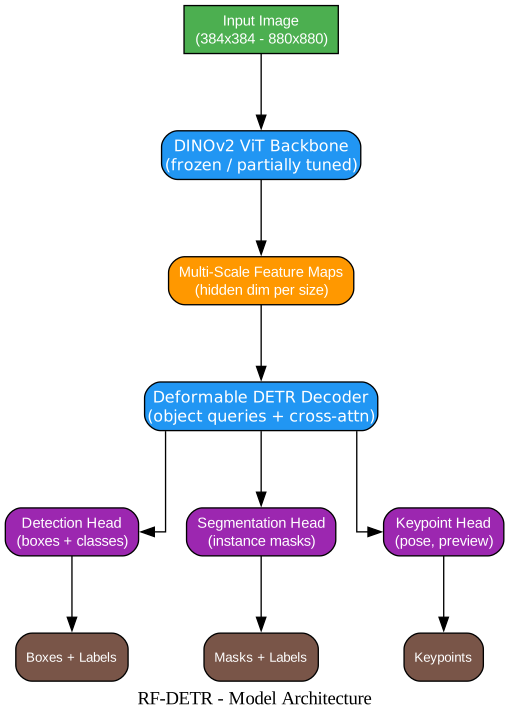
The design is intentionally modular. The same backbone and decoder serve all three tasks, so a user who trains a detection model can later add a segmentation head without rebuilding the backbone. The DINOv2 backbone is pretrained on self-supervised data, which gives RF-DETR strong feature representations even on small datasets, and the Deformable DETR decoder keeps the cross-attention local and efficient through deformable sampling, which is what lets the model run in real time on a T4.
Model Size Matrix
RF-DETR ships six model sizes, from Nano to 2XLarge, across detection, instance segmentation, and keypoint detection. The table below summarizes the detection sizes; the segmentation variants follow the same N-to-2XL progression with slightly larger parameter counts due to the mask head.
| Size | Detection class | Segmentation class | COCO AP50:95 (det) | COCO AP50:95 (seg) | Latency (ms) | Params (M) | Resolution | License |
|---|---|---|---|---|---|---|---|---|
| N | RFDETRNano | RFDETRSegNano | 48.4 | 40.3 | 2.3-3.4 | 30.5-33.6 | 384x384 | Apache 2.0 |
| S | RFDETRSmall | RFDETRSegSmall | 53.0 | 43.1 | 3.5-4.4 | 32.1-33.7 | 512x512 | Apache 2.0 |
| M | RFDETRMedium | RFDETRSegMedium | 54.7 | 45.3 | 4.4-5.9 | 33.7-35.7 | 576x576 | Apache 2.0 |
| L | RFDETRLarge | RFDETRSegLarge | 56.5 | 47.1 | 6.8-8.8 | 33.9-36.2 | 704x704 | Apache 2.0 |
| XL | RFDETRXLarge | RFDETRSegXLarge | 58.6 | 48.8 | 11.5-13.5 | 126.4-38.1 | 700x700 | PML 1.0 |
| 2XL | RFDETR2XLarge | RFDETRSeg2XLarge | 60.1 | 49.9 | 17.2-21.8 | 126.9-38.6 | 880x880 | PML 1.0 |
The matrix below shows how the six sizes map onto the three tasks and the two license tiers.
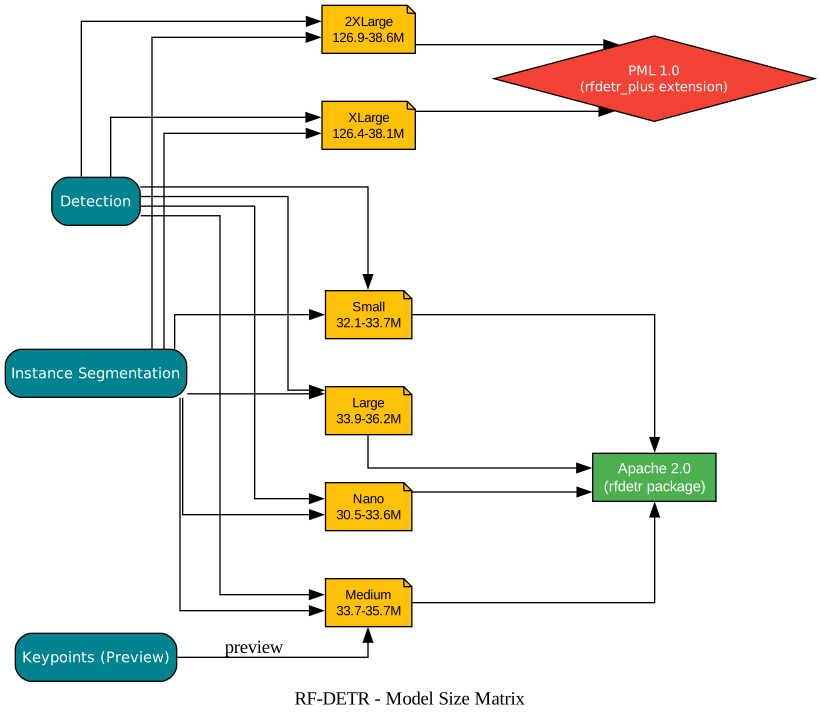
The Nano through Large sizes are Apache 2.0 and cover the latency-sensitive range from 2.3 ms to 8.8 ms on an NVIDIA T4 with TensorRT FP16. The XL and 2XL sizes are PML 1.0 and push accuracy further, reaching 60.1 COCO AP50:95 for detection and 49.9 for segmentation. The keypoint variant is currently a single preview model at 71.8 COCO AP50:95 (OKS-based).
Benchmarks
RF-DETR achieves state-of-the-art results on both object detection and instance segmentation. All COCO accuracy numbers are measured in-house using pycocotools in single-artifact benchmarking (SAB) over the full 5,000-image val2017 split, so every row is directly comparable. Latency is measured on an NVIDIA T4 using TensorRT, FP16, and batch size 1. Parameter counts are deployment-fused nn.Module counts. For full benchmarking methodology and reproducibility details, see roboflow/sab.
On detection, RF-DETR-L reaches 56.5 COCO AP50:95 at 6.8 ms, outperforming YOLO26-X (56.9 AP at 9.6 ms) and D-FINE-L (57.2 AP at 7.5 ms) in the latency-accuracy trade-off. On instance segmentation, RF-DETR-Seg-2XL reaches 49.9 COCO AP50:95 at 21.8 ms, against YOLO26-X-Seg at 46.8 AP at 12.92 ms. On keypoints (preview), RF-DETR reaches 71.8 COCO AP50:95 (OKS-based) at 9.7 ms, against YOLO26-pose-X at 71.0 AP at 9.8 ms.
Training and Fine-Tuning
RF-DETR supports training for object detection, instance segmentation, and keypoint detection. The training pipeline is driven by YAML configs, one per model size and task, which set the backbone, decoder, resolution, augmentations, optimizer, and loss weights. The backbone is initialized from DINOv2 pretrained weights, the model is assembled from backbone, decoder, and task head, and the data loader applies augmentations like mosaic, mixup, and resize.
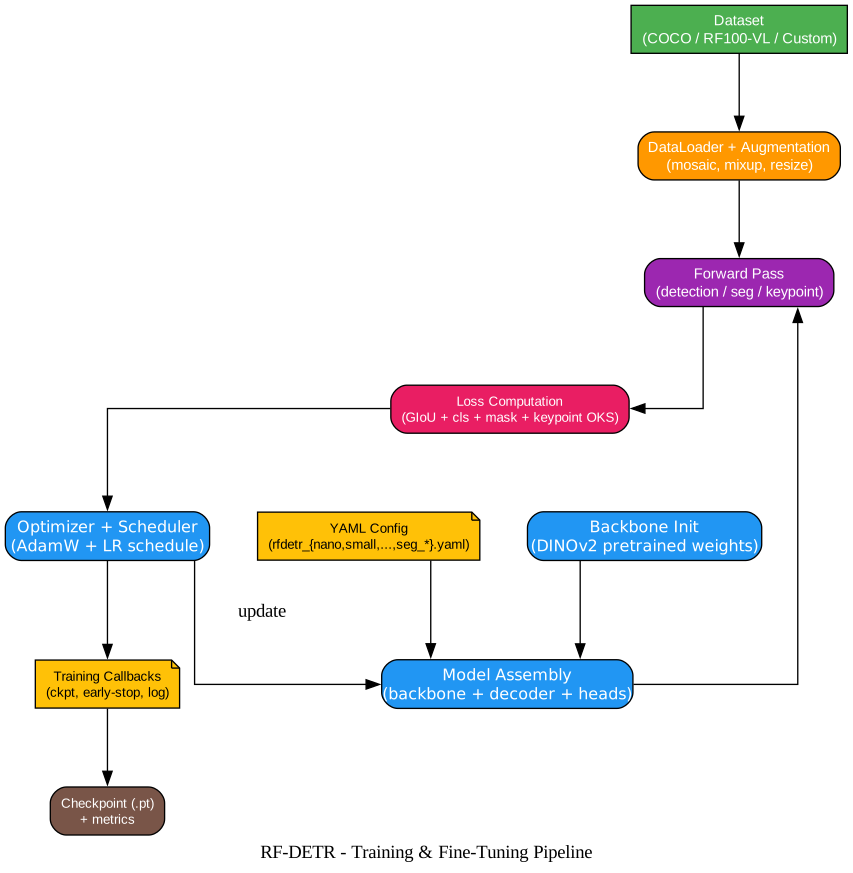
The forward pass produces task-specific predictions, and the loss is a combination of generalized IoU for boxes, classification loss, mask loss for segmentation, and OKS-based loss for keypoints. The optimizer is AdamW with a learning rate schedule, and training callbacks handle checkpointing, early stopping, and logging. The output is a checkpoint file and metrics. A user can fine-tune on a custom dataset in Google Colab or directly on the Roboflow platform.
Export and Deployment
RF-DETR can export a trained checkpoint to four formats for deployment across cloud, edge, and browser targets. The rfdetr.export module produces ONNX for ONNX Runtime and in-browser inference, CoreML for iOS and macOS, TFLite for Android and edge, and ExecuTorch for mobile and edge. For NVIDIA targets, the model can be converted to TensorRT FP16 for the lowest latency on T4 and Jetson.
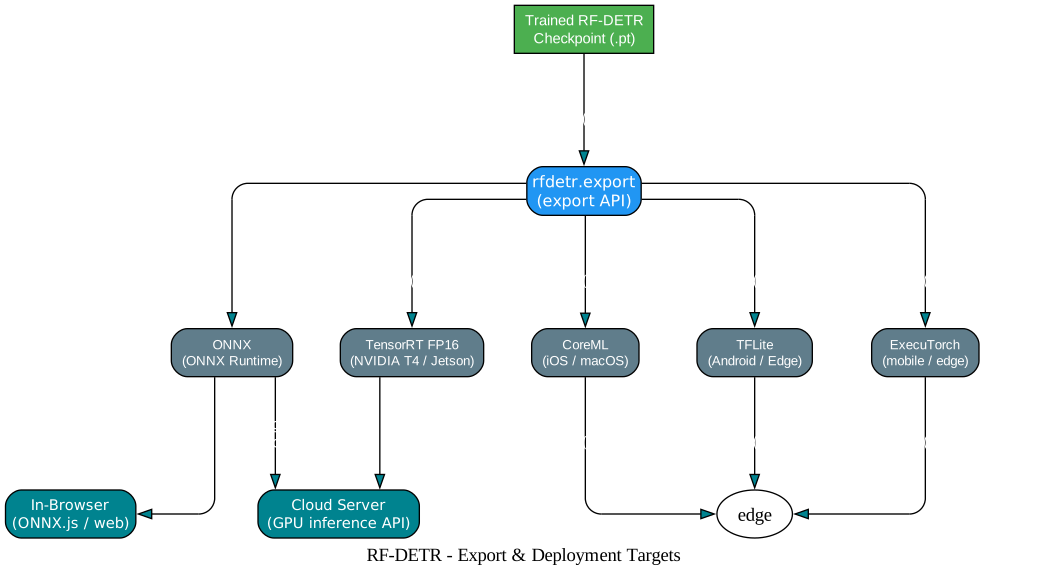
The export path means a single trained model can serve a cloud inference API, a Jetson edge device, and an in-browser demo without changing the training code. The same rfdetr API that runs inference on a server GPU also produces the artifacts needed for mobile and browser deployment.
Installation
RF-DETR requires Python 3.10 or later. Install the rfdetr package with pip.
pip install rfdetr
For the Plus components (RF-DETR-XL and RF-DETR-2XL detection models), install the extension.
pip install rfdetr[plus]
To install from source for the latest unreleased features:
pip install https://github.com/roboflow/rf-detr/archive/refs/heads/develop.zip
Quick Start
Run detection with a Medium model on a sample image.
import supervision as sv
from rfdetr import RFDETRMedium
from rfdetr.assets.coco_classes import COCO_CLASSES

model = RFDETRMedium()

detections = model.predict("https://media.roboflow.com/dog.jpg", threshold=0.5)

labels = [f"{COCO_CLASSES[class_id]}" for class_id in detections.class_id]

annotated_image = sv.BoxAnnotator().annotate(detections.metadata["source_image"], detections)
annotated_image = sv.LabelAnnotator().annotate(annotated_image, detections, labels)
For instance segmentation, swap in RFDETRSegMedium and use sv.MaskAnnotator() instead of sv.BoxAnnotator(). For keypoints (preview), use RFDETRKeypointPreview.
Licensing
Licensing is split by component. The open-source rfdetr package and the Apache-designated model weights (Nano through Large) are licensed under Apache License 2.0. Plus components, including the rfdetr_plus extension and the RF-DETR-XL and RF-DETR-2XL detection models, are licensed under PML 1.0. This split lets a user build and ship Apache-licensed detection and segmentation models for free, while reserving the largest sizes for the commercial Plus tier.
Acknowledgements
RF-DETR is built upon LW-DETR, DINOv2, and Deformable DETR.
Conclusion
RF-DETR is a pragmatic answer to the accuracy-latency trade-off in real-time vision. By pairing a DINOv2 backbone with a Deformable DETR decoder and three task heads, it covers object detection, instance segmentation, and keypoint detection under one API, with six model sizes that span from a 2.3 ms Nano to a 60.1 AP 2XLarge. The Apache 2.0 base, the Colab fine-tuning path, and the four export formats make it straightforward to train on a custom dataset and deploy from cloud to edge to browser. The source is on GitHub at roboflow/rf-detr, the package is on PyPI, and the documentation is at rfdetr.roboflow.com. Enjoyed this post? Never miss out on future posts by following us 


