Why Attention
A transformer encoder or decoder builds a contextual representation for every token in a sequence. A token’s representation should depend on the other tokens around it - not just on a fixed word embedding. Attention is the operation that performs this contextual mixing: for each query token, it computes a weighted sum of value representations of all tokens, with weights derived from how strongly the query matches each key. Multihead attention runs this in parallel across multiple heads, each with its own notion of similarity, then recombines the results.
Scaled Dot-Product Attention (One Head)
A single attention head takes three matrices derived from the input: a query matrix Q, a key matrix K, and a value matrix V, each of shape [seq_len, d_k] (the head dimension). The output is a weighted sum of the values, where the weights come from how strongly each query matches each key.
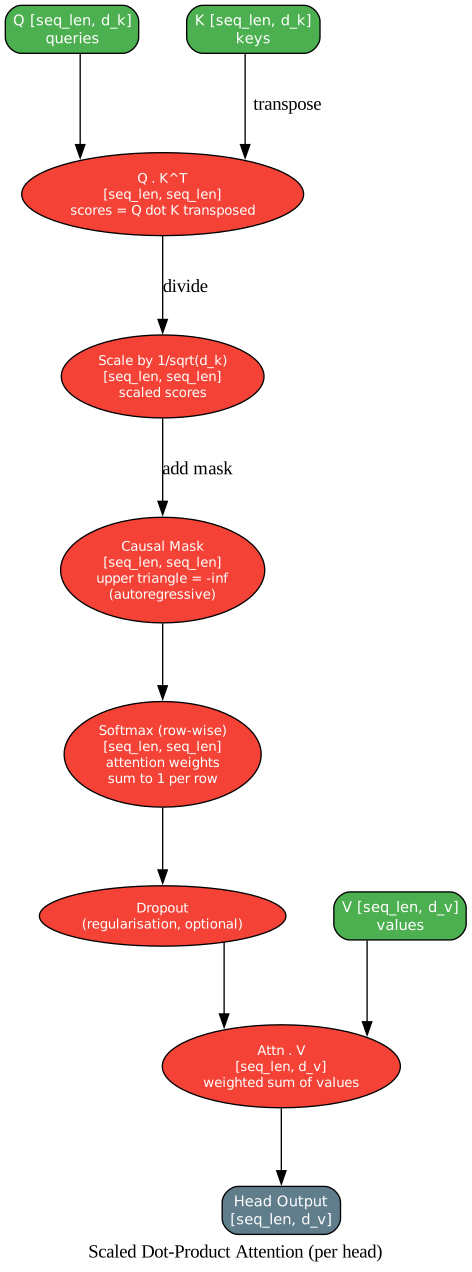
The computation in one head:
- Scores -
Q . K^Tgives a[seq_len, seq_len]matrix. Cell[i, j]measures how much queryiattends to keyj. - Scale - divide by
sqrt(d_k). This keeps the dot products from growing large asd_kgrows, which would push softmax into regions with vanishing gradients. - Causal mask - set the upper triangle to
-infso each query can only attend to past and current positions. This is what makes a decoder autoregressive: at positioni, the model cannot peek at future tokens. - Softmax - normalise each row so the attention weights sum to 1.
- Weighted sum - multiply the attention weights by
Vto get the head’s output[seq_len, d_v].
In code:
def attention(q, k, v, d_k, mask=None):
    scores = (q @ k.transpose(-2, -1)) / math.sqrt(d_k)
    if mask is not None:
        scores = scores.masked_fill(mask == 0, float("-inf"))
    weights = torch.softmax(scores, dim=-1)
    return weights @ v
Multihead Attention
A single head can only learn one kind of relationship. Multihead attention projects the input into n_heads separate (Q, K, V) triples, runs attention in parallel on each, concatenates the results, and projects back to d_model with a final output projection.
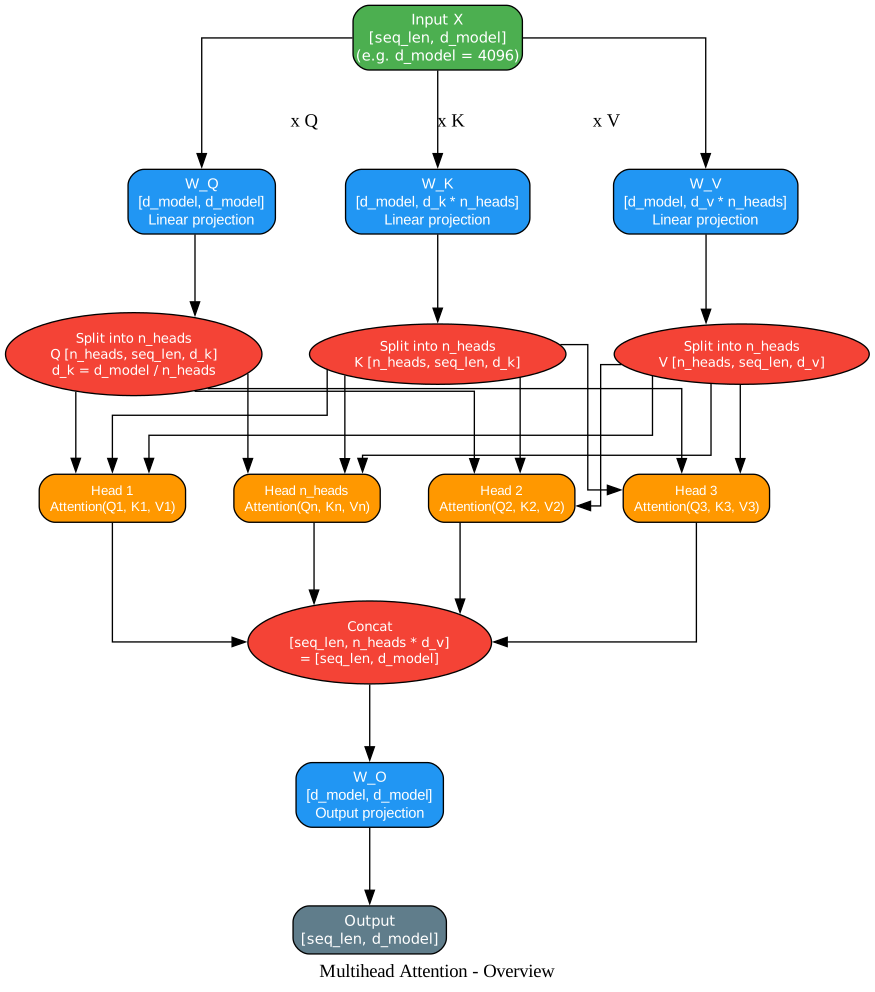
The dimensions: if d_model is the model dimension (e.g. 4096 in LLaMA-7B) and n_heads is the number of heads, then the head dimension is d_k = d_model / n_heads. Each head gets its own slice of the projected Q, K, and V. After all heads produce their outputs, concatenation gives a [seq_len, n_heads * d_k] = [seq_len, d_model] tensor, which the output projection W_O mixes back together.
class MultiHeadAttention(nn.Module):
    def __init__(self, d_model, n_heads):
        super().__init__()
        self.n_heads = n_heads
        self.d_k = d_model // n_heads
        self.w_q = nn.Linear(d_model, d_model, bias=False)
        self.w_k = nn.Linear(d_model, d_model, bias=False)
        self.w_v = nn.Linear(d_model, d_model, bias=False)
        self.w_o = nn.Linear(d_model, d_model, bias=False)

    def forward(self, x):
        b, s, _ = x.shape
        q = self.w_q(x).view(b, s, self.n_heads, self.d_k).transpose(1, 2)
        k = self.w_k(x).view(b, s, self.n_heads, self.d_k).transpose(1, 2)
        v = self.w_v(x).view(b, s, self.n_heads, self.d_k).transpose(1, 2)
        out = attention(q, k, v, self.d_k, mask=causal_mask(s))
        out = out.transpose(1, 2).contiguous().view(b, s, -1)
        return self.w_o(out)
What LLaMA Changes
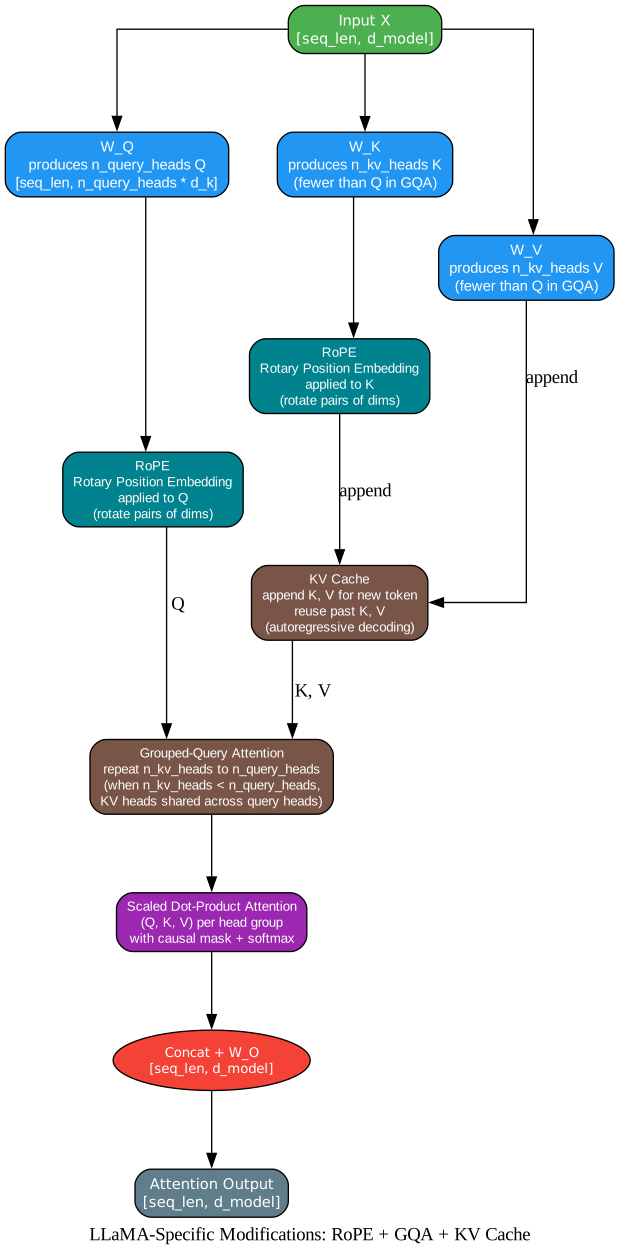
LLaMA keeps the multihead skeleton but makes three specific changes.
Rotary Position Embeddings (RoPE)
Classic transformers add a learned position vector to each token embedding. The trouble is that this gives an absolute notion of position rather than a relative one, and generalisation to longer sequences suffers. LLaMA replaces additive position vectors with Rotary Position Embeddings, which rotate pairs of dimensions in Q and K based on their position. The rotation angles are chosen so that the dot product Q . K^T depends only on the relative offset between query and key positions, not their absolute positions. This means the model can attend based on relative distance, which generalises better to sequence lengths unseen during training.
RoPE is applied to Q and K (not V). The rotation is applied per head, in the head dimension, by pairing adjacent dimensions and rotating each pair by an angle proportional to the position index.
Grouped-Query Attention (GQA)
In standard multihead attention, each query head has its own key and value head. During autoregressive decoding, this means the KV cache (the cached past K and V tensors) stores one entry per head - and that memory grows linearly with both sequence length and n_heads. LLaMA-2 (70B) and LLaMA-3 use Grouped-Query Attention: instead of n_heads key and value heads, there are n_kv_heads where n_kv_heads < n_heads. Each key and value head is shared by several query heads. This cuts the KV cache size and the bandwidth to read it on every token step, which is the main bottleneck in long-context inference. Multi-Query Attention is the extreme case where n_kv_heads = 1; LLaMA uses intermediate values (e.g. 8 KV heads for 64 query heads) which preserves most of the quality while still shrinking the cache.
KV Cache
During autoregressive decoding, each new token only appends one new row to Q, K, and V. The keys and values for all past positions do not change, so they are cached and reused on every step. The KV cache holds [past_seq_len, n_kv_heads, d_k] for K and V. On each forward pass, the model computes K and V only for the new token, appends them to the cache, and runs attention against the full cached K and V. This turns the per-step complexity from O(seq_len^2) (recomputing everything) into O(seq_len) (only the new query against the cached keys). The downside is the cache grows with sequence length, which is exactly the problem GQA helps with.
Full LLaMA Decoder Layer
The attention block is one of two sublayers in each LLaMA decoder layer. The other is a SwiGLU feed-forward network. Both are wrapped with residual connections and pre-norm RMSNorm.
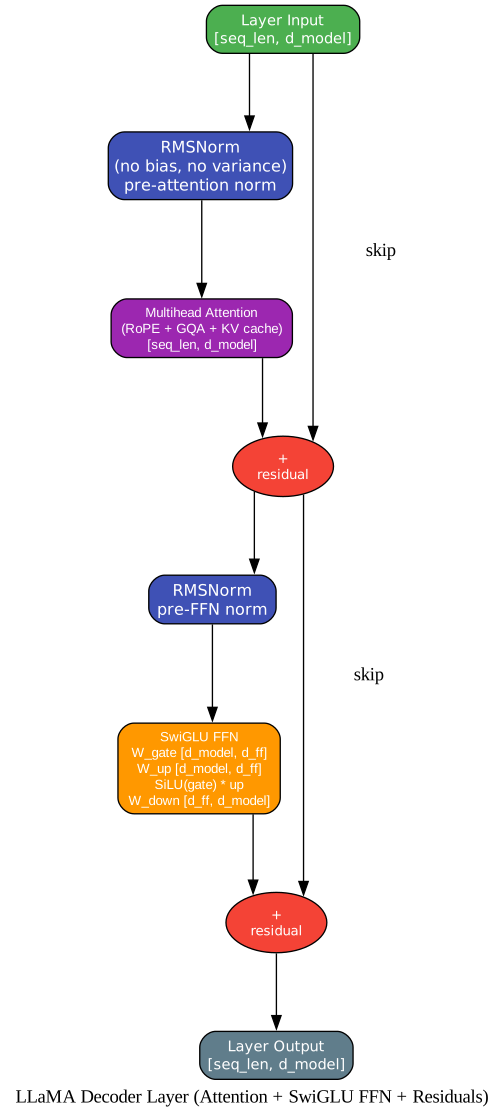
A LLaMA decoder layer:
- Pre-norm -
RMSNormnormalises the input. RMSNorm is a simpler variant of LayerNorm: it normalises by the root-mean-square of the activations and applies a learnable scale, with no mean subtraction and no bias. - Multihead attention - RoPE, GQA, KV cache, causal mask, as described above.
- Residual - add the attention output back to the layer input.
- Pre-norm - another RMSNorm before the feed-forward sublayer.
- SwiGLU feed-forward -
W_gateandW_upboth project fromd_modeltod_ff(typicallyd_ff = 2/3 * 4 * d_modelin LLaMA), the gate branch goes through SiLU (swish), the two are multiplied elementwise, andW_downprojects back tod_model. SwiGLU replaces the ReLU activation used in the original transformer FFN. - Residual - add the FFN output back to the post-attention residual.
The output of this layer feeds into the next, and so on for n_layers (32 in LLaMA-7B, 80 in LLaMA-2 70B, and more in later models).
Why These Choices Matter
The three LLaMA-specific changes all bend the same dial: inference efficiency without giving up quality.
- RoPE drops the position embedding table (no learned vector per position) and gives relative attention that extrapolates to longer sequences.
- GQA cuts the KV cache size and the memory bandwidth spent re-reading it on every token step, which is the dominant cost in long-context decoding.
- KV cache reuses past K and V instead of recomputing them, turning per-step cost from quadratic to linear in context length.
Together with RMSNorm (cheaper than LayerNorm), SwiGLU (better than ReLU FFN at equal parameter count), and the absence of bias terms, these are the changes that distinguish a LLaMA decoder from the original Transformer. The multihead attention skeleton - Q, K, V projections, parallel heads, scaled dot-product, causal mask, softmax, weighted sum, concat, output projection - is unchanged. What changed is how positions are encoded, how KV heads are shared, and how past computations are cached.
Putting It Together
Multihead attention in LLaMA is the same multihead attention from “Attention Is All You Need”, with three engineering choices layered on top. The single-head computation stays Enjoyed this post? Never miss out on future posts by following us softmax((Q . K^T) / sqrt(d_k)) . V with a causal mask. The multihead split into n_heads parallel heads and the concat-plus-output-projection recombination are unchanged. What is new is RoPE on Q and K (rotary position embeddings instead of additive ones), GQA (fewer KV heads than query heads, shared across groups), and the KV cache (past K and V kept across decoding steps). The attention block sits inside a LLaMA decoder layer between two RMSNorms and a SwiGLU feed-forward, with residual connections around each sublayer. The result is a model that runs faster on long contexts, generalises better to unseen sequence lengths, and reuses computation across decoding steps without sacrificing the core attention mechanism. 


