Learn Ruby in a Single Post: A Complete Ruby Tutorial from Blocks and Mixins to Metaprogramming and Rails
Ruby’s philosophy is “programmer happiness” — Matz designed it to read like natural language, favor expressiveness over brevity, and make common things beautiful. The result is a dynamically typed, object-oriented language where everything is an object (even numbers and classes), blocks are first-class, and metaprogramming is routine. Rails turned it into the dominant startup-web stack for a decade.
This post teaches the whole language in five stages with runnable snippets. By the end you’ll understand the object model, blocks/procs/lambdas, modules and mixins, metaprogramming, and the Rails/gem ecosystem.
We target Ruby 3.x (everything here runs on 3.0+; notes flag 3.0+ features).
The Roadmap
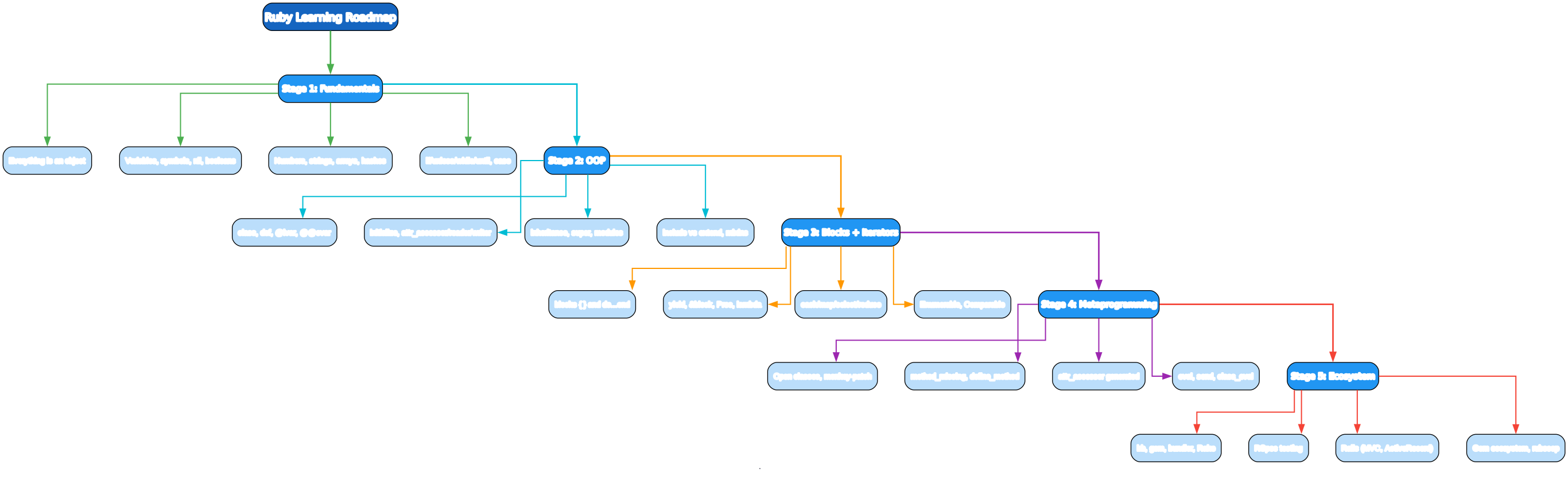
- Fundamentals — everything is an object, variables, symbols, control flow, collections
- OOP — classes,
initialize,@ivar,attr_accessor, inheritance, modules - Blocks + Iterators — blocks,
yield,Proc/lambda,Enumerable - Metaprogramming — open classes,
method_missing,define_method,eval - Ecosystem —
irb,gem,bundler,RSpec,Rails,ActiveRecord
Stage 1 — Fundamentals
A program
puts "Hello, Ruby!"
That’s the whole program. Run it with ruby hello.rb or in irb (the REPL). No main, no semicolons, no boilerplate — Ruby reads top to bottom.
Everything is an object
5.class          # Integer
"hi".class       # String
[].class         # Array
nil.class        # NilClass
5.send(:+, 3)    # 8 — even + is a method

5.times { |i| print i }   # 01234 — Integer responds to times
-5.abs            # 5
3.14.round       # 3
"ada".upcase      # "ADA"
[1, 2, 3].length  # 3
Everything is an object — there are no primitives. 5 is an Integer with methods; nil is a NilClass object; even + is a method you can call via send. This uniformity is the heart of Ruby’s metaprogramming.
Variables, symbols, nil
name = "Ada"        # local variable (snake_case)
@count = 0          # instance variable
@@total = 0         # class variable
$global = 0         # global (avoid)
CONST = 3.14        # constant (ALL_CAPS convention; warning if reassigned)

:symbol             # immutable symbol — "interned string"
status = :active    # often used as enum/identifier
:symbol.object_id == :symbol.object_id  # true — same object

nil                 # "no value" — only nil and false are falsy; 0 and "" are truthy!
Symbols (:foo) are immutable, interned identifiers — use them for hash keys, enum-like values, and method names. Unlike Python/JS, only nil and false are falsy — 0, "", and [] are all truthy. This trips newcomers.
Collections
nums = [1, 2, 3]                    # Array (ordered, index)
nums << 4                          # append (push); returns the array
nums.push(4); nums.first; nums.last
nums.map { |n| n * n }              # [1, 4, 9, 16] — new array
nums.each { |n| puts n }            # iterate
nums.select { |n| n.even? }         # filter

h = { name: "Ada", age: 30 }        # Hash (symbol keys shorthand)
h[:name]                            # "Ada"
h[:missing]                         # nil
h.fetch(:missing, "default")        # "default" — explicit default
h.transform_values { |v| v.to_s }   # transform

# Range
(1..5).to_a    # [1, 2, 3, 4, 5]   inclusive
(1...5).to_a   # [1, 2, 3, 4]      exclusive
Arrays and hashes are the workhorses. Methods end with ? for predicates (even?, empty?) and ! for in-place mutation (map vs map!). Prefer the non-bang version unless you want to mutate.
Control flow
if x > 0
  "positive"
elsif x == 0
  "zero"
else
  "negative"
end

# Modifier form — Ruby's signature conciseness
puts "big" if x > 100
x = 0 unless defined? x

# unless = if not
unless done? then keep_going end

case status
when :active then "online"
when :inactive, :banned then "offline"
else "unknown"
end

# Loops — but prefer iterators
while cond do ... end
until cond do ... end
loop { break if done? }   # infinite
3.times { |i| puts i }    # idiomatic — preferred over for
Ruby’s if/unless are expressions (they return values); the modifier form (statement if condition) reads like English. Prefer iterators (each, times, map) over for/while — they’re idiomatic and avoid loop-variable scoping surprises.
Stage 2 — OOP
Classes
class Counter
  def initialize(start = 0)   # constructor — invoked by Counter.new
    @count = start             # @count is an instance variable
  end

  def inc
    @count += 1
    self                       # return self for chaining: c.inc.inc
  end

  def count
    @count                     # getter (no parens on call)
  end

  def to_s
    "Counter(#{@count})"
  end
end

c = Counter.new(5)
c.inc.inc
puts c.count   # 7
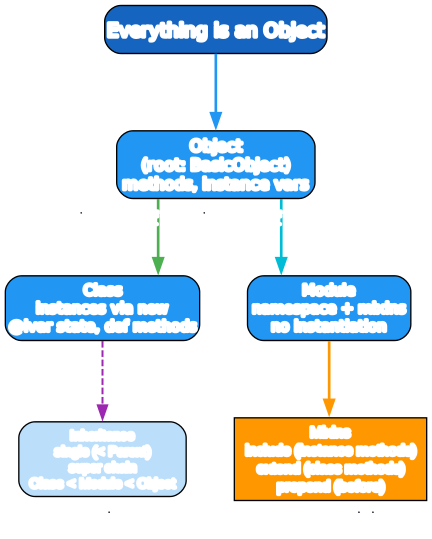
Counter.new allocates and calls initialize. Instance variables (@foo) are private by default — accessed only through methods. Methods with no arguments are called without parens (c.count, not c.count()), which gives Ruby its natural-language feel.
attr_accessor / reader / writer
class Person
  attr_accessor :name, :age      # generates getter + setter
  attr_reader :id                 # getter only
  attr_writer :email              # setter only

  def initialize(name, age, id)
    @name, @age, @id = name, age, id
  end
end

p = Person.new("Ada", 30, 1)
p.name           # "Ada"  (reader generated)
p.age = 31       #        (writer generated)
p.id             # 1
attr_accessor :name writes a getter and setter for you — the equivalent of a dozen lines of boilerplate. This is metaprogramming at the most everyday level: attr_accessor literally calls define_method to generate the methods.
Inheritance and super
class Animal
  def sound = "..."              # endless method (3.0+) — one-liner
  def describe = "#{self.class}: #{sound}"
end

class Dog < Animal               # single inheritance
  def sound = "woof"              # override
end

Dog.new.describe   # "Dog: woof"
Dog.new.sound       # "woof"
Ruby has single inheritance (one parent, <). super calls the parent’s version; super (no parens) forwards all args, super() passes none. The endless method (def f = expr, 3.0+) makes one-liners elegant.
Modules, mixins, include vs extend
Ruby solves the single-inheritance limit with modules — namespaces that can be mixed into classes:
module Walkable
  def walk
    "walking"
  end
end

module Swimmable
  def swim
    "swimming"
  end
end

class Duck < Animal
  include Walkable         # instance methods
  include Swimmable
end

Duck.new.walk   # "walking"
Duck.new.swim   # "swimming"
include Module— adds the module’s methods as instance methods of the class.extend Module— adds them as class methods (singleton methods on the class).prepend Module— inserts the module before the class in the method lookup chain (so the module’ssupercalls the class method).
This is how Enumerable (gives you map/select/reduce when you define each) and Comparable (gives you </<=> when you define <=>) work — they’re mixins.
class MyCollection
  include Enumerable
  def initialize(items) = @items = items
  def each(&block) = @items.each(&block)
end

MyCollection.new([1, 2, 3]).map { |n| n * 2 }   # [2, 4, 6] — Enumerable gives map
Stage 3 — Blocks and Iterators
Blocks are Ruby’s signature feature — they make iteration, callbacks, and DSLs expressive.

Blocks
# Two syntaxes for blocks
[1, 2, 3].each { |n| puts n }            # inline braces — single line
[1, 2, 3].each do |n|                      # do...end — multi-line
  puts n
end

# Block returns its last evaluated value
summed = [1, 2, 3].map { |n| n * n }       # [1, 4, 9] — last expr is the value
A block is an anonymous chunk of code attached to a method call. The method decides whether/when to run it via yield. Blocks come in two syntaxes: { |x| ... } (inline, conventionally single-line) and do |x| ... end (multi-line).
yield and &block
def twice
  yield
  yield
end

twice { puts "hi" }   # hi\nhi

def with_result
  result = yield(5)
  puts "got: #{result}"
end

with_result { |n| n * 2 }   # got: 10 — block takes an arg, returns value

# &block — block as an explicit Proc object
def apply(&block)
  block.call(42)
end
apply { |n| n + 1 }   # 43

# Pass a block onward
def delegate(&b) = other_method(&b)
yield invokes the block (passing args, receiving the return value). &block captures the block as a Proc object you can store, pass around, or forward. Most code uses yield; reach for &block when you need to store or forward the block.
Proc, lambda, and the difference
# Proc — block wrapped in an object
p = Proc.new { |x| x * 2 }
p.call(5)        # 10
p.(5)            # 10 — .() syntax
p[5]             # 10 — [] syntax

# Lambda — stricter Proc
l = lambda { |x| x * 2 }
l = ->(x) { x * 2 }   # stabby lambda literal (->)

# Differences:
# 1. lambda checks arity (extra args -> error); Proc ignores them
p.call(1, 2)   # 2 — Proc ignores the extra arg
->(x){ x }.call(1, 2)  # ArgumentError — lambda is strict

# 2. return inside a lambda returns from the lambda; in a Proc it returns from the ENCLOSING method
def proc_test
  p = Proc.new { return 1 }
  p.call
  return 2   # never reached — Proc's return exits the method
end
proc_test     # 1
Proc is lenient (like a block: ignores extra args, return exits the enclosing method). lambda is strict (checks args, return exits only the lambda — behaves like a regular method). Rule of thumb: use lambda when you want method-like semantics; Proc when you want block-like.
Iterators and Enumerable
nums = [1, 2, 3, 4, 5]

nums.each { |n| ... }                # iterate
nums.map { |n| n * n }               # transform -> new array
nums.select { |n| n.even? }          # filter
nums.reject { |n| n.even? }           # inverse filter
nums.reduce(0) { |sum, n| sum + n }  # fold -> 15
nums.find { |n| n > 3 }               # first match -> 4
nums.group_by(&:even?)                # {true=>[2,4], false=>[1,3,5]}
nums.sort                              # sorted
nums.max_by { |n| -n }                # 1 — max by key
nums.tally                             # {1=>1, 2=>1, ...} (3.0+)

# Symbol#to_proc — the & shorthand
nums.map(&:to_s)                      # ["1", "2", ...]  == nums.map { |n| n.to_s }

# Lazy (for infinite or large sequences)
(1..).lazy.map { |n| n * n }.first(5)   # [1, 4, 9, 16, 25] — infinite range, take 5
Enumerable is the magic mixin: define each on your class, include Enumerable, and you get map/select/reduce/sort/min/max/group_by/tally/… for free. The &:method_name shorthand (&:to_s) is Symbol#to_proc — converts :to_s to { |x| x.to_s }.
Stage 4 — Metaprogramming
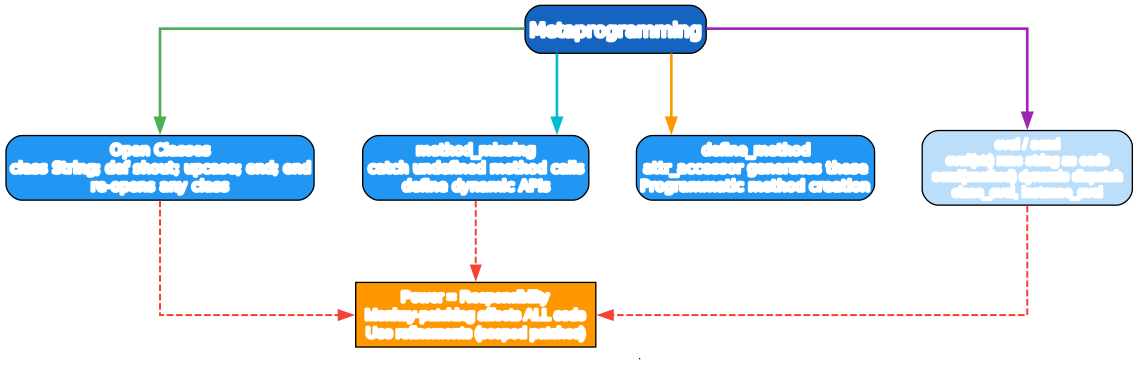
Ruby’s classes are open — you can add or redefine methods on any class, including built-ins, at any time. This is powerful and dangerous.
Open classes (monkey-patching)
class String
  def shout
    upcase + "!"
  end
end

"hello".shout   # "HELLO!" — defined on String itself
You can re-open any class and add methods. This is how Rails extends String with things like "path".classify. The danger: your patch affects all code in the process. Use refinements for scoped patches that only apply where you using them:
module ShoutRefinement
  refine String do
    def shout = upcase + "!"
  end
end

using ShoutRefinement
"hello".shout   # "HELLO!"
# outside the `using` scope, shout is undefined
method_missing
When you call a method that doesn’t exist, Ruby calls method_missing before raising NoMethodError. Override it to build dynamic APIs:
class Dynamic
  def method_missing(name, *args)
    if name.to_s.end_with?("_please")
      "you said #{name}"
    else
      super   # fall back to default — raises NoMethodError
    end
  end

  def respond_to_missing?(name, include_private = false)
    name.to_s.end_with?("_please") || super
  end
end

d = Dynamic.new
d.help_please   # "you said help_please"
d.help          # NoMethodError (super was called)
Always override respond_to_missing? alongside method_missing so respond_to? reports the dynamic methods correctly. method_missing is how Active Record builds dynamic finders like find_by_email_and_status.
define_method and attr_accessor
class Config
  [:host, :port, :timeout].each do |attr|
    define_method(attr) { instance_variable_get("@#{attr}") }
    define_method("#{attr}=") { |v| instance_variable_set("@#{attr}", v) }
  end
end

c = Config.new
c.host = "localhost"
c.host   # "localhost"

# attr_accessor is literally define_method under the hood
class Person
  attr_accessor :name   # generates name + name= via define_method
end
define_method creates a method programmatically — the foundation of attr_accessor, validations, and much of Rails’ magic.
eval and dynamic dispatch
# send — call a method by name (string or symbol)
"hi".send(:upcase)   # "HI"
obj.send("method_#{var}=", value)   # dynamic setter

# eval — run a string as Ruby (use sparingly; security risk on user input)
result = eval("1 + 2")   # 3

# class_eval — evaluate code in the context of a class
SomeClass.class_eval do
  define_method(:new_method) { "dynamic" }
end
eval runs arbitrary strings as Ruby code — powerful but a security risk with user input (code injection). Reach for send (method dispatch by name) or define_method first; reserve eval for build-time codegen or trusted configs.
Stage 5 — Ecosystem and Rails
The basics
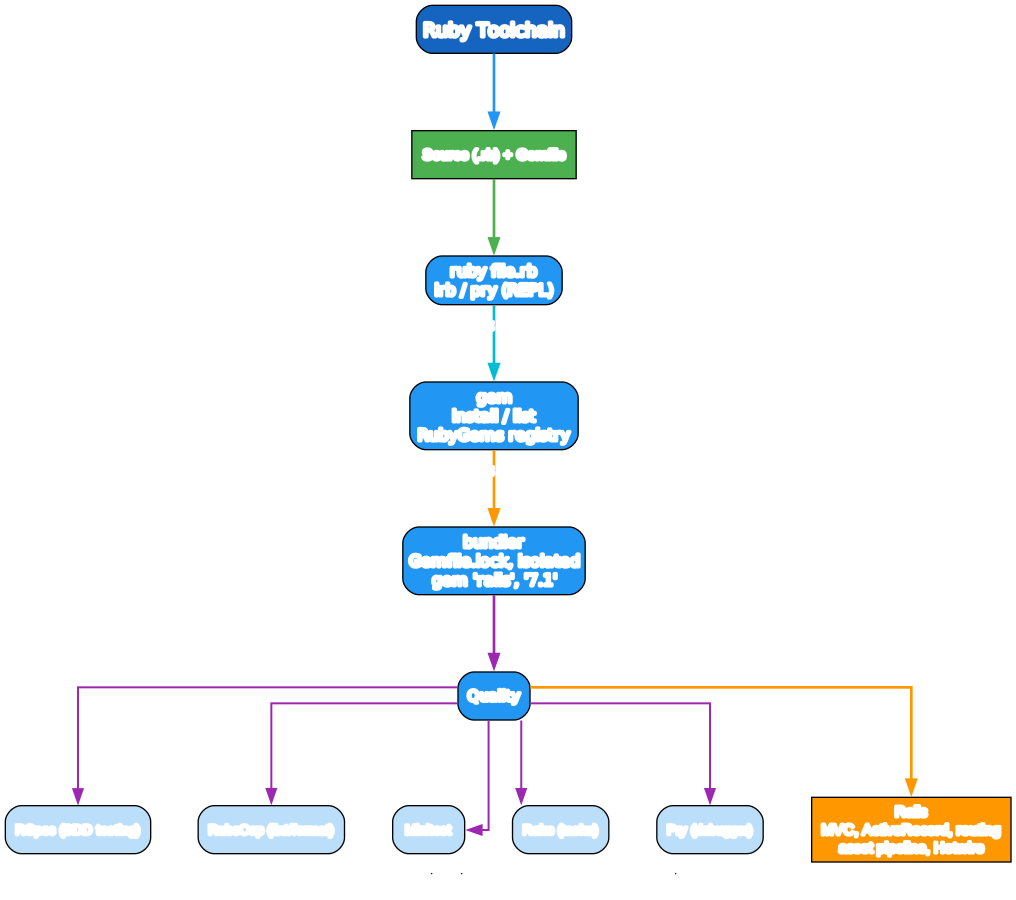
ruby file.rb            # run a script
irb                     # REPL (use pry for a better one)
ri Array#map            # built-in docs

gem install rails        # install a gem (package)
gem list                 # list installed gems
gem sources              # registry (default: rubygems.org)

bundle install           # install Gemfile deps
bundle exec rake test    # run a command in the Gemfile context
bundle exec rspec         # run RSpec tests
Bundler and the Gemfile
# Gemfile
source "https://rubygems.org"

gem "rails", "~> 7.1"
gem "pg"                          # PostgreSQL adapter
gem "puma"                        # web server
gem "rspec-rails", group: :test

group :development do
  gem "rubocop"
  gem "pry-byebug"
end
bundle install locks versions in Gemfile.lock. Always run commands via bundle exec so they use the locked versions, not whatever’s globally installed.
RSpec — behavior-driven testing
# spec/counter_spec.rb
require "rspec"
require_relative "../lib/counter"

RSpec.describe Counter do
  let(:counter) { Counter.new(5) }    # fresh for each example

  describe "#inc" do
    it "increments the count" do
      expect { counter.inc }.to change { counter.count }.by(1)
    end

    it "returns self for chaining" do
      expect(counter.inc).to be(counter)
    end
  end
end
RSpec reads like English — expect(...).to, change { }.by(n), be, include. It’s the dominant Ruby test framework; Minitest is the smaller alternative (Rails ships with it by default).
Rails — the framework
gem install rails
rails new myapp --database=postgresql
cd myapp
rails server    # http://localhost:3000
rails generate scaffold Post title:string body:text
rails db:migrate
rails test
Rails is convention over configuration — a full-stack MVC framework with:
- Active Record — ORM; models map to tables, with migrations, validations, associations.
Post.where(published: true).order(created_at: :desc). - Action Pack — routing (
get "/posts/:id", to: "posts#show"), controllers, views (ERB / Slim). - Asset pipeline — Sprockets / Propshaft / esbuild for JS/CSS.
- Hotwire — modern Turbo + Stimulus for SPA-like apps without an SPA.
- Active Job — background jobs; Action Mailer; Action Cable (WebSockets).
A Rails model:
# app/models/post.rb
class Post < ApplicationRecord
  has_many :comments, dependent: :destroy
  belongs_to :user

  validates :title, presence: true, length: { maximum: 100 }
  scope :published, -> { where(published: true) }
end

Post.published.recent.limit(10)   # chained scopes -> SQL
Tooling
irb/pry— REPLs;pryhas better navigation (ls,show-source,binding.prybreakpoints).gem/bundler— package management;bundle execfor locked versions.rake— task runner;rake -Tlists tasks.rubocop— lint + style; run in CI; auto-correct with-a.rspec/minitest— testing.standardrb— opinionated RuboCop config, zero setup.
A Quick-Start Checklist
- Install Ruby 3.x via
rbenvorrvm(manage versions per project). - Use
bundler— every project has aGemfile; runbundle execfor commands. - Prefer iterators (
each,map,select) overfor/while. - Use
attr_accessorinstead of hand-written getters/setters. - Mixins over deep inheritance —
include Enumerableafter definingeach. - Lambdas for method-like, Procs for block-like — default to
lambda(stabby->). - Test with RSpec (or Minitest); write one spec per behavior.
- Metaprogram with restraint — reach for
define_method/sendbeforeeval; use refinements for scoped patches. - Run
rubocopin CI; usebinding.pryfor debugging.
Common Pitfalls
0and""are truthy — onlynilandfalseare falsy.if 0runs the branch.!(bang) mutates in place —arr.map { }returns a new array;arr.map! { }mutates. Read the docs.- Monkey-patch blast radius — re-opening
Stringaffects the whole process, including gems. Use refinements or avoid. method_missingwithoutrespond_to_missing?—respond_to? :dynamic_methodreturns false; break introspection.returninside a Proc — exits the enclosing method, not just the Proc. Uselambda(ornext) to return from the block.- Symbol vs string keys —
{ name: "x" }uses:name;h["name"]isnil. Pick one convention;HashWithIndifferentAccess(Rails) paper-overs this. - Implicit
nil— undefined instance vars arenil(no error);@missingsilently returnsnil. unlesswithelse—unless cond; ... else; ... endis hard to read; useif !condor flip the branches.- Frozen string literals — strings are mutable by default;
# frozen_string_literal: trueat the top of a file makes them immutable (faster, catches accidental mutation).
What to Learn Next
- Ruby docs — ruby-doc.org the standard library reference.
- Why’s (Poignant) Guide to Ruby — _why’s legendary, whimsical intro — a cult classic.
- Programming Ruby (“the Pickaxe”) by Dave Thomas — the canonical reference.
- Eloquent Ruby by Russ Olsen — idioms and style.
- Metaprogramming Ruby 2 by Paolo Perrotta — the deep dive on the object model and metaprogramming.
- Rails Guides — guides.rubyonrails.org the official, excellent walkthrough.
- The Rails 7 Way by Obie Fernandez — comprehensive Rails reference.
- Ruby Tapas — rubytapas.com short screencasts on idioms.
Ruby’s design — readable, expressive, everything an object, blocks everywhere — was optimized for developer joy over raw performance. The metaprogramming power means a small amount of code does a lot, and Rails’ “magic” is the same power at framework scale. Learn the object model and blocks first; the rest follows.
Good luck — and bundle exec rspec.
Resources:
- Ruby docs: https://ruby-doc.org/
- RubyGems: https://rubygems.org/
- Rails: https://rubyonrails.org/
- Bundler: https://bundler.io/
- RSpec: https://rspec.info/

Enjoyed this post? Never miss out on future posts by following us