MiniMind: Train a 64M-Parameter LLM From Scratch in 2 Hours
Most introductions to large language models stop at calling a transformers API: load a pretrained checkpoint, attach a LoRA adapter, and fine-tune on a small dataset. While useful, this skips over the actual mechanics of how a transformer learns. MiniMind, an open-source project by jingyaogong, takes the opposite approach. It trains a roughly 64M-parameter language model from scratch in about two hours on a single NVIDIA 3090 GPU, with every core algorithm implemented in pure PyTorch - no transformers training wrappers, no peft abstractions, no trl recipe boilerplate.
The repository covers the complete LLM lifecycle: tokenizer training, pretraining, supervised fine-tuning, LoRA, DPO, RLAIF (PPO / GRPO / CISPO), tool use, Agentic RL, adaptive thinking, and white-box distillation. The architecture is aligned with the Qwen3 / Qwen3-MoE ecosystem, supports both Dense and Mixture-of-Experts variants, and interoperates with llama.cpp, vllm, and ollama for inference. This article walks through MiniMind’s architecture, training pipeline, and the implementation choices that make a from-scratch LLM tractable on consumer hardware.
Project Overview
MiniMind is released under the Apache 2.0 license and the current main line is minimind-3 (released 2026-04-01). The Dense variant has approximately 64M parameters and the MoE variant has 198M total parameters with 64M active per token. For context, the smallest minimind-3 is roughly 1/2700th the size of GPT-3, which is what makes end-to-end training feasible on a single GPU.
Key facts at a glance:
| Property | Value |
|---|---|
| Repository | jingyaogong/minimind |
| License | Apache 2.0 |
| Architecture | Qwen3-aligned (Dense + MoE) |
| Parameters (Dense) | 64M |
| Parameters (MoE) | 198M total / 64M active |
| Hidden size | 768 |
| Layers | 8 |
| Attention heads | 8 Q / 4 KV (GQA) |
| Vocabulary | 6400 tokens |
| Context length | up to 32768 (YaRN scaling) |
| Framework | Pure PyTorch (transformers for I/O only) |
Architecture
The MiniMind model is a standard decoder-only transformer with the modern features you would expect from a 2025-era design: Grouped Query Attention (GQA), Rotary Position Embeddings (RoPE) with YaRN long-context extension, RMSNorm with Q/K normalization, SwiGLU feed-forward networks, and tied input/output embeddings. The MoE variant replaces the dense FFN with a Top-K routing layer over four SwiGLU experts.
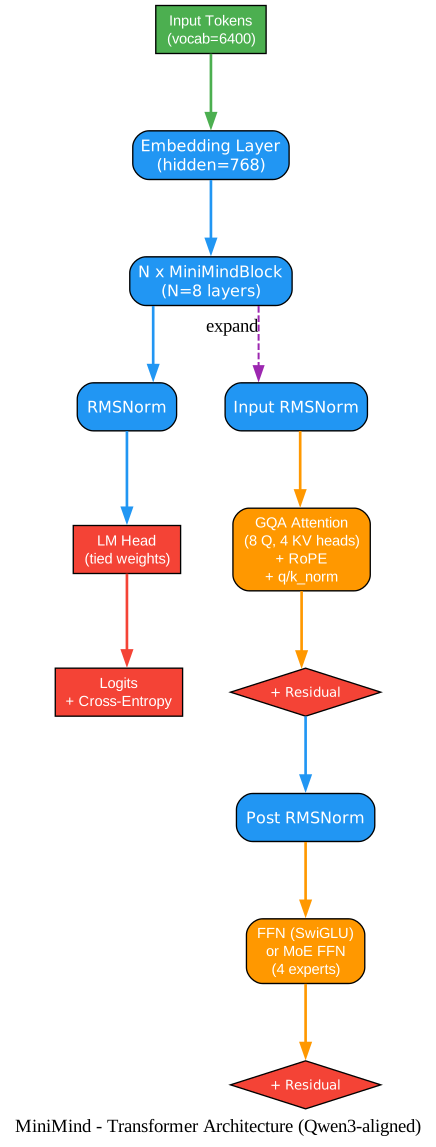
Understanding the Architecture
The diagram above shows the high-level data flow through the model, along with the internal structure of a single MiniMindBlock. Each component is described below.
Input Tokens and Embedding Layer The model accepts token IDs from a 6400-token vocabulary trained with a custom BPE + ByteLevel tokenizer. An nn.Embedding layer projects each token to a 768-dimensional vector. The embedding matrix is tied to the LM head weights (tie_word_embeddings=True), which both reduces parameter count and often improves generalization on small models. This is the same tying strategy used in modern Qwen, Gemma, and Llama models.
Stack of MiniMindBlocks The backbone is a stack of 8 identical MiniMindBlock modules. Each block follows the now-standard pre-norm transformer pattern: normalize, attend, residual add, normalize, feed-forward, residual add. The residual connections are critical for stability when training from scratch because they provide a gradient highway that bypasses the nonlinear transformations.
Inside a MiniMindBlock The block expands into two sub-modules separated by residual connections. The first sub-module is Grouped Query Attention: 8 query heads share 4 key/value heads via repeat_kv, reducing the KV cache size by half compared to multi-head attention while preserving quality. RoPE is applied to queries and keys after a per-head RMSNorm (q_norm / k_norm), a trick popularized by Qwen2 that stabilizes attention logits at long sequence lengths. Flash Attention (via torch.nn.functional.scaled_dot_product_attention) is used whenever the sequence length is greater than 1 and no padding mask is required.
The second sub-module is the feed-forward network. The Dense variant uses a single SwiGLU FFN: down_proj(act_fn(gate_proj(x)) * up_proj(x)). The MoE variant replaces this with a MOEFeedForward module that routes each token to one of four experts. The intermediate size is derived as ceil(hidden_size * pi / 64) * 64, a neat trick that approximates the 4x expansion ratio used in larger models while staying multiple-of-64 for hardware efficiency.
Final RMSNorm and LM Head After the last block, a final RMSNorm normalizes the hidden states and the tied LM head projects them back to vocabulary logits. Cross-entropy loss is computed with label shifting (logits[..., :-1] vs labels[..., 1:]) and ignore_index=-100 to skip padding tokens.
Key Insights The architecture deliberately mirrors Qwen3’s structure rather than reinventing it. This means weights can be mapped into transformers checkpoints and served by llama.cpp, vllm, and ollama without modification - a practical decision that trades a bit of novelty for substantial ecosystem compatibility. The generate method inherits from transformers.GenerationMixin, so the same sampling parameters (temperature, top-k, top-p, repetition penalty) work as users expect.
RoPE and YaRN Long-Context Extension
MiniMind precomputes cosine and sine frequency tables at initialization using a base frequency of 1,000,000 and supports up to 32768 positions. When inference_rope_scaling is enabled, the YaRN algorithm rescales frequencies outside the original 2048-token training window using a linear ramp between beta_fast=32 and beta_slow=1. This is the same mechanism used by Qwen2.5 and Mistral to extend context without retraining.
The Full Training Pipeline
MiniMind’s distinguishing feature is that it ships working training scripts for every stage of LLM development. Each script is self-contained, uses the same model and dataset abstractions, and can be run on a single GPU or distributed across multiple GPUs with DDP and DeepSpeed.
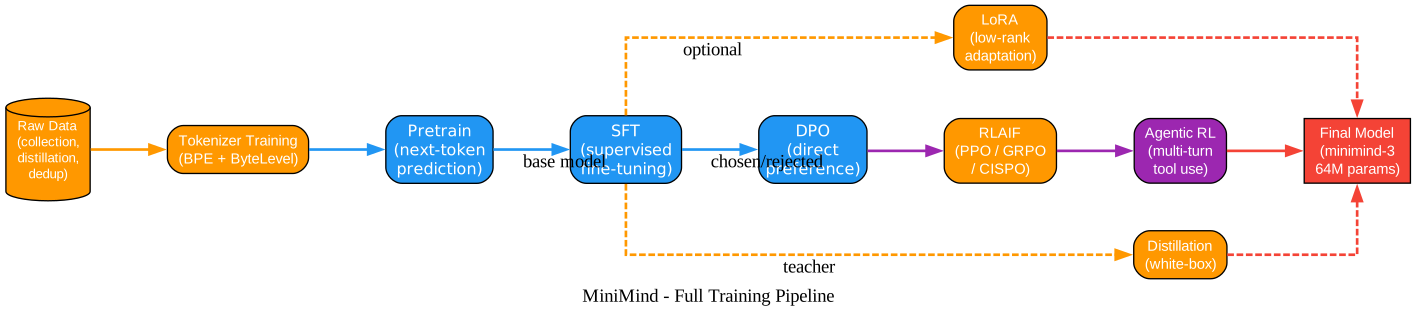
Understanding the Training Pipeline
The pipeline diagram traces the journey from raw data to a final aligned model. Each stage is described in detail below.
1. Data Preparation MiniMind ships cleaned and deduplicated datasets for every stage: pretrain_t2t.jsonl for pretraining, sft_t2t.jsonl for supervised fine-tuning, rlaif.jsonl for RLHF, and agent_rl.jsonl / agent_rl_math.jsonl for Agentic RL. The data pipeline uses datasketch for MinHash deduplication, jieba for Chinese tokenization, and simhash for near-duplicate detection. This mirrors how production LLM teams clean pretraining corpora.
2. Tokenizer Training The tokenizer is a BPE + ByteLevel model trained with a 6400-token vocabulary. The chat template uses special tokens (<|im_start|>, <|im_end|>) for conversation boundaries and dedicated tokens for tool calls (<tool_call>, </tool_call>) and reasoning (<think>, </think>). Buffer tokens are reserved for future extensions.
3. Pretraining (train_pretrain.py) Pretraining uses next-token prediction with cross-entropy loss. The script supports mixed-precision training (bfloat16 or float16) with torch.cuda.amp.GradScaler, gradient accumulation, gradient clipping (grad_clip=1.0), and a custom cosine learning-rate scheduler with warmup. The MoE auxiliary loss (load-balancing) is added to the language modeling loss during pretraining of the MoE variant. Checkpoints are saved as half-precision state dictionaries to minimize disk usage.
4. Supervised Fine-Tuning (train_full_sft.py) SFT uses the same training loop as pretraining but with a different dataset and loss masking strategy. The SFTDataset class applies the chat template via tokenizer.apply_chat_template and masks labels so that only assistant responses contribute to the loss. System prompts are randomly injected with a 20% probability to improve robustness. Tool-call capabilities are mixed into the main SFT data, so a single SFT run yields a model that can already perform basic tool use.
5. LoRA Fine-Tuning (train_lora.py) The LoRA implementation is written from scratch rather than using peft. The LoRA module wraps an nn.Linear with two low-rank matrices A (Gaussian init) and B (zero init), ensuring the adapter starts as an identity transformation. The adapter is attached only to square Linear layers (where in_features == out_features), which corresponds to the attention projections. Training optimizes only the LoRA parameters; the base model weights are frozen.
6. DPO (train_dpo.py) Direct Preference Optimization is implemented natively in PyTorch. The loss function dpo_loss computes the difference between chosen and rejected log-probabilities, subtracts reference-model log-probabilities, and applies the sigmoid-based loss -F.logsigmoid(beta * logits). This is the standard DPO objective - no reward model is needed because the implicit reward is the policy itself.
7. RLAIF: PPO, GRPO, CISPO MiniMind implements three on-policy RL algorithms from scratch. The GRPO trainer (train_grpo.py) is particularly instructive: it generates G responses per prompt using a decoupled rollout engine, computes a group-relative advantage (reward minus the group mean), and optimizes a clipped surrogate objective with a KL penalty against a frozen reference model. The reference model also serves as the reward model - a pragmatic design choice that simplifies the training stack.
8. Agentic RL (train_agent.py) This is the most advanced stage. The agent is trained to use tools (calculator, weather, time, currency converter, translator) across multi-turn conversations. Reward signals include tool-call format validity, argument correctness, answer correctness, length penalties, and repetition penalties. The rollout engine is abstracted behind a RolloutEngine interface with a PyTorch implementation and an optional sglang backend for faster inference.
9. Distillation (train_distillation.py) White-box distillation transfers knowledge from a larger teacher model to MiniMind by matching hidden states and logits. This is how the minimind2-DeepSeek-R1 distilled models were created.
Key Insights The pipeline is deliberately ordered so that each stage builds on the previous one: pretraining produces a base model with language understanding, SFT adds instruction following, DPO/RL aligns with human preferences, and Agentic RL adds tool-use capabilities. Skipping stages (e.g., going straight from pretrain to RL) tends to produce unstable training because the policy has no prior on what a reasonable response looks like.
Mixture of Experts Routing
The MoE variant (use_moe=True) replaces the dense SwiGLU FFN with a Top-1 routing layer over four experts. This is the same design used by Qwen3-MoE and Mixtral, scaled down.
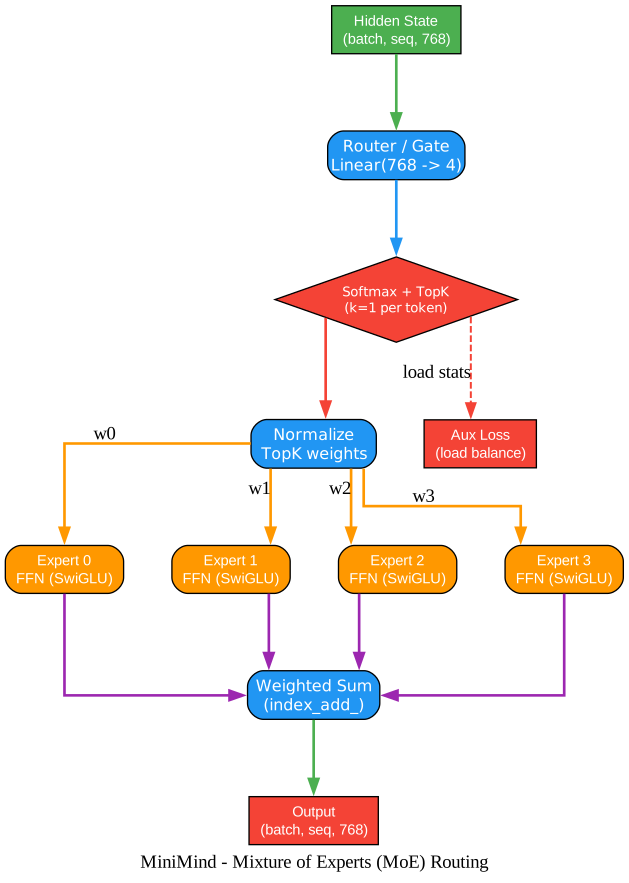
Understanding MoE Routing
Router / Gate A single linear layer (Linear(768, 4)) produces logits for each of the four experts. The logits are passed through softmax to produce a probability distribution, and torch.topk selects the highest-scoring expert per token. With num_experts_per_tok=1, each token is routed to exactly one expert, which keeps inference FLOPs close to the dense model.
Weight Normalization After Top-K selection, the routing weights are renormalized to sum to 1 (norm_topk_prob=True). This is important for numerical stability - without it, a low-probability expert selection could be effectively ignored.
Expert Computation Each expert is a standard FeedForward (SwiGLU) module with its own gate_proj, up_proj, and down_proj. The implementation is efficient: instead of running all experts and masking, it uses index_add_ to scatter the weighted expert outputs back to the original token positions. Tokens not routed to a given expert are skipped entirely.
Auxiliary Load-Balancing Loss A critical problem in MoE training is router collapse, where the gate learns to send all tokens to a single expert. MiniMind addresses this with an auxiliary loss: the average load per expert is multiplied by the average router probability per expert, and the sum is scaled by router_aux_loss_coef=5e-4. This term encourages balanced routing and is added to the main language modeling loss during training.
Key Insights The MoE design follows the principle that sparse expert models can scale parameters without scaling FLOPs. MiniMind’s 198M-A64M model has three times the parameters of the dense variant but uses roughly the same compute per token. The trade-off is memory: all four expert weights must be resident in GPU memory even though only one is active per token. This makes MoE particularly suitable for inference-floored but memory-rich deployments.
GRPO Reinforcement Learning Flow
GRPO (Group Relative Policy Optimization) is the algorithm behind DeepSeek-R1 and is one of the most popular RL methods for LLMs in 2025. MiniMind implements it from scratch with a clean, decoupled rollout engine.
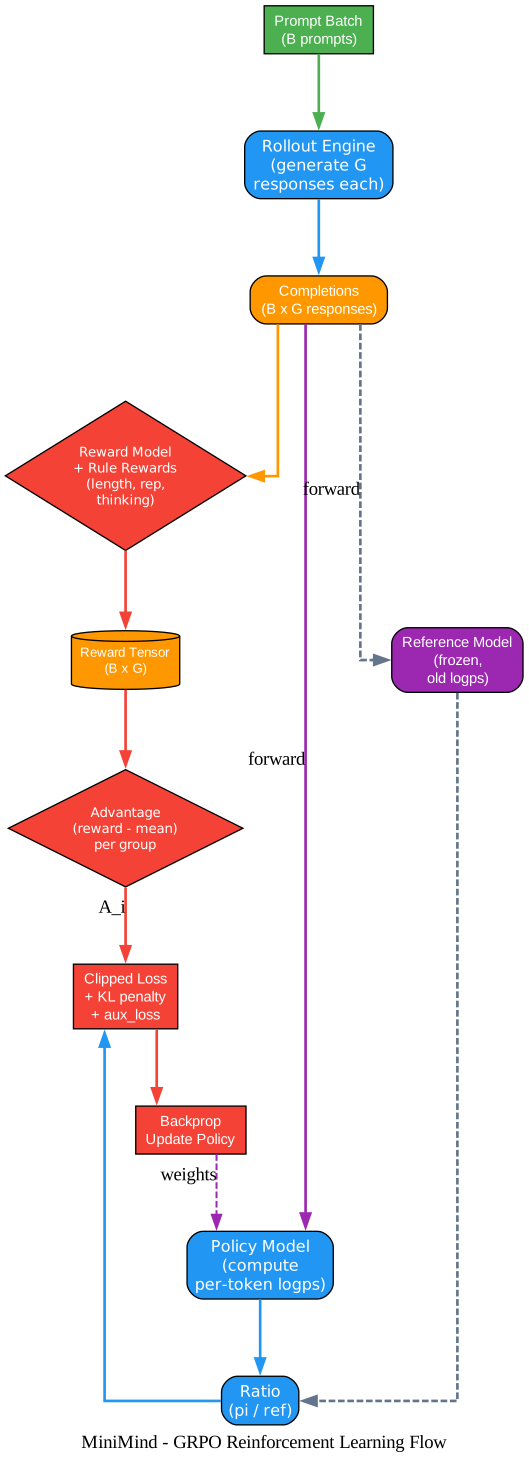
Understanding the GRPO Flow
Prompt Batch and Rollout Training starts with a batch of B prompts. For each prompt, the rollout engine generates G candidate responses (typically 4-8) by sampling from the current policy. The TorchRolloutEngine uses the model’s generate method directly; an alternative SGLangRolloutEngine connects to a running sglang server for faster batched inference.
Reward Computation Rewards are a combination of rule-based and model-based signals:
- Length reward: +0.5 if the response is between 20 and 800 characters, -0.5 otherwise
- Thinking format reward: +1.0 if the
<think>...</think>block is between 20 and 300 characters - Single-thinking reward: +0.25 if exactly one
</think>token appears - Repetition penalty: subtracts a normalized trigram repetition score
- Reward model score: a separate
LMForRewardModelprovides a learned scalar reward
The reward model is built on the same MiniMind architecture - a pragmatic choice that avoids pulling in a large external reward model.
Group-Relative Advantage Unlike PPO, which estimates a value baseline with a critic network, GRPO computes the advantage as reward_i - mean(rewards_in_group). This eliminates the need for a value function and substantially reduces memory usage. The advantage is computed per group of G responses to the same prompt.
Policy and Reference Log-Probabilities For each generated response, the policy model and a frozen reference model both compute per-token log-probabilities. The compute_per_token_logps function uses logits_to_keep to avoid recomputing logits for the prompt portion, which is a significant optimization.
Clipped Surrogate Loss The ratio pi_theta(a|s) / pi_ref(a|s) is clipped to a range (typically 0.8 to 1.2) and multiplied by the advantage. A KL divergence penalty between the policy and reference model provides additional regularization. The total loss is clip_loss + beta * KL + aux_loss.
Backpropagation and Policy Update Gradients are computed only with respect to the policy model parameters (the reference model is frozen). The implementation uses DistributedDataParallel for multi-GPU training and supports torch.compile for additional speedup.
Key Insights GRPO’s key advantage over PPO is the removal of the value function. This eliminates an entire model worth of memory and compute, which matters enormously when you are training on a single 3090. The trade-off is higher variance in the advantage estimate, which GRPO mitigates by averaging over the group of G responses. MiniMind’s implementation also demonstrates a practical pattern: the reward model and reference model can be the same checkpoint, which halves the memory footprint of the RL training stack.
Installation and Quick Start
The repository is structured for direct cloning and immediate training.
# Clone the repository
git clone https://github.com/jingyaogong/minimind.git
cd minimind

# Install dependencies (Python 3.10+ recommended)
pip install -r requirements.txt
The key dependencies are:
| Dependency | Version | Purpose |
|---|---|---|
torch | 2.6.0+ | Core training framework |
transformers | 4.57.6 | Tokenizer and model I/O |
datasets | 3.6.0 | Data loading |
swanlab | 0.9.8 | Training visualization (drop-in wandb replacement) |
streamlit | 1.50.0 | Web demo UI |
sentencepiece | 0.2.0 | Tokenizer training |
Note that torch is commented out in requirements.txt because the correct version depends on your CUDA setup. Install PyTorch separately from the official wheel index matching your CUDA version.
Training a Model From Scratch
The fastest path to a trained model is:
# Step 1: Pretrain (the "2 hours on a 3090" claim)
cd trainer
python train_pretrain.py \
    --epochs 1 \
    --batch_size 32 \
    --learning_rate 5e-4 \
    --data_path ../dataset/pretrain_t2t_mini.jsonl \
    --save_dir ../out

# Step 2: Supervised fine-tuning
python train_full_sft.py \
    --epochs 2 \
    --batch_size 16 \
    --learning_rate 1e-5 \
    --data_path ../dataset/sft_t2t_mini.jsonl \
    --from_weight pretrain \
    --save_dir ../out

# Step 3 (optional): LoRA fine-tuning on a custom task
python train_lora.py \
    --epochs 1 \
    --batch_size 16 \
    --data_path ../dataset/sft_t2t_mini.jsonl \
    --from_weight full_sft \
    --save_dir ../out
For multi-GPU training, launch with torchrun:
torchrun --nproc_per_node=4 trainer/train_pretrain.py \
    --epochs 1 \
    --batch_size 8 \
    --data_path ../dataset/pretrain_t2t_mini.jsonl
The scripts automatically detect distributed mode via init_distributed_mode() and wrap the model in DistributedDataParallel. DeepSpeed is supported for larger configurations.
Inference and Serving
MiniMind provides three inference paths.
Web Demo (Streamlit)
cd scripts
streamlit run web_demo.py
The web UI supports thinking display, tool selection, and multi-turn tool calls.
OpenAI-Compatible API Server
cd scripts
python serve_openai_api.py
This starts a Flask server that implements the OpenAI Chat Completions API, including support for reasoning_content, tool_calls, and open_thinking fields. It can be plugged directly into Open-WebUI, FastGPT, or any other OpenAI-compatible client.
Programmatic Chat
cd scripts
python chat_api.py
This is a minimal interactive REPL that shows the chat template handling, thinking tokens, and tool-call parsing in a few dozen lines.
Third-Party Inference Engines
Because the model is transformers-compatible, you can export and serve it with production-grade engines:
# llama.cpp (GGUF quantization)
python convert_model.py --model_path ../out/pretrain_768.pth --output minimind-3
llama-cli -m minimind-3.gguf -p "Hello, who are you?"

# vLLM (high-throughput serving)
vllm serve minimind-3 --dtype bfloat16

# ollama
ollama create minimind -f Modelfile
ollama run minimind
Evaluation
MiniMind includes an evaluation harness that runs the model on standard benchmarks:
python eval_llm.py --model_path ../out/full_sft_768.pth
Supported benchmarks include C-Eval, C-MMLU, and OpenBookQA. Results are written to a JSON report and can be visualized with the included radar chart generator. YaRN-based long-context evaluation is also supported for testing RoPE extrapolation.
Troubleshooting
Out of memory during pretraining Reduce batch_size to 8 or 4 and increase accumulation_steps to 4 or 8. The effective batch size is batch_size * accumulation_steps, which preserves training dynamics while fitting in memory.
Tokenizer loading errors Ensure model/tokenizer.json and model/tokenizer_config.json are on the Python path. The tokenizer is loaded via AutoTokenizer.from_pretrained('model') - if you run from a different directory, pass the full path.
NaN loss during RL training Reduce the learning rate (RL typically uses 1e-6 to 5e-6) and ensure the reference model is frozen. If the KL penalty coefficient is too low, the policy can drift away from the reference and collapse.
MoE training imbalance If the auxiliary loss is not decreasing, increase router_aux_loss_coef from 5e-4 to 1e-3. Also check that norm_topk_prob=True - without normalization, routing can become unstable.
Slow generation on CPU Use KV caching (use_cache=True, the default) and consider exporting to GGUF via convert_model.py for llama.cpp-based CPU inference, which is typically 5-10x faster than the native PyTorch path on CPU.
Checkpoint resume fails The lm_checkpoint utility saves optimizer state, scaler state, epoch, step, and wandb ID. If you change the model configuration (e.g., hidden_size), the checkpoint will not load - start a fresh run or delete the checkpoint directory.
Conclusion
MiniMind is a remarkable educational project because it refuses to hide the mechanics of LLM training behind abstractions. Every algorithm - from RMSNorm to GRPO - is implemented in plain PyTorch, readable in an afternoon, and trainable on a single consumer GPU. Whether you want to understand how RoPE works, see a real MoE router in action, or experiment with Agentic RL without renting an H100 cluster, MiniMind provides a complete, working reference.
The fact that the architecture is aligned with Qwen3 means that the lessons learned here transfer directly to production-scale models. The same code patterns - GQA with q/k_norm, SwiGLU FFN, YaRN RoPE scaling, Top-K MoE routing, clipped surrogate RL objectives - appear in the largest open-weight models being trained today. MiniMind just makes them small enough to actually run.
Related Posts
- yaml-cpp: A YAML Parser and Emitter in C++
- Catch2: A Natural C++ Testing Framework
- meshoptimizer: Making 3D Meshes Smaller and Faster
Links

Enjoyed this post? Never miss out on future posts by following us


