1. Introduction
Security testing has long been the bottleneck of modern software delivery. Teams ship code faster than ever, yet penetration testing remains a manual, episodic, and expensive ritual performed by a small pool of specialists. Strix is an open-source AI penetration testing tool that rewrites that equation. With over 37,984 GitHub stars and explosive growth of more than 10,000 stars per week, Strix has quickly become one of the most watched security projects in the open-source ecosystem.
Strix deploys autonomous AI agents that behave like real attackers — they reconnoiter your application, discover weaknesses, craft working proofs of concept, and then generate remediation guidance you can act on immediately. Written in Python and released under the Apache 2.0 license, it integrates the best offensive security tooling (Caido, Nuclei, Playwright) with frontier large language models from OpenAI, Anthropic, and Google. The result is a platform that does not just flag vulnerabilities — it validates them with real exploits and tells you exactly how to fix them.
In this post we will walk through every layer of Strix: its architecture, its AI-driven workflow, its offensive toolkit, its multi-agent orchestration, installation, usage, CI/CD integration, LLM provider support, and enterprise features. By the end you will understand why AI-powered pentesting is not a gimmick but a fundamental shift in how we secure software.
2. The Problem with Traditional Pentesting
Traditional penetration testing suffers from three structural problems that have resisted decades of tooling investment.
First, it is slow. A typical engagement takes weeks to scope, schedule, execute, and report. By the time the report lands, the codebase has already moved on. Critical vulnerabilities discovered in a snapshot from three weeks ago may no longer exist — or worse, may have been replaced by new ones nobody has looked at.
Second, it is expensive. Skilled penetration testers are scarce and charge accordingly. Most organizations can afford a thorough external pentest once or twice a year, leaving the remaining 364 days as a blind spot. Startups and small teams often skip it entirely.
Third, static analysis tools drown teams in false positives. SAST scanners flag every suspicious-looking code pattern regardless of whether it is actually exploitable in context. Security engineers spend more time triaging noise than fixing real issues. DAST tools are better at runtime behavior but still lack the reasoning needed to understand business logic flaws or chained exploit paths.
Strix was built to solve all three problems simultaneously. By combining static analysis, dynamic testing, and LLM-based reasoning, it produces findings that are already validated with working proofs of concept. No more “this might be vulnerable” — Strix shows you the exploit working, then hands you the fix.
3. How Strix Works
At its core, Strix treats penetration testing as an agentic reasoning problem rather than a signature-matching problem. Instead of scanning for known patterns, it deploys AI agents that interact with your application the way a human attacker would.
The process begins with reconnaissance. A recon agent maps the attack surface — endpoints, parameters, authentication flows, technologies, and configuration. It feeds this intelligence to an exploit agent that hypothesizes vulnerabilities, crafts attacks, and executes them inside an isolated Docker sandbox. If an exploit succeeds, the finding is confirmed with a working proof of concept. If it fails, the agent reasons about why and tries a different approach — exactly like a human tester iterating on a lead.
What makes this powerful is the reasoning loop. Traditional scanners run a fixed checklist. Strix agents adapt. If they discover an unexpected parameter during testing, they can pivot and explore it. If an initial exploit fails because of a WAF, they can try encoding variations or alternative injection points. This dynamic behavior is what separates agentic pentesting from rule-based scanning.
Once a vulnerability is confirmed, a post-exploitation agent assesses the blast radius — what data is exposed, what lateral movement is possible, what the business impact really is. Finally, the system generates an auto-fix patch and a compliance-ready report. The entire loop, from target input to validated finding to remediation, can run in minutes rather than weeks.
4. Architecture Overview
Strix is organized into a clean, modular architecture that separates concerns between orchestration, agent logic, tooling, and reporting. The diagram below shows how these layers fit together.

At the top sits the CLI / TUI interface, built on the Textual framework, which provides a rich terminal experience for interacting with scans in real time. Below it is the core orchestrator, the brain of the system that handles task planning, agent coordination, and state management.
The orchestrator drives the multi-agent system — a collection of specialized agents (recon, exploitation, post-exploitation) that collaborate dynamically. Each agent draws from a shared skills library that encodes pentesting capabilities as reusable, composable units.
Agents interact with the target through the offensive security toolkit: an HTTP interception proxy built on Caido, browser automation via Playwright, shell execution for runtime probing, and recon/OSINT modules. All of this runs inside a Docker sandbox runtime that isolates exploit execution from the host system.
On the side, the LLM provider layer (powered by LiteLLM) connects agents to frontier models from OpenAI, Anthropic, Google, and local providers. A config and telemetry subsystem manages settings, logging, and metrics throughout the run. Finally, the report engine produces compliance-ready output in SOC 2, ISO 27001, and PCI DSS formats.
This separation of concerns is what makes Strix both powerful and extensible. You can swap LLM providers, add new skills, or plug in additional tools without touching the orchestration core.
5. AI Pentesting Workflow
The end-to-end workflow that Strix follows transforms a raw target into a validated, fixed, and documented security assessment. The diagram below illustrates this pipeline.
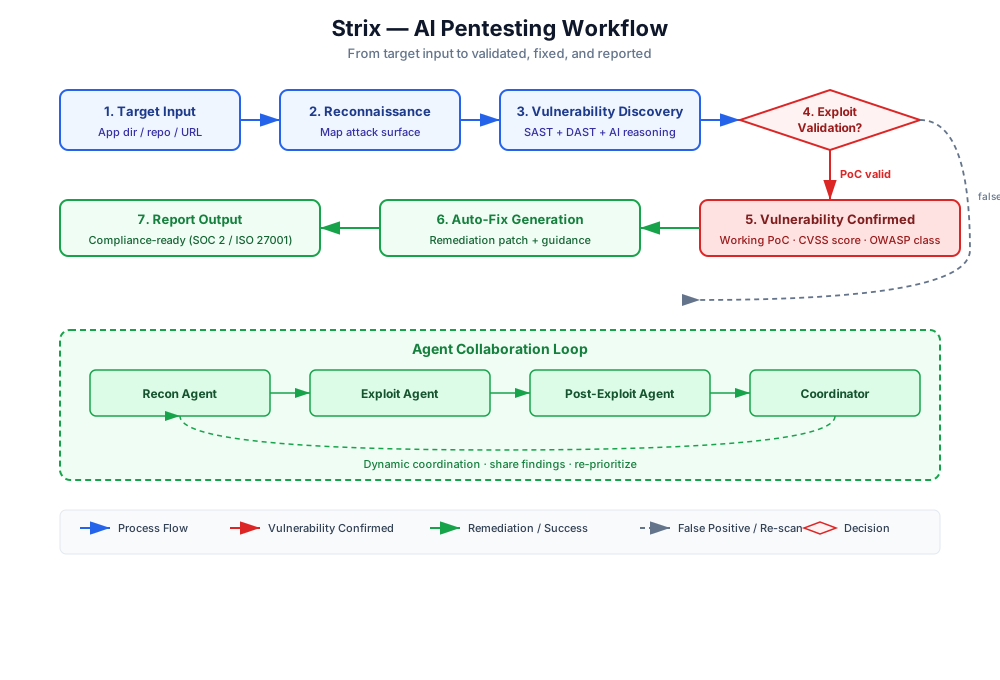
The workflow proceeds in seven stages:
- Target Input — You point Strix at an application directory, a Git repository, or a live URL.
- Reconnaissance — The recon agent maps the full attack surface, cataloging endpoints, parameters, technologies, and authentication mechanisms.
- Vulnerability Discovery — SAST, DAST, and AI reasoning run in parallel to identify candidate vulnerabilities across the OWASP Top 10.
- Exploit Validation — Each candidate is tested with a real exploit attempt. This is the critical decision point: if the PoC succeeds, the vulnerability is confirmed; if it fails, the finding is discarded as a false positive and the agent re-scans with adjusted strategy.
- Vulnerability Confirmed — A confirmed finding includes a working PoC, a CVSS score, and an OWASP classification.
- Auto-Fix Generation — Strix generates a remediation patch with developer-friendly guidance.
- Report Output — A compliance-ready report is produced with full evidence and audit documentation.
Underpinning this linear flow is a continuous agent collaboration loop. The recon, exploit, and post-exploit agents share findings dynamically. If the exploit agent discovers a new endpoint during an attack, it signals the recon agent to incorporate it. If the post-exploit agent finds that a vulnerability enables deeper access, it can request the exploit agent to chain additional attacks. This is what makes Strix agentic rather than merely automated.
6. Key Features
Strix packs a comprehensive set of capabilities that cover the full spectrum of modern penetration testing. The diagram below summarizes the six pillars of the platform.

Agentic Tools — Strix does not rely on a single scanning engine. It gives its agents a full toolkit: HTTP interception via Caido for traffic manipulation, browser exploitation through Playwright for client-side attacks, shell execution for runtime probing, a custom exploit runtime for tailored attacks, and recon/OSINT modules for information gathering. Agents choose the right tool for each situation, just as a human tester would.
Vulnerability Scanner — Coverage spans the entire OWASP Top 10: broken access control, injection attacks (SQL, command, LDAP), SSRF, XSS, business logic flaws, authentication and session management issues, infrastructure and cloud misconfigurations, and API security. Each category is tested with context-aware techniques, not just signature matching.
Multi-Agent Orchestration — Multiple agents run in parallel, each specializing in a different phase of the attack. A coordinator dynamically assigns work, shares intelligence, and re-prioritizes based on findings. This distributed approach dramatically reduces scan time compared to sequential testing.
CI/CD Integration — Strix drops directly into GitHub Actions workflows, enabling security scanning on every pull request. Automated security gates can block merges when critical vulnerabilities are found, bringing pentesting into the shift-left DevSecOps pipeline.
Auto-Fix — Beyond finding vulnerabilities, Strix generates actionable remediation patches. The AI proposes concrete code changes with explanations, turning security findings into immediately mergeable fixes rather than vague recommendations.
Compliance Reports — Output is formatted for SOC 2, ISO 27001, and PCI DSS compliance, complete with evidence, CVSS scoring, and audit-ready documentation. This bridges the gap between technical security testing and the reporting requirements of compliance frameworks.
All of this is built on industry-leading open-source foundations: LiteLLM for model abstraction, Caido for HTTP interception, Nuclei for template-based scanning, Playwright for browser automation, and Textual for the terminal interface.
7. Vulnerability Detection Pipeline
The heart of Strix’s accuracy is its multi-signal vulnerability detection pipeline. Rather than relying on a single analysis method, it fuses three independent signals and then validates findings with real exploits. The diagram below shows this pipeline in detail.
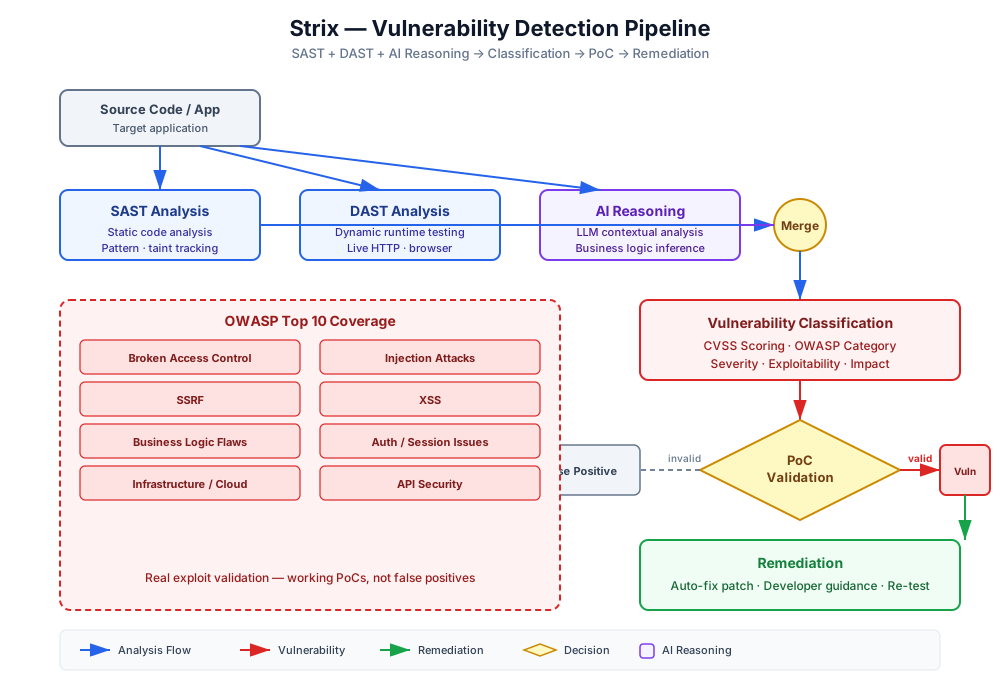
The pipeline begins with the target application feeding into three parallel analysis branches:
SAST Analysis performs static code analysis, using pattern matching and taint tracking to identify potentially vulnerable code paths. This catches issues like unsanitized input flows, hardcoded secrets, and insecure API calls before the application even runs.
DAST Analysis performs dynamic runtime testing, sending live HTTP requests and driving a real browser to observe how the application behaves under attack. This catches issues that only manifest at runtime, such as misconfigured headers, broken authentication flows, and server-side errors triggered by specific inputs.
AI Reasoning applies LLM-based contextual analysis on top of both static and dynamic signals. This is where Strix separates itself from traditional scanners. The AI understands business logic — it can reason about whether a discount code application flow can be abused, whether an IDOR vulnerability exists in a multi-tenant context, or whether a sequence of API calls could bypass a rate limit. This kind of reasoning is simply impossible with signature-based tools.
These three signals merge into a vulnerability classification stage that assigns a CVSS score, an OWASP category, a severity level, and an exploitability assessment. Every candidate then enters PoC validation — a real exploit is attempted in the sandbox. If the PoC succeeds, the vulnerability is confirmed with full evidence. If it fails, it is classified as a false positive and discarded.
Only validated vulnerabilities proceed to remediation, where Strix generates an auto-fix patch, developer guidance, and a re-test plan. This validate-then-report approach is why Strix’s findings carry weight — they are not theoretical risks but demonstrated exploits.
8. Multi-Agent Orchestration
The multi-agent architecture is what gives Strix its speed and depth. Instead of a single monolithic scanner, Strix deploys a team of specialized agents that work in parallel and coordinate dynamically.
The recon agent is the scout. It maps the application’s attack surface, identifies technologies, enumerates endpoints, and catalogs authentication mechanisms. Its output is a structured model of the target that other agents consume.
The exploit agent is the attacker. It takes candidate vulnerabilities from the discovery phase and attempts to exploit them. It iterates — if an initial attempt fails, it reasons about why and tries alternative approaches, much like a human pentester working a lead.
The post-exploit agent is the assessor. Once a vulnerability is confirmed, it determines the real-world impact: what data is exposed, what privileges are gained, what lateral movement is possible. This transforms a technical finding into a business-risk finding.
A coordinator oversees the entire operation. It assigns tasks, manages dependencies between agents, and dynamically re-prioritizes based on what is being discovered. If the exploit agent finds a critical RCE, the coordinator can redirect the recon agent to map internal services that might be reachable from the compromised host.
This orchestration enables parallel execution. While the recon agent is mapping a new endpoint, the exploit agent can be validating a previously discovered injection point, and the post-exploit agent can be assessing the impact of an already-confirmed vulnerability. The result is a scan that is dramatically faster than sequential testing while also being more thorough, because agents can chase down leads that a linear scanner would skip.
9. Offensive Security Toolkit
Strix’s agents are only as capable as the tools they can wield. The platform integrates a serious offensive security toolkit that gives AI agents the same instruments a human pentester would use.
HTTP Proxy (Caido) — Caido provides a powerful HTTP interception proxy that allows agents to inspect, modify, and replay HTTP traffic. This is essential for testing API endpoints, manipulating request parameters, and analyzing server responses. Agents can intercept a request, modify a parameter to test for injection, and observe the response — all programmatically.
Browser Exploitation (Playwright) — Many modern vulnerabilities live in the client side. Playwright gives agents a real browser they can drive programmatically: clicking buttons, filling forms, executing JavaScript, and capturing DOM state. This enables testing for XSS, CSRF, clickjacking, and client-side authentication bypasses that pure HTTP tools cannot reach.
Shell Execution — For runtime probing, agents can execute shell commands inside the Docker sandbox. This allows them to inspect file systems, check process lists, test network connectivity, and verify whether a suspected command injection is actually exploitable.
Custom Exploit Runtime — Not every vulnerability fits a template. Strix includes a custom exploit runtime that lets agents write and execute tailored exploit code on the fly. If an agent discovers a unique business logic flaw, it can craft a specific exploit script to validate it rather than forcing the finding into a pre-existing template.
Recon and OSINT — Before attacking, agents gather intelligence. The recon toolkit includes subdomain enumeration, technology fingerprinting, port scanning, and open-source intelligence gathering. This builds the contextual map that makes subsequent attacks targeted rather than scattershot.
All tools operate inside the Docker sandbox, ensuring that exploit execution is isolated and cannot affect the host system or other running services.
10. Installation and Quick Start
Strix is designed to be up and running in minutes. The install script handles dependencies, and configuration is a matter of setting two environment variables.
# Install Strix
curl -sSL https://strix.ai/install | bash

# Configure your LLM provider
export STRIX_LLM="openai/gpt-5.4"
export LLM_API_KEY="your-api-key"

# Run your first scan
strix --target ./app-directory
The STRIX_LLM environment variable tells Strix which LLM provider to use, formatted as provider/model. The LLM_API_KEY provides authentication. Strix uses LiteLLM under the hood, so the same variable format works across all supported providers.
If you prefer to run Strix from source, you can clone the repository and install it with Poetry:
git clone https://github.com/usestrix/strix.git
cd strix
poetry install
poetry run strix --target ./app-directory
Docker is required for the sandbox runtime. Make sure Docker is installed and running before starting a scan, as exploit validation executes inside isolated containers.
11. Usage Examples
Strix supports several scanning modes depending on what you are testing.
Basic application scan:
# Scan a local application directory
strix --target ./my-app

# Scan with a specific LLM provider
strix --target ./my-app --llm "anthropic/claude-sonnet-4.6"
GitHub repository scan:
# Clone and scan a repository in one step
strix --repo https://github.com/myorg/myapp

# Scan a specific branch
strix --repo https://github.com/myorg/myapp --branch develop
Web application assessment:
# Scan a live web application
strix --url https://staging.myapp.com

# Include authentication credentials
strix --url https://staging.myapp.com --auth "admin:password123"

# Scan with custom headers
strix --url https://api.myapp.com --headers "Authorization: Bearer token123"
Generating a compliance report:
# Run a scan and generate a SOC 2 report
strix --target ./my-app --report-format soc2 --output ./reports/

# Generate all compliance formats
strix --target ./my-app --report-format all --output ./reports/
Each scan produces a detailed report with confirmed vulnerabilities, working PoCs, CVSS scores, and remediation guidance. The TUI interface lets you watch agents work in real time, see which vulnerabilities are being tested, and intervene if needed.
12. CI/CD Integration
One of Strix’s most powerful capabilities is its ability to run as part of your CI/CD pipeline. This brings penetration testing into the development loop rather than treating it as an afterthought.
Here is a GitHub Actions workflow that runs Strix on every pull request:
name: Security Scan

on:
  pull_request:
    branches: [ main, develop ]
  push:
    branches: [ main ]

jobs:
  strix-scan:
    runs-on: ubuntu-latest
    steps:
      - name: Checkout code
        uses: actions/checkout@v4

      - name: Install Strix
        run: curl -sSL https://strix.ai/install | bash

      - name: Run penetration test
        env:
          STRIX_LLM: "openai/gpt-5.4"
          LLM_API_KEY: $
        run: |
          strix --target ./ \
            --report-format all \
            --output ./security-reports/ \
            --fail-on critical

      - name: Upload security reports
        if: always()
        uses: actions/upload-artifact@v4
        with:
          name: security-reports
          path: ./security-reports/

      - name: Comment PR with findings
        if: github.event_name == 'pull_request'
        uses: actions/github-script@v7
        with:
          script: |
            const fs = require('fs');
            const report = fs.readFileSync('./security-reports/summary.md', 'utf8');
            github.rest.issues.createComment({
              issue_number: context.issue.number,
              owner: context.repo.owner,
              repo: context.repo.repo,
              body: `## 🔒 Security Scan Results\n\n${report}`
            });
The --fail-on critical flag ensures the workflow fails if any critical vulnerabilities are found, acting as an automated security gate. Reports are uploaded as artifacts for archival, and a summary is posted as a comment on the pull request so developers see findings immediately.
This setup transforms security from a periodic audit into a continuous, automated process that runs on every change.
13. LLM Provider Support
Strix is model-agnostic thanks to its LiteLLM integration. You can use any of the major frontier model providers, and switching between them is as simple as changing an environment variable.
OpenAI:
export STRIX_LLM="openai/gpt-5.4"
export LLM_API_KEY="sk-your-openai-key"
Anthropic:
export STRIX_LLM="anthropic/claude-sonnet-4.6"
export LLM_API_KEY="sk-ant-your-anthropic-key"
Google Gemini:
export STRIX_LLM="gemini/gemini-3-pro"
export LLM_API_KEY="your-google-api-key"
Vertex AI, Bedrock, and Azure:
# Google Vertex AI
export STRIX_LLM="vertex_ai/gemini-3-pro"
export GOOGLE_APPLICATION_CREDENTIALS="/path/to/service-account.json"

# AWS Bedrock
export STRIX_LLM="bedrock/anthropic.claude-sonnet-4.6"
export AWS_REGION="us-east-1"

# Azure OpenAI
export STRIX_LLM="azure/gpt-5.4"
export AZURE_API_KEY="your-azure-key"
export AZURE_API_BASE="https://your-resource.openai.azure.com"
Local models (Ollama / vLLM):
# Using Ollama for fully offline scanning
export STRIX_LLM="ollama/llama3.1"
export LLM_API_KEY="dummy"

# Using a vLLM-hosted model
export STRIX_LLM="openai/your-model"
export LLM_API_KEY="dummy"
export OPENAI_API_BASE="http://localhost:8000/v1"
Local model support is particularly valuable for organizations that cannot send source code or application data to external APIs for security or compliance reasons. You can run the entire Strix pipeline on your own infrastructure with a self-hosted model.
14. Enterprise Features
For organizations with larger-scale security needs, Strix offers a range of enterprise capabilities that make it suitable for production deployment across teams.
Single Sign-On (SSO) — Enterprise deployments support SAML and OIDC-based SSO integration, allowing teams to authenticate through their existing identity providers. This enforces access control and provides an audit trail of who ran which scans.
Compliance Reporting — Beyond the standard report formats, enterprise tiers offer customizable report templates tailored to specific regulatory frameworks. Reports include executive summaries, technical appendices, evidence packages, and remediation tracking — everything an auditor expects.
Dedicated Support — Enterprise customers receive priority support with dedicated security engineers who can help tune scan configurations, interpret findings, and integrate Strix into existing security operations workflows.
VPC Deployment — For organizations with strict data residency requirements, Strix can be deployed inside a Virtual Private Cloud. This ensures that source code, application traffic, and scan results never leave your infrastructure. Combined with local LLM support, this enables a fully air-gapped pentesting pipeline.
Team Collaboration — Shared scan histories, finding tracking, and integration with issue trackers (Jira, GitHub Issues, Linear) make it easy for security and engineering teams to collaborate on remediation. Findings flow directly into developer workflows rather than living in a separate security silo.
Role-Based Access Control — Different team members can be granted different permissions: security engineers can run full scans, developers can view findings on their code, and auditors can access reports without seeing raw exploit details.
These features make Strix viable not just as a developer tool but as a central component of an enterprise security program.
15. Conclusion
Strix represents a fundamental shift in how we approach application security. For decades, penetration testing has been a manual, expensive, and episodic practice — a luxury that most teams could not afford to run continuously. By combining autonomous AI agents, a real offensive security toolkit, multi-agent orchestration, and frontier LLM reasoning, Strix makes continuous, validated penetration testing accessible to any team that can run a CLI command.
The key innovation is validation. Traditional scanners produce lists of theoretical risks. Strix produces working proofs of concept. When Strix tells you there is a SQL injection vulnerability, it shows you the exploit working — it extracts data, demonstrates the impact, and then hands you the fix. This eliminates the false-positive fatigue that has made security tools a source of frustration rather than value.
The multi-agent architecture brings the parallelism and adaptability of a human pentesting team to an automated system. Agents specialize, collaborate, and iterate. They chase down leads, adjust strategies, and share intelligence dynamically. This is not a scanner running a checklist — it is a team of AI agents conducting a real engagement.
With CI/CD integration, Strix brings penetration testing into the development loop. Every pull request can be security-tested before merge. Critical vulnerabilities become merge blockers, not post-deployment surprises. This is the promise of DevSecOps finally realized — security that moves at the speed of development.
The model-agnostic design means you are never locked into a single AI provider. Use OpenAI today, switch to Anthropic tomorrow, or run fully offline with a local model for sensitive workloads. The LiteLLM abstraction makes this a configuration change, not a migration project.
And with enterprise features like SSO, VPC deployment, compliance reporting, and team collaboration, Strix scales from a solo developer’s terminal to an organization-wide security program.
The future of security testing is autonomous, continuous, and validated. Strix is building that future today, in the open, under the Apache 2.0 license, with 37,984 stars and counting. If you are responsible for application security — as a developer, a security engineer, or a team lead — Strix deserves a place in your toolkit.
To get started, visit the Strix GitHub repository, run the install script, and point it at your application. The first validated vulnerability it finds might be the one your last pentest missed. Enjoyed this post? Never miss out on future posts by following us 


