DeepSeek Harness: The Everything-Is-a-Plugin Agent Harness
DeepSeek AI has released DeepSeek Harness (dsh) — an open-source agent harness that has rocketed to the top of GitHub’s trending chart with 62,300 weekly star gains. The core idea is radical in its simplicity: everything is a plugin, including the model adapter, the tool registry, the session log, and the agent loop itself. There is no privileged core to patch. You extend dsh by mounting a plugin beside the others, and every registration is a reversible effect that unwinds when its plugin unloads.
The Foundation: Cordis and Spatiotemporal Composability
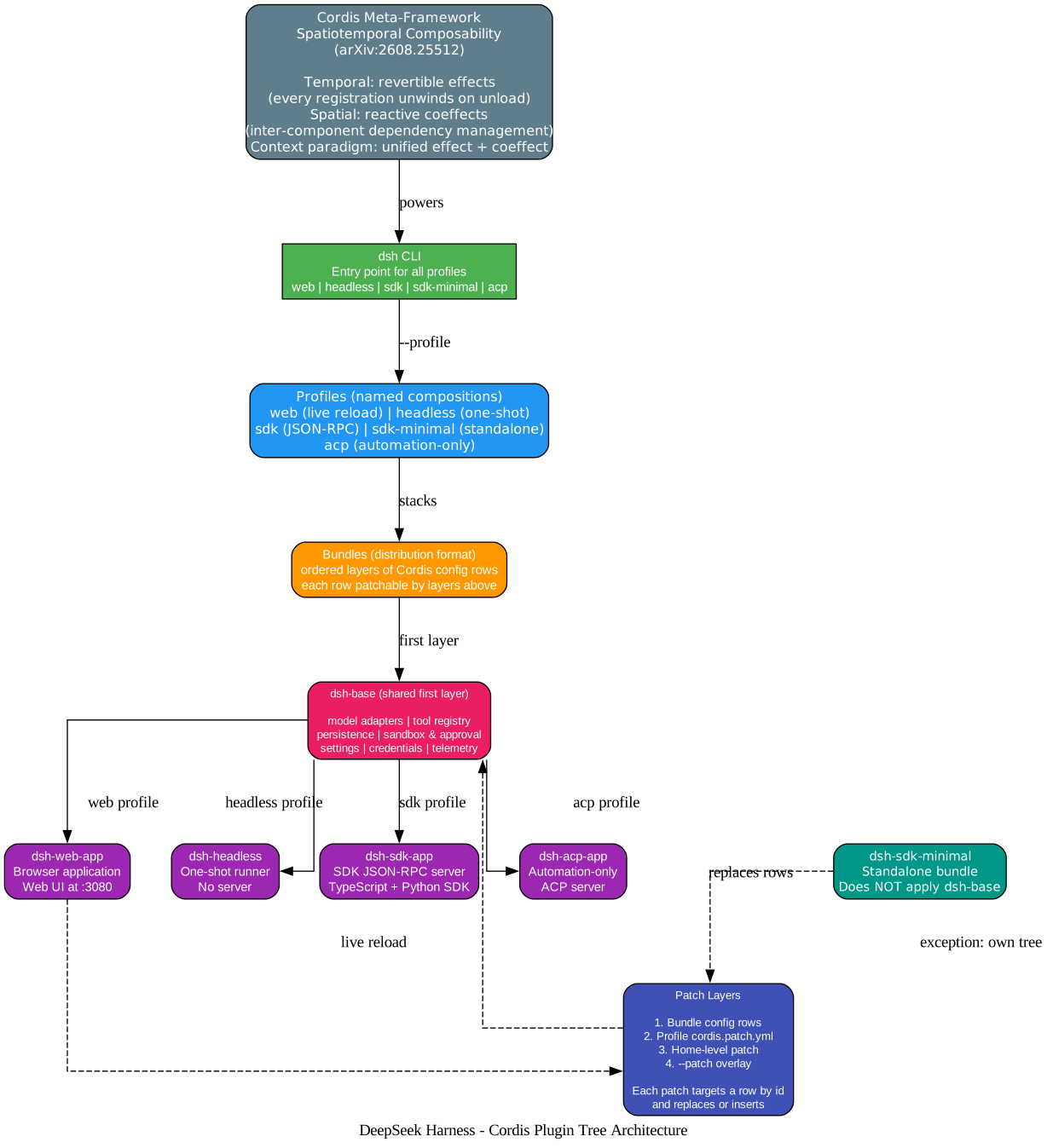
DeepSeek Harness is powered by Cordis, a meta-framework whose design is described in the paper A Programming Paradigm for Spatiotemporal Composability (arXiv:2608.25512, submitted August 2026 by Yifan Shi, Wei Zhang, and Tianyi Cui from Peking University and DeepSeek-AI).
The paper identifies two orthogonal dimensions of dynamic composition:
| Dimension | Problem | Cordis Solution |
|---|---|---|
| Temporal composability | Reverting a component’s side effects upon removal | Revertible effects — every context transformation carries an inverse that the runtime holds |
| Spatial composability | Declaring and managing inter-component dependencies | Reactive coeffects — every context change is classified against a component’s coeffect specification to drive activation/deactivation |
These two dimensions are unified into a single context type — the context paradigm — through which every effect and coeffect is mediated. This means the effects of distinct components interleave without disturbing one another.
In practical terms: when a plugin registers a tool, a model adapter, or an event handler, that registration is an effect with an inverse. When the plugin unloads, the effect unwinds — the tool disappears from the registry, the adapter stops responding, the event handler stops firing. No manual cleanup required.
Profiles and Bundles
A running dsh instance is a plugin tree composed at boot from ordered layers.
Profiles
A profile is a named composition stored in the Harness home. It lists the bundles it stacks, holds any out-of-tree plugins it installs, and keeps the user’s own cordis.patch.yml. Five profiles ship as templates:
| Profile | Purpose | Reload |
|---|---|---|
web | Browser application at http://127.0.0.1:3080 | Live reload |
headless | One-shot runner with no server | Once at startup |
sdk | SDK JSON-RPC server (TypeScript + Python) | Once at startup |
sdk-minimal | Standalone bundle (does NOT apply dsh-base) | Once at startup |
acp | Automation-only ACP server | Once at startup |
Bundles
A bundle is a distribution format for Cordis config rows and the code they mount. Each declares itself in its package.json under a dsh field: dsh.profile lists a profile’s bundles, and dsh.bundle points at a bundle’s patch file.
dsh-base is the shared first layer of the web, headless, sdk, and acp profiles. It provides:
- Model adapters
- Tool registry
- Persistence
- Sandbox and approval policy
- Settings, credentials, telemetry
Profile-specific bundles then add their own capabilities on top:
dsh-web-appadds the browser applicationdsh-headlessadds a one-shot runnerdsh-sdk-appadds the SDK JSON-RPC serverdsh-acp-appadds the automation-only ACP serverdsh-sdk-minimalis the exception — it owns its complete explicit SDK tree and does not applydsh-base
Patch Layers
Layers apply to an empty entry list in this order:
- Each bundle in the profile’s listed order
- The profile’s
cordis.patch.yml - The home-level patch
- Any
--patchoverlay
A patch targets a row by id and replaces its whole config, or inserts new rows. To see the tree your machine boots:
dsh --profile web --dump-config
Any row it prints can be replaced by a patch of your own.
Core Packages
| Package | Owns | ctx Key |
|---|---|---|
core/session | Append-only SessionEvent log and in-memory store | ctx.sessions |
core/system-prompt | Prompt-section and tool-schema assembly | ctx.systemPrompt |
core/tools | Scoped tool registry and guarded execution pipeline | ctx.tools |
core/agent | Agent interface, live registry, and agent/* events | ctx.agents |
core/agent-loop | Default driver implementing the Agent interface | ctx.agentLoop |
core/scope | Per-agent scoped-registration primitive | library, no key |
llm/llm | Message and stream vocabulary plus the adapter seam | ctx.llm |
webhook/webhook | Authenticated-delivery dispatch and Workspace Session creation | ctx.webhookRuntime |
Agent Turn Flow
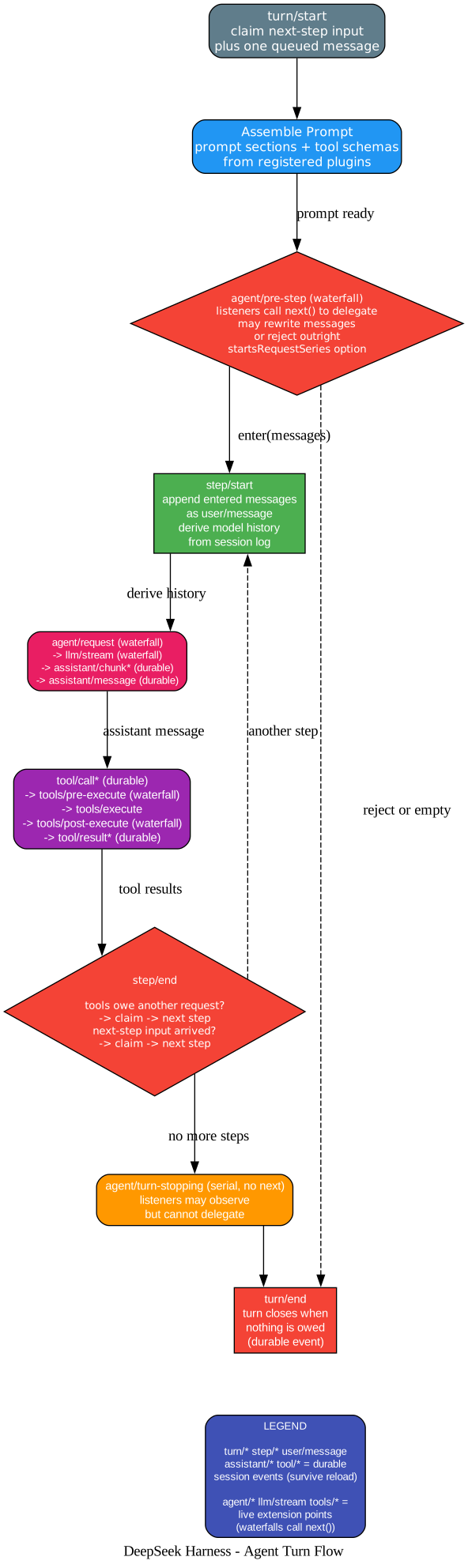
A step is one model request plus the tools it calls. A turn is zero or more steps: it opens before its first input is claimed and closes once nothing is owed.
The turn flow has three event domains:
- Session events (durable) —
turn/*,step/*,user/message,assistant/*,tool/*— survive reloads and are the source of model-visible context - Agent events (live) —
agent/*— carry a liveAgentfor observing or intercepting work in flight - Capability events —
fs/*,tools/*,telemetry/*— attach policy and adapters without importing the loop
Key waterfall events (listeners must call next() to delegate): agent/pre-step, agent/request, llm/stream, tools/pre-execute, tools/post-execute. The agent/turn-stopping event is serial and has no next().
The Model-Visible Invariant
Model-visible means logged. Anything that reaches a model request must be reconstructable from the session log, and a runtime invariant asserts this. This is why a new model-visible input requires a new session event: extend SessionEventMap and render from the log.
Capability Seams: One Swap Changes Everything
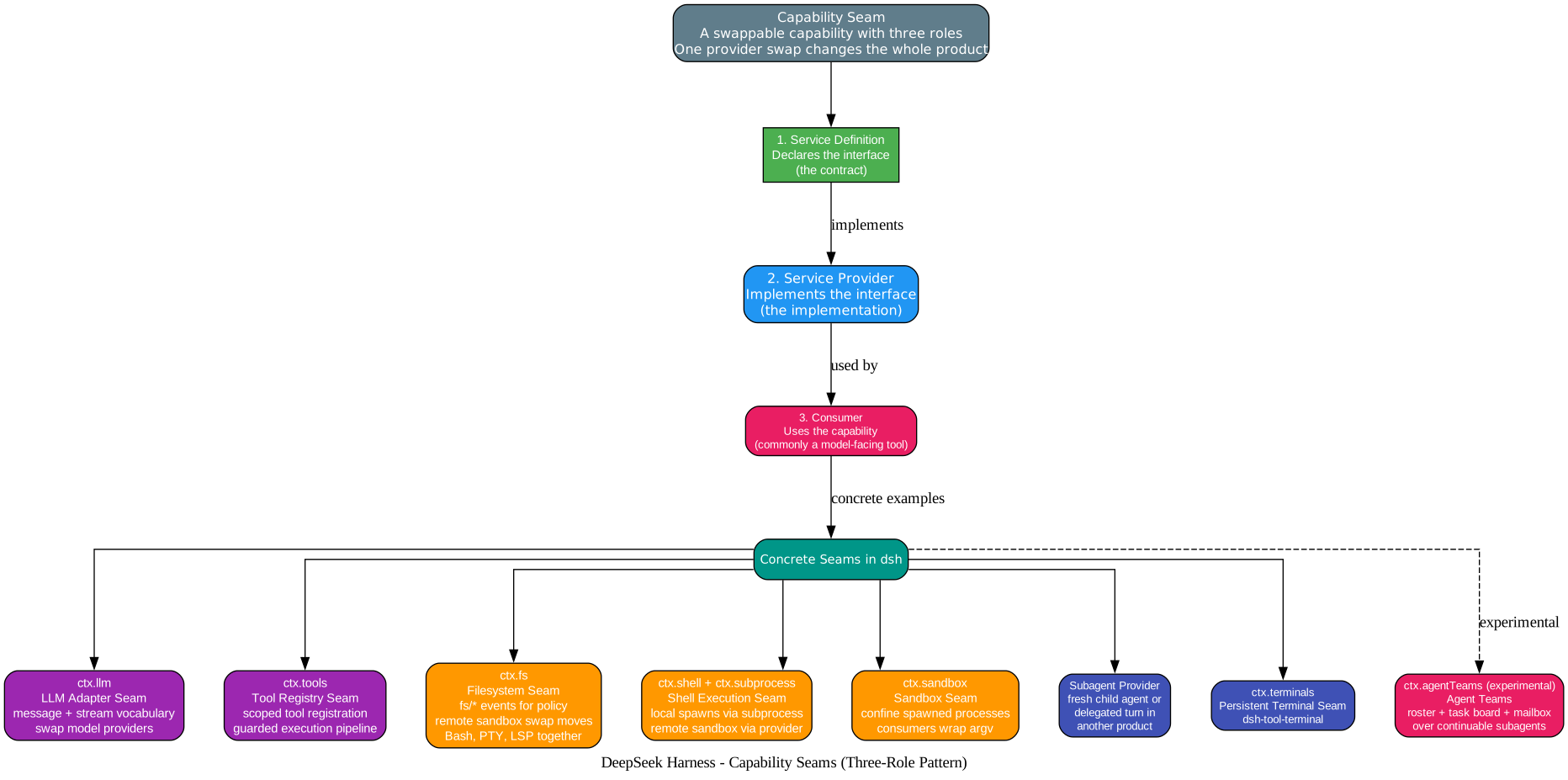
A seam is a swappable capability with three roles:
- Service Definition — declares the interface (the contract)
- Service Provider — implements the interface (the implementation)
- Consumer — uses the capability (commonly a model-facing tool)
Seams are why one provider swap changes the whole product. Filesystem and subprocess providers share one execution world, so pointing them at a remote sandbox moves Bash, PTY, and LSP with them — no provider forks needed. Subagent providers vary just as widely behind one interface, from a fresh child agent to a delegated turn in another product.
Experimental: Agent Teams
Agent Teams is a private opt-in coordination seam on ctx.agentTeams, with a durable roster, task board, and mailbox layered over continuable subagents.
Extension Points Map

New behavior attaches to a documented extension point. There is no privileged core to patch — you extend dsh by mounting a plugin beside the others.
| Goal | Mechanism |
|---|---|
| Add a model provider | Register its adapter on ctx.llm |
| Add a model-facing capability | Register on ctx.tools; schema joins prompt assembly |
| Add shell execution | Register a ctx.shell backend; local one spawns through ctx.subprocess |
| Add persistent terminal execution | Register a ctx.terminals backend plus dsh-tool-terminal |
| Add a human command | Register on ctx.commands; dispatches without a model turn |
| Add background work | Register on ctx.jobs; job_* tools collect or stop it |
| Start a Session from an external webhook | Register a trusted rule on ctx.webhookRuntime and mount a provider adapter |
| Add filesystem access or policy | Register a ctx.fs provider or listen to fs/* events |
| Confine spawned processes | Use a ctx.sandbox backend; consumers wrap argv before spawning |
| Intercept a request, tool, or turn | Use its agent/* or tools/* event; agent/turn-stopping stops a turn |
| Add model-facing context | Call agent.inject(); lands in the next admitted request |
| Add UI or editor integration | Drive ctx.agents and render from session/event |
| Add a Web Client Chat node | Register a ConversationNodeDefinition + keyed renderer |
| Add durable session state | Extend SessionEventMap; render and replay from the log |
| Store sessions in a new backend | Implement SessionPersistence (create/open/stat/list/export) |
| Fork a session at a turn boundary | ctx.agents.create({ sessionId, seed, meta: { parentSession, seedLength } }) |
Quick Start
Run from npm
npx @deepseek-ai/dsh web
This starts the Web UI at http://127.0.0.1:3080 by default. Pass --no-open to run the server without opening a browser.
Run from Source
git clone https://github.com/deepseek-ai/deepseek-harness.git
cd deepseek-harness
pnpm install
pnpm run build
pnpm dsh web
Configure a Model
Open Settings > Models in the Web UI, enter your DeepSeek API key, and save. Model routing becomes available immediately — no server restart needed.
Python SDK
The Python SDK packages the normal dsh CLI as deepseek-harness-sdk-runtime-<platform>-<arch>. The client launches dsh --profile sdk with an explicit Harness home by default. The minimal example selects the shipped sdk-minimal profile.
Safety Notice
DeepSeek Harness is in developer preview and iterating rapidly. There will be compatibility-breaking changes. Review the safety notice before running the project.
The repository enforces application entrypoint integrity via verify-application-entrypoints, which keeps every package bin, executable source, and root demo in an explicit class and rejects a Node application path that bypasses dsh.
Key Design Decisions
Why everything-is-a-plugin? Traditional agent harnesses have a privileged core that you patch to add features. dsh eliminates the core: every capability is a plugin, so extension never requires modifying the framework. This makes customization safe and composable.
Why revertible effects? When a plugin unloads, its effects must completely unwind — otherwise the system accumulates stale registrations. Revertible effects make hot module replacement safe: you can load and unload plugins at runtime without restarting the server.
Why the context paradigm? Unifying effects and coeffects into a single context type means the runtime can mediate every interaction between components. This induces an observational equivalence under which the effects of distinct components interleave without disturbing one another — the formal foundation for plugin isolation.
Why durable session events? The session log is the source of truth for model-visible context. deriveMessages() projects model history from it, and raw assistant/chunk events preserve replay and UI fidelity. Fork, resume, transcripts, telemetry, and persistence all derive from this stream.
Why waterfall events? Waterfalls let multiple plugins observe and potentially modify a request before it proceeds. Each listener must call next() to delegate, giving plugins the power to intercept, rewrite, or reject model requests and tool executions in a composable chain.
Further Reading
- GitHub: deepseek-ai/deepseek-harness — MIT license
- Documentation
- Architecture Documentation
- Cordis Primer
- Paper: A Programming Paradigm for Spatiotemporal Composability (arXiv:2608.25512)
- Agent Lifecycle Sequence Diagram
- Tool Execution Pipeline
- Extension Cookbook
- Capability Seams
- Discord Community
- DeepSeek API Keys
Summary
DeepSeek Harness is the #1 trending repository on GitHub, and for good reason. It rethinks the agent harness from first principles: instead of a monolithic core with extension points, every part of the product is a plugin — model adapters, tool registries, session logs, and the agent loop itself. The foundation is Cordis, a meta-framework for spatiotemporal composability whose formal theory (revertible effects + reactive coeffects = context paradigm) ensures that plugins can be loaded, unloaded, and interleaved without disturbing one another. With five profiles (web, headless, sdk, sdk-minimal, acp), a comprehensive extension points map, capability seams that make one provider swap change the whole product, and MIT licensing, Enjoyed this post? Never miss out on future posts by following us dsh is both a production-ready agent harness and a research platform for the next generation of composable AI systems. 


