TimesFM: A Decoder-Only Foundation Model for Time-Series Forecasting
Large language models transformed NLP by pretraining on massive text corpora and then generalizing zero-shot to unseen tasks. Google Research’s TimesFM applies the same recipe to time-series forecasting: pretrain a patched decoder-only transformer on a large time-series corpus, and the model can forecast unseen time series zero-shot — with accuracy approaching state-of-the-art supervised forecasting models trained individually on each dataset.
The Key Idea: Patching Makes Time Series Like Text
The central insight is that a time-series patch can serve the same role as a text token in an LLM. Instead of processing individual time steps, TimesFM splits the input series into fixed-size patches (patch_len=32), embeds each patch into a hidden dimension, and feeds the resulting token sequence into a decoder-only transformer — exactly like GPT processes text.
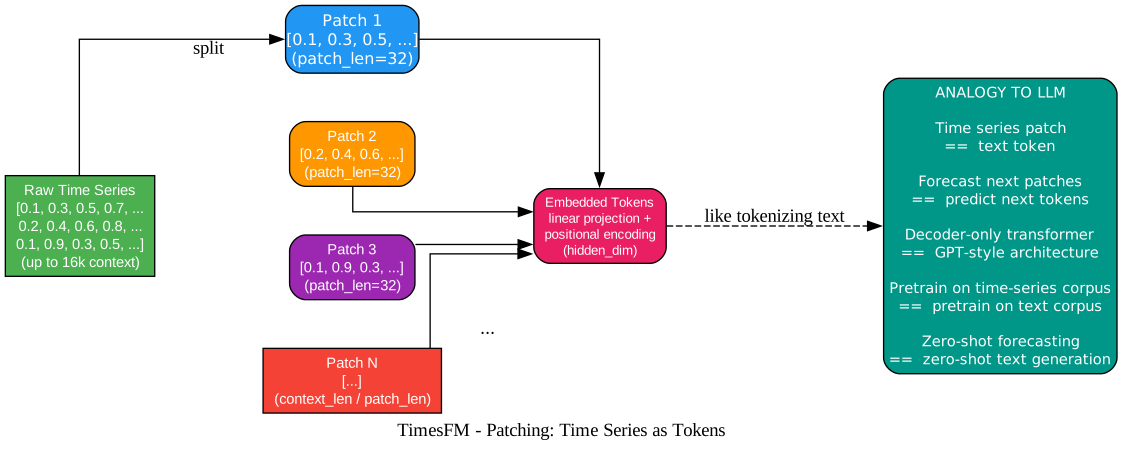
This analogy runs deep:
| LLM Concept | TimesFM Equivalent |
|---|---|
| Text token | Time-series patch (32 time steps) |
| Predict next token | Forecast next patch(es) |
| Decoder-only transformer | Same (causal self-attention) |
| Pretrain on text corpus | Pretrain on time-series corpus |
| Zero-shot text generation | Zero-shot forecasting |
| Context length (e.g. 4k tokens) | Context length (up to 16k time steps) |
The benefit: the same architectural innovations that made LLMs successful — scaling, pretraining, decoder-only generation — transfer directly to time-series forecasting.
Version Evolution: Smaller But More Capable
TimesFM has evolved through three versions, and the trajectory is counterintuitive: the latest model is smaller but more capable.
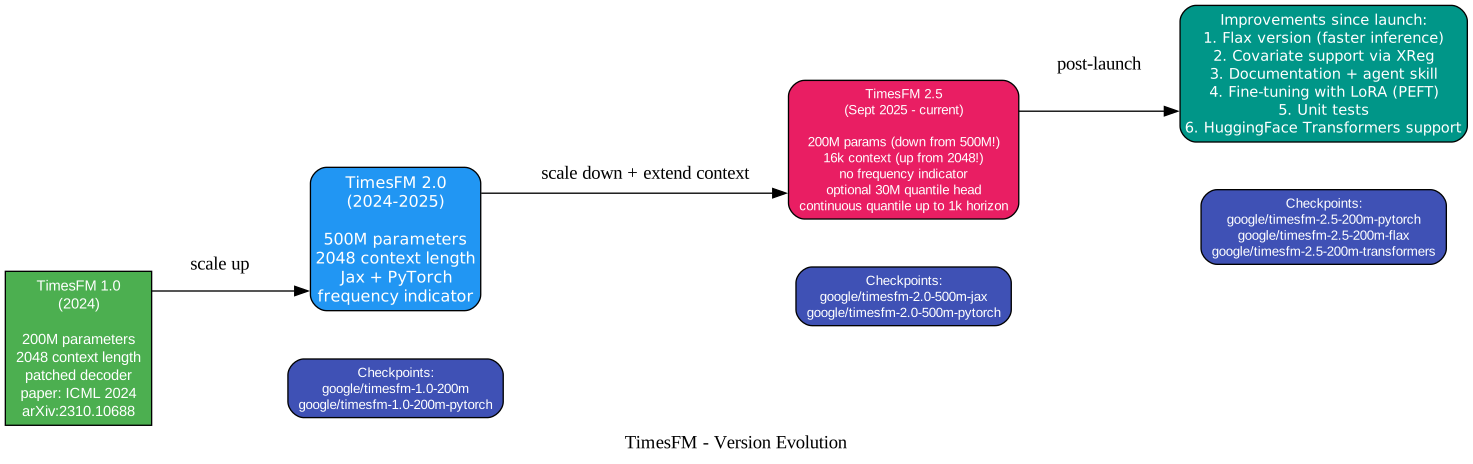
| Version | Parameters | Context Length | Key Changes |
|---|---|---|---|
| 1.0 (2024) | 200M | 2,048 | Initial patched decoder, ICML 2024 paper |
| 2.0 (2024-2025) | 500M | 2,048 | Scaled up, frequency indicator, Jax + PyTorch |
| 2.5 (Sept 2025) | 200M | 16,384 | Scaled down, 8x longer context, quantile head, no frequency indicator |
TimesFM 2.5 is the current recommended version. The reduction from 500M to 200M parameters — while simultaneously extending context from 2k to 16k — suggests that longer context matters more than raw parameter count for time-series forecasting. This aligns with the intuition that seeing more history leads to better predictions.
New in 2.5
- Continuous quantile forecast: An optional 30M quantile head produces not just point forecasts but full quantile forecasts (mean, 10th through 90th quantiles) up to a 1k-token horizon.
- No frequency indicator: The model no longer needs to be told the sampling frequency of the time series — it infers this from the data itself.
- Covariate support (XReg): External regressors can be incorporated via the XReg module (added October 2025).
- Fine-tuning with LoRA: HuggingFace Transformers + PEFT integration enables parameter-efficient fine-tuning.
- Flax version: A JAX/Flax implementation provides faster inference and TPU support.
- HuggingFace Transformers: Native integration as
google/timesfm-2.5-200m-transformers(237k downloads). - Agent skill: The repository includes an
AGENTS.mdentry point andSKILL.mdfor agent-driven forecasting workflows.
Architecture: Patched Decoder-Only Transformer
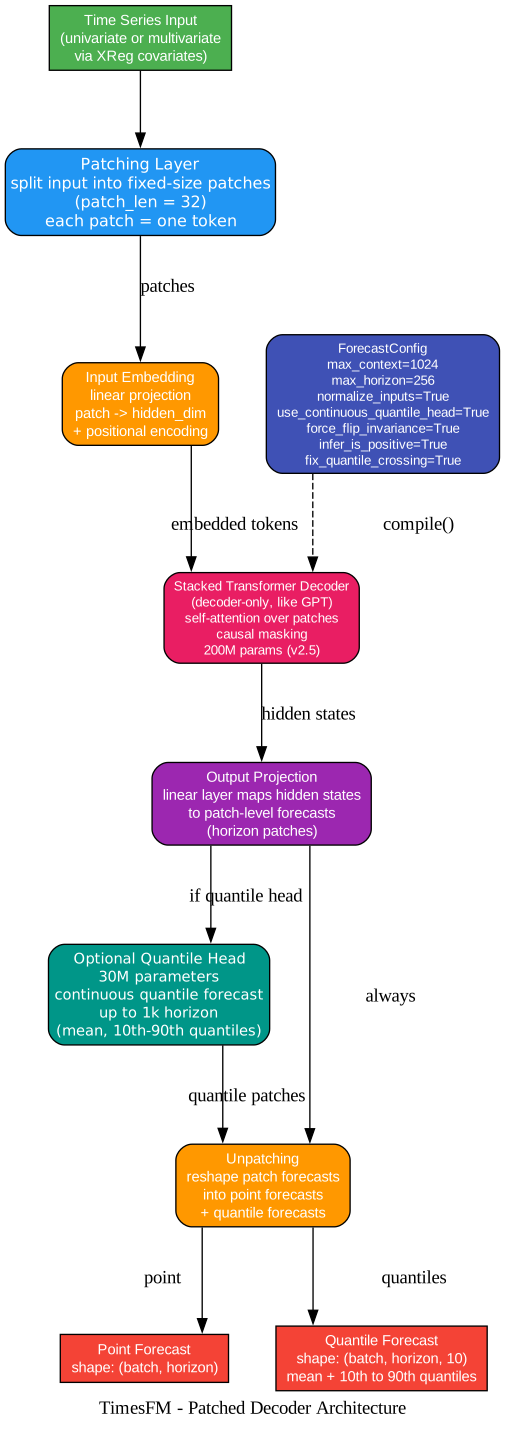
The architecture is deliberately simple and LLM-like:
- Patching layer: Split input time series into non-overlapping patches of length 32.
- Input embedding: Linear projection from patch dimension to hidden dimension, plus positional encoding.
- Stacked transformer decoder: Self-attention with causal masking over the patch sequence. 200M parameters.
- Output projection: Linear layer mapping hidden states to patch-level forecasts.
- Optional quantile head: 30M parameter head for continuous quantile forecasts.
- Unpatching: Reshape patch forecasts into point and quantile forecast arrays.
The model is compiled with a ForecastConfig that controls inference behavior:
import torch
import numpy as np
import timesfm

torch.set_float32_matmul_precision("high")

model = timesfm.TimesFM_2p5_200M_torch.from_pretrained(
    "google/timesfm-2.5-200m-pytorch"
)

model.compile(
    timesfm.ForecastConfig(
        max_context=1024,           # max history length
        max_horizon=256,            # max forecast horizon
        normalize_inputs=True,      # normalize each input series
        use_continuous_quantile_head=True,  # enable quantile forecasts
        force_flip_invariance=True,  # invariant to time reversal
        infer_is_positive=True,      # clamp negative forecasts to 0
        fix_quantile_crossing=True,  # ensure quantiles don't cross
    )
)

point_forecast, quantile_forecast = model.forecast(
    horizon=12,
    inputs=[
        np.linspace(0, 1, 100),       # series 1
        np.sin(np.linspace(0, 20, 67)),  # series 2
    ],
)

# point_forecast.shape  -> (2, 12)         batch=2, horizon=12
# quantile_forecast.shape -> (2, 12, 10)   mean + 10th to 90th quantiles
Deployment Options
TimesFM can be deployed locally or through Google’s first-party products.
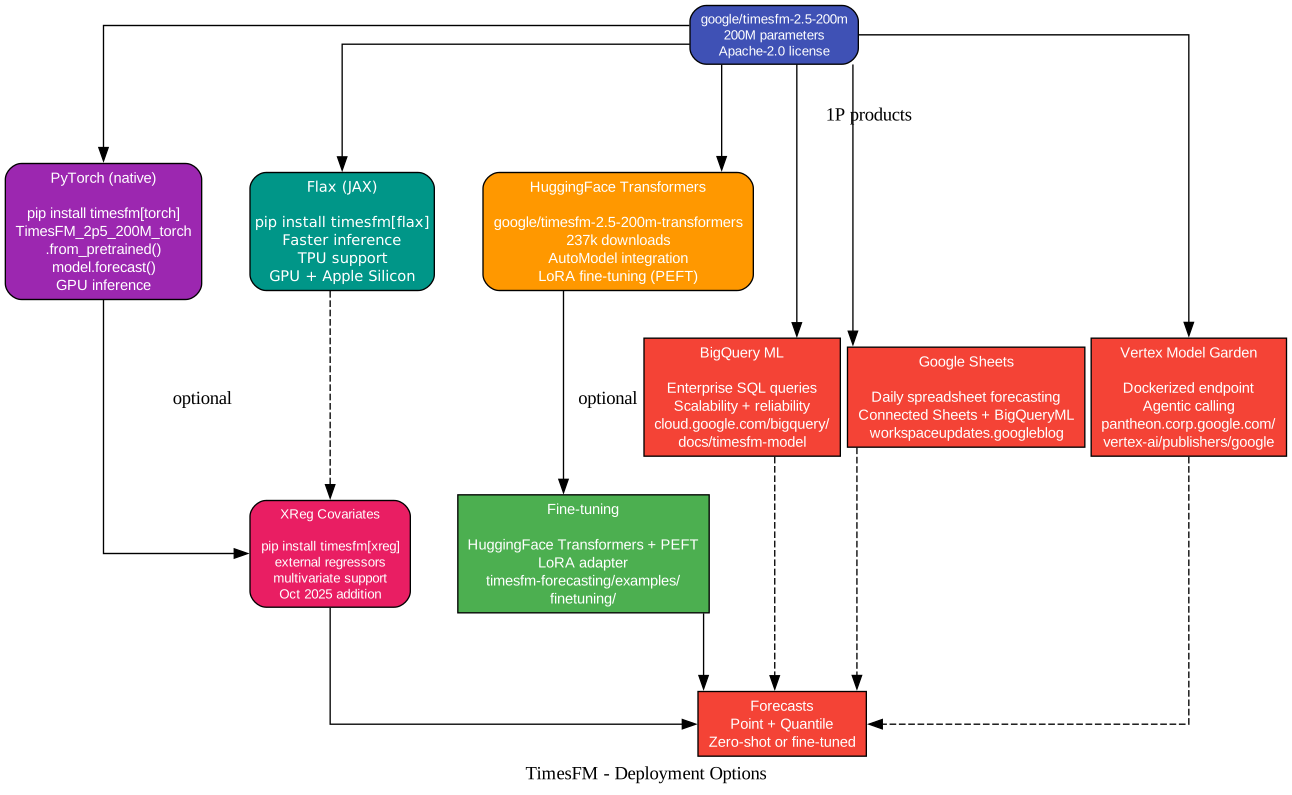
Local Deployment
Three local paths cover different use cases:
PyTorch (native) — the simplest path for GPU inference:
pip install timesfm[torch]
Flax (JAX) — faster inference, TPU and Apple Silicon support:
pip install timesfm[flax]
HuggingFace Transformers — native integration, LoRA fine-tuning, 237k downloads:
# The transformers-compatible checkpoint
# google/timesfm-2.5-200m-transformers
XReg covariates — for multivariate forecasting with external regressors:
pip install timesfm[xreg]
Google First-Party Products
TimesFM is deployed inside three Google products:
- BigQuery ML — enterprise-level SQL queries for scalability and reliability.
- Google Sheets — forecasting in your daily spreadsheet via Connected Sheets + BigQueryML.
- Vertex Model Garden — dockerized endpoint for agentic calling.
Fine-Tuning
Fine-tuning is supported via HuggingFace Transformers + PEFT (LoRA). See the timesfm-forecasting/examples/finetuning/ directory for examples.
Installation
# From PyPI
pip install timesfm[torch]       # PyTorch backend
pip install timesfm[flax]        # Flax/JAX backend
pip install timesfm[xreg]        # + covariate support

# From source (for development)
git clone https://github.com/google-research/timesfm.git
cd timesfm
uv venv
source .venv/bin/activate
uv pip install -e .[torch]
Checkpoints
| Model | Parameters | Backend | HuggingFace |
|---|---|---|---|
| TimesFM 1.0 | 200M | JAX | google/timesfm-1.0-200m |
| TimesFM 1.0 | 200M | PyTorch | google/timesfm-1.0-200m-pytorch |
| TimesFM 2.0 | 500M | JAX | google/timesfm-2.0-500m-jax |
| TimesFM 2.0 | 500M | PyTorch | google/timesfm-2.0-500m-pytorch |
| TimesFM 2.5 | 200M | PyTorch | google/timesfm-2.5-200m-pytorch |
| TimesFM 2.5 | 200M | Flax | google/timesfm-2.5-200m-flax |
| TimesFM 2.5 | 200M | Transformers | google/timesfm-2.5-200m-transformers |
Older versions (1.0, 2.0) are archived in the v1 subdirectory. To install the legacy package: pip install timesfm==1.3.0.
Key Design Decisions
Why decoder-only (not encoder-decoder)? A decoder-only architecture lets the model generate forecasts autoregressively — predicting the next patch given all previous patches. This mirrors how LLMs generate text and enables the same pretraining strategy (next-token prediction applied to patches).
Why patches instead of individual time steps? Processing individual time steps would make the sequence length impractically long. A patch length of 32 reduces the sequence length by 32x, making attention tractable while still capturing local temporal patterns within each patch.
Why scale down from 500M to 200M? Longer context (16k vs 2k) appears to matter more than parameter count for forecasting quality. A smaller model with longer context outperforms a larger model with shorter context — the same lesson the LLM community learned with context window extensions.
Why drop the frequency indicator? In v2.0, the model was told whether the data was hourly, daily, weekly, etc. In v2.5, the model infers this from the patch patterns themselves — removing a manual input and improving generality.
Why is zero-shot forecasting important? Traditional forecasting models (ARIMA, Prophet, etc.) need to be fit to each time series individually. A pretrained foundation model can forecast unseen series zero-shot — no fitting required — which matters when you have thousands or millions of time series to forecast (e.g., retail demand across all SKUs).
Further Reading
- Paper: A decoder-only foundation model for time-series forecasting (ICML 2024)
- Google Research blog post
- TimesFM HuggingFace Collection
- BigQuery ML TimesFM docs
- Google Sheets integration
- GitHub: google-research/timesfm — Apache-2.0 license
Summary
TimesFM demonstrates that the decoder-only transformer recipe from NLP transfers to time-series forecasting. By treating patches of time steps as tokens, the model can be pretrained on a large time-series corpus and then forecast unseen series zero-shot — approaching the accuracy of supervised models trained individually on each dataset. The latest v2.5 release (200M params, 16k context, quantile head, covariate support, LoRA fine-tuning) is available on PyPI, HuggingFace, and inside Google’s BigQuery ML, Sheets, and Vertex AI products. Enjoyed this post? Never miss out on future posts by following us