Why Sandboxing Matters for AI Agents
As AI agents become more capable and autonomous, they increasingly need to execute code, run scripts, and interact with external systems. This creates a fundamental challenge: how do you let an AI agent run arbitrary code without putting your infrastructure at risk?
Traditional containerization solutions like Docker are powerful but heavyweight. They take seconds to spin up, consume significant resources, and were never designed for the rapid-fire, ephemeral workloads that AI agents generate. What AI agents need is a sandbox that is instant, isolated, and lightweight.
CubeSandbox by Tencent Cloud is an open-source sandbox service built specifically to solve this problem. With over 9,000 stars on GitHub and written in Rust for maximum performance, CubeSandbox provides instant, concurrent, secure, and lightweight sandbox environments purpose-built for AI agent workloads.
Architecture Overview
CubeSandbox is designed as a modular system with clear separation of concerns. Each component handles a specific aspect of sandbox management, from API routing to network isolation.
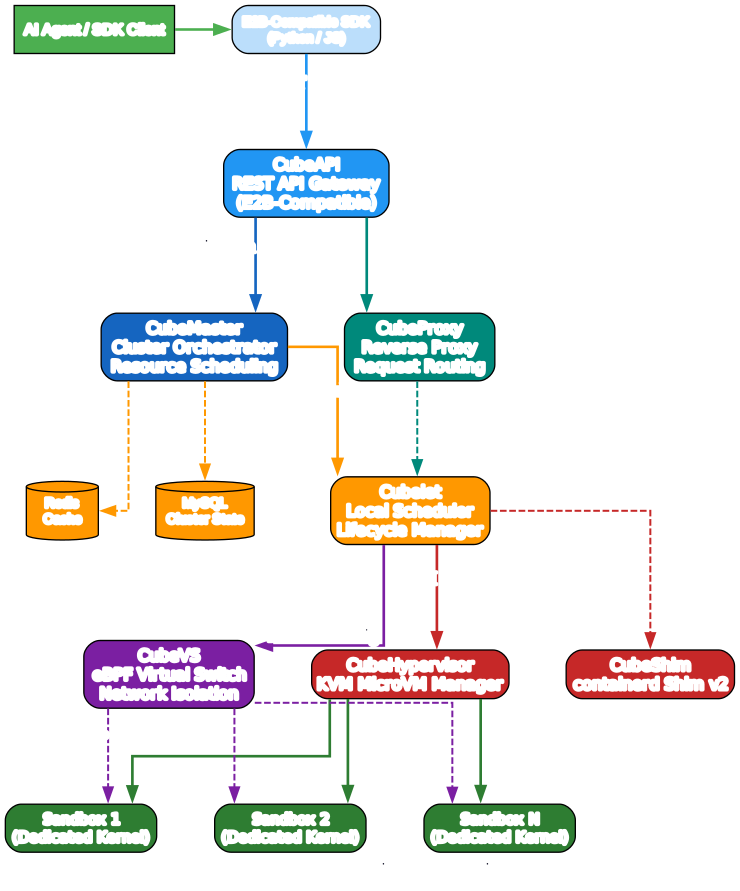
The architecture follows a clear request flow:
- AI Agent sends an API request to CubeAPI, the REST gateway
- CubeAPI dispatches the request to CubeMaster, the orchestrator
- CubeMaster schedules and manages sandbox lifecycle through Cubelet
- Cubelet creates and runs individual sandbox containers
- CubeNet provides per-sandbox network isolation
- CubeEgress controls outbound traffic from sandboxes
- CubeProxy routes requests between components
- CubeShim adapts between different container runtimes
This modular design means each component can be scaled independently, and failures in one area do not cascade to others.
Key Features
CubeSandbox delivers five core capabilities that make it ideal for AI agent sandboxing:
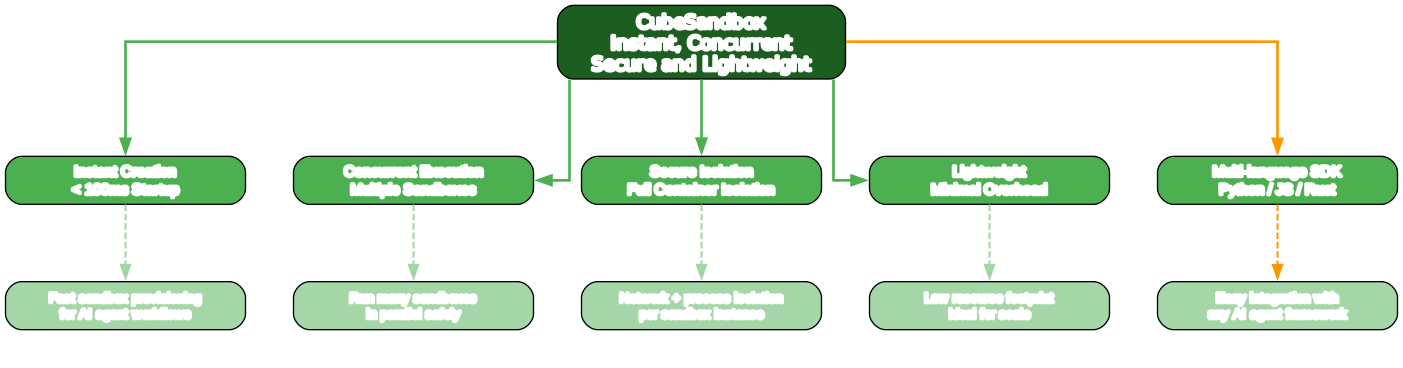
Instant Creation
CubeSandbox can create a new sandbox in under 100 milliseconds. This is critical for AI agent workflows where latency directly impacts user experience. Traditional Docker containers take seconds to start; CubeSandbox achieves near-instant provisioning through lightweight isolation techniques and pre-warmed container pools.
Concurrent Execution
AI agents often need to run multiple operations in parallel — testing code, evaluating outputs, or processing different data streams simultaneously. CubeSandbox supports true concurrent execution, allowing multiple sandboxes to run side by side with complete isolation between them.
Secure Isolation
Every sandbox is fully isolated at the process, network, and filesystem level. CubeNet creates separate network namespaces per sandbox, and CubeEgress filters all outbound traffic. This means even if an AI agent generates malicious code, it cannot escape its sandbox or affect other running instances.
Lightweight
Built in Rust, CubeSandbox has minimal resource overhead. Each sandbox consumes only the resources it needs, making it practical to run hundreds or thousands of concurrent sandboxes on a single machine. This efficiency translates directly to cost savings at scale.
Multi-language SDK
CubeSandbox provides SDKs for Python, JavaScript, and Rust, making it easy to integrate with any AI agent framework. Whether you are building with LangChain, AutoGPT, or a custom agent system, the SDK provides a clean API for creating sandboxes, executing code, and retrieving results.
Component Breakdown
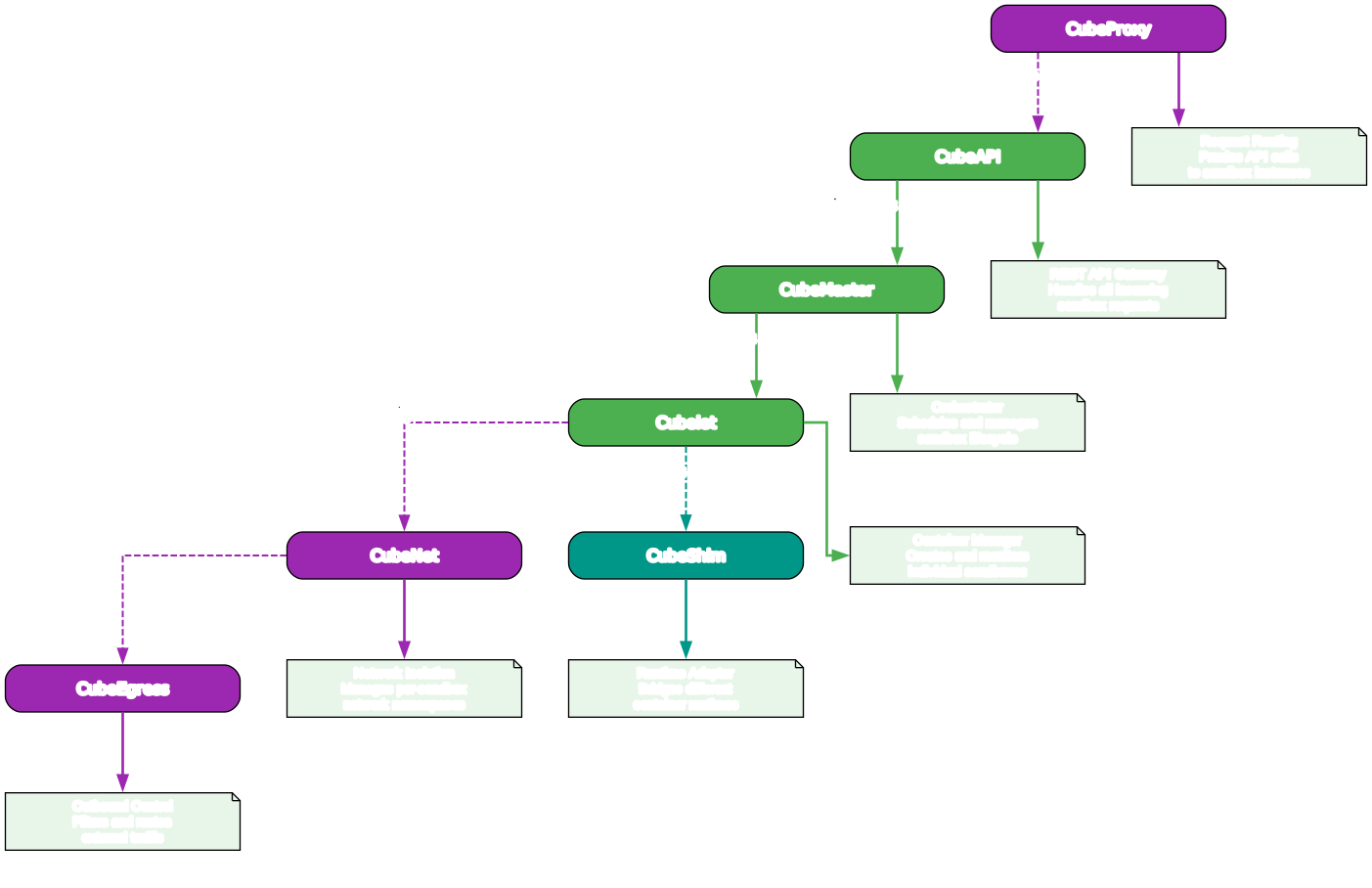
Understanding CubeSandbox’s seven components helps you configure and deploy it effectively:
| Component | Role | Description |
|---|---|---|
| CubeAPI | REST Gateway | Handles all incoming sandbox creation, execution, and management requests via a clean REST API |
| CubeMaster | Orchestrator | Schedules sandbox creation, manages lifecycle events, and coordinates between components |
| Cubelet | Container Manager | Creates, monitors, and destroys individual sandbox containers on each host |
| CubeNet | Network Isolation | Manages per-sandbox network namespaces, ensuring complete network isolation |
| CubeEgress | Outbound Control | Filters and routes external traffic from sandboxes, preventing unauthorized network access |
| CubeProxy | Request Routing | Proxies API calls to the appropriate sandbox instances for inter-component communication |
| CubeShim | Runtime Adapter | Bridges different container runtimes (runc, containerd, etc.) for flexibility |
The core components (CubeAPI, CubeMaster, Cubelet) handle the primary sandbox lifecycle, while the network components (CubeNet, CubeEgress, CubeProxy) manage isolation and routing. CubeShim provides runtime flexibility.
Getting Started
Installation
CubeSandbox can be deployed using Docker, which is the recommended approach for most users:
# Clone the repository
git clone https://github.com/TencentCloud/CubeSandbox.git
cd CubeSandbox

# Start with Docker Compose
docker compose up -d
For production deployments, you can also build from source using Cargo (Rust’s package manager):
# Build from source
cargo build --release

# Configure and run
./target/release/cube_api --config config.toml
Creating a Sandbox
Once CubeSandbox is running, creating a sandbox is straightforward using the Python SDK:
from cubesandbox import Sandbox

# Create a new sandbox
sandbox = Sandbox.create(
    language="python",
    timeout=30  # seconds
)

# Execute code in the sandbox
result = sandbox.execute("""
import json
data = {"message": "Hello from CubeSandbox!"}
print(json.dumps(data))
""")

# Access results
print(result.stdout)  # {"message": "Hello from CubeSandbox!"}
print(result.exit_code)  # 0
print(result.execution_time)  # 0.045s

# Clean up
sandbox.destroy()
REST API
You can also interact with CubeSandbox directly via its REST API:
# Create a sandbox
curl -X POST http://localhost:8080/sandbox/create \
  -H "Content-Type: application/json" \
  -d '{"language": "python", "timeout": 30}'

# Execute code
curl -X POST http://localhost:8080/sandbox/{id}/execute \
  -H "Content-Type: application/json" \
  -d '{"code": "print(\"Hello, World!\")"}'

# Destroy sandbox
curl -X DELETE http://localhost:8080/sandbox/{id}/destroy
Use Cases for AI Agent Sandboxing
CubeSandbox shines in several AI agent scenarios:
Code Generation and Testing
When an AI agent generates code, it needs a safe environment to execute and validate that code before presenting results to the user. CubeSandbox provides instant, isolated execution environments where generated code can be tested without risk.
Multi-Agent Systems
In multi-agent architectures, different agents may need to run code simultaneously. CubeSandbox’s concurrent execution model allows each agent to have its own isolated sandbox, preventing interference between agents.
Automated Code Review
AI-powered code review tools can use CubeSandbox to safely execute and analyze pull request code, run test suites, and check for security vulnerabilities — all within isolated sandboxes that cannot affect the host system.
Data Processing Pipelines
AI agents that process untrusted data (web scraping, log analysis, ETL) can use sandboxes to safely transform and analyze data without risking contamination of the host environment.
Educational Platforms
Online coding platforms and AI tutors can use CubeSandbox to give students safe, instant coding environments where they can experiment without any risk to the underlying infrastructure.
Workflow
The typical workflow for using CubeSandbox follows a clear six-step process:
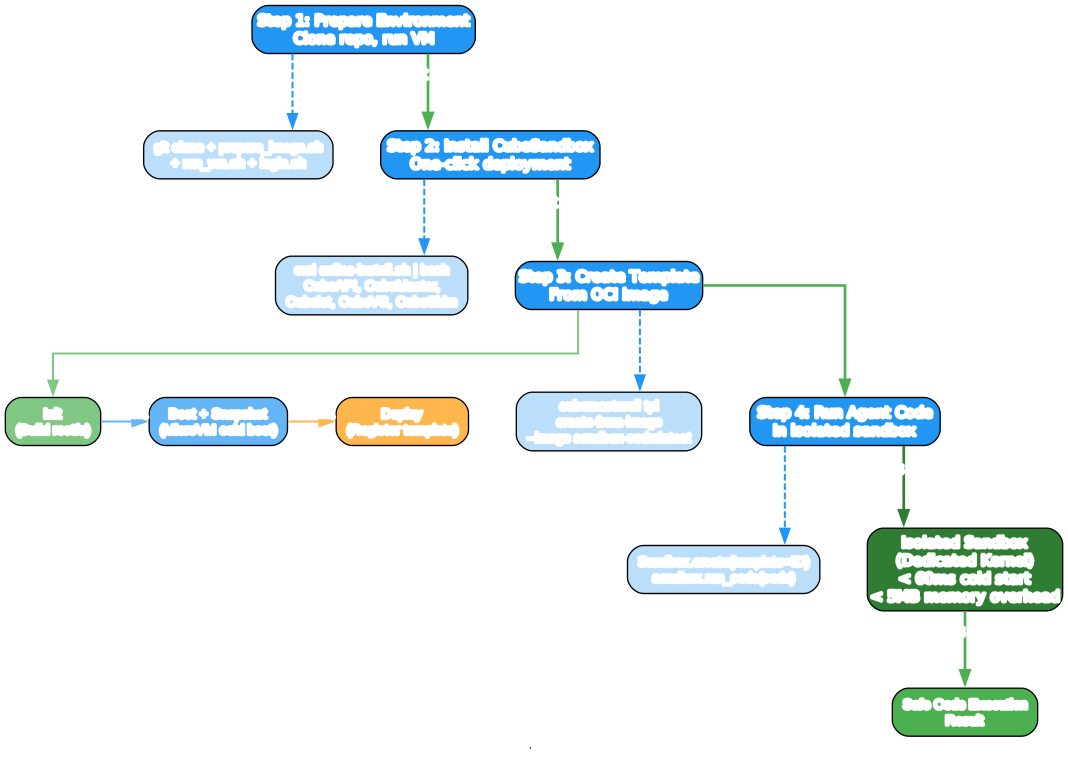
- Install — Set up CubeSandbox via Docker or build from source
- Configure — Set API ports, resource limits, and network policies
- Create Sandbox — Request a new sandbox with your desired language and timeout
- Execute Code — Send code to the sandbox for isolated execution
- Get Results — Retrieve stdout, stderr, exit codes, and timing information
- Cleanup — Destroy the sandbox and release all resources
If execution fails, the workflow loops back to step 4 for retry, ensuring resilient operation even when code produces errors.
Security Model
CubeSandbox’s security model is defense-in-depth:
- Process Isolation: Each sandbox runs in its own container with restricted process capabilities
- Network Isolation: CubeNet creates separate network namespaces, preventing sandboxes from accessing each other’s network traffic
- Egress Filtering: CubeEgress controls all outbound connections, allowing you to whitelist only necessary external services
- Resource Limits: Each sandbox has configurable CPU, memory, and timeout limits to prevent resource exhaustion
- Filesystem Isolation: Sandboxes get their own filesystem with no access to the host filesystem
This multi-layered approach ensures that even compromised sandboxes cannot escalate privileges or affect other sandboxes or the host system.
Performance
Being written in Rust gives CubeSandbox significant performance advantages:
- Sub-100ms sandbox creation — compared to seconds for traditional containers
- Minimal memory overhead — each sandbox uses only the resources it needs
- Efficient concurrency — Rust’s zero-cost abstractions enable true parallel execution
- Low latency — no garbage collection pauses or runtime overhead
These characteristics make CubeSandbox suitable for high-throughput AI agent workloads where performance and reliability are critical.
Conclusion
CubeSandbox fills a critical gap in the AI agent ecosystem by providing a purpose-built sandbox service that is instant, concurrent, secure, and lightweight. Its modular architecture, Rust-based performance, and multi-language SDKs make it an excellent choice for any team building AI agent systems that need safe, isolated code execution.
With over 9,000 GitHub stars and active development by Tencent Cloud, CubeSandbox is production-ready and well-supported. Whether you are building a code generation tool, a multi-agent system, or an educational platform, CubeSandbox provides the isolation and performance you need.
Check out the CubeSandbox GitHub repository to get started, and join the growing community of developers building safer AI agent systems. Enjoyed this post? Never miss out on future posts by following us 


