Introduction
English Level Up Tips is a 54,000-star open-source repository that began as a focused English learning tutorial and gradually evolved into something far broader: a “life level-up guide” that weaves together language acquisition, AI-assisted learning methodology, and a deeply personal recovery story. The repository is maintained by a developer who writes under the handle byoungd, and it has grown over several years from a single answer to a friend’s question into a multi-chapter bilingual reference used by readers across the world.
The origin story is simple and human. In July 2017, someone named W. asked the author a straightforward question: “How do I learn English efficiently?” Rather than give a throwaway answer, the author started writing, and the writing never really stopped. What began as a reply became a blog post, then a Zhihu article, then a GitHub repository, and finally a living notebook that the author continues to update as new tools, new failures, and new lessons arrive.
The guide delivers three pillars that are rarely found together in a single resource. First, it offers an executable English learning system: seven chapters that move from mindset calibration through vocabulary, listening, reading, speaking, and writing, and end with AI-assisted English practice. Second, it provides a practical AI learning methodology: a seven-step loop that can be applied to any skill, not just language, with concrete scenario templates for programming, writing, exams, industry research, and work output. Third, it includes a personal recovery case study: the author’s own journey from front-end developer to general manager, through the collapse of a software company and a hot spring resort investment, and back to writing and building again.
The repository is released under the Creative Commons Attribution-NonCommercial 4.0 International license (CC BY-NC 4.0). The author explicitly refuses all monetary donations and sponsorship, asking readers who find the guide valuable to buy a book or support a cause instead. The guide is available in both Chinese (the primary language, written natively) and English (a translation maintained alongside the original). This bilingual approach makes it accessible to a wide audience while preserving the author’s authentic voice in the source text.
The English Learning Path
The English learning path is the backbone of the guide, structured as seven chapters that follow a deliberate sequence: Understanding, Vocabulary, Listening, Reading, Speaking, Writing, and AI-Assisted English. The order is not accidental. The author argues that most learners fail not because they lack materials, but because they skip the foundational work of calibrating their mindset and environment before touching any textbook.
The Understanding chapter comes first because the author learned this lesson the hard way. In high school, he pushed himself too hard, burned out, and stopped studying English for years. The chapter covers mindset calibration, Edgar Dale’s Cone of Learning (the learning pyramid), the importance of setting realistic goals, understanding your own emotional relationship with learning, and creating an immersive English environment without forcing it. The core message is that sustainable progress beats heroic bursts.
The Vocabulary chapter introduces the 7000-word watershed, a concept derived from Oxford English Corpus data. The data shows that knowing the most frequent 1,000 words yields approximately 75% comprehension of everyday English text, 3,000 words yields around 80%, and 7,000 words pushes comprehension to roughly 90%. Beyond 7,000 words, the returns diminish and the learning strategy shifts from memorization to context-based acquisition. The chapter also distinguishes between visual learners (who remember through reading and writing) and auditory learners (who remember through listening and speaking), and offers two memorization strategies: daily moderate intake and bulk input followed by consolidation.
The Listening chapter separates intensive listening (transcription, repetition, shadowing) from extensive listening (audiobooks, podcasts, movies as background). It identifies common pitfalls: scattered materials, above-level materials that cause frustration, subtitle dependency that prevents real comprehension, disinterest in the content, and passive listening without engagement. Recommended materials include New Concept English, graded audiobooks, and podcasts matched to the learner’s level.
The Reading chapter mirrors the listening structure with intensive reading (close analysis of short texts) and extensive reading (volume-based consumption of longer texts). The guide recommends six English books graded by difficulty: Animal Farm by George Orwell, The Curious Incident of the Dog in the Night-Time by Mark Haddon, The Diary of a Young Girl by Anne Frank, the Harry Potter series by J.K. Rowling, The Kite Runner by Khaled Hosseini, and On Writing Well by William Zinsser. The chapter also covers reading English technical documentation as a practical bridge between language learning and professional work.
The Speaking chapter builds from phonetics. The author provides Chinese phonetic analogies for each English vowel and consonant, helping Chinese-speaking learners map unfamiliar sounds to familiar ones. The chapter then moves to reading aloud as a daily practice and finally to real conversation, whether with language partners, tutors, or AI voice assistants.
The Writing chapter treats reading as the foundation of writing. You cannot write well in a language you do not read in. The chapter covers practice methods, feedback exchange with peers and tools, and the cautious use of AI writing assistants. The author warns against using AI to generate clickbait or to outsource thinking, advocating instead for using AI as a feedback partner that corrects, suggests, and challenges.
The final chapter, AI-Assisted English, transforms AI from a translator into a training partner. The guide recommends Gemini as the primary English learning engine, using Gemini Live for speaking practice, Canvas for writing, Guided Learning for reading, Gems for custom course setup, and built-in quizzes and flashcards for review. The chapter is not a tool advertisement but a workflow description: how to configure AI tools so that they push you to produce, not just consume.

The roadmap above visualizes the complete seven-chapter journey as four phases flowing left to right. Phase 1, the Starting Point, groups Understanding and Vocabulary together because the guide insists that mindset calibration and vocabulary foundation must precede any skill work. The author’s own experience of burning out in high school informs this ordering: he tried to skip ahead to listening and speaking without a vocabulary base, failed, and quit for years. The 7000-word watershed concept from the Oxford English Corpus anchors the Vocabulary node, giving learners a concrete, measurable target rather than a vague aspiration.
Phase 2, Input, contains Listening and Reading. These are the intake channels through which language enters the learner’s system. The guide distinguishes intensive from extensive practice in both channels, and the roadmap reflects this by placing them as parallel nodes within the same phase. The Listening node highlights subtitle weaning as a specific sub-skill, because subtitle dependency is the most common reason learners plateau at an intermediate level. The Reading node references the six recommended books and English documentation reading, bridging from fiction to technical text.
Phase 3, Output, contains Speaking and Writing. The guide treats output as the differentiator between passive recognition and active mastery. The Speaking node emphasizes phonetics as the foundation, because pronunciation errors fossilize quickly if not addressed early. The Writing node references reading as its foundation, reinforcing the guide’s principle that input quality determines output quality. The feedback loop in the diagram, shown as dashed arrows from the AI-Assisted English node back to Listening and Speaking, captures the guide’s argument that AI does not replace earlier phases but enhances them. A learner who has built a vocabulary base and practiced listening can use Gemini Live to multiply speaking practice, and can use AI-guided reading to encounter vocabulary in richer contexts.
Phase 4, AI Integration, is deliberately placed at the end, not the beginning. The guide warns against the temptation to start with AI tools before building a foundation, because AI can mask a lack of underlying skill with fluent-sounding output that the learner cannot actually reproduce independently. The AI-Assisted English node lists Gemini Live, Canvas, Guided Learning, and quizzes or flashcards as the specific sub-capabilities that the guide recommends. The feedback arrows from this node back to Listening and Speaking illustrate the cyclical nature of the path: AI-assisted training sends the learner back to earlier phases with higher expectations and richer materials.
The key insight the roadmap conveys is that the path is not linear but cyclical. Learners return to the Understanding chapter as their level advances, finding new depth in mindset calibration each time. They return to Vocabulary with context-based acquisition after passing the 7000-word mark. They return to Listening with materials that would have been inaccessible at their previous level. The guide recommends choosing one phase based on your current bottleneck rather than reading sequentially, because most learners do not need all seven chapters at once.
The 7-Step AI Learning Loop
The guide’s most transferable contribution is not its English advice but its AI learning methodology. The core philosophy is stated plainly: “Configure AI as a learning system, not an answer machine.” This distinction separates learners who use AI to grow from learners who use AI to avoid effort. An answer machine gives you the output you want. A learning system forces you to produce the output yourself, then corrects, reviews, and extends it.
The methodology is structured as a seven-step loop that can be applied to any skill, not just language learning.
Step 1: Define Goal. The guide breaks any learning target into four dimensions: outcome (what you want to produce), scenario (where you will use it), time (how long you have), and evidence (how you will know you succeeded). “I want to learn programming” is too vague. “I want to build a CLI tool that renames files in bulk, within two weeks, and I will know I succeeded when I can run it on my own machine” is a defined goal.
Step 2: Organize Materials. The learner feeds AI specific materials: book chapters, papers, video transcripts, code, exam questions, or real business problems. The guide offers a key prompt for this step: “Don’t rush to summarize. First tell me what this material can and cannot solve.” This prompt forces AI to map the material’s boundaries before consuming it, preventing the illusion that one resource covers everything.
Step 3: Step-by-Step Explanation. The learner requires AI to teach in layers: a one-sentence summary, an analogy, a professional definition, and a real case. After each layer, the learner answers a check question before proceeding. This layered approach prevents the common failure mode where AI delivers a dense explanation that feels comprehensive but leaves no durable understanding.
Step 4: Force Output. The guide states bluntly: “Without output, learning stays in illusion.” Output types include summaries, problem solutions, code, presentations, process designs, recordings, and teaching others. The act of producing output reveals gaps that passive consumption hides.
Step 5: Correct Mistakes. The principle is “fix less, fix the important.” AI should identify only the top three issues, with reasons, suggestions, and mini re-do exercises. Correcting everything at once overwhelms the learner and dilutes focus. Three issues, addressed thoroughly, produce more growth than twenty issues glanced at.
Step 6: Spaced Review. The guide reminds learners that “understanding today does not mean you can use it in three days.” Spaced review uses flashcards, application problems, and weekly review checklists to combat the forgetting curve. AI can generate review materials automatically from the learning history.
Step 7: Project Delivery. The final step transforms “I read a lot” into “I actually made something.” The guide recommends turning learning into a two-week project with deliverables, milestones, and acceptance criteria. A project forces integration of all previous steps and produces tangible evidence of growth.
The guide also provides five high-value scenario templates that apply this loop to specific domains. The Programming template reframes the goal from “learn syntax” to “build tools.” The Writing template trains judgment rather than outsourcing thinking. The Exams template builds an error-cause system rather than drilling questions. The Industry Research template builds a judgment framework rather than collecting links. The Work Output template co-creates deliverables rather than generating them wholesale.
A one-week minimal execution template makes the loop concrete: Monday for goal definition, Tuesday for material organization, Wednesday for output, Thursday for correction, Friday for transfer, and the weekend for review. The guide also sets risk boundaries: do not fully delegate fact-checking to AI, protect privacy by not feeding sensitive data, maintain academic integrity by not submitting AI-generated work as your own, and annotate source dates because AI training data has a cutoff.
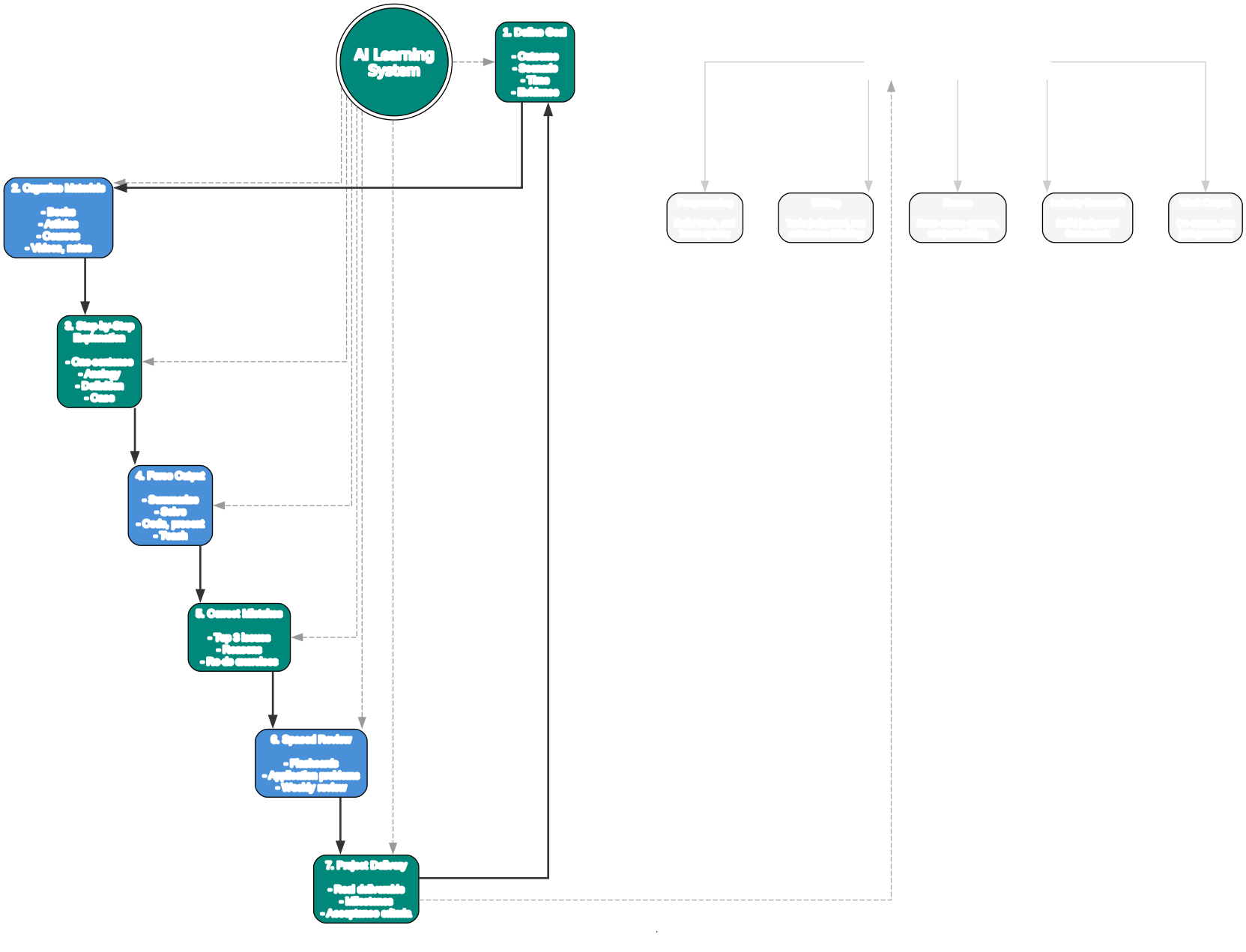
The diagram above renders the seven-step loop as a circular flow with a central hub labeled “AI Learning System.” The hub represents the configuration layer: AI is not a step in the loop but the system that powers every step. Dashed lines radiate from the hub to each step, indicating that AI participates in goal definition (by asking clarifying questions), material organization (by mapping what sources can and cannot solve), explanation (by teaching in layers), output (by providing prompts and constraints), correction (by identifying the top three issues), review (by generating flashcards), and delivery (by helping define milestones and acceptance criteria).
The seven step nodes alternate between teal and blue, but the color alternation is visual, not semantic. Every step carries equal weight in the loop, and skipping any step breaks the cycle. The circular arrows connecting step one through step seven and back to step one emphasize that the loop is not a one-time sequence but a recurring practice. A learner who completes the loop for one goal begins again for the next, with a higher baseline and richer materials.
Below the circle, five scenario template boxes represent the high-value applications: Programming, Writing, Exams, Industry Research, and Work Output. These boxes are rendered in light gray to signal that they are templates, not steps. A learner picks one template, applies the seven-step loop within it, and produces a deliverable. The guide’s scenario templates are pre-configured: the Programming template specifies “build tools, not learn syntax,” the Writing template specifies “train judgment, not outsource thinking,” and so on. These specifications prevent the most common failure mode in each domain.
The dashed connection from step seven (Project Delivery) to the scenario section shows where the templates plug in. A project delivery that produces a real artifact is the bridge between the abstract loop and a concrete domain. The guide argues that without this bridge, the loop remains theoretical. With it, the loop becomes a repeatable engine for skill acquisition across any field.
The key insight the diagram conveys is the guide’s central claim: “AI will not automatically make a person stronger. It only amplifies your learning method.” A learner with no method gets amplified noise. A learner with a method gets amplified growth. The seven-step loop is the method, and the five scenario templates are the domains where the method proves itself.
The Tools and Resources Ecosystem
One of the most common questions the guide receives is “which AI tool should I use?” The guide’s answer is division of labor, not picking one winner. Different tools have different strengths, and the guide maps them to specific learning tasks rather than ranking them overall.
Gemini serves as the primary English learning engine. The guide recommends Gemini because of its integrated learning chain: Gemini Live for speaking practice, Canvas for writing, Gems for custom course setup, Guided Learning for reading with AI-generated explanations, and native quiz, flashcard, and study guide generation. The Guided Learning feature, released in August 2025, allows learners to read any text with AI-generated explanations at each step, making it particularly suited for extensive reading practice.
ChatGPT plays a complementary role. Its Study Mode supports step-by-step concept learning, and its Projects feature allows long-term accumulation of errors, sample outputs, and expression libraries. The guide recommends ChatGPT for learners who want to build a persistent context across multiple learning sessions.
Claude is recommended for long-form reading, writing feedback, and large material processing. Its Projects feature with retrieval-augmented generation (RAG) allows learners to upload large material sets and query them with source-grounded responses. The guide positions Claude as the tool for deep, sustained work on complex texts.
NotebookLM is the source-grounded learning tool. By constraining AI to uploaded materials, it reduces hallucination and forces responses to cite specific sources. The guide recommends NotebookLM for learners who want to study a fixed set of materials (a textbook, a course, a paper collection) without AI drifting to unrelated content.
Perplexity handles web research and material filtering. The guide uses Perplexity to find latest sources, compare viewpoints, and build reading lists. Its Spaces feature allows organizing research into persistent collections.
DeepL Write is reserved for final polish only. The guide explicitly warns against using DeepL Write for initial drafting, because it optimizes for naturalness at the cost of the learner’s own voice. It is recommended for emails, applications, resumes, and public-facing content where polish matters more than authenticity.
The guide also provides a word lists ecosystem: ten curated vocabulary lists covering Common English and eight programming languages (Go, Java, JavaScript, PHP, Python, Swift, Rust) plus a Vibe Coding list. These lists are designed for developers who need domain-specific vocabulary and want to learn English in the context of their professional work rather than through generic word lists.
The author’s own AI products appear in the ecosystem as well. token.love is an AI gateway designed for developers and enterprises, providing access to multiple AI models through a unified interface. ku0.com is an AI resource library that curates tools, prompts, and learning materials. These products are mentioned not as advertisements but as context for the author’s perspective: he builds AI tools professionally, and his recommendations come from daily use, not from reading documentation.
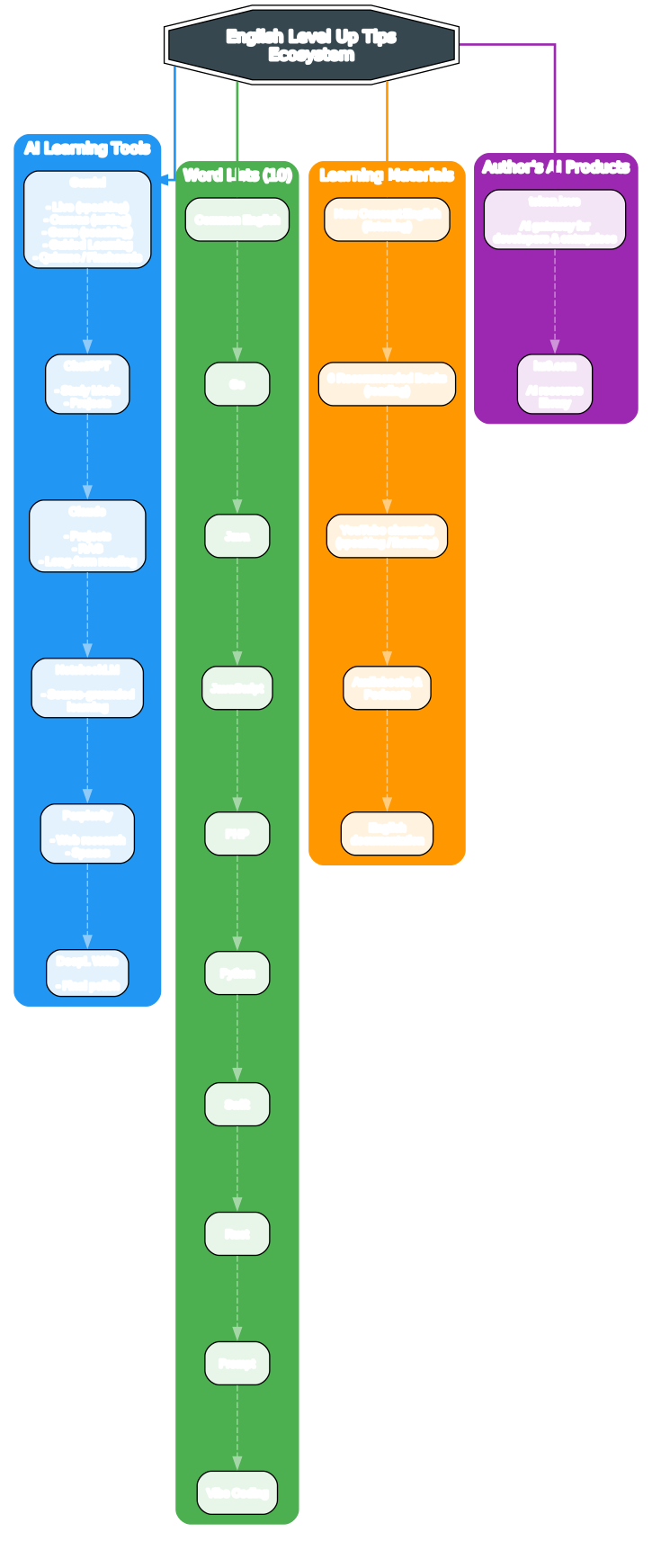
The diagram above maps the ecosystem as a hub-and-spoke layout with four color-coded clusters radiating from a central hub labeled “English Level Up Tips Ecosystem.” The hub, rendered in dark slate, represents the guide itself as the organizing framework that connects tools, materials, and products into a coherent system rather than a list of recommendations.
The top cluster, AI Learning Tools, is rendered in blue and contains six tools: Gemini, ChatGPT, Claude, NotebookLM, Perplexity, and DeepL Write. The internal chain within this cluster, shown as dashed blue lines, represents the guide’s recommended workflow: Gemini as the primary engine, ChatGPT for step-by-step learning and project accumulation, Claude for long-form reading and writing, NotebookLM for source-grounded study, Perplexity for web research, and DeepL Write for final polish. The chain is not a ranking but a sequence: each tool handles a task type that the others handle less well.
The bottom-left cluster, Word Lists, is rendered in green and contains ten vocabulary lists. The internal chain connects Common English through the eight programming language lists (Go, Java, JavaScript, PHP, Python, Swift, Rust) to Prompt and Vibe Coding. This chain represents the guide’s approach to vocabulary for developers: start with common English, then add domain-specific lists based on your working languages, and finally add the Prompt and Vibe Coding lists for AI-era development vocabulary.
The bottom-right cluster, Learning Materials, is rendered in orange and contains five material types: New Concept English for listening, six recommended books for reading, YouTube channels for speaking and listening, audiobooks and podcasts for extensive listening, and English documentation for technical reading. The internal chain connects these materials in a sequence that mirrors the learning path: listening materials first, then reading materials, then speaking materials, then extensive listening, then technical reading.
The right cluster, Author’s AI Products, is rendered in purple and contains token.love and ku0.com. This cluster is separated from the others because these are the author’s own products, not independent recommendations. The dashed connection between them indicates that they are complementary: token.love provides the gateway, ku0.com provides the library.
The key insight the diagram conveys is the guide’s answer to the tool-selection question: “Don’t waste time on which tool is best. Divide labor by task type.” The ecosystem is not a competition but a workshop, where each tool has a station and a job. A learner who tries to use one tool for everything will hit its limitations quickly. A learner who divides labor across tools will find that the combination is more capable than any single tool.
CEFR Levels and Progress Milestones
The guide references the Common European Framework of Reference for Languages (CEFR), the international standard developed by the Council of Europe, to give learners an external benchmark for their progress. The CEFR defines six levels: A1 (Breakthrough), A2 (Waystage), B1 (Threshold), B2 (Vantage), C1 (Effective Operational Proficiency), and C2 (Mastery).
The guide maps its own learning path to these levels. The A1-A2 range corresponds to the guide’s vocabulary building phase (1,000 to 3,000 words), basic listening, and phonetics work. The B1-B2 range corresponds to extensive reading, intensive listening, speaking practice, and writing fundamentals, with vocabulary approaching the 7,000-word mark. The C1-C2 range corresponds to AI-assisted training, professional English, exam preparation, and workplace communication.
The vocabulary milestones are drawn from Oxford English Corpus data. At 1,000 words, a learner can comprehend approximately 75% of everyday English text. At 3,000 words, comprehension rises to around 80%. At 7,000 words, comprehension reaches approximately 90%, and this is the key watershed: beyond 7,000 words, the strategy shifts from memorization to context-based acquisition, because the remaining vocabulary appears in increasingly specific contexts that are better learned through reading and use than through lists.
The guide recommends a concrete first goal: 40 words per day for 175 days to reach 7,000 words. This is not a heroic target. It is deliberately moderate, because the guide’s philosophy is that sustainable effort beats intensity. A learner who memorizes 40 words daily for six months builds a foundation that supports all subsequent work.
Alongside the language progression, the guide describes a parallel life level-up map with five steps: Open Input, Train Output, Create Artifacts, Review Life, and Serve Reality. Open Input means using English to connect to a wider information world, expanding what you can notice and access. Train Output means turning “I understand” into “I can explain, build, and communicate.” Create Artifacts means transforming learning into articles, projects, reports, and products, not leaving it in saved links. Review Life means placing failure, health, and choices on one timeline and learning from the pattern. Serve Reality means using your abilities in real work, entrepreneurship, family, and community.
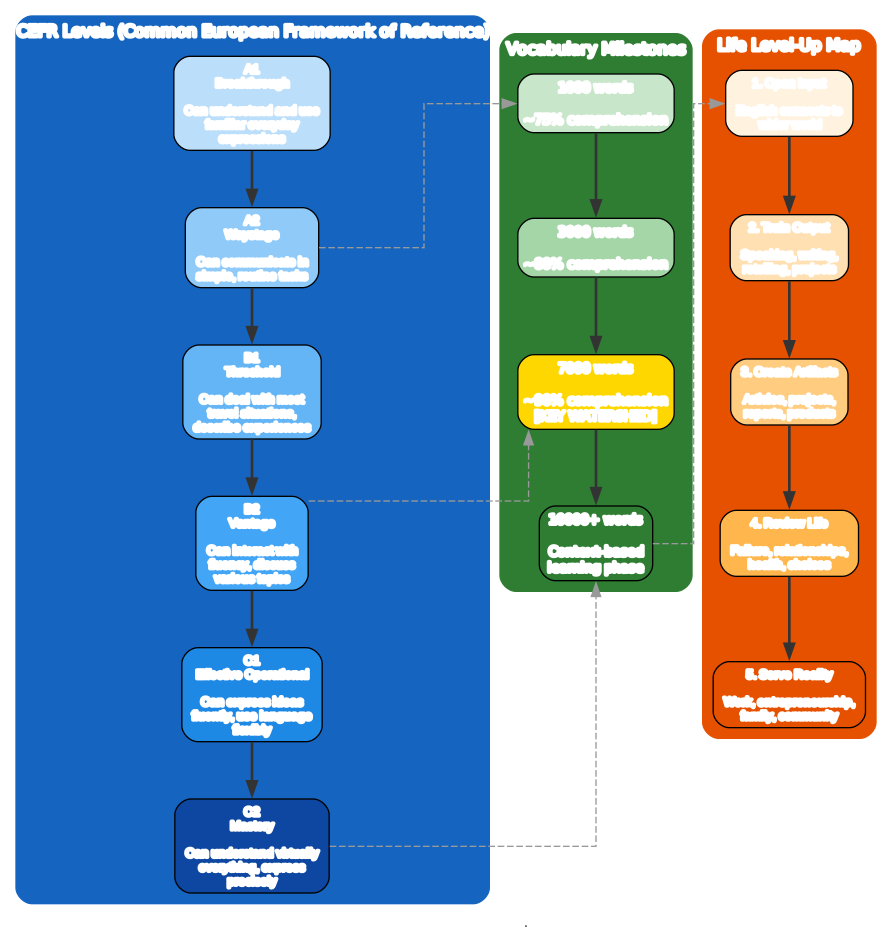
The diagram above organizes the three progress systems as three horizontal bands stacked vertically. The top band, CEFR Levels, shows the six levels from A1 to C2 with a color gradient from light blue to deep blue. The gradient is not decorative: it represents increasing proficiency, with each level building on the previous one. The sequential arrows between levels indicate that progression is cumulative, not substitutive. A B2 learner does not forget A1 skills; they build on them. The descriptions under each level are condensed from the Council of Europe’s official can-do statements, giving learners a concrete sense of what each level means in practice.
The middle band, Vocabulary Milestones, shows four markers with a color gradient from light green to dark green, with the 7,000-word marker highlighted in gold. The gold highlight is the guide’s most important visual signal: 7,000 words is the watershed where comprehension crosses 90% and the learning strategy changes. Before 7,000 words, the strategy is memorization. After 7,000 words, the strategy is context-based acquisition through reading and use. The dashed vertical lines connecting the CEFR band to the vocabulary band show the mapping: A1-A2 aligns with 1,000 to 3,000 words, B1-B2 aligns with the 7,000-word watershed, and C1-C2 aligns with 10,000+ words and context-based learning.
The bottom band, the Life Level-Up Map, shows five steps with a warm gradient from light amber to deep amber. The sequential arrows indicate that these steps are progressive, like the CEFR levels. Open Input leads to Train Output, which leads to Create Artifacts, which leads to Review Life, which leads to Serve Reality. The dashed connection from the vocabulary band to the life band indicates that language proficiency and life progression are parallel systems: they influence each other but do not depend on each other linearly. A learner can be at C1 in English and still be at step one in the life map, or vice versa.
The key insight the diagram conveys is that the guide maps language proficiency to life progression, and both require consistent, sustainable effort rather than heroic bursts. The 40-words-per-day recommendation is not a minimum; it is a sustainable pace. The five-step life map is not a checklist; it is a progression that takes years. The guide’s argument is that the same discipline that builds vocabulary builds a life: small, daily, compounding effort that eventually crosses a watershed and changes what is possible.
The Personal Story: Recovery and Entrepreneurship
The guide includes a personal narrative that is unusual in an open-source technical repository. The author started as a front-end developer in 2017, the same year W. asked the English question that started this project. Over the following years, he rose to general manager and partner at a company, and he spent 20 million RMB acquiring a software company that ultimately failed. The love story is woven through this: he met W., the same person who asked the English question, married her, and they had a child.
The downfall came when he expanded beyond software into hot spring resort hotels. The investment suffered heavy losses, his health collapsed under the pressure, and he found himself starting over. The recovery began with writing. He returned to the English-level-up-tips repository, rebuilt his practice through the act of documenting what he had learned, and started new AI companies: token.love as an AI gateway and ku0.com as an AI resource library.
The guide states its philosophy plainly: “This guide does not sell anxiety or promise shortcuts.” There are no claims of rapid mastery, no testimonials of overnight success, no upsells to premium courses. The author refuses all monetary sponsorship and donations, asking readers who find the guide valuable to buy a book or support a cause instead. In June 2026, the author visited Alibaba Cloud headquarters as chairman of China Token Cloud Computing Co., Ltd., a detail that grounds the recovery story in a specific, verifiable context rather than vague claims of bouncing back.
The personal story matters because it models the guide’s own advice. The seven-step AI learning loop, the sustainable vocabulary pace, the life level-up map: these are not abstract recommendations from someone who has never failed. They are the methods the author used to rebuild after failure, and the guide is the artifact of that rebuilding.
How to Use This Guide
The guide offers three reading paths for different goals. The English learning path starts with the Understanding and Vocabulary chapters, uses Listening and Reading for input, and uses Speaking and Writing for output. The AI learning path starts with the “Learning Anything with AI” chapter, then moves to “Learning English with AI” for the specific workflow. The Personal recovery path reads the author’s story, the entrepreneurship chapter, and the old blog archive.
The guide also describes four usage modes. The first pass means choosing one path and reading it through. The goal-based lookup means using chapters as a toolbox, consulting specific sections when a concrete need arises. The weekly execution means setting one goal per week and working through the relevant chapter. The periodic review means returning to the guide after weeks or months to reassess your progress and adjust your plan.
The fastest start, the guide says, is to read the Understanding chapter, choose one concrete goal, and use the AI learning chapter to design a one-week plan. This takes roughly two hours of reading and planning, and it produces a actionable schedule rather than a vague intention. The guide’s design is optimized for this entry point: enough structure to start, enough flexibility to adapt.
Key Features Summary
| Feature | Description |
|---|---|
| 7-Chapter English Path | Mindset to AI-assisted mastery, covering Understanding, Vocabulary, Listening, Reading, Speaking, Writing, and AI-Assisted English |
| 7-Step AI Learning Loop | Goal to project delivery system with five high-value scenario templates for programming, writing, exams, industry research, and work output |
| 10 Word Lists | Common English plus eight programming languages (Go, Java, JavaScript, PHP, Python, Swift, Rust) and Vibe Coding |
| CEFR Mapping | Progress tracking against the international CEFR standard from A1 to C2, with vocabulary milestones from 1,000 to 10,000+ words |
| Personal Recovery Story | Real case study of entrepreneurial failure, health collapse, and rebuilding through writing and AI companies |
| Bilingual | Chinese as the primary language with an English translation maintained alongside |
| Open Source | CC BY-NC 4.0 license, no donations accepted, readers asked to buy books or support causes instead |
Conclusion and Links
English Level Up Tips is not a one-time article. It is a living notebook that grows with the author’s experience and the tools he uses. The repository has been updated over years, and the personal story within it is still being written. The guide’s core message is worth repeating because it applies beyond language learning: “AI will not automatically make a person stronger. It only amplifies your learning method.” A learner with no method gets amplified noise. A learner with a method gets amplified growth. The seven-step loop, the vocabulary milestones, the CEFR mapping, and the life level-up map are the method. The tools are the amplifier. The guide is the instruction manual for connecting them.
Links
- GitHub repository: https://github.com/byoungd/English-level-up-tips
- GitHub Pages (online reading): https://byoungd.github.io/up/#/
- Zhihu article: https://zhuanlan.zhihu.com/p/444211376
- License (CC BY-NC 4.0): https://creativecommons.org/licenses/by-nc/4.0/

Enjoyed this post? Never miss out on future posts by following us


