What Is Turso
Turso describes itself as “The Database for the Age of AI Agents” and, in the same breath, “Millions of Databases. One Architecture.” Both taglines capture the same idea: Turso is an in-process SQL database engine written from scratch in Rust, compatible with SQLite, and designed to run wherever your application runs – on a server, in a browser tab, on a mobile device, or at the edge.
The project lives at github.com/tursodatabase/turso and has attracted significant community traction. At the time of writing, the repository has over 20,796 stars, 9,205 forks, 256 contributors, and 18,145 commits. It is released under the MIT license, making it freely usable in both open-source and commercial projects.
The core value proposition is straightforward: Turso is an embedded database that runs in-process with your application. There is no separate server process to install, configure, or network to. The database is a library linked into your program, reading and writing local files. This eliminates network round-trips entirely for local workloads.
Turso is offered as a dual product. The open-source engine can be embedded in any application at no cost. Turso Cloud provides a managed service layer on top of the engine, adding multi-region replication, copy-on-write database branching, built-in analytics, and an always-on architecture with no cold starts. You can learn more about the product on the Turso website and the What is Turso page.
Why a Rust Rewrite of SQLite
SQLite is the most widely deployed database in the world. It runs on every mobile phone, every web browser, and countless embedded devices. But SQLite was written in C, and its architecture reflects design constraints from the 2000s. It is remarkably stable and battle-tested, but it carries inherent limitations that matter more today than they did two decades ago.
Turso is not a fork of SQLite. It is a ground-up rewrite in Rust that maintains SQL compatibility with SQLite while rethinking the internal architecture from first principles. The choice of Rust is deliberate: Rust provides memory safety without a garbage collector, zero-cost abstractions that match C performance, and a type system that enables fearless concurrency. These properties allow Turso to eliminate entire classes of bugs – buffer overflows, use-after-free, data races – that are endemic to C codebases like SQLite.
The specific limitations of SQLite that Turso addresses include:
- Single-writer limitation. SQLite uses file-level locking that permits only one write transaction at a time. Turso introduces a novel concurrency model that allows multiple writers to operate simultaneously without conflicts.
- No native async I/O. SQLite’s I/O is synchronous, which limits throughput on modern storage devices. Turso is built async-first, using Linux io_uring for batched, zero-copy asynchronous I/O.
- No built-in vector search. SQLite requires loading external extensions for vector operations. Turso includes native vector search as a first-class engine feature.
- Limited browser/WASM story. SQLite’s WASM compilation is an afterthought. Turso is designed to compile to WebAssembly and use the Origin Private File System (OPFS) for persistent browser storage.
The full compatibility matrix between Turso and SQLite is documented in COMPAT.md in the repository. This transparency is important: Turso does not claim to be a drop-in replacement in every edge case, but it documents exactly what works and what does not.
Architecture Overview
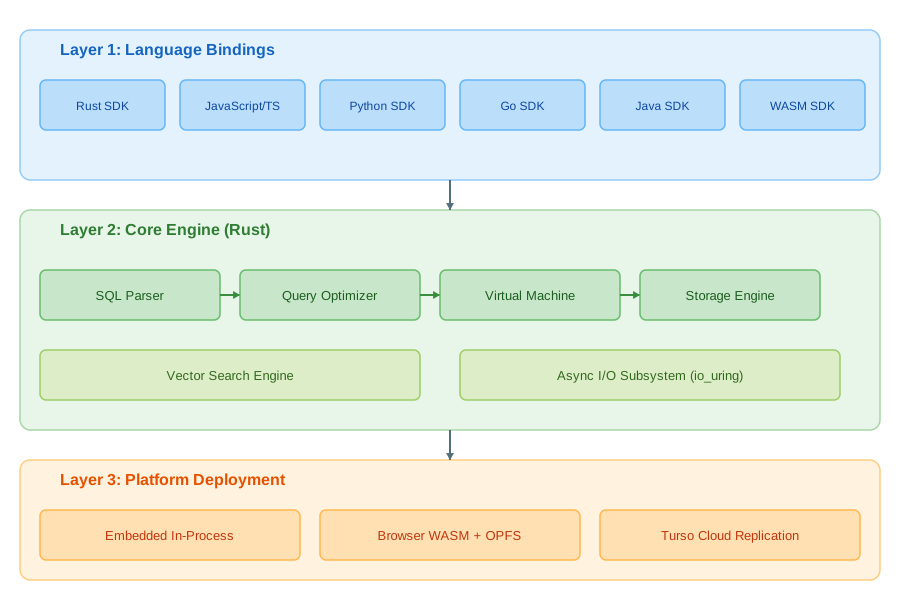
Understanding the Turso Architecture
The architecture diagram above illustrates Turso’s three-layer design, which enables the same core engine to run in multiple deployment contexts without modification. Let us examine each layer in detail.
Layer 1: Language Bindings
The top layer provides SDKs for six languages: Rust, JavaScript/TypeScript, Python, Go, Java, and WebAssembly. Each binding wraps the core Rust engine through Foreign Function Interface (FFI) or WebAssembly bindings. This means developers can embed Turso directly in their application process regardless of their language choice, eliminating the need for a separate database server process or network round-trips.
The Rust binding is the most direct, as it links against the native Rust crate. The JavaScript binding compiles the engine to WebAssembly for browser and Node.js usage. Python, Go, and Java bindings use C FFI to call into the compiled Rust shared library.
Layer 2: Core Engine
The core engine is the heart of Turso, written entirely in Rust. It contains four primary subsystems arranged in a pipeline: the SQL Parser tokenizes and validates SQL statements, the Query Optimizer generates an efficient execution plan, the Virtual Machine executes the plan, and the Storage Engine manages on-disk page layout and caching.
Two cross-cutting subsystems support the pipeline: the Vector Search Engine provides native vector indexing and similarity search without requiring extensions, and the Async I/O Subsystem leverages Linux io_uring for high-throughput non-blocking I/O operations.
Layer 3: Platform Deployment
The bottom layer shows the three deployment modes. In embedded mode, the engine runs in-process with the host application using local files. In browser mode, the engine compiles to WASM and uses the Origin Private File System (OPFS) for persistent storage. In cloud mode, the engine connects to Turso Cloud for replication, branching, and analytics while maintaining a local embedded replica for low-latency reads.
Key Insight
This layered design is what makes Turso unique among databases. The same SQL queries, the same vector search operations, and the same storage format work identically whether you are running on a server, in a browser tab, or syncing with a cloud primary. This eliminates the impedance mismatch that typically exists between local development databases and production cloud databases.
Core Engine Internals
The core engine is where Turso’s Rust rewrite pays off most visibly. It is composed of four primary subsystems arranged in a pipeline, plus two cross-cutting subsystems that serve the entire engine.
The SQL Parser tokenizes incoming SQL statements and produces an abstract syntax tree. Because Turso targets SQLite compatibility, the parser must handle the full SQLite SQL dialect, including the quirks and extensions that SQLite applications rely on. The parser is written in Rust, which means parsing errors are handled safely without the risk of buffer overflows that can occur in C parsers.
The Query Optimizer takes the parsed syntax tree and generates an efficient execution plan. It considers index availability, join ordering, and predicate pushdown to minimize the amount of data that must be scanned. The optimizer is where Turso can diverge from SQLite’s execution strategy while still producing compatible results.
The Virtual Machine executes the query plan. Turso’s VM is designed to be interruptible and async-aware, meaning long-running queries can yield control to the I/O subsystem rather than blocking the entire process. This is a fundamental difference from SQLite’s synchronous execution model.
The Storage Engine manages on-disk page layout, B-tree structures, and the page cache. Turso uses a page-based storage format that is compatible with SQLite’s file format, meaning existing SQLite database files can be opened and used by Turso without conversion. The storage engine coordinates with the Async I/O subsystem to perform reads and writes without blocking the query execution thread.
The Async I/O subsystem is a critical differentiator. On Linux, Turso uses io_uring, the modern asynchronous I/O interface that batches multiple I/O operations into single submissions, dramatically reducing syscall overhead. On other platforms, Turso uses platform-appropriate async backends. This is what enables Turso’s high throughput and concurrent write capabilities.
The Vector Search Engine provides native vector indexing and similarity search. Unlike SQLite, which requires loading external extensions for vector operations, Turso includes vector32 and vector64 data types, similarity search functions, and vector indexing as first-class engine features. No extension loading is required. The full engine manual is available at docs/manual.md in the repository.
Key Features
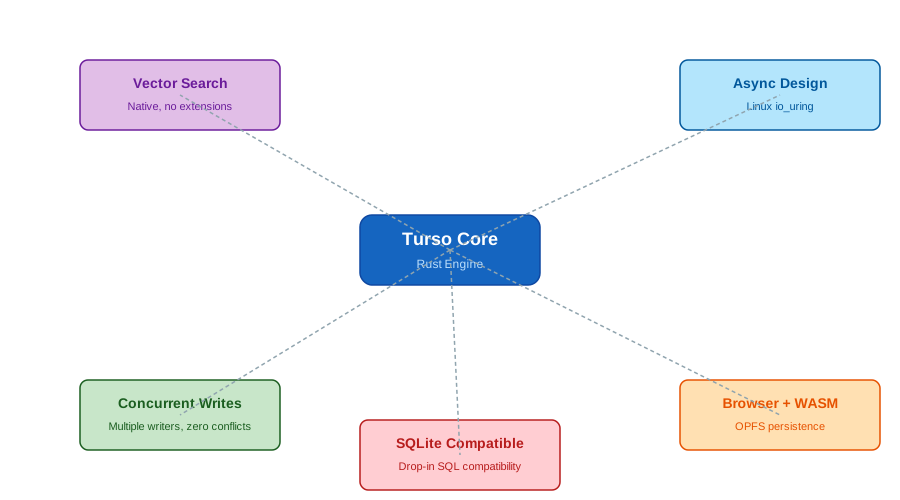
| Feature | Description |
|---|---|
| Vector Search | Native vector search built into the engine – no extensions, no separate vector DB |
| Async Design | Built async-first using Linux io_uring for maximum I/O throughput |
| Concurrent Writes | Multiple writers can operate simultaneously with zero conflicts |
| Browser + Persistence | Runs in the browser via WASM with OPFS for persistent storage |
| SQLite Compatible | Drop-in compatibility with SQLite SQL dialect and file format |
Understanding Turso’s Key Features
The features diagram highlights the five capabilities that distinguish Turso from traditional SQLite and other embedded databases. Each feature addresses a specific limitation of the SQLite architecture while maintaining full SQL compatibility.
Vector Search
Turso includes native vector search built directly into the storage engine. Unlike SQLite, which requires loading external extensions for vector operations, Turso provides vector32 and vector64 data types, similarity search functions, and vector indexing as first-class features. This is particularly significant for AI agent applications that need on-device Retrieval Augmented Generation (RAG) without the overhead of a separate vector database process.
Async Design
The entire I/O subsystem is built async-first. On Linux, Turso uses io_uring for batched, zero-copy asynchronous I/O, which dramatically reduces syscall overhead compared to traditional read/write calls. This design allows Turso to saturate high-throughput storage devices and handle thousands of concurrent operations efficiently.
Concurrent Writes
SQLite’s most well-known limitation is its single-writer model: only one write transaction can execute at a time, enforced by a global write lock. Turso overcomes this with a novel concurrency model that allows multiple writers to operate simultaneously without conflicts. This is a fundamental architectural advantage for write-heavy workloads.
Browser and WASM
Turso compiles to WebAssembly and runs directly in the browser. Combined with the Origin Private File System (OPFS) API, Turso provides persistent, high-performance SQL storage entirely client-side. This enables true offline-first web applications with full database capabilities, not just key-value stores.
SQLite Compatibility
Despite being a ground-up rewrite, Turso maintains compatibility with the SQLite SQL dialect and file format. Existing SQLite databases can be opened with Turso, and SQL queries written for SQLite work without modification in most cases. The COMPAT.md file in the repository documents the full compatibility matrix.
SQLite Compatibility
“SQLite compatible” is a phrase that needs precise definition. In Turso’s context, it means three things: SQL dialect compatibility, data type compatibility, and file format compatibility.
SQL dialect compatibility means that SQL statements written for SQLite – including DDL (CREATE TABLE, CREATE INDEX), DML (INSERT, UPDATE, DELETE, SELECT), transaction control (BEGIN, COMMIT, ROLLBACK), and full-text search (FTS) – work in Turso without modification in the vast majority of cases. The COMPAT.md file in the repository documents the full compatibility matrix, including known incompatibilities and edge cases.
Data type compatibility means that SQLite’s dynamic type system – where columns have storage classes (NULL, INTEGER, REAL, TEXT, BLOB) rather than rigid types – is preserved. Turso also extends this with vector types (vector32, vector64) that do not exist in standard SQLite.
File format compatibility means that existing SQLite database files can be opened and used by Turso. The page size, B-tree structure, and journal modes follow SQLite conventions, ensuring interoperability. This is critical for migration: you do not need to export and re-import your data.
The following SQL example demonstrates a query that works in both SQLite and Turso, with the addition of Turso’s native vector search:
CREATE TABLE users (id INTEGER PRIMARY KEY, name TEXT, embedding BLOB);
INSERT INTO users (name, embedding) VALUES ('Alice', vector32('[0.1, 0.2, 0.3]'));
SELECT name FROM users WHERE vector_match(embedding, '[0.1, 0.2, 0.3]', 5);
The CREATE TABLE and INSERT statements are standard SQLite SQL. The vector32 type and vector_match function are Turso extensions that provide native vector search without loading any external module.
Technology Stack
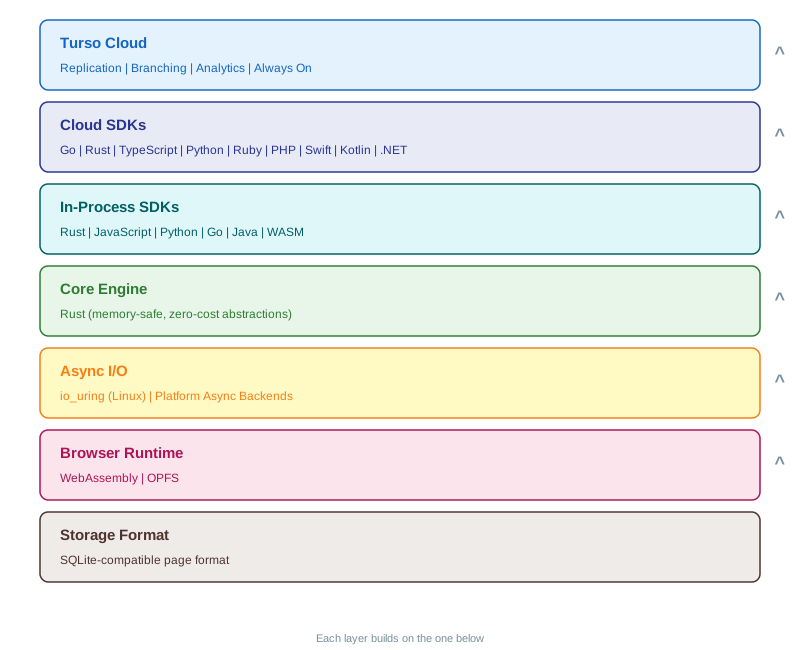
Understanding the Turso Technology Stack
The technology stack diagram presents Turso’s components from the foundational storage layer at the bottom to the cloud services at the top. Each layer builds on the one below it, and the entire stack is designed for portability across deployment targets.
Storage Format Layer
At the base, Turso uses a SQLite-compatible page-based storage format. This means existing SQLite database files can be read and written by Turso without conversion. The page size, B-tree structure, and journal modes follow SQLite conventions, ensuring interoperability.
Browser Runtime Layer
For browser deployments, Turso compiles the Rust core to WebAssembly. The Origin Private File System (OPFS) provides persistent, high-performance file storage in the browser, enabling Turso to maintain a real database with ACID transactions entirely client-side.
Async I/O Layer
The async I/O subsystem is a critical differentiator. On Linux, Turso uses io_uring, the modern asynchronous I/O interface that batches multiple I/O operations into single submissions. On other platforms, Turso uses platform-appropriate async backends. This layer is what enables Turso’s high throughput and concurrent write capabilities.
Core Engine Layer
The core engine is written in Rust, providing memory safety without garbage collection pauses. Rust’s zero-cost abstractions allow Turso to achieve C-level performance while eliminating entire classes of bugs (buffer overflows, use-after-free, data races) that plague C codebases like SQLite.
SDK Layers
Above the core engine sit two categories of SDKs. In-process SDKs (Rust, JavaScript, Python, Go, Java, WASM) embed the engine directly in the application. Cloud SDKs (Go, Rust, TypeScript, Python, Ruby, PHP, Swift, Kotlin, Flutter, React Native, .NET) connect to Turso Cloud’s managed API for replication, branching, and analytics.
Turso Cloud Layer
At the top, Turso Cloud provides managed services: multi-region replication with embedded replicas, copy-on-write database branching for development workflows, built-in analytics, and an always-on architecture with no cold starts. The cloud supports unlimited databases, making per-tenant database isolation economically viable.
Language Bindings and SDKs
Turso provides two categories of SDKs: in-process SDKs that embed the engine directly in your application, and cloud SDKs that connect to Turso Cloud’s managed API.
In-process SDKs wrap the core Rust engine and run it inside your application process. These are the bindings for embedded usage:
| Language | Binding Path | Docs URL |
|---|---|---|
| Rust | bindings/rust | docs.turso.tech/sdk/rust |
| JavaScript/TypeScript | bindings/javascript | docs.turso.tech/sdk/ts |
| Python | bindings/python | docs.turso.tech/sdk/python |
| Go | turso-go | docs.turso.tech/sdk/go |
| Java | bindings/java | docs.turso.tech/sdk |
| WebAssembly | bindings/javascript | docs.turso.tech/sdk |
Cloud SDKs connect to Turso Cloud’s managed API and are available for Go, Rust, TypeScript, Python, Ruby, Ruby on Rails, PHP, Laravel, Swift, Kotlin, Flutter, React Native, and .NET. The full SDK documentation is at docs.turso.tech/sdk.
The following Rust example shows embedded usage – the engine runs in-process, reading and writing a local file:
use turso::Builder;

fn main() -> Result<(), Box<dyn std::error::Error>> {
    let db = Builder::new_local("local.db").build()?;
    let conn = db.connect()?;
    conn.execute("CREATE TABLE IF NOT EXISTS items (id INTEGER PRIMARY KEY, name TEXT)", ())?;
    conn.execute("INSERT INTO items (name) VALUES ('hello turso')", ())?;
    let mut rows = conn.query("SELECT id, name FROM items", ())?;
    while let Some(row) = rows.next()? {
        let id: i64 = row.get(0)?;
        let name: String = row.get(1)?;
        println!("{id}: {name}");
    }
    Ok(())
}
The following JavaScript example shows browser usage – the engine compiles to WebAssembly and uses OPFS for persistence:
import { Database } from "@tursodatabase/turso";

const db = new Database("local.db");
db.exec("CREATE TABLE IF NOT EXISTS notes (id INTEGER PRIMARY KEY, text TEXT)");
db.exec("INSERT INTO notes (text) VALUES ('hello from browser')");
const rows = db.prepare("SELECT * FROM notes").all();
console.log(rows);
Both examples use the same SQL dialect and the same storage format. The only difference is the deployment context.
Turso Cloud: Replication, Branching, and Analytics
Turso Cloud is the managed service layer built on top of the open-source engine. It adds capabilities that an embedded database alone cannot provide:
| Cloud Feature | Description |
|---|---|
| Replication and Sync | Multi-region replication with automatic sync to embedded replicas |
| Branching | Copy-on-Write database branching for dev/staging/preview environments |
| Analytics | Built-in analytics on top of your database without separate infrastructure |
| Always On | No cold starts – databases are always ready |
| Unlimited Databases | Create millions of databases at no per-database cost overhead |
The embedded replica pattern is central to Turso Cloud’s design. Your application runs a local in-process Turso database that serves all reads and writes with zero network latency. In the background, the local database syncs with a cloud primary, which handles durability, multi-region replication, and backup. This means your application always has a fast local database, and the cloud provides the safety net.
This pattern is ideal for offline-first applications. Your app continues to function when connectivity is lost, and syncs automatically when connectivity returns. The cloud primary stores data in S3 and S3 Express, using 128kB segments with WAL persistence, achieving 11 nines of durability.
Branching uses copy-on-write semantics to create instant database copies. You can branch a production database to create a staging environment, run migrations against the branch, and merge changes back – all without copying the full dataset. This is particularly useful for preview environments in CI/CD pipelines.
Pricing details are available at turso.tech/pricing, and you can sign up at app.turso.tech/signup.
Use Cases
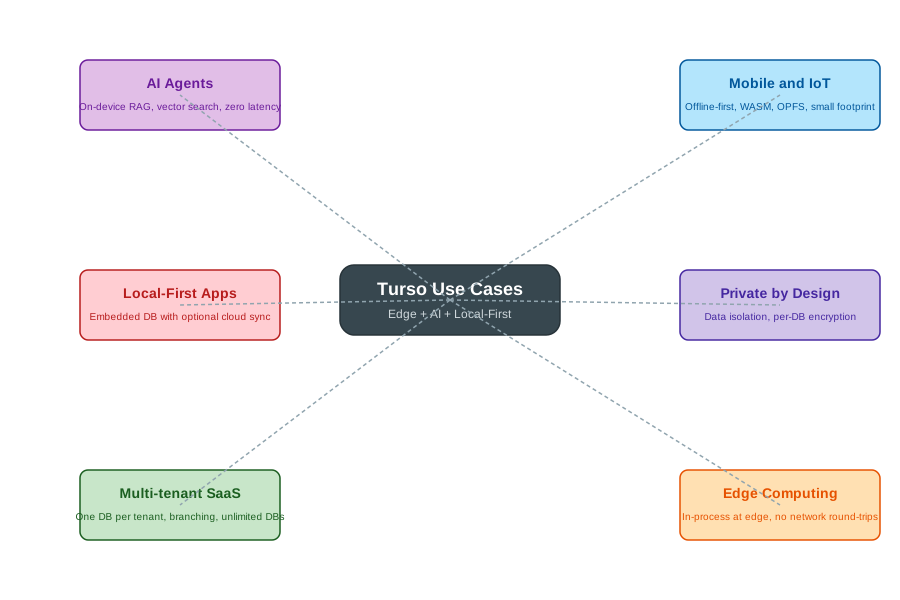
| Use Case | Why Turso |
|---|---|
| AI Agents | Local vector search, zero network latency, on-device RAG, offline-ready |
| Mobile and IoT | Offline-first architecture, WASM and OPFS persistence, small footprint |
| Private by Design | Data isolation, per-database encryption, no shared infrastructure |
| Multi-tenant SaaS | One database per tenant with branching, unlimited databases |
| Edge Computing | In-process database at the edge, no network round-trips |
| Local-First Apps | Embedded database with optional cloud sync |
Understanding Turso Use Cases
The use cases diagram maps Turso’s technical capabilities to real-world application domains. Each use case leverages a specific combination of Turso’s features to solve problems that traditional database architectures handle poorly.
AI Agents
AI agents need fast, local access to context data and vector embeddings. Turso’s native vector search enables on-device Retrieval Augmented Generation (RAG) without a separate vector database or network calls. Agents can store conversation history, tool results, and knowledge embeddings locally, achieving zero-latency retrieval. When connectivity is available, Turso Cloud syncs the local database with a remote primary, making agents offline-ready by design.
Mobile and IoT
Mobile applications and IoT devices often operate in environments with intermittent connectivity. Turso’s embedded architecture provides a full SQL database that runs in-process with the app, using local storage. The WASM compilation target and OPFS support enable browser-based mobile apps (PWAs) with persistent database capabilities. The small footprint makes Turso suitable for resource-constrained IoT devices.
Multi-tenant SaaS
Traditional multi-tenant architectures share a single database across all tenants, creating noisy neighbor problems and security risks. Turso Cloud’s unlimited databases model makes it economically viable to give each tenant their own database. Copy-on-Write branching allows creating tenant-specific dev/staging databases instantly from a production template.
Edge Computing
Edge compute nodes need local data storage without network round-trips to a central database. Turso’s in-process model means the database runs directly on the edge node, providing microsecond-latency reads and writes. Embedded replicas sync with a central primary when connectivity permits, ensuring eventual consistency across the edge topology.
Local-First Applications
The local-first software movement advocates for applications where the primary data store is local, with cloud sync as an optional enhancement. Turso is purpose-built for this paradigm: the embedded engine is the source of truth, and Turso Cloud provides sync, backup, and multi-device coordination. This inverts the traditional cloud-first model.
Private by Design
Applications handling sensitive data benefit from Turso’s per-database isolation and encryption. Each tenant or user can have an isolated, encrypted database, eliminating the risk of cross-tenant data leakage inherent in shared-database architectures.
Getting Started
Getting started with Turso takes minutes. The Turso CLI is the primary tool for creating and managing databases.
Install the Turso CLI and create your first database:
# Install Turso CLI
curl -sSfL https://get.tur.so/install.sh | bash

# Create your first database
turso db create my-first-db

# Open a SQL shell to your database
turso db shell my-first-db
To use Turso embedded in a Rust application, add the turso crate to your Cargo.toml and use the Builder API as shown in the Language Bindings and SDKs section above. The Rust SDK documentation is at docs.turso.tech/sdk/rust.
To use Turso in the browser, install the @tursodatabase/turso npm package and use the Database API as shown in the same section. The TypeScript SDK documentation is at docs.turso.tech/sdk/ts.
The full documentation, including tutorials, API references, and deployment guides, is available at docs.turso.tech. The Turso team also publishes technical articles and announcements on the Turso blog.
Community and Adoption
Turso has built a substantial open-source community. The repository has 256 contributors and 18,145 commits, indicating sustained development activity. The project is actively maintained, with regular releases and responsive issue handling.
Several organizations have adopted Turso and reported positive experiences. These testimonials are reported by Turso itself and should be evaluated accordingly:
- Adaptive.ai uses Turso for AI agent infrastructure, leveraging the embedded vector search for on-device retrieval.
- Kin uses Turso as the data layer for a personal AI companion application, taking advantage of the local-first architecture.
- Spice AI integrates Turso into an AI data platform that requires low-latency local data access.
- Prisma provides ORM integration with Turso, making it accessible to the large Prisma developer ecosystem.
- Val Town runs Turso on a serverless JavaScript platform, where the in-process model eliminates cold-start database connections.
- Vercel has highlighted Turso for edge deployment scenarios where in-process databases reduce latency.
You can join the Turso community on Discord and follow updates on X/Twitter.
Conclusion
Turso represents a meaningful evolution of the embedded database concept. By rewriting SQLite from scratch in Rust, Turso gains memory safety, async I/O via io_uring, concurrent writes, native vector search, and browser/WASM support – all while maintaining SQL and file format compatibility with the most widely deployed database in the world.
The value proposition is clearest in the context of AI agents. Agents need fast, local access to context data and vector embeddings. Turso provides this with zero network latency, offline-ready operation, and native vector search built into the engine. When cloud sync is needed, Turso Cloud adds replication, branching, and analytics without changing the local development experience.
If you are building applications that need a database at the edge, in the browser, or inside an AI agent, Turso is worth evaluating. The open-source engine is free to use, and Turso Cloud offers a generous free tier for getting started.
- GitHub: github.com/tursodatabase/turso
- Website: turso.tech
- Documentation: docs.turso.tech
- Pricing: turso.tech/pricing
- Sign up: app.turso.tech/signup
Related Posts
- RustFS: High-Performance S3-Compatible Object Storage
- Cognee: Open-Source AI Memory Platform for Agents
- Google LiteRT-LM: Edge LLM Inference Framework

Enjoyed this post? Never miss out on future posts by following us


