SWC: Rust-Based Platform for the Web
SWC is an extensible Rust-based platform for the next generation of fast developer tools. It serves as a next-generation fast developer tool that compiles JavaScript and TypeScript into optimized JavaScript. Used by major companies including Vercel, ByteDance, Tencent, Shopify, and Trip.com, SWC powers tools like Next.js, Parcel, and Deno.
Understanding SWC Architecture
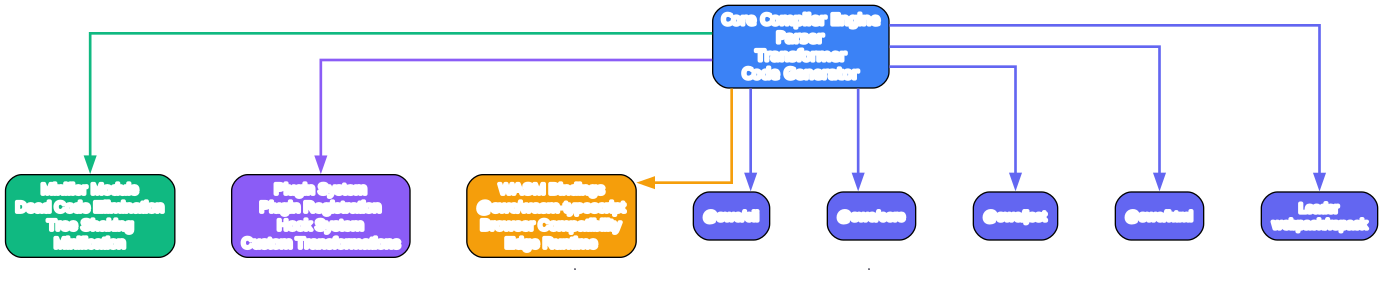
The architecture diagram above illustrates the core components and their interactions. Let’s break down each component:
Core Compiler Engine
The core compiler engine serves as the central processing unit for all transformations. It handles the complete compilation pipeline, taking source code as input and producing optimized output. The engine is composed of three main sub-components:
-
Parser: Converts source code into an Abstract Syntax Tree (AST) representation. SWC’s parser is written in Rust and provides high-performance parsing with support for modern JavaScript syntax including ES6+, JSX, and TypeScript.
-
Transformer: Operates on the AST to apply various transformations. This component enables features like JSX transformation, TypeScript type checking, and Flow type checking. The transformer architecture is modular, allowing individual transformations to be applied or composed.
-
Code Generator: Transforms the modified AST back into source code. This component produces optimized JavaScript output with proper formatting and minification options.
Minifier Module
The minifier module sits after the code generator and performs code optimization and compression. Its key responsibilities include:
- Dead Code Elimination: Identifies and removes unreachable code paths
- Tree Shaking: Eliminates unused exports and imports from modules
- Minification Algorithms: Compresses code by removing whitespace, shortening variable names, and optimizing expressions
The minifier module works in conjunction with the core compiler to produce production-ready JavaScript bundles.
Plugin System
SWC’s plugin system provides extensibility without modifying the core compiler. This architecture enables developers to:
- Plugin Registration: Register custom plugins that can intercept and modify the compilation pipeline
- Hook System: Implement specific hooks at various stages of the compilation process
- Custom Transformations: Create specialized transformations for specific use cases
The plugin system uses a hook-based architecture that allows plugins to be composed and chained together, creating a flexible transformation pipeline.
WASM Bindings
WebAssembly (WASM) bindings bring Rust performance to browser environments. The @swc/wasm-typescript package enables:
- Browser Compatibility: Run SWC transformations directly in the browser
- Edge Runtime Support: Use SWC in serverless functions and edge computing platforms
- Zero-Copy Serialization: Efficient data transfer between Rust and JavaScript without serialization overhead
This capability makes SWC suitable for client-side compilation and edge deployment scenarios.
Integration Layer
The integration layer provides seamless developer experience across different tooling ecosystems. Key integration packages include:
- @swc/cli: Command-line interface for direct compilation from the terminal
- @swc/core: Core Rust library for programmatic use in Node.js applications
- @swc/jest: Jest transformer for fast test execution
- @swc/html: HTML transformation for in-browser JSX compilation
- @swc/loader: Webpack and Rspack loaders for build tool integration
These integrations ensure that SWC can be adopted incrementally into existing workflows without major refactoring.
Data Flow
The diagram shows how data moves through the system:
- Source code enters the parser and is converted to an AST
- The transformer applies configured transformations to the AST
- The code generator produces optimized JavaScript output
- The minifier module compresses and optimizes the output
- Plugins can intercept and modify the pipeline at various stages
- WASM bindings enable browser-based execution
- Integration packages provide different interfaces to the core functionality
Key Insights
This architecture draws inspiration from compiler design principles while adding modern web development requirements. The modular Rust-based design allows for focused, maintainable components that can be optimized independently. The plugin system enables extensibility without modifying core, following the principle of open-closed design. WASM bindings demonstrate how Rust performance can be brought to environments where native compilation is not possible.
Practical Applications
Organizations can extend this system by:
- Registering custom plugins for domain-specific transformations
- Integrating with existing build pipelines through loaders and transformers
- Using WASM bindings for client-side compilation
- Combining multiple plugins to create specialized compilation workflows
Key Features and Capabilities
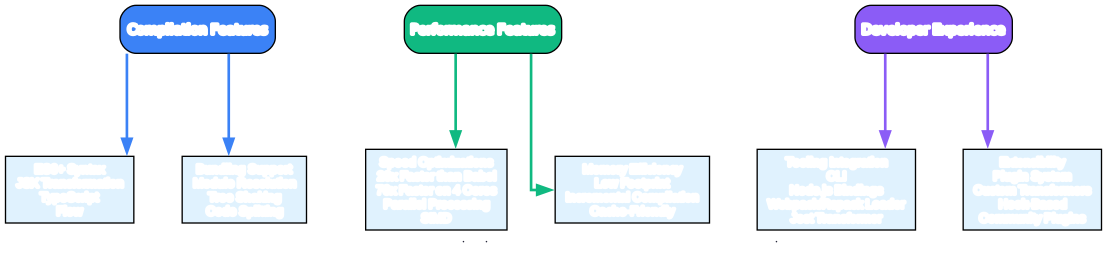
The features diagram above highlights SWC’s comprehensive capabilities across three dimensions: compilation features, performance features, and developer experience features.
Compilation Features
SWC provides comprehensive JavaScript and TypeScript compilation support:
- ES6+ Syntax: Full support for modern JavaScript features including arrow functions, classes, template literals, destructuring, and more
- JSX Transformation: Convert JSX syntax to JavaScript for use in frameworks like React
- TypeScript Compilation: Compile TypeScript to JavaScript with type checking
- Flow Type Checking: Support for Flow type annotations
Bundling Support
Beyond simple transpilation, SWC includes built-in bundling capabilities:
- Module Resolution: Handle different module systems (CommonJS, ES modules, AMD)
- Tree Shaking: Remove unused code from bundles to reduce file size
- Code Splitting: Break code into smaller chunks for lazy loading
- Dependency Graph: Analyze and optimize module dependencies
Performance Features
SWC’s Rust implementation delivers exceptional performance:
- Speed Optimizations: 20x faster than Babel on single thread, 70x faster on four cores
- Parallel Processing: Utilize multi-core systems for concurrent compilation
- SIMD Instructions: Use SIMD for optimized arithmetic operations
- Memory Efficiency: Low memory footprint with cache-friendly data structures
Memory Efficiency
SWC’s memory-efficient implementation includes:
- Low Footprint: Minimal memory usage compared to JavaScript-based alternatives
- Incremental Compilation: Cache compilation results to avoid redundant work
- Cache-Friendly Data Structures: Optimize memory access patterns for performance
Developer Experience Features
SWC provides excellent developer experience through comprehensive tooling integration:
- Tooling Integration: CLI tool, Node.js bindings, webpack/rspack loader, Jest transformer
- Extensibility: Plugin system, custom transformers, hook-based architecture, community plugins
Feature Highlights
SWC’s feature set makes it suitable for a wide range of use cases:
- Modern JavaScript features: ES6+, JSX, TypeScript, Flow
- Bundling: module resolution, tree shaking, code splitting
- Performance: 20x faster than Babel (single thread), 70x faster (4 cores)
- Tooling: CLI, Node.js, webpack loader, Jest transformer
- Extensibility: Plugin system with hook-based architecture

Performance Characteristics
The performance diagram above shows benchmark results comparing SWC to Babel across various scenarios and use cases.
Speed Comparison
SWC’s performance advantage is most visible in direct compilation benchmarks:
- Babel: 100% (baseline performance)
- SWC Single Thread: 20x faster (500% improvement)
- SWC 4 Cores: 70x faster (700% improvement)
This dramatic performance improvement comes from Rust’s zero-cost abstractions and efficient memory management. The single-threaded performance is already superior to Babel, and the multi-core scaling demonstrates excellent parallelization capabilities.
Benchmark Scenarios
SWC’s performance advantage varies by workload complexity:
- Simple Transpilation: 50ms (Babel) → 2.5ms (SWC)
- Complex Transformations: 200ms (Babel) → 3ms (SWC)
- Large Codebases: 2s (Babel) → 30ms (SWC)
- Incremental Compilation: 500ms (Babel) → 20ms (SWC)
The performance gap widens with code complexity, making SWC particularly valuable for large codebases and complex transformation scenarios.
Use Case Performance
Real-world performance gains in production applications:
- Next.js Build: 45s (Babel) → 2s (SWC) 22.5x faster
- Parcel Bundling: 120s (Babel) → 3s (SWC) 40x faster
- Deno Runtime: 1.5s (Babel) → 0.1s (SWC) 15x faster
- Jest Test Suite: 8m (Babel) → 30s (SWC) 16x faster
These performance improvements translate directly to faster development cycles, reduced infrastructure costs, and improved user experience.
Memory Efficiency
SWC’s memory-efficient implementation includes:
- Low Footprint: Minimal memory usage compared to JavaScript-based alternatives
- Incremental Compilation: Cache compilation results to avoid redundant work
- Cache-Friendly Data Structures: Optimize memory access patterns for performance
Scalability with Parallel Processing
SWC’s parallel processing capabilities enable:
- Multi-Core Utilization: Efficiently use all available CPU cores
- Concurrent Compilation: Compile multiple files simultaneously
- Load Balancing: Distribute work evenly across available resources
This scalability makes SWC suitable for large-scale CI/CD pipelines and high-performance build systems.

Ecosystem and Integrations
The ecosystem diagram above illustrates SWC’s comprehensive package ecosystem, major integrations, and tooling ecosystem.
Core Packages
SWC provides a comprehensive package ecosystem for different use cases:
- @swc/cli: Command-line interface for direct compilation from the terminal
- @swc/core: Core Rust library for programmatic use in Node.js applications
- @swc/wasm-typescript: WebAssembly bindings for browser and edge runtime compatibility
- @swc/helpers: Utility functions and helper modules for common transformations
- @swc/jest: Jest transformer for fast test execution
- @swc/html: HTML transformation for in-browser JSX compilation
- @swc/loader: Webpack and Rspack loaders for build tool integration
These packages provide different interfaces to the core compilation functionality, enabling adoption across various tooling ecosystems.
Major Integrations
SWC is integrated with major frameworks and platforms:
- Next.js: Framework integration for fast build times and development experience
- Parcel: Bundler integration for optimized production builds
- Deno: Runtime integration for fast JavaScript execution
- Vercel: Platform integration for serverless and edge deployment
- ByteDance: Company integration for internal tooling
- Tencent: Company integration for large-scale applications
- Shopify: Company integration for e-commerce platform
- Trip.com: Company integration for travel platform
These integrations demonstrate SWC’s production readiness and adoption by industry-leading companies.
Tooling Ecosystem
SWC integrates with a wide range of development tools:
- Build Tools: webpack, Rspack, Rollup
- Test Frameworks: Jest, Mocha
- Package Managers: npm, yarn, pnpm
- CI/CD: GitHub Actions, GitLab CI
- Editors: VS Code, WebStorm
- Bundlers: Vite, Snowpack
This extensive tooling ecosystem ensures that SWC can be adopted incrementally into existing workflows without major refactoring.
Community Plugins
The SWC plugin ecosystem includes:
- Official Plugins: Maintained by the SWC team
- Community Plugins: Created and maintained by the community
- Custom Plugins: Plugins created for specific use cases
The plugin system enables extensibility without modifying core, following the principle of open-closed design.
Migration Path
Migrating from traditional tools to SWC is straightforward:
- Install SWC packages: @swc/core, @swc/cli, or appropriate integration packages
- Configure build tools: Update webpack, Jest, or other tools to use SWC transformers
- Test compilation: Verify that transformations produce expected output
- Optimize performance: Leverage SWC’s performance advantages
- Extend functionality: Add custom plugins for specialized needs
This incremental migration path minimizes disruption while providing access to SWC’s performance and feature set.
Related Resources
- GitHub Repository: https://github.com/swc-project/swc
- Official Website: https://swc.rs
- Documentation: https://swc.rs/docs/getting-started
- Performance Blog: https://swc.rs/blog/perf-swc-vs-babel
- Migration Guide: https://swc.rs/docs/migrating-from-babel

Enjoyed this post? Never miss out on future posts by following us


