abseil-cpp: Google’s Foundation C++ Libraries for the Modern Standard
When you use protobuf, gRPC, OpenTelemetry C++, or any of Google’s open-source C++ projects, you are using Abseil. abseil-cpp is Google’s collection of C++ common libraries, battle-tested in Google’s own codebase, designed to augment the C++ standard library with utilities that Google depends on daily. From the ubiquitous absl::flat_hash_map (the “Swiss Table”) to absl::Status error handling, Abseil provides the foundation that modern C++ infrastructure builds upon. This post explores the layered architecture, key components, and design philosophy that make Abseil the backbone of production C++ at scale.
Understanding the Module Architecture
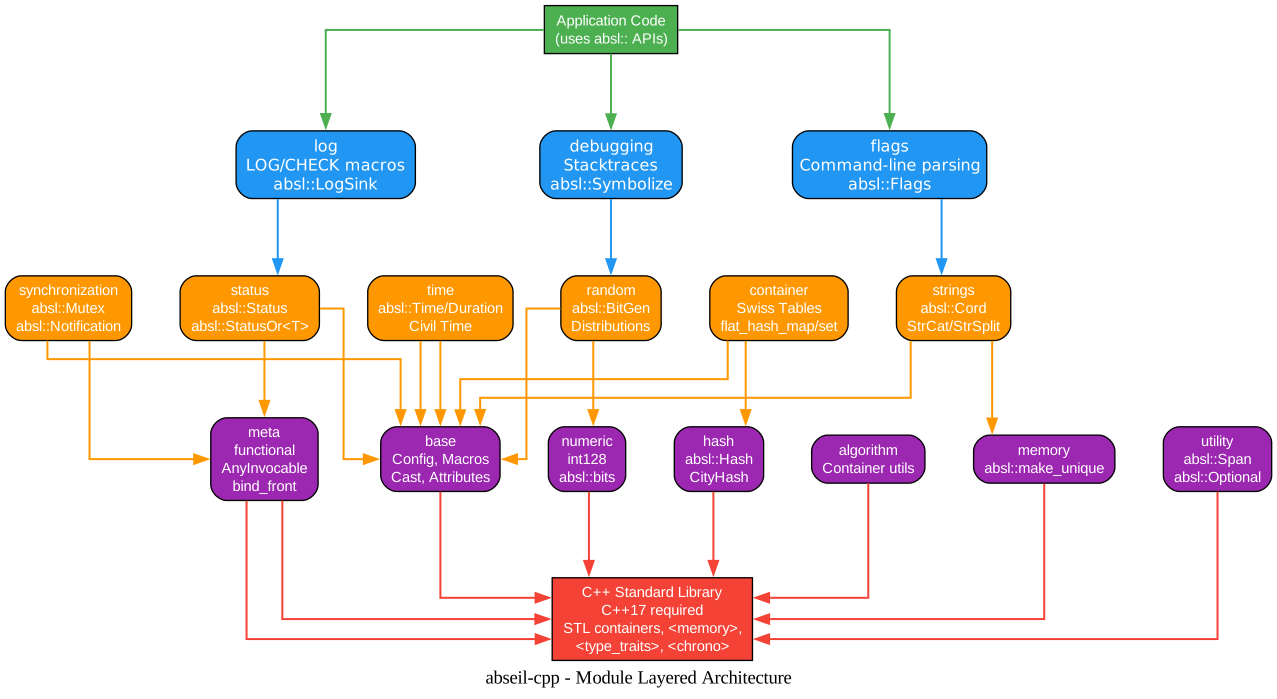
The architecture diagram above shows the layered dependency structure of abseil-cpp. The design follows a strict layering principle: lower layers never depend on higher layers, ensuring that the foundation is stable and reusable.
Application Layer At the top sits your application code, which consumes Abseil’s public APIs. The typical usage pattern involves including a single header like #include <absl/container/flat_hash_map.h> and linking against the corresponding target. Abseil’s header-only design for many components means that in many cases no separate compilation is required - the library is designed to be consumed at the source level, compiled consistently with your own code.
High-Level Libraries (flags, log, debugging) The top Abseil layer contains libraries that build on everything below. absl::flags provides command-line flag parsing with reflection, marshalling, and usage reporting. absl::log offers LOG and CHECK macros with structured logging, log sinks, and verbose logging levels. absl::debugging provides stacktrace collection, symbolization, failure signal handlers, and leak detection. These components depend on mid-level libraries like strings, status, and random to implement their functionality.
Mid-Level Libraries (container, synchronization, time, random, status, strings) This is where Abseil’s most heavily-used components live. absl::container provides the Swiss Table family of hash containers (flat_hash_map, flat_hash_set, node_hash_map, node_hash_set, btree_map, btree_set). absl::synchronization provides absl::Mutex (a faster alternative to std::mutex), absl::CondVar, absl::Notification, and absl::Barrier. absl::time provides absl::Time, absl::Duration, civil time conversions, and time zone handling. absl::random provides absl::BitGen with the Randen algorithm (AES-based, hardware-accelerated). absl::status provides absl::Status and absl::StatusOr<T>, the primary error-handling mechanism within Google. absl::strings provides absl::string_view, absl::Cord (a rope data structure for large strings), absl::StrCat, absl::StrSplit, absl::StrJoin, and many other string utilities.
Core Libraries (base, meta, numeric, hash, algorithm, memory, utility, functional) The core layer provides foundational primitives. absl::base contains configuration macros, type casts, attributes, log severity, portability helpers, and the spinlock implementation. absl::meta provides type traits that augment <type_traits>. absl::numeric provides int128 (128-bit integer type) and bitwise math functions. absl::hash provides the absl::Hash framework and default hash functor implementations. absl::functional provides absl::AnyInvocable (a type-erased callable, move-only alternative to std::function) and absl::FunctionRef (a non-owning reference to a callable).
Foundation: C++ Standard Library Everything in Abseil ultimately builds on the C++ standard library. Abseil requires C++17, and the codebase is designed to be compiled with the exact same options as your application code. This “live at head” philosophy, combined with the strong API compatibility guarantee (but no ABI compatibility guarantee), means Abseil is best consumed as source code rather than as a pre-compiled library.
How to Build
Abseil supports both Bazel and CMake. The recommended approach is to build Abseil from source as part of your project, ensuring ABI consistency.
CMake (FetchContent)
include(FetchContent)

FetchContent_Declare(
  abseil-cpp
  GIT_REPOSITORY https://github.com/abseil/abseil-cpp.git
  GIT_TAG 20260817.0
)
FetchContent_MakeAvailable(abseil-cpp)

target_link_libraries(your_target PUBLIC absl::strings absl::container)
CMake (System Install)
git clone --branch 20260817.0 --depth 1 https://github.com/abseil/abseil-cpp.git
cd abseil-cpp

cmake -S . -B build \
  -DCMAKE_BUILD_TYPE=Release \
  -DCMAKE_CXX_STANDARD=17 \
  -DCMAKE_POSITION_INDEPENDENT_CODE=ON \
  -DCMAKE_INSTALL_PREFIX=/usr/local \
  -DABSL_ENABLE_INSTALL=ON \
  -DBUILD_SHARED_LIBS=ON

cmake --build build --parallel $(nproc)
sudo cmake --install build
sudo ldconfig
Bazel
# MODULE.bazel
bazel_dep(name = "abseil-cpp", version = "20260817.0")
# BUILD.bazel
cc_binary(
    name = "my_app",
    srcs = ["main.cc"],
    deps = [
        "@abseil-cpp//absl/strings",
        "@abseil-cpp//absl/container:flat_hash_map",
    ],
)
Swiss Table Hash Containers
Understanding the Swiss Table
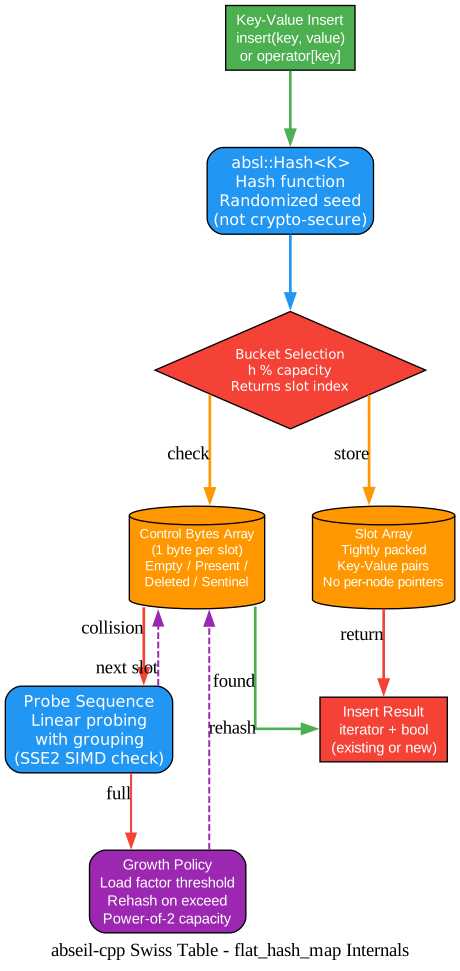
The Swiss Table diagram illustrates the internal design of absl::flat_hash_map, Abseil’s high-performance hash map. The design achieves both speed and memory efficiency through a clever separation of metadata and data.
Hash Function and Bucket Selection When you insert a key-value pair, Abseil first computes the hash using absl::Hash<K>. The hash function uses a randomized seed that is initialized once per process (not per container). This randomization prevents Hyrum’s Law dependencies on iteration order - it is not a security feature against hash flooding attacks. The bucket index is computed as hash % capacity, where capacity is always a power of two, making the modulo a fast bitwise AND.
Control Bytes Array The key innovation of the Swiss Table is the control bytes array - a separate array of one-byte metadata entries, one per slot. Each control byte indicates the slot’s state: empty (0x80), present (lower 7 bits of hash), deleted (0xFE), or sentinel (0xFF). This separation allows the lookup probe sequence to scan the control bytes array using SIMD instructions (SSE2 on x86, NEON on ARM), checking 16 slots in a single instruction. This is dramatically faster than the traditional approach of checking each key individually.
Slot Array The slot array holds the tightly-packed key-value pairs. Unlike std::unordered_map which allocates a node per element, the Swiss Table stores elements inline in a contiguous array. This reduces memory allocation overhead, improves cache locality, and eliminates per-node pointer overhead. The flat_hash_map stores keys and values directly; the node_hash_map stores pointers to keys and values (useful for stable pointers or non-movable types).
Probe Sequence and Grouping When a collision occurs (the target slot is occupied by a different key), the Swiss Table uses linear probing with grouping. The probe sequence advances one slot at a time, checking the control bytes. The SIMD check means that 16 consecutive slots are examined per probe step, making the probe sequence extremely cache-friendly. Abseil’s implementation includes a “grouping” optimization where related elements are kept close together to minimize probe length.
Growth Policy The hash table maintains a load factor threshold (typically 7/8 for flat_hash_map). When the number of elements exceeds this threshold, the table rehashes: a new array twice the size is allocated, and all elements are re-inserted. The power-of-two capacity ensures that the modulo operation is a bitwise AND, and it allows the SIMD probing to work efficiently. The growth policy is designed to amortize the rehashing cost to O(1) per insertion.
Insert Result The insert operation returns an iterator pointing to the inserted (or existing) element, plus a bool indicating whether a new insertion occurred. The iterator is stable until the next rehashing operation. Note that as of the 20260817.0 LTS release, hashtable iterators returned from insert/emplace are now non-iterable, as any prior use of iteration was likely a bug.
Using Swiss Tables
#include <absl/container/flat_hash_map.h>
#include <absl/container/flat_hash_set.h>
#include <string>

int main() {
    // flat_hash_map - inline storage, fastest
    absl::flat_hash_map<std::string, int> ages;
    ages["Alice"] = 30;
    ages["Bob"] = 25;
    ages.insert({"Charlie", 35});

    // Lookup is O(1) average
    auto it = ages.find("Alice");
    if (it != ages.end()) {
        // it->first is key, it->second is value
    }

    // flat_hash_set - unique elements
    absl::flat_hash_set<int> primes = {2, 3, 5, 7, 11};

    // btree_map - ordered, O(log n), cache-friendly
    #include <absl/container/btree_map.h>
    absl::btree_map<std::string, int> ordered;
    ordered["apple"] = 1;
    ordered["banana"] = 2;  // iterates in sorted order

    return 0;
}
Synchronization Primitives
Understanding Synchronization
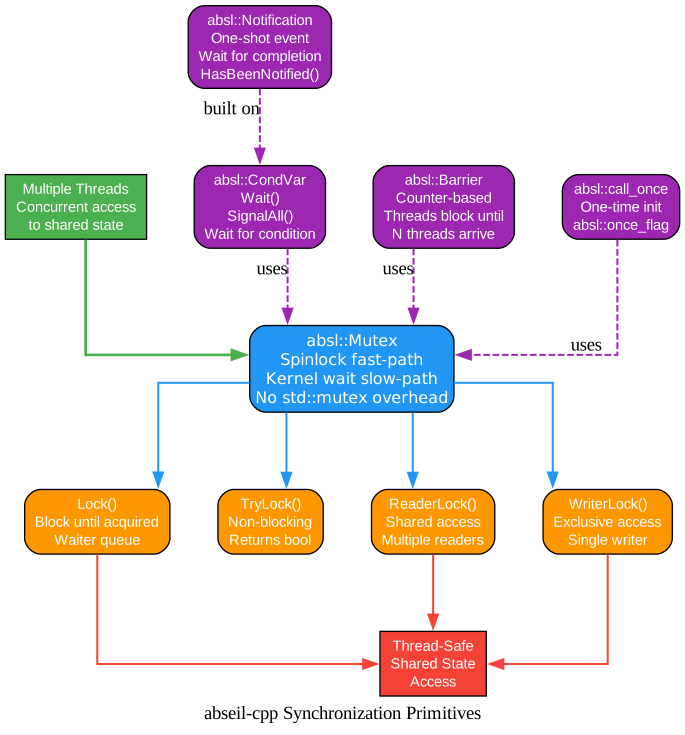
The synchronization diagram shows the hierarchy of concurrency primitives that Abseil provides. At the center is absl::Mutex, the foundation upon which the higher-level primitives are built.
absl::Mutex absl::Mutex is Abseil’s flagship synchronization primitive, designed as a drop-in replacement for std::mutex with better performance. The key design difference is the fast-path: when a mutex is uncontended, Lock() uses an atomic compare-and-swap (via the spinlock implementation in base/internal/spinlock.h) without any system call. Only when contention is detected does it fall back to a kernel wait (futex on Linux, keyed events on Windows, pthread_mutex on other platforms). The mutex also maintains a waiter queue for fairness and supports reader-writer locks, which std::mutex does not.
Reader-Writer Locking absl::Mutex supports shared (reader) and exclusive (writer) locking modes. ReaderLock() allows multiple threads to read shared state concurrently, while WriterLock() allows one thread to modify it. This is more efficient than a plain mutex for read-heavy workloads. The implementation uses a writer-preference strategy to avoid writer starvation, while still allowing reader batching when no writers are waiting.
absl::CondVar absl::CondVar provides condition variable semantics: threads can wait for a condition to become true, and other threads can signal when the condition might be satisfied. Unlike std::condition_variable, absl::CondVar integrates with absl::Mutex and supports WaitWithTimeout and WaitWithDeadline for time-bounded waiting. The SignalAll() method wakes all waiters, while Signal() wakes one.
absl::Notification absl::Notification is a one-shot event primitive. One thread can notify, and multiple threads can wait for the notification. HasBeenNotified() checks whether the event has occurred without blocking. This is useful for signaling completion of asynchronous operations, implementing barriers, and coordinating shutdown. Internally, Notification is built on CondVar and Mutex, providing a simpler API for the common case of waiting for a single event.
absl::Barrier absl::Barrier is a counter-based synchronization primitive. It is initialized with a count N, and Barrier::Block() decrements the counter and blocks the calling thread. When N threads have called Block(), all are released simultaneously. This is useful for synchronizing parallel workloads where all threads must reach a certain point before any can proceed.
absl::call_once absl::call_once provides one-time initialization, similar to std::call_once but with better performance. Combined with absl::once_flag, it ensures that a function is executed exactly once, even if called concurrently from multiple threads. This is useful for lazy initialization of singletons and global state.
Using Synchronization Primitives
#include <absl/synchronization/mutex.h>
#include <absl/synchronization/notification.h>
#include <thread>
#include <vector>

class ThreadSafeCounter {
public:
    void Increment() {
        absl::WriterMutexLock lock(&mutex_);
        ++count_;
    }

    int Get() const {
        absl::ReaderMutexLock lock(&mutex_);
        return count_;
    }

private:
    mutable absl::Mutex mutex_;
    int count_ = 0;
};

int main() {
    ThreadSafeCounter counter;
    absl::Notification done;

    std::vector<std::thread> threads;
    for (int i = 0; i < 10; ++i) {
        threads.emplace_back([&counter, &done]() {
            for (int j = 0; j < 1000; ++j) {
                counter.Increment();
            }
            // Signal when this thread is done
        });
    }

    // Wait for all threads (using a barrier-like pattern)
    for (auto& t : threads) {
        t.join();
    }

    // Notification example
    done.Notify();
    done.WaitForNotification();  // blocks until notified

    return 0;
}
Status and StatusOr: Error Handling
Understanding the Status Model
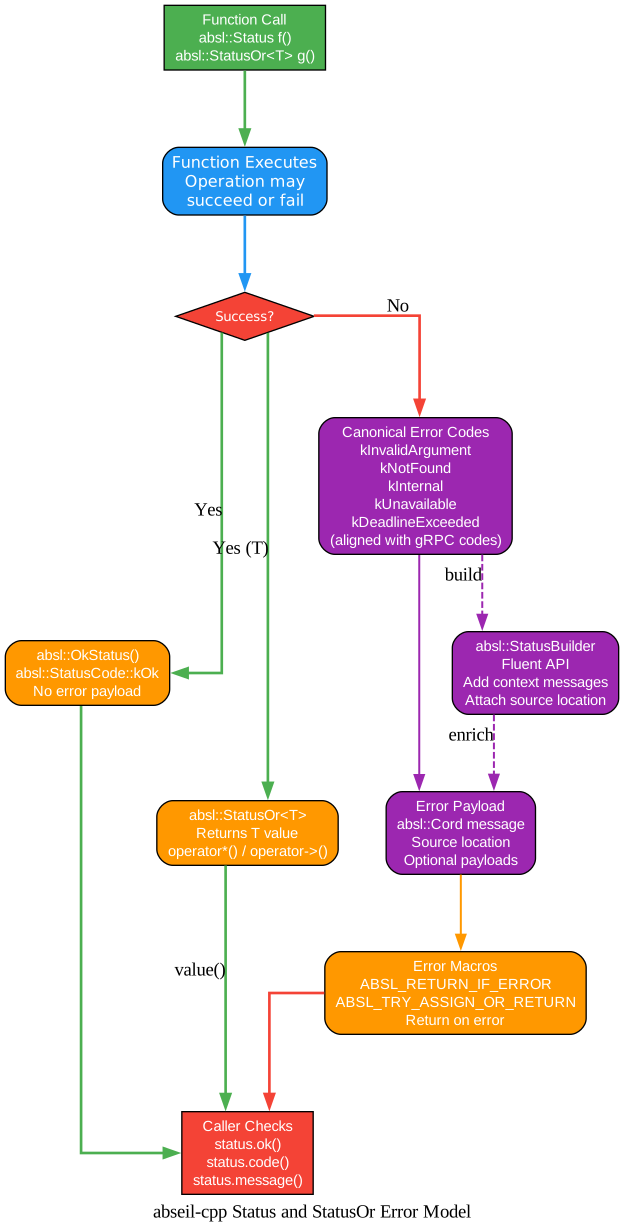
The status diagram shows how Abseil handles errors through absl::Status and absl::StatusOr<T>. This model, inspired by Google’s internal practices and aligned with gRPC error codes, is the primary error-handling mechanism in modern C++ codebases that use Abseil.
Function Returns Status Functions that can fail return either absl::Status (for operations with no value to return) or absl::StatusOr<T> (for operations that return a value on success). This explicit error handling avoids the performance overhead and exception-safety concerns of C++ exceptions, while providing richer error information than simple return codes.
Canonical Error Codes Abseil defines canonical error codes in absl::StatusCode, aligned with the gRPC status codes: kOk, kCancelled, kUnknown, kInvalidArgument, kDeadlineExceeded, kNotFound, kAlreadyExists, kPermissionDenied, kResourceExhausted, kFailedPrecondition, kAborted, kOutOfRange, kUnimplemented, kInternal, kUnavailable, kDataLoss, and kUnauthenticated. These codes are understood across API and RPC boundaries, making them suitable for both in-process library calls and distributed system communication.
Error Payload and Source Location An absl::Status carries an error message stored as an absl::Cord (efficient for large messages and cross-thread passing), an optional source location (file and line where the error was created, using absl::SourceLocation), and optional payloads (arbitrary key-value metadata attached to the status). The 20260526.0 LTS release added absl::StatusBuilder, a fluent API for constructing statuses with additional context and source location information.
**absl::StatusOr
Error Macros Abseil provides macros to simplify error propagation. ABSL_RETURN_IF_ERROR(status) checks a status and returns it immediately if it is not OK. ABSL_TRY_ASSIGN_OR_RETURN(auto value, status_or) extracts the value from a StatusOr or returns the error status. These macros reduce the boilerplate of manual checking and make error propagation more readable, similar to the ? operator in Rust.
Caller Checks The caller of a function returning absl::Status or absl::StatusOr<T> must check the result. The ok() method returns true for success, code() returns the error code, and message() returns the error message string. For StatusOr, value() (or operator*()) returns the contained value, which is undefined behavior if the status is not OK.
Using Status and StatusOr
#include <absl/status/status.h>
#include <absl/status/statusor.h>
#include <absl/strings/str_cat.h>
#include <string>

// Function returning Status
absl::Status OpenFile(const std::string& filename) {
    if (filename.empty()) {
        return absl::InvalidArgumentError("filename cannot be empty");
    }
    // ... try to open file ...
    if (file_not_found) {
        return absl::NotFoundError(
            absl::StrCat("File not found: ", filename));
    }
    return absl::OkStatus();
}

// Function returning StatusOr<T>
absl::StatusOr<int> ParseInt(const std::string& str) {
    try {
        return std::stoi(str);
    } catch (const std::exception&) {
        return absl::InvalidArgumentError(
            absl::StrCat("Cannot parse '", str, "' as integer"));
    }
}

// Using the error macros
absl::Status ProcessConfig(const std::string& filename) {
    absl::Status s = OpenFile(filename);
    ABSL_RETURN_IF_ERROR(s);  // returns s if not OK

    absl::StatusOr<int> port = ParseInt("8080");
    ABSL_RETURN_IF_ERROR(port.status());  // returns error if not OK

    int port_value = port.value();  // safe to access now
    // ... use port_value ...

    return absl::OkStatus();
}

// StatusBuilder for richer errors (LTS 20260526.0+)
absl::Status LoadConfig(const std::string& path) {
    if (!exists(path)) {
        return absl::StatusBuilder(absl::NotFoundError())
            << "Configuration file '" << path << "' does not exist"
            << " (checked at runtime)";
    }
    return absl::OkStatus();
}
String Utilities
Abseil’s strings library provides a comprehensive set of string utilities that are more efficient and more convenient than the C++ standard library equivalents.
#include <absl/strings/str_cat.h>
#include <absl/strings/str_split.h>
#include <absl/strings/str_join.h>
#include <absl/strings/string_view.h>
#include <absl/strings/cord.h>
#include <vector>

int main() {
    // StrCat - efficient string concatenation (no temporary strings)
    std::string result = absl::StrCat("Hello, ", 42, " ", 3.14);

    // StrSplit - split strings by delimiter
    std::vector<std::string> parts = absl::StrSplit("a,b,c", ',');

    // StrJoin - join strings with delimiter
    std::string joined = absl::StrJoin(parts, " | ");

    // string_view - non-owning string reference (pre-C++17 std::string_view)
    absl::string_view sv = "hello world";

    // Cord - rope data structure for large strings
    absl::Cord cord;
    cord.Append("chunk1 ");
    cord.Append("chunk2 ");
    cord.Append("chunk3");
    // Cord avoids copying large strings and supports efficient substring

    // StrFormat - type-safe printf-like formatting
    #include <absl/strings/str_format.h>
    std::string formatted = absl::StrFormat("%s is %d years old", "Alice", 30);

    return 0;
}
Key Features
| Feature | Description |
|---|---|
| Swiss Table Hash Containers | flat_hash_map/set with SIMD-accelerated probing, inline storage, 87.5% load factor |
| absl::Status Error Handling | Canonical error codes aligned with gRPC, StatusOr |
| absl::Mutex | High-performance mutex with spinlock fast-path, reader-writer support, kernel wait fallback |
| absl::Cord | Rope data structure for efficient large string manipulation and cross-thread passing |
| absl::BitGen | Randen-based random number generator with AES hardware acceleration |
| 128-bit Integers | absl::int128 for 128-bit arithmetic (pre-C++23 __int128 alternative) |
| absl::Span | Non-owning view of contiguous data (pre-C++20 std::span) |
| absl::AnyInvocable | Move-only type-erased callable (superior to std::function) |
| Live at Head | API compatibility guarantee, no ABI compatibility, daily source releases |
| 20+ Library Components | base, algorithm, cleanup, container, crc, debugging, flags, hash, log, memory, meta, numeric, profiling, random, status, strings, synchronization, time, types, utility |
Troubleshooting
ODR (One Definition Rule) Violations The most common Abseil issue is ODR violations caused by mixing compile options. If your code is compiled with -std=c++17 but Abseil is compiled with -std=c++14, you may get linker errors or undefined runtime behavior. Always set CMAKE_CXX_STANDARD globally (not per-target) and build Abseil from source as part of your project. Never mix pre-compiled Abseil with different compile options.
Hash Randomization Surprises Abseil’s hash function uses a global random seed. If you link Abseil incorrectly (e.g., static Abseil in multiple shared libraries), different calls to the hash function may return different values, rendering hash elements inaccessible. This causes crashes or missing data in hash containers. Always ensure a single Abseil instance is linked throughout your binary. The solution is to use shared linking or to ensure all shared libraries use the same static Abseil build.
Mixed-Mode Compilation Applying -std=c++17 to an individual target in your build file while Abseil is compiled with a different standard creates a mixed-mode compile. This is a common source of ODR violations. Set the C++ dialect globally: with Bazel, use --cxxopt=-std=c++17 on the command line or in .bazelrc; with CMake, use set(CMAKE_CXX_STANDARD 17) at the top level.
Live at Head and Hyrum’s Law Abseil’s “live at head” philosophy means you should update to the latest commit frequently. If you have good automated testing, you will catch Hyrum’s Law dependencies (implicit dependencies on implementation details) incrementally rather than being overwhelmed by them. Do not pin to an old Abseil version unless you have a specific reason - the API compatibility guarantee means updates should be routine.
Sanitizer Issues When using LLVM sanitizers (ASan, MSan, TSan), ensure all code including Abseil and the C++ standard library is built with the same sanitizer configuration. Instrumentation mismatches cause ODR violations. The easiest way is to use Bazel with --config=asan (or msan, tsan) on the command line, and to build an instrumented libc++ for MemorySanitizer.
Conclusion
Abseil represents a unique contribution to the C++ ecosystem: a library that is not designed to replace the standard library, but to augment it with components that have proven their worth at Google scale. The Swiss Table hash containers demonstrate how careful engineering - separating metadata from data, using SIMD for probing, and choosing the right load factor - can deliver both speed and memory efficiency. The absl::Status error model shows how explicit error handling, with canonical codes and StatusOr<T>, can provide the safety of exceptions without the performance cost. The synchronization primitives illustrate how a spinlock fast-path with kernel fallback can outperform std::mutex while adding reader-writer support.
The “live at head” philosophy, combined with the strong API compatibility guarantee, reflects Google’s confidence that good API design allows continuous improvement without breaking users. For any C++ project that needs production-grade infrastructure - hash containers, error handling, synchronization, strings, time, random numbers - Abseil is the foundation to build upon. Its adoption by protobuf, gRPC, OpenTelemetry, and countless other projects ensures that Abseil will remain a central pillar of the C++ ecosystem for years to come.
Links
- abseil-cpp GitHub Repository
- Abseil Quickstart Guide
- CMake Quickstart
- Abseil Compatibility Guarantees
- Abseil LTS 20260817.0 Release
- Foundational C++ Support Matrix
Related Posts
- yaml-cpp: YAML 1.2 Parser and Emitter in C++
- meshoptimizer: Mesh Optimization for GPU Rendering
- PyShine Screen Recorder: Native C++ Engine

Enjoyed this post? Never miss out on future posts by following us


