AMD Ryzen AI Halo vs NVIDIA DGX Spark: Which Local AI Machine Should You Buy?
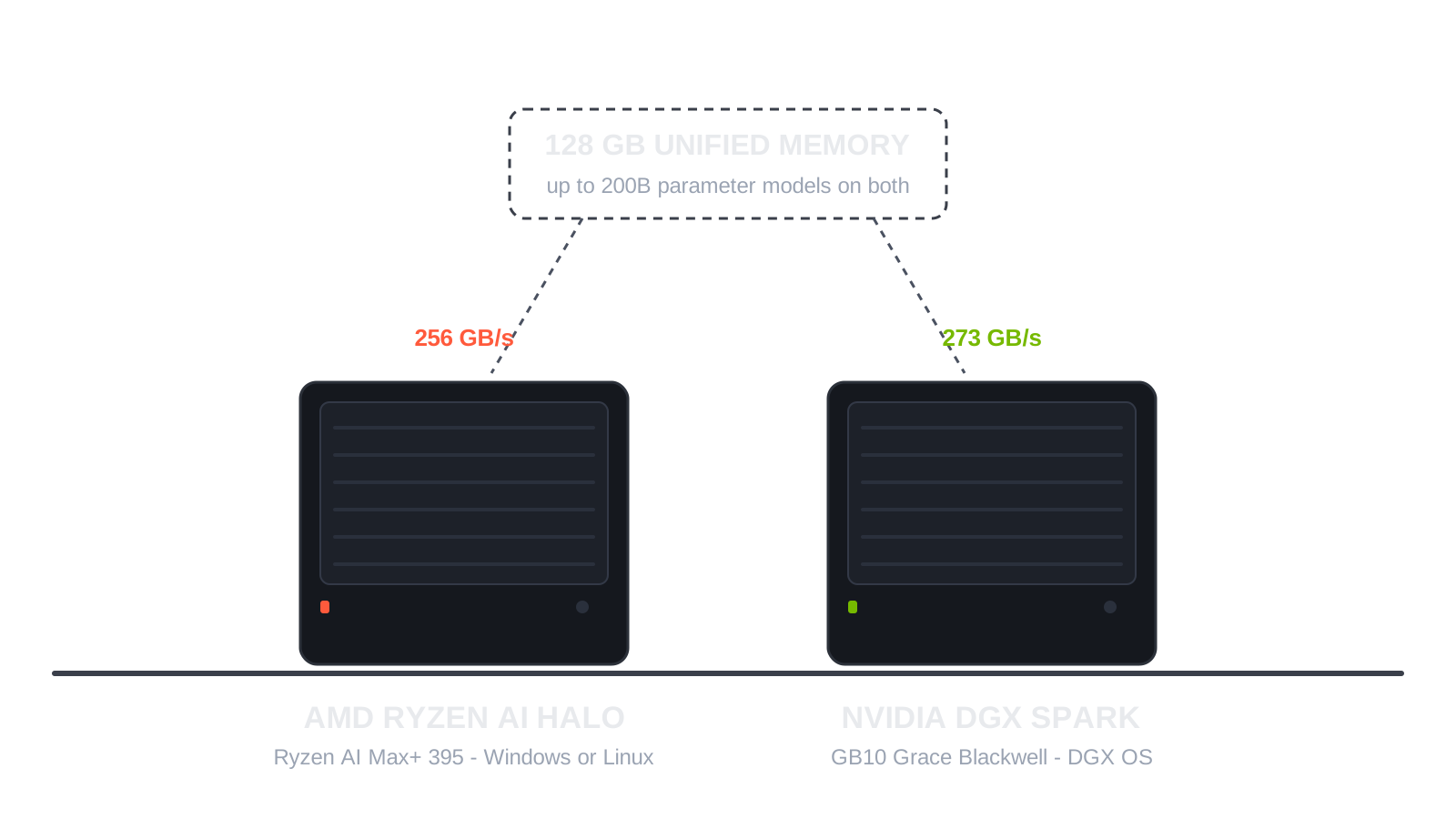
Local AI has officially outgrown the garage. Two of the biggest names in silicon now sell desk-sized machines built around the same core idea: strap a very large pool of unified memory onto a very capable accelerator, and let you run models that normally demand a data center. NVIDIA’s DGX Spark arrived first with its Grace Blackwell GB10 superchip. AMD’s Ryzen AI Halo answered with the Ryzen AI Max+ 395, its first self-branded compact developer platform. Both are roughly 150 by 150 millimeter squares that promise inference on models up to 200 billion parameters. Both cost thousands of dollars. And both are sitting in a pricing war that changes every few months. If you are about to spend real money on a local AI machine, this head-to-head is the decision you are actually making.
Why This Comparison Matters
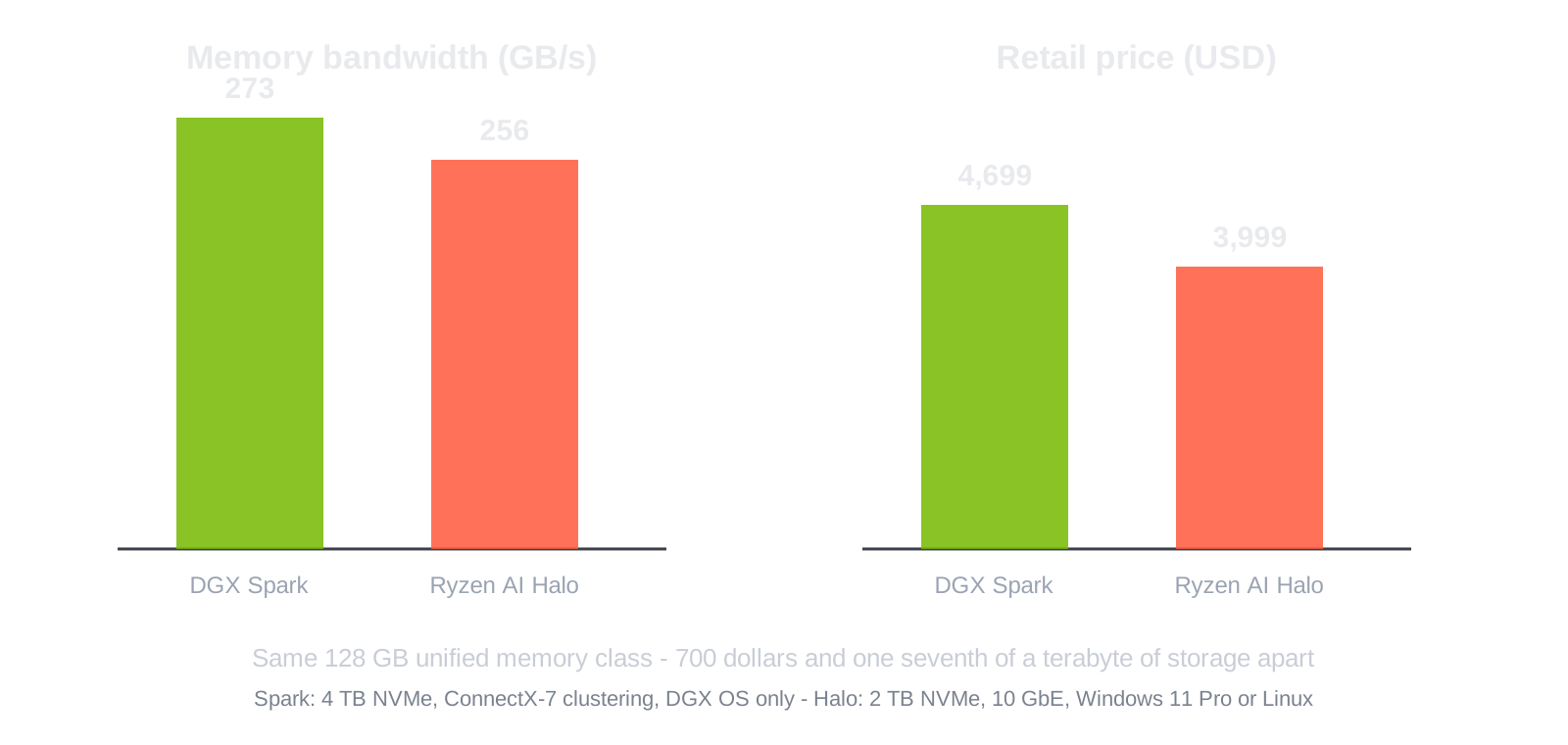
For years, running a serious model locally meant compromise: squeeze a quantized model into 24 GB of graphics VRAM, or stream layers off system RAM and watch tokens crawl. Unified memory broke that trade-off, and as we explained in our LLM memory and decode deep dive, token generation is bound by how fast weights move, not just how much fits. These two machines represent the first time AMD and NVIDIA have gone feature-for-feature against each other in the same form factor, at nearly the same memory capacity, chasing the same developer. The pricing makes it urgent. The DGX Spark launched at 3,999 dollars in late 2025 and climbed to 4,699 dollars after a spring 2026 increase. The Ryzen AI Halo sells for 3,999 dollars exclusively through Micro Center. That is a 700 dollar gap between two machines that look almost identical from orbit.
Meet the Contenders
Here is how they stack up on paper:
| Spec | NVIDIA DGX Spark | AMD Ryzen AI Halo |
|---|---|---|
| Chip | GB10 Grace Blackwell superchip | Ryzen AI Max+ 395 “Strix Halo” |
| CPU | 20 Arm cores (10 Cortex-X925 + 10 Cortex-A725) | 16 Zen 5 cores, 32 threads, up to 5.1 GHz |
| Accelerator | Blackwell GPU, 5th-gen tensor cores, up to 1 PFLOP FP4 | Radeon 8060S, 40 RDNA 3.5 CUs, plus 50 TOPS XDNA 2 NPU |
| Memory | 128 GB LPDDR5x, 256-bit, 273 GB/s | 128 GB LPDDR5x-8000, 256-bit, 256 GB/s |
| Storage | 4 TB self-encrypting NVMe | 2 TB self-encrypting NVMe |
| Networking | ConnectX-7, 200 Gb/s for clustering | 10 GbE plus Wi-Fi 7 |
| OS | DGX OS (Linux only) | Windows 11 Pro or Linux |
| Size | 150 x 150 x 50.5 mm | 150 x 150 x 45.4 mm |
| Price | 4,699 dollars | 3,999 dollars |
The similarities are the story. Same memory class, same 256-bit bus, same claim of 200-billion-parameter inference, nearly identical footprints. The differences are where your money goes. NVIDIA’s box is an inference and fine-tuning appliance: NVIDIA officially supports fine-tuning models up to 70 billion parameters and clusters two Sparks over ConnectX-7 to tackle 405-billion-parameter FP4 workloads. AMD’s box is a full x86 computer: it boots Windows, runs your everyday desktop software, and still dedicates most of its 128 GB to the GPU at your command, while an onboard NPU handles background AI tasks at up to 50 TOPS.
Performance: What the Benchmarks Actually Show
Raw bandwidth says the Spark should win decode speed by about seven percent, and compute says much more: independent measurements collected by the LMSYS team put the Spark at roughly 2,000 tokens per second of prompt processing on a 20B model, while rating its overall AI muscle between an RTX 5070 and 5070 Ti. But single-stream decode on a 273 GB/s machine is humbling: that same review measured a 70B FP8 model at just 2.7 tokens per second, and published 4-bit 70B runs land near four to five tokens per second. AMD’s own published numbers claim the Halo actually leads the Spark by 4 to 14 percent on popular mixture-of-experts models like GPT-OSS-120B and Qwen 3.5-122B, a reminder that MoE models, as we covered in our sparse scaling explainer, activate only a few billion parameters per token and stress memory differently than dense models.
Here is the closest thing to a recorded head-to-head, assembled from published single-stream runs on both machines: llama.cpp author Georgi Gerganov’s own Spark numbers and Ollama’s official runs collected in Aimultiple’s benchmark roundup, the LMSYS dataset, and independent Strix Halo measurements on a Framework Desktop and a Strix Halo laptop. Decode speed, in tokens per second:
| Model (quantization) | DGX Spark | Ryzen AI Max+ 395 |
|---|---|---|
| GPT-OSS 20B (MXFP4) | 50 - 59 | 65 - 77 |
| GPT-OSS 120B (MXFP4) | 39 - 49 | 34 - 54 |
| Llama 70B-class (4-bit) | about 4.4 | 4.5 - 5.1 |
Different testers, software versions, and context lengths mean you should read these as ballpark figures, but the pattern repeats in every record we could find. Prefill is where the Blackwell tensor cores dominate: published runs put the Spark at roughly 3,200 to 3,600 tokens per second processing GPT-OSS 20B prompts against roughly 1,200 on Strix Halo, and 1,200 to 1,700 on GPT-OSS 120B prompts against 340 to 500. Decode is the reverse surprise: the Radeon iGPU beats the Spark on the 20B MoE model in most recorded runs, which lines up with AMD’s vendor comparison, while the dense 70B row is a bandwidth-bound wash at four to five tokens per second on either box.
The deeper lesson from a year of benchmarks: these machines punish single-chat thinking and reward concurrency. One widely shared Spark experiment served a 49B model to 256 simultaneous streams and measured aggregate throughput near 700 tokens per second, roughly 120 times its single-stream figure. Whichever badge is on the case, the winning pattern is the same: batch workloads, quantize aggressively using the formats from our quantization guide, and treat one-user chat speed as the wrong metric.
Advantages of Each Machine
The DGX Spark’s advantages are ecosystem and headroom. CUDA remains the default dialect of AI research, so every new model, paper, and recipe lands there first, often day one. The software stack is turnkey: DGX OS ships with drivers, containers, NVIDIA’s documentation and playbooks, and NIM microservices, and the official fine-tuning support up to 70B parameters has no documented AMD equivalent. ConnectX-7 clustering is the sleeper feature: two units behave like one bigger machine, a path to scale that AMD’s 10 GbE cannot match.
The Ryzen AI Halo’s advantages are value and versatility. It costs 700 dollars less, includes a faster SSD-for-the-price story only if you upgrade, and is the only one of the two that runs Windows, which matters for developers whose day job lives in Visual Studio, .NET, or game engines. The x86 CPU chews through general code, the Radeon 8060S is a genuinely capable gaming and graphics iGPU, and ROCm now powers PyTorch, vLLM, llama.cpp, Ollama, ComfyUI, and LM Studio on this platform. The NPU is a genuine differentiator for always-on agent workloads at low power.
Benefits: Who Each Machine Is For
Buy the DGX Spark if your identity is machine learning: you fine-tune models as we describe in our LoRA and QLoRA guide, you prototype workloads destined for data center GPUs, or you want the option to cluster later. The premium buys a shorter path from experiment to production NVIDIA stack.
Buy the Ryzen AI Halo if you want one machine that is both your main computer and your AI rig, you prefer open tooling, or you simply want the best tokens-per-dollar. AMD goes further and argues the machine pays for itself, modeling up to six-times lower three-year cost than equivalent cloud API spending for sustained local inference. Budget-adjacent shoppers should also know the wider Strix Halo ecosystem: third-party mini PCs with the same chip, such as a 64 GB Minisforum workstation near 2,700 dollars, trade capacity for cash.
Usage: Getting Productive on Day One
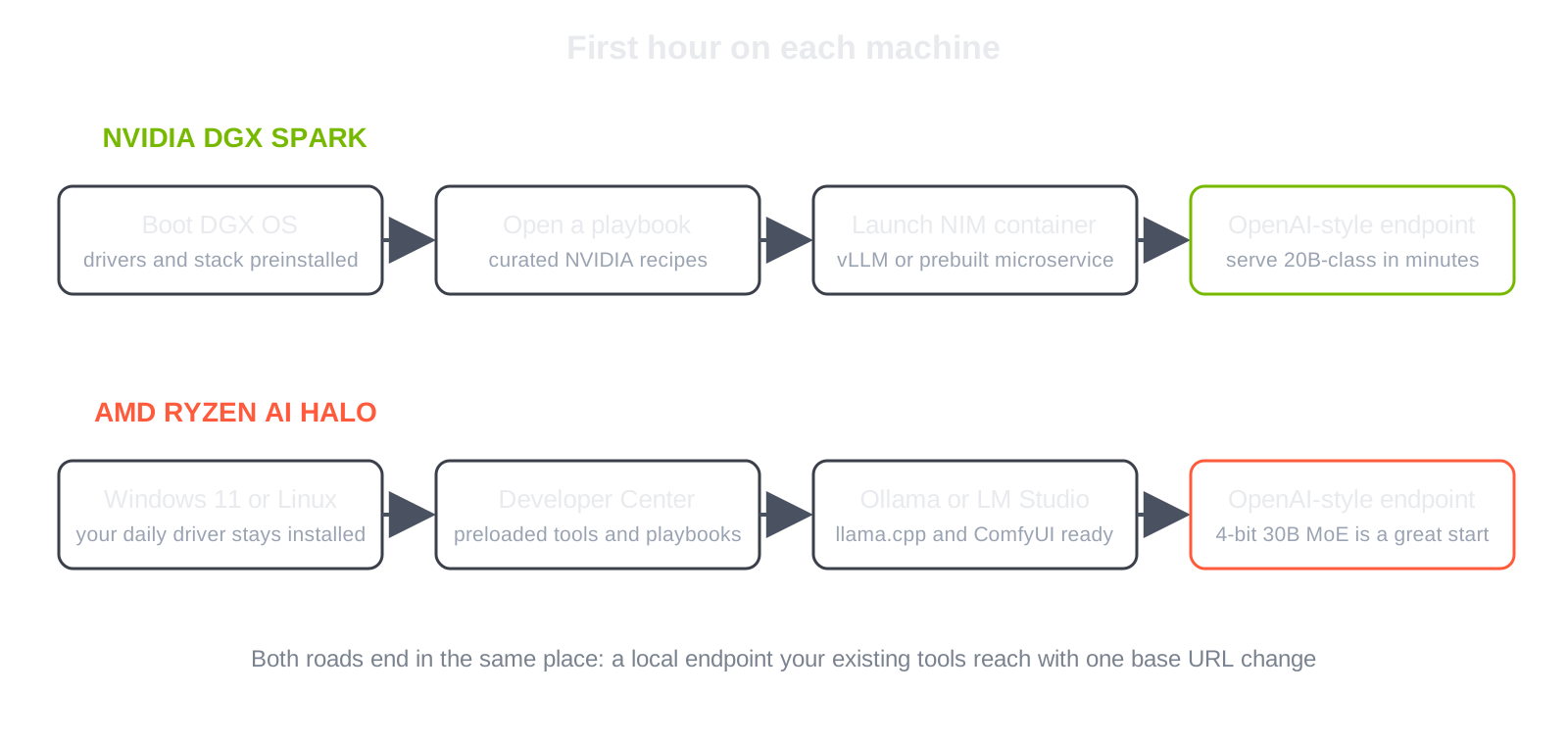
Both machines target the same first hour. On the Spark, you boot DGX OS, open the provided playbooks, and launch a container: an OpenAI-compatible endpoint serving a 20B-class model is typically minutes away, and NVIDIA’s summer 2026 DGX OS update claims up to 1.9-times faster inference with newer open models preinstalled. On the Halo, you pick your OS, open the preinstalled Developer Center, and pull a playbook for llama.cpp, Ollama, or LM Studio; a 4-bit 30B MoE model makes an excellent first load, and image generation through ComfyUI works well on the Radeon iGPU. On either machine, plan your context budget before your first long session: KV cache grows fast, 4-bit quantization is the sensible default, and serving endpoints let your existing tools consume local models with one base-URL change.
Conclusion
Two squares, 128 gigabytes each, and 700 dollars between them. The DGX Spark is the safer bet for AI-native work: unmatched software gravity, official fine-tuning, and a clustering escape hatch, at a premium price and Linux-only. The Ryzen AI Halo is the sharper deal for everyone else: the same memory, Windows or Linux, an NPU for agents, and benchmark-leading tokens per dollar on the MoE models people actually run. If you live in CUDA, pay the NVIDIA tax. If you live in everything else, AMD built your machine - and the cloud never has to see your data again. Enjoyed this post? Never miss out on future posts by following us 


