Imagine typing a few lines of lyrics and a style prompt, and getting back a complete song with vocals, accompaniment, and studio-quality audio. Now imagine doing that for free, on your own GPU, with a model whose internal composition plan you can read, edit, and re-render.
That is YuE2.
What is YuE2
YuE2 is an open source music generation model from Multimodal Art Projection (m-a-p), a research community spanning HKUST, Tokenwave.AI, NYU, Stanford, MBZUAI, NOIZ, and ACE Studio. Released on September 9, 2026, it turns lyrics and a style prompt into complete songs with vocals and accompaniment at 48 kHz stereo quality.
The headline: YuE2 best-of-8 achieves 6.9632 SongBench Avg on WildSongBench, the highest mean among all 17 evaluated systems, including Suno v5 (6.8721), Mureka 9 (6.9377), and Suno v6 (6.5562). This is an open-weights model matching or beating proprietary systems.
The tagline says it best: Compose in symbols. Create in sound.
Three things make YuE2 different from every other music AI you have tried:
- White-box composition: YuE2 does not jump straight from text to audio. It first writes a melody-and-chord plan in ABC notation that you can read, play, and edit before rendering. This is the “score” layer.
- Zero-shot covers: Transcribe any recording into a melody score with SheetSage2, then re-render it in a completely different style. Mandarin pop becomes English jazz, no fine-tuning needed.
- Agentic editing: Talk to an agent about the composition. Ask it to change the harmony, add a saxophone solo, or swap the tempo. The agent revises the ABC score, checks musical invariants, and re-renders the song.
How It Works: One Backbone, Two Modes
YuE2 uses a single AR-NAR Mixture-of-Transformers backbone that works in two stages.
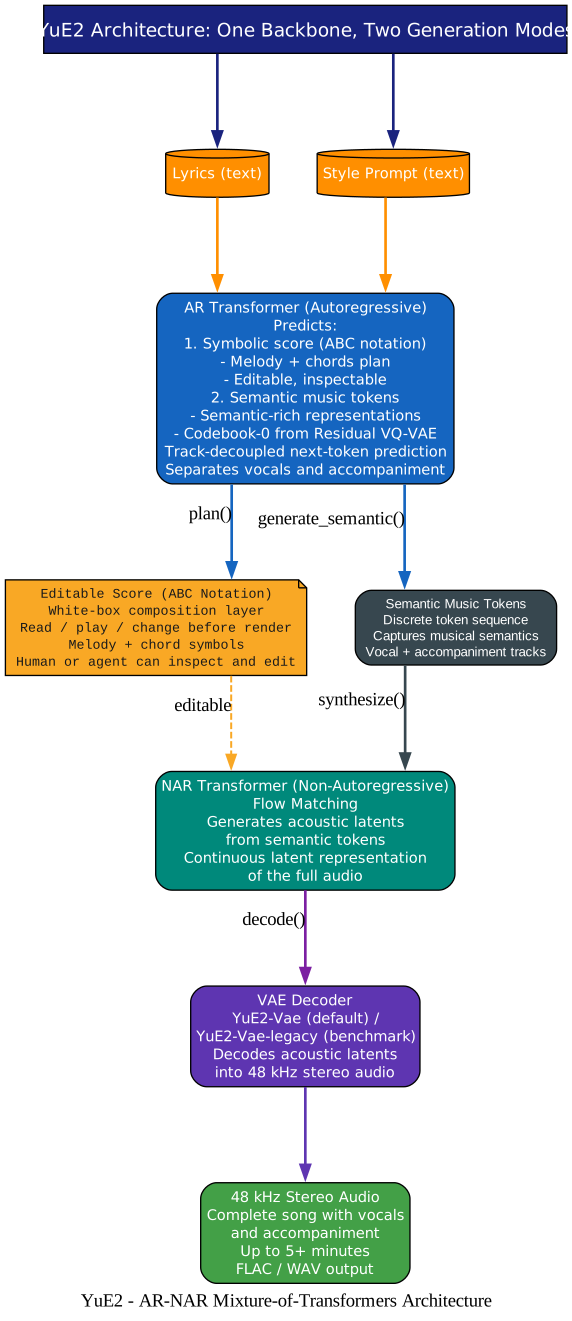
Stage 1: Autoregressive (AR) Transformer
The AR transformer takes your lyrics and style prompt and predicts two things autoregressively:
- Symbolic score in ABC notation: a human-readable plan containing melody and chord symbols. This is the white-box layer you can inspect and edit.
- Semantic music tokens: discrete token sequences that capture the musical semantics, separated into vocal and accompaniment tracks using track-decoupled next-token prediction. This technique, inherited from YuE v1, overcomes the challenge of dense mixture signals in music.
Stage 2: Non-Autoregressive (NAR) Flow Matching
The NAR transformer takes the semantic tokens and generates acoustic latents using flow matching, a continuous generation method that avoids the slowness of token-by-token autoregression. These latents are then decoded by a VAE into 48 kHz stereo audio.
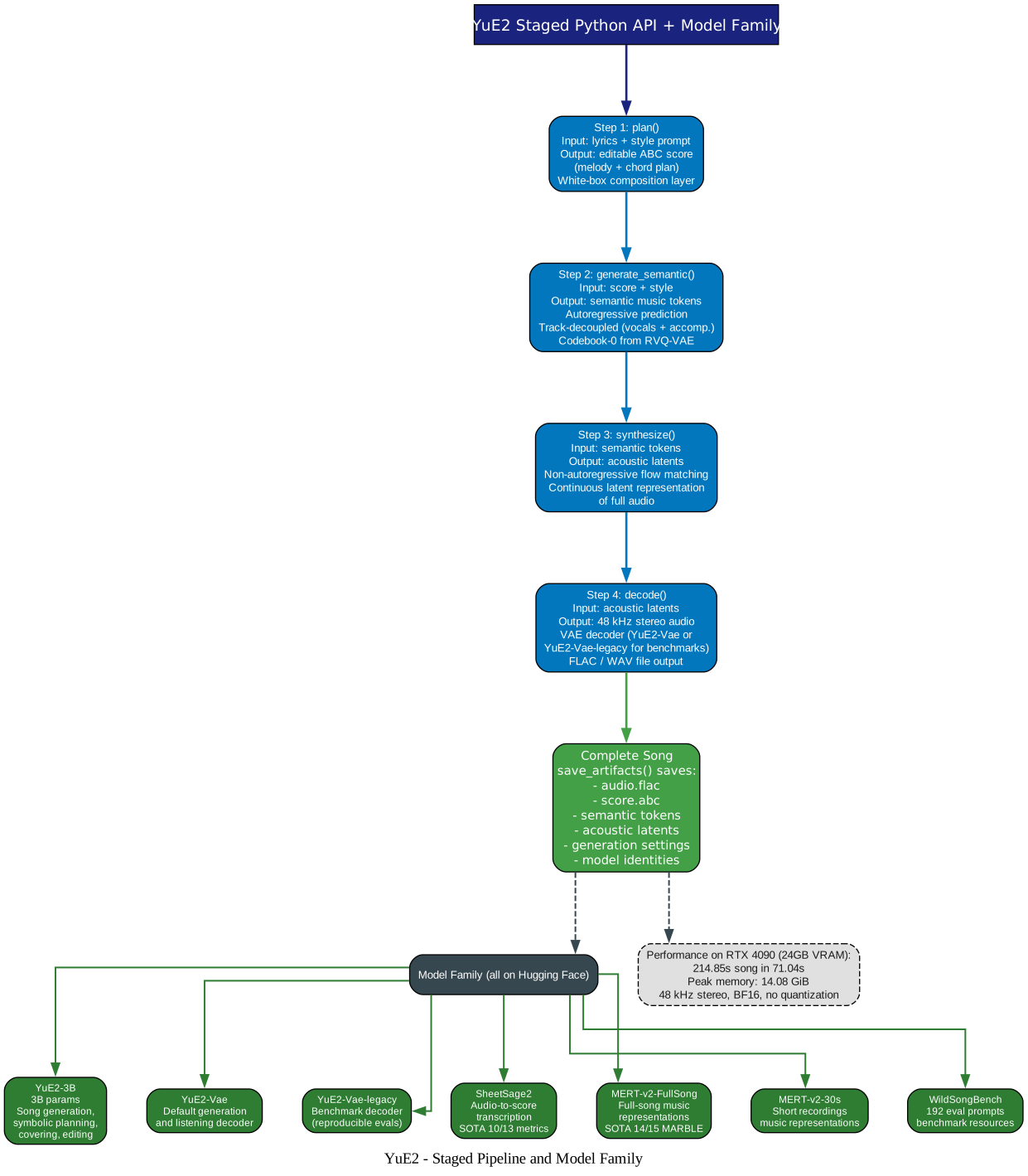
The staged Python API makes this explicit: plan() then generate_semantic() then synthesize() then decode(). Each stage produces an artifact you can inspect, reuse, or replace.
Three Modes, One Model
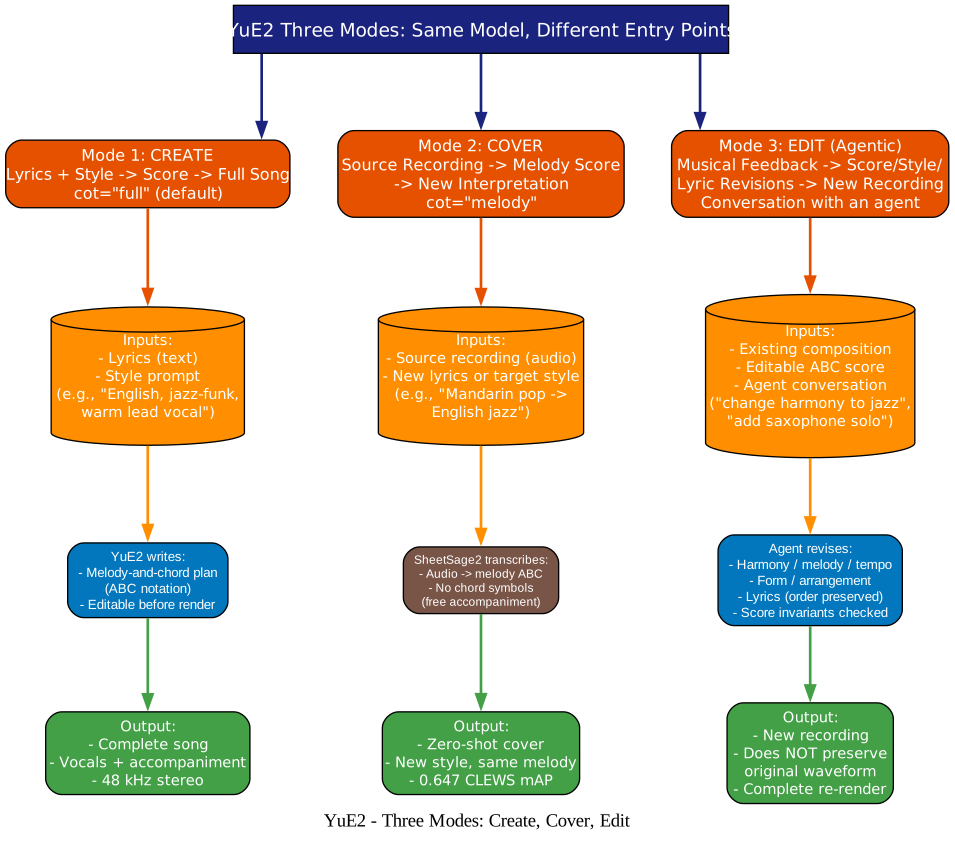
YuE2 supports three workflows from the same model checkpoint. The difference is where the score comes from.
Mode 1: Create
Give YuE2 lyrics and a style prompt. It writes a melody-and-chord plan, then renders it as a complete song. This is the default mode (cot="full").
from yue2 import YuE2Pipeline

with YuE2Pipeline.from_pretrained("m-a-p/YuE2-3B", device="cuda") as pipe:
    song = pipe(
        style="English, piano-pop, warm vocal, acoustic guitar",
        lyrics="Verse 1...\nChorus...",
        cot="full",  # default: generate editable plan
    )
    song.save_artifacts("outputs/my-song")
The output directory contains not just audio.flac but also the score.abc file, semantic tokens, acoustic latents, generation settings, and model identities. Everything is reproducible.
Mode 2: Cover
Take a source recording, transcribe it into a melody score with SheetSage2, then re-render it in a new style. Use cot="melody" with a score that has no chord symbols, so the accompaniment can adapt freely to the new style.
The agentic demo follows “The Last Train” through 9 steps and 14 versions, from Mandarin pop to English jazz with new harmony and a saxophone solo. On 948 cover works, YuE2 reaches 0.647 CLEWS mAP (versus 0.006 without a score), using the general generator without cover-specific fine-tuning.
Mode 3: Edit (Agentic)
Export the plan, revise the musical details, and re-render. You can ask an agent to change harmony, melody, tempo, or form. The agent revises the ABC score, checks musical invariants, and generates a new recording.
Use the yue2-music skill to create an English piano-pop song. Keep the original audio and score. Make a second version with jazz harmony, preserve the vocal melody and lyric order, and give me both versions to compare.
Editing generates a new complete recording. It does not preserve the original waveform outside an edit. The editable score is the white-box interface: you can inspect the intended composition and intervene on it.
Staged Pipeline and Model Family
YuE2 is not a single model file. It is a family of specialized models, all available on Hugging Face.
The Four-Stage API
| Stage | Function | Input | Output |
|---|---|---|---|
| 1 | plan() | Lyrics + style | Editable ABC score (melody + chords) |
| 2 | generate_semantic() | Score + style | Semantic music tokens (AR prediction) |
| 3 | synthesize() | Semantic tokens | Acoustic latents (NAR flow matching) |
| 4 | decode() | Acoustic latents | 48 kHz stereo audio (VAE decoder) |
Each stage produces a saved artifact. You can reuse an exact plan across multiple renders, swap decoders, or intervene at any stage.
Model Family
| Model | Purpose | License |
|---|---|---|
| YuE2-3B | Song generation, symbolic planning, covering, editing | CC BY-NC 4.0 |
| YuE2-Vae | Default generation and listening decoder | CC BY-NC 4.0 |
| YuE2-Vae-legacy | Benchmark decoder (reproducible evals) | CC BY-NC 4.0 |
| SheetSage2 | Audio-to-score transcription for covers | CC BY-NC 4.0 |
| MERT-v2-FullSong | Full-song music representations (SheetSage2’s encoder) | CC BY-NC 4.0 |
| MERT-v2-30s | Music representations for short recordings | CC BY-NC 4.0 |
| WildSongBench | 192 evaluation prompts and benchmark resources | CC BY 4.0 |
Performance
On an NVIDIA RTX 4090 (24GB VRAM, BF16, no quantization):
- 214.85-second song generated in 71.04 seconds (faster than real-time)
- Peak memory: 14.08 GiB
- Output: 48 kHz stereo audio
WildSongBench: How YuE2 Compares
WildSongBench uses 192 prompts with automatic evaluation across four metrics: SongBench Avg (overall), AudioBox PQ (production quality), MuLan (text-music alignment), and PER (phoneme error rate, lower is better).

The Results
| System | SongBench Avg | AudioBox PQ | MuLan | PER |
|---|---|---|---|---|
| YuE2 (best-of-8) | 6.9632 | 8.2714 | 0.5051 | 9.79% |
| Mureka 9 | 6.9377 | 8.0226 | 0.4394 | 11.69% |
| Suno v5 | 6.8721 | 8.1698 | 0.5428 | 8.10% |
| YuE2 | 6.7316 | 8.2598 | 0.5068 | 8.44% |
| Suno v5.5 | 6.7150 | 8.1955 | 0.5089 | 5.96% |
| Suno v4.5 | 6.6995 | 8.2541 | 0.5022 | 5.80% |
| Suno v6 | 6.5562 | 8.1296 | 0.4916 | 7.58% |
| LeVo 2 | 6.3247 | 8.3966 | 0.3542 | 26.12% |
| MiniMax Music 2.6 | 6.3222 | 8.1711 | 0.4251 | 24.55% |
| ACE-Step 1.5 | 6.0118 | 8.0518 | 0.4372 | 7.46% |
| YuE 1 (previous) | 4.9165 | 7.8683 | 0.2623 | 36.38% |
Key takeaways:
- YuE2 best-of-8 has the highest mean score among all 17 evaluated settings.
- YuE2 standard (best-of-2) at 6.7316 is still competitive with Suno v5.5 (6.7150).
- Suno v5 leads on MuLan (text-music alignment) and Suno v4.5 leads on PER (lowest phoneme error).
- Rankings vary by metric; the small gap between the highest means does not establish statistical significance.
- YuE2 jumped from 4.9165 (YuE 1) to 6.7316 (YuE2 standard), a massive generational improvement.
SOTA Companion Models
YuE2 ships with two companion models that are each state-of-the-art in their own right.
MERT2 is a music understanding model that is SOTA on 14 of 15 MARBLE metrics, with 91.72% genre accuracy on GTZAN. It provides full-song music representations and serves as SheetSage2’s encoder. While MERT2 feature extraction is optional for generation, it powers music understanding tasks across the ecosystem.
SheetSage2 is an audio-to-score transcription model that is SOTA on 10 of 13 benchmark metrics, with 82.51% vocal melody pitch-class F1 on RWC-Pop. It runs in a separate environment and loads its MERT2 encoder automatically. SheetSage2 is what makes zero-shot covers possible: it transcribes any recording into an ABC melody score that YuE2 can then re-render in a new style.
Agent Skill
YuE2 includes a yue2-music skill that teaches AI agents how to:
- Generate songs from lyrics and style prompts
- Transcribe and cover recordings
- Edit ABC scores
- Check musical invariants
- Organize listening comparisons
The skill works with any agent that supports SKILL.md packages, including Claude Code and Cursor. Install the Python runtime separately with pip install ., then point your agent at the skill directory.
Quick Start
Prerequisites: Linux, Python 3.12, NVIDIA GPU with BF16 support and 24 GB VRAM.
git clone https://github.com/multimodal-art-projection/YuE.git
cd YuE
python3.12 -m venv .venv
source .venv/bin/activate
python -m pip install --upgrade pip
python -m pip install .
python examples/generate.py --output outputs/first-song
Open outputs/first-song/audio.flac. The output directory also contains the score, semantic tokens, acoustic latents, generation settings, and model identities.
Cot Settings
| Setting | Behavior |
|---|---|
cot="full" | Generate an editable melody-and-chord plan (default for new songs) |
cot="melody" | Use a melody plan with free accompaniment (recommended for covers) |
cot="off" | Generate directly from lyrics and style (no plan) |
abc=... | Supply your own score in full or melody mode |
Cover a Song
Transcribe a source recording with SheetSage2, review its melody ABC, and provide new lyrics or a target style:
from yue2 import YuE2Pipeline

with YuE2Pipeline.from_pretrained("m-a-p/YuE2-3B", device="cuda") as pipe:
    cover = pipe(
        style="English, jazz-funk, warm lead vocal, Rhodes, bass and drums",
        lyrics=open("cover-lyrics.txt").read(),
        abc=open("cover-score/score.abc").read(),
        cot="melody",
        seed=42,
    )
    cover.save_artifacts("outputs/cover")
Edit a Composition
Export a plan, revise the musical details, and render the edited score:
from yue2 import YuE2Pipeline

with YuE2Pipeline.from_pretrained("m-a-p/YuE2-3B", device="cuda") as pipe:
    plan = pipe.plan(
        style="English, piano-pop",
        lyrics=open("lyrics.txt").read(),
    )
    plan.save("outputs/plan")
    # Edit outputs/plan/score.abc, then re-render:
    # python examples/generate.py --request examples/song.json \
    #   --abc-file edited.abc --cot full --output outputs/edited
License
- Code, agent skill, and documentation: Apache 2.0
- Model weights: CC BY-NC 4.0 (non-commercial use only)
- Third-party components: retain their original licenses
The non-commercial restriction on weights is important: if you want to build a commercial product, you will need to negotiate a separate license. The code itself is permissive Apache 2.0.
Why YuE2 Matters
Most music AI tools are black boxes. You type a prompt, you get audio, and you have no idea what happened in between. If the melody is wrong, you re-roll. If the chords are off, you re-roll. You are rolling dice.
YuE2 changes this. The symbolic score layer means you can see the plan before the audio exists. You can change a chord, adjust a melody, shift the tempo, and re-render. You can cover a song in a new style without fine-tuning. You can have a conversation with an agent about musical decisions. The model is not just a generator; it is a collaborator with a transparent inner life.
And it does all of this at quality that matches or beats the best proprietary systems, with weights you can download from Hugging Face and run on a single consumer GPU.
That is the open future of music creation.
Related Posts
- ACE Step UI: Open Source AI Music Generation
- HyperFrames: Write HTML, Render Video, Built for AI Agents
- Supertonic: On-Device Multilingual TTS

Enjoyed this post? Never miss out on future posts by following us


